
One of the most difficult questions to answer is – “How do you know”? This is because it challenges both the logic behind your thinking and the quality of information on which you based your statement or opinion. Is it possible you have taken reliable information and put it together in the wrong way or is the evidence supporting your argument questionable?
Saying something with confidence will lead people to believe that what you are saying is true but without real evidence it is still only an opinion.
The so called scientific method which introduced us to the idea of gathering evidence cannot be attributed to one individual, the high-profile contributors include Aristotle, Ibn al-Haytham, Descartes and Newton. It was clearly an organic process that Newton eloquently described as standing upon the shoulder of giants.
Regardless of the originator, the scientific method has changed the way we think and shaped much of the modern world, from discoveries in medicine, putting a man on the moon and the creation of the internet. But……Not Learning.
Learning science
Although still a relatively new field there are a group of individuals who include cognitive and computer scientists, linguists and educational phycologists who collectively call themselves Learning Scientists. By gathering evidence in the form of data about how students learn they have been able to draw conclusions that are “evidence based”. What can be proven and what cannot. For both students and teachers their findings should be essential reading.
One important point, this does not in any way detract from what a good teacher does, no more than offering advice to doctors on the evidence supporting the success of a new drug.
The top 6 evidence-based study techniques
1. Spaced practice (distributed)
Spaced practice is the exact opposite of cramming, you are effectively taking the same amount of time to study, just doing it over a longer period of time. The evidence shows that if you revisit what you have studied over time it boosts what is called your retrieval and storage strength but if you study in a short period of time, your retrieval strength improves but your storage strength reduces. One implication is that cramming can work but only if you want to retain information for a short period of time, to pass an exam for example. As such it is understandable why students do this, because they have proved in the past it was successful. If, however you need that information for the next level of study, you may need to learn it all over again!
“The effect is simple: the same amount of repeated studying of the same information spaced out over time will lead to greater retention of that information in the long run, compared with repeated studying of the same information for the same amount of time in one study session.”
Watch this video, it’s an excellent summary.
2. Interleaving
Interleaving is simply studying different subjects or topics as opposed to studying one topic very thoroughly before moving to the next, this latter process is called blocking. However as with spaced practice students might find it harder (see desirable difficulty) because interleaving involves retrieval practice and is more difficult than blocked practice, but the knowledge is retained for far longer. One proven technique is for students to alternate between attempting a problem and viewing a worked example. This is much better than attempting to answer one question after another. Its simply about switching activity.
But be careful, interleaving is best done within a subject, don’t move from Chemistry to Art for example. Unfortunately we don’t have any evidence as to what the optimum time period should be, so that might have to come down to trial and error. If however its too short a time there is a danger you will effectively be multitasking, and as I have mentioned in a previous blog, that simply doesn’t work.
This video by brain hack is excellent
“Interleaving occurs when different ideas or problem types are tackled in a sequence, as opposed to the more common method of attempting multiple versions of the same problem in a given study session, known as blocking.”
3. Retrieval practice
This may come as no surprise to many students and certainly not to anyone who reads this blog, its true testing actually improves memory. The process of reflecting back and having to retrieve a memory of something previously learned is very powerful. There is also an added benefit, if you are told there is going to be a test, the increased test expectancy leads to better-quality encoding of the new information.
One concern is that while there is little doubt that retrieval practice works, there is some research to show that pressure, perhaps the result of test anxiety during retrieval can undermine some of the learning benefit.
“However, we know from a century of research that retrieving knowledge actually strengthens it.”
Part two, next month
I hope this insight into evidence based learning has been useful, next month I will cover Elaboration, Concrete examples and Dual coding.
And if you would like to find out more here is a link to the article that quotes much of the research to support these techniques.



 A major new idea was presented to the world in 1991, to many it will mean very little but in terms of improving our understanding of the brain it was a milestone.

 The title of this month’s blog is not mine but taken from what many would consider a classic book about what can realistically be achieved by someone stood at the front of a classroom or lecture theatre, simply talking. Written some 25 years ago but updated recently Donald A. Bligh’s book takes 346 pages to answer the question,

 This month’s blog is coming from Malaysia, I have been presenting at the ICAEW learning conference in KL. The only relevance of this, is that as with any lecture/presentation or lesson you have to put yourself in the shoes of your audience and ask, what do they want to get out of this, why are they giving up their valuable time and in many instances money to listen to what you have to say?
 I have to admit in the last few months I have spent a fair bit of time looking into the facts behind the EU and checking on some of the statements made by both the remain and leave sides, attempting to discover truths or otherwise so that I could make a more informed decision. It proved difficult; much was opinion dressed up as fact by using numbers open to interpretation. Another technique used on the face of it to offer clarity, but in reality did just the opposite, was to state the “facts” forcefully, with conviction and repeat them often, giving the impression that what was being said was not only true but believed to be true.
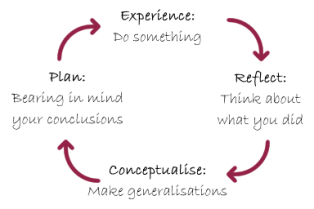 Step one in Kolb’s learning cycle is to have the experience. Step two, reflect, think back on what we have experienced. Step three, conceptualise, generate a hypothesis about the meaning of the experience, what is it we have learned, and step four, test that the hypothesis is supported by the experience, does it confirm that what we have learned is correct.