

An Inspiring story from Japan – Intellectual agency

On a recent trip to Japan, I noticed a bronze statue outside some primary schools. It features a young boy walking with a heavy bundle of firewood strapped to his back, his eyes glued to an open book.

TL;DR – the short audio version

The boy is Ninomiya Sontoku (Kinjiro), a 19th-century philosopher and economist. Born into poverty, he lost his parents as a teenager and had to spend his days doing hard manual labour. Because he couldn’t afford lamp oil to read at night, he studied mostly by reading on his walks up and down the mountains to chop wood. It is there to remind children of the desire for relentless self-improvement and that learning requires effort but is possible even in difficult circumstances. He eventually used his self-taught wisdom in maths, economics, and agriculture to save over 600 villages across Japan from poverty and famine.

However, Sontoku’s life points to a broader truth. He didn’t seek knowledge to collect titles or because someone told him to do so. He believed it would help him better navigate the world and understand his surroundings. His motives were to become self reliant and show that a peasant, armed with a book and a sharp mind, could control their own destiny.

Transactional learning
It also has a message for us today. AI is challenging the traditional motivation for learning, which has long been more about acquiring knowledge simply to pass a test. We have become conditioned to see a qualification as the goal and learning a necessary evil. It’s a purely transactional relationship.

That said, this arrangement has worked incredibly well for many years. Motivation is rarely sustained by abstract reasoning, and is most effective when there are concrete short-term goals to provide personal relevance and reward. How many people would commit to learning something on the strength of its intrinsic value, with no immediate incentive – not many!

Intellectual agility
In the post AI world, the ultimate competitive advantage isn’t what you know, it’s how fast you can adapt. The future belongs to the agile learner, someone who sees each new subject as a challenge that carries its own reward. AI models can now explain the basic facts of almost any field in seconds, knowledge that used to take years to acquire and a career to monetise. This doesn’t make expertise worthless, but it does remove the advantage of simply having it. What AI still can’t do well is judge which knowledge matters right now, or apply it to a messy, real-world situation. So, the value of a person shifts from what they know to the judgment required in figuring out what they need to learn next.

The agile learner also treats unfamiliarity as being interesting and not a problem to overcome. Instead of waiting until they feel confident, they ask questions early and adjust as they go. And they don’t mind looking like a beginner and having to start all over again. Over time this mental attitude builds a level of resilience to change that gets stronger the more challenges they face.

Continual learning
My trip to Japan reminded me that learning was never meant to be a game with a beginning and an end. If we want to thrive alongside AI, we have to drop the obsession with credentials and fall in love with the process of continual learning. I know this is Idealistic, and should not in any way be seen as an argument to remove tests and exams, they are as important as ever for the reasons I mentioned above. However, they cannot be thought of as standalone goals but as part of a much bigger and longer-term plan of continual improvement.

Like the boy with the firewood, the real goal was never to finish the book, it was to develop the skills he needed to have choices and control over his life. AI can now read the book for us, but it can’t give us the skills needed to maximise the potential of AI and ensure we still remain relevant and in control.

PS – In recent years a number of schools have actually removed the statues, partly over safety concerns about depicting a child reading while walking, some parents thought this was dangerous. Maybe the new image would show Sontoku concentrating not on a book but an iPhone……still as risky but potentially less rewarding.


The self-isolating learner – a new mindset

COVID-19 is forcing everyone to make changes, effortlessly disrupting routine and future plans, for many students the exams you have been working towards may well have been cancelled or alternative methods of assessment announced, and your School, University or College will have closed its doors for an unspecified period of time. With what could be described as a Dunkirk spirit many educational establishments have achieved what would have seemed impossible, a shift from face to face lectures and a physical campus-based mentality to a virtual learning environment.

If you are continuing to study, doing it remotely might be a brand-new experience and although it will mean some changes what remains the same is the way we learn. In fact, one of the biggest challenges is in not wasting time, something ironically because of the restrictions we now all have a lot more of. This new virtual learning can take many different forms, the platform will most likely be one of the following, Blackboard, Canvas, Moodle, Brightspace but there are others. Content will be delivered via any one or a combination of, live webcast, instructionally designed eLearning, video or simply tagged learning materials. All of them however require a positive approach to self-study.

Tips to studying when working from home

Prepare a Timetable – without the discipline of the classroom or a formal schedule you will need something to help manage your time. A timetable can seem unnecessary for experienced students but the process of preparing one will give you a mental picture of the tasks and challenges ahead. It should include important learning activities and tests that need completing and by when. Don’t underestimate how long something will take, learning is not an exact science so don’t forget to build in a buffer. Also make sure you include breaks and non-study time – just not too many.

Create a learning space – most students prefer a quiet place with little distraction in which to study. This may of course be difficult in a busy household but try and find a space and use the same one every day. If noise is a problem consider a headset with low volume classical or instrumental music playing in the background. Avoid listening to songs with lyrics as it can break your concentration.
Next remove as many distractions as possible. This will of course mean putting your mobile phone away, also turn off any alerts, the noise is enough to create what is called a “dopamine bump”, a short pleasurable sensation which will make it almost impossible for you not to check your messages. Contrary to popular student culture, multi-tasking doesn’t work. You may feel as if you’re watching Game of Thrones and answering a question at the same time, in reality you are simply swapping attention between two competing activities, which is tiring and reduces levels of concentration.

Don’t study for too long or cramCramming can work in those later stages of revision, the problem when learning and not revising is it overloads short term memory resulting in you forgetting something from the day before. Little and often is the secret to effective study. We don’t have any hard evidence as to the optimum period of study but most believe something around one and a half hours works best. After your session make sure you have a reasonable break, 10, 20 or even 30 minutes, grab a cup of coffee or take a walk outside, it’s important to physically move. There is a lot of evidence to show that exercise helps improve concentration and the ability to focus on specific tasks.

Question practice is key – Although attempting questions can seem a little disheartening, especially if you get something wrong it is one of the most effective methods of learning. The process of answering a question involves what we call retrieval practice forcing the brain to think back over what has previously been learned and in so doing transferring knowledge into long term memory.

Keep in contact with others – fellow students can be a real help when it comes to clarifying problems or just giving moral support. Also don’t forget your University or College, they will be only too pleased to support you, with many providing, forums, technical help and direct contact with your lecturer/teacher.

Develop a positive mindset – working alone can result in moments of self-doubt which can turn to worry and or stress. The important point is that both of these are perfectly normal reactions to a challenging situation. There is a view that worry is simply the way in which the brain moves something up your list of priorities. Lists are a great way of dealing with worry, simply write down what you are worried about and turn it into an action. Remember a certain amount of stress can also be good, its continual long-term stress that can cause problems.
Drink lots of water and as mentioned above build exercise into your daily routine, it’s a great antidote to stress and who knows you might not only pass your next exam but end up with a six pack as well.

If you would like to find out more about studying from home, here is a short video.

The independent learner – Metacognition

Metacognition is not a great word but it’s an important one when it comes to learning, especially if you are studying at higher academic levels or on your own. Cognition refers to the range of mental processes that help you acquire knowledge and understanding or more simply, learn. These processes include the storage, manipulation, and retrieval of information. Meta on the other hand means higher than or overarching, put the two together and we are talking about something that sits above learning, connecting it by way of thought. For this reason, it’s often described as thinking about thinking or in this context thinking about how you learn.

Smarter not harder

When you have a lot to learn in terms of subject matter it may feel like a distraction to spend any time learning something other than what you must know, let alone reflecting on it, but this fits under the heading of working smarter not harder, if you can find more effective ways of learning that must be helpful.
As mentioned earlier cognition is about mental processes, storage and retrieval relate to memory, manipulation, to the shifting of attention, changing perception etc. But the meta aspect creates distance, allowing us to become aware of what we are doing, standing back and observing how for example perception has changed, this reflection is a high-level skill that many believe is unique to humans. One final aspect is that we can take control of how we learn, planning tasks, changing strategies, monitoring those that work and evaluating the whole process.

Keeping it simple

Its very easy to overcomplicate metacognition, in some ways its little more than asking a few simple questions, thinking about how you are learning, what works and what doesn’t.  Here are some examples as to how you might do this.

  • Talk to yourself, ask questions at each stage, does this make sense, I have read it several times maybe I should try writing it down.
  • Ask, have I set myself sensible goals?
  • Maybe it’s time to try something different, for example mind mapping, but remember to reflect on how effective it was or perhaps was not.
  • Do I need help from anyone, this could be a fellow student or try YouTube which is a great way to find a different explanation in a different format?

Clearly these skills are helpful for all students but they are especially valuable when studying on your own perhaps on a distance learning programme or engaged in large periods of self-study.

Benefits

There are many reasons for investing some time in this area.

  • Growing self-confidence – by finding out more about how you learn you will discover both your strengths and weaknesses. Confidence isn’t about being good at everything but understanding your limitations.  
  • Improves performance – research has shown that students who actively engage in metacognition do better in exams.
  • Gives control – you are no longer reliant on the way something is taught; you have the ability to teach yourself. Being an autonomous learner is also hugely motivational.
  • The skills are transferable – this knowledge will not only help with your current subjects but all that follow, not to mention what you will need to learn in the workplace.  

It will take some time initially but, in a way, metacognition is part of learning, it’s an essential component and as such you will end up knowing more about yourself at some point, even if you don’t want to, so why not do it sooner rather than later.

And just for fun – Sheldon knows everything about himself – even when he is wrong

Blended – taking responsibility for your own learning

Taking responsibilityBlended course programmes are here to stay. The idea that studying comprises of both time in the classroom with others and time learning on your own using online or even traditional learning materials is certainly not new. Of course the purist will argue that blended learning has to or exclusively use online materials rather than a text book – no matter.

This blog is not about blended learning, more the implications of what studying on blended programmes means i.e. you have to study on your own and as a result take responsibility for how you learn.

Instructor led – easier

In a traditional classroom the teacher (instructor) stands at the front of the classroom and leads the learning. They tell you what to learn, when to learn, even how to learn.  They also dictate the pace and mood of the delivery. There is of course nothing wrong with this and many students really value it, in fact it’s their preferred method of learning. Of course its far from perfect, not everyone learns at the same pace or in the same way, but let’s put that debate, or blog aside for another day.

With a blended programme the student has to leave the security of the classroom and enter the world of self managed learning (SML).

Student led (SML) -harder but more effective

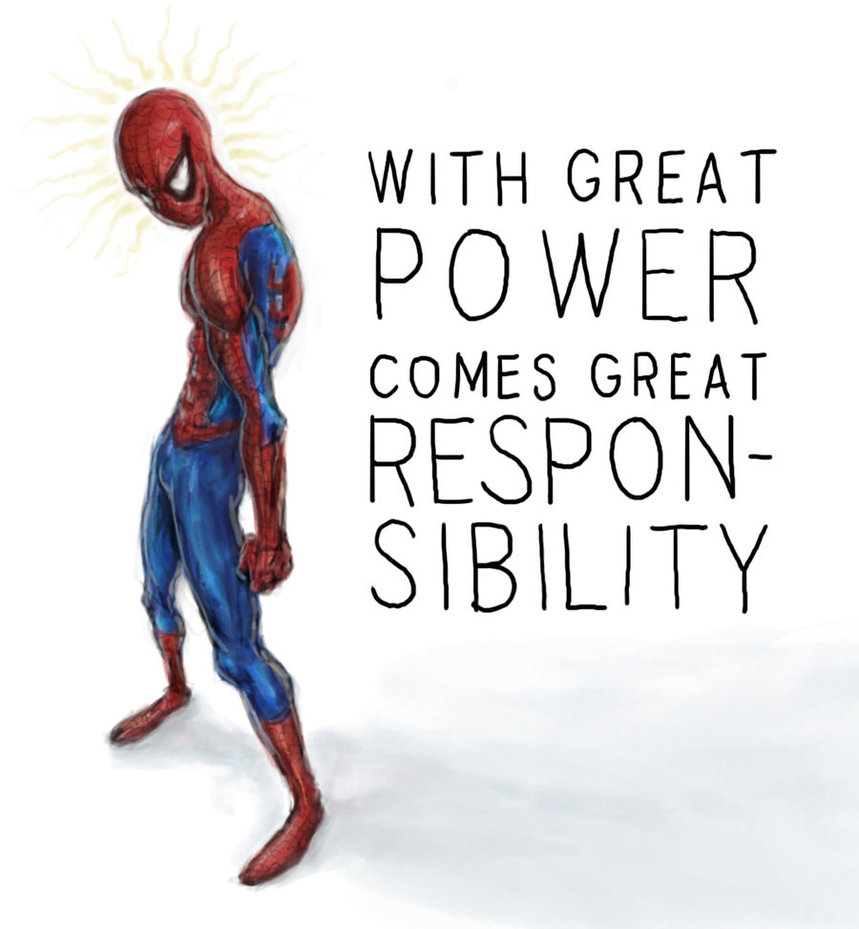
Self managed learning gives the student great power, they can study what they want, perhaps not the subject matter but certainly the order, when they want, how they want etc. However as Spiderman* once said, with great power comes great responsibility. You now have to take responsibility for the result. This means if something doesn’t make sense it’s not the teacher’s fault it’s yours!

Its perhaps even more basic than that, you are also responsible for how long you spend studying, you don’t have to do anything if you don’t want to. You can study on a Monday or Wednesday, or just the weekend. You can study for one hour or for 20 minutes. And there lies the problem, when it’s up to the individual a lot of people take the easy way out, the route of least resistance and put it off for another day.

However when you do take responsibility, the quality of the learning is significantly improved. Listening to the teacher is easy but not always that effective. The SMLearner has to set goals, monitor their performance and finally reflect, how well did they do compared with how well they thought they would? It is partly this process that makes the learning so good, but it will feel harder.

How to be a SML

These may all be worth covering in more detail in another blog but for now think of this as a check list.

  • Use a timetable – Google calendar is great for this. Put in all your key dates including exactly what you will do e.g. read chapters one to three – make notes – answer question 2,3 and 4.
  • Have a place to learn. This might seem obvious but you need somewhere that is quiet, plenty of space, good lighting, with little distraction. Perhaps most important is that you know that when you are in this room you feel ready to study.
  • Read carefully, I have written on this before. Underline key points as you go. Don’t just read, you have to think as well.
  • Make notes, even if you have pre- prepared ones. Once again I have written on the best way to do this. If you are following an e learning module make notes as you work through the online guidance.
  • Listen to your internal dialogue. When you are working alone just make sure that what you are saying to yourself is positive. Remember this is not about telling yourself everything will be fine, it’s about moving forward e.g. I just don’t understand this, what I need to do is read it again perhaps from another book.

Taking responsibility

Want to find out more about taking responsibility for learning – watch video 1video 2video 3. They are all less than three minutes long and well worth it.

PS *Of course Spiderman can’t really talk it was Stan Lee the writer of Spiderman, although Franklin D Roosevelt and others have also been quoted as saying this or something similar.