
Carrots and sticks – Motivation and the thinking Donkey

Donkey carrot and stickMotivation is one of those topics that is so important to learning and passing exams that we will constantly keep coming back to it.

If you are motivated when studying then you will study for longer, more frequently and be more focused.

As a result I have written about motivation in the past Motivation – How to want to study, Rocky boxing No – it’s about motivation to name but two.

I have always liked the simple idea that if you want to motivate someone to do something then you give them a reward (carrot) or a punishment (stick). You will probably have used carrot and stick techniques on yourself. If I answer these exam questions by the weekend I will have Sunday off or if I don’t answer these exam questions by the weekend then I won’t have Sunday off.

But are we more complicated?

In his book Drive – the surprising truth about what motivates us, Daniel H Pink (a former Al Gore speech writer) argues that there are in fact three motivational systems. One survival , motivated to eat, drink and reproduce. Two, seek reward and avoid punishment, the so called carrot and stick and three, intrinsic  motivation, the idea that motivation comes from within not from external stimuli.

These are not mutually exclusive, you are still motivated to eat, drink and reproduce, equally carrots and sticks do work, but what are these intrinsic motivators.

Type X and Type I

Type X behaviour is fuelled more by extrinsic desire, how much money will I get, I don’t want to have to work Sunday, this fits with carrot and stick. Type I behaviour requires intrinsic motivation and is concerned with the satisfaction gained from an activity. Pink argues that extrinsic motivation works better for algorithmic/routine tasks that require little cognitive processing. But if you have to think, understand, create then intrinsic motivation is more effective. Got it……

And the point is……

Studying and learning require a huge amount of cognitive processing (It is a type I behaviour) and so rather than using carrot and stick motivators you would be better using intrinsic ones. Pink explains that intrinsic motivators can be broken into Autonomy, Mastery and Purpose.

  • Autonomy – This can be achieved by making your own decisions as to how you study when you study, rather than listening to others or being rewarded for doing it. It’s about taking ownership.
  • Mastery -This is a mind set and involves you believing that what you are learning is not something in isolation but contributing to a greater and longer term skill set.
  • Purpose – This links nicely back to goals, which has been the topic of previous blogs. You must feel that what you are learning has some value and purpose possibly beyond simply passing the exam. Will it help you do your job better etc

Motivation can be difficult to understand, personally I feel that it does come from within (intrinsic), it’s my desire to do something not someone else’s and so the argument that you should not use carrot and stick (extrinsic ) type rewards makes a whole lot of sense.

Let me know what you think….?

Listen to Daniel H Pink at TED And an RSA animated lecture 

Reflection/Goals/Planning……Inspiration and bravery

2013_time100_yousafzaiIt’s nearly the start of a New Year 2014, traditionally a time for both reflection, taking stock of what went well/not so well and looking forward to what the future might hold. On the whole this is a healthy process, looking back gives you chance to put things into perspective and hopefully learn a few lessons, whilst looking forward gets you thinking about what you might like to happen and set goals to make those events more likely.

Looking back on 2013, one event that stood out for me was the nomination of Malala Yousufzai for the Nobel peace prize in November 2013*. It is not the nomination that is important but the fact it provided a reason to revisit the incredible story of one little girls determination to have an education, something that many of us are fortunate enough to be given for free or at least freeish!

Reflection – The story in brief

By 1997, the year in which Malala was born her father Ziauddin Yousufzai had been running a private girls school for several years in the Swat

A classroom in Swat valley

A classroom in Swat valley

district of Pakistan. This was before the Taliban took over. At the end of 2008 the local Taliban leader, Mullah Fazlullah, issued a warning, all female education had to cease within a month, or schools would suffer consequences. Malala was 11 and supported by her father started an anonymous blog for the BBC “Diary of a Pakistan school girl.”  The blog stopped after only 10 weeks as Malala had to leave Swat. Although clearly influenced and inspired by her father Malala had a voice of her own and one that was now being heard outside Pakistan, she was passionate about education, especially for women. A documentary by the New York Times bought the story to a wider audience.

 All I want is an education, and I am afraid of no one. 

But on the 9th of October 2012 when Malala was just 15 two men boarded her school bus and asked “Which one of you is Malala? Speak up, otherwise I will shoot you all” The other girls looked at Malala, innocently identifying her; she was shot in the head and neck and left for dead. She was initially flown to a military hospital in Peshawar and then onto the Birmingham Queen Elizabeth hospital in the UK where she had further operations and continued her recovery.

They cannot stop me. I will get my education, if it is in (the) home, school or any place. 

On 12 July, nine months after the shooting, came a major milestone. Malala stood up at the UN headquarters in New York and addressed a specially convened youth assembly. It was her 16th birthday and her speech was broadcast around the world.

Goals and Planning

Malala wanted to be a Doctor, but wanting to be a Doctor is not an effective goal, it’s a wish or desire, it was outside her control. What was within her control was to work hard, motivate herself and fight for the education she deserved.

Malala wanted to be a Doctor but events changed all that, a bullet intended to kill her sent her down a different path. Now she wants to be a politician, not a goal but a wish, driven perhaps by a deep routed desire to help people less fortunate than herself. Yet those same goals of hard work, motivation and learning will equally help turn this wish into a reality.

Let us make our future now, and let us make our dreams tomorrow’s reality.

And so to 2014

When thinking back on 2013, learn from your mistakes, maybe the exams (life in general) didn’t go as well as you might have hoped. But don’t Happy New Yearask why, ask what have I learned and so need to do differently in 2014. Remember when setting those goals make sure they are within your control and take inspiration from the story of a brave little girl who worked hard, motivated herself and most of all believed in the importance of education.

  Let us remember: One book, one pen, one child, and one teacher can change the world. 

Ps

Malala is now working hard for her GCSE’s incidentally at the same school as my daughter.

Well worth watching – BBC – Shot for going to school.

And the *Nobel Peace Prize 2013 was awarded to Organisation for the Prohibition of Chemical Weapons “for its extensive efforts to eliminate chemical weapons.

Intelligence and IQ – does it matter?

Yesterday Boris Johnson delivered the annual Margaret Thatcher lecture at the Centre for Policy Studies in London, in it he said:

“Whatever you may think of the value of IQ tests, it is surely relevant to a conversation about equality that as many as 16 per cent of our species have an IQ below 85, while about 2 per cent have an IQ above 130.”

Mr Johnson (Boris) uses the measure of IQ to make the point that if we don’t have equality in intelligence then economic equality is not possible. Effectively he is saying we should accept that some animals are more equal than others, apologies for the Animal Farm digression…..

What is Intelligence?

Yet a large part of Boris’s argument hinges on the term intelligence and that it has some meaning or value, but what is intelligence? The word itself is derived from the Latin verb intelligere, to comprehend or perceive. A good start, but that’s all it is a start, here are a few more definitions:

  • Judgment, otherwise called “good sense,” “practical sense,” “initiative,” the faculty of adapting one’s self to circumstances  (Alfred Binet the creator of the IQ)
  • The ability to learn or understand or to deal with new or trying situations (Merriam-Webster dictionary)
  • To my mind, a human intellectual competence must entail a set of skills of problem solving, enabling the individual to resolve genuine problems or difficulties that he or she encounters. (Howard Gardner, Multiple Intelligence Theory)

The last of these is my personal favourite as it gives purpose to having intelligence, to solve problems. The bottom line, there is no one single definition and experts disagree on how it should be tested/measured. Interestingly the IQ (intelligent quotient) developed by Alfred Binet was only ever intended to be used to identify intellectual disability not to form the basis of an elitist club or for Boris to hijack for his Margaret Thatcher lecture.

Does it matter?

People often have a personal view of their own intelligence, this can sometimes be empowering when you find out “You’re a god Dammed Genius” or limiting if “you discover your IQ is only 75.” Just for the record, 91-110 is average, 80-90 is dull normal, 66-79 borderline and 65 and below, defective.

The very fact that you believe you are intelligent can be motivational, resulting in you putting in more effort. The self belief that you can solve any problem will often result in you solving most of them, and of course proving you are not only intelligent but a genius!

I know that I am intelligent, because I know that I know nothing.

Socrates

Contrast that with the behaviour of someone who believes they are not intelligent or maybe not as intelligent as others. Faced with a problem they will give up, believing the solution is beyond them, and of course proving that they were also right and not a genius.

But Does Boris have a point?

Boris uses IQ (The measure of intelligence) to illustrate the point that we are all different, something that most people would readily accept. What I find uncomfortable is the deterministic nature of his proposition, it implies having a high IQ predicts success and by the exclusion of the many other factors that contribute to success, suggests is the only thing that matters. The Telegraph headline made this point very strongly.

Boris Johnson: some people are too stupid to get on in life

Natural differences between human beings will always mean that some will succeed and others will fail, the Mayor of London says in a speech

Yet on the basis that there is little agreement as to what Intelligence is, the testing and what should be tested is subjective, it would appear a poor basis on which to hang his argument.

Lessons for learning

What I do agree with is that we are all different and that some of this is the function of genetics. (Research indicates that 60% of intelligence is genetic) yet on the basis that you can do very little about this, does it matter?

It is always better to work on what you can change rather than what you can’t. I am sure many of us know people who seem to grasp principles, concepts’ etc and solve problems pretty quick. If you compare yourself to them it’s easy to conclude that they are better and you will always be second rate, so stop trying. The simple answer is don’t compare yourself with them, compare only with yourself, are you getting better and if you are then your improving, and that’s a result.

So forget about measuring intelligence and whether your better than someone else and get on with trying hard and being the best you can.

More on intelligence

Human intelligence, BBC Horizon. An interesting programme that evaluates the intelligence of different high performers.

And the smartest man in the world is…...click here

Thinking in box’s – Cracking case study

Put it in a boxExaminations come in many shapes and sizes, short form, multiple choice, essay, case study etc. I know there are other methods of assessment but I am thinking here of the most common. Of these one stands out as being very different, the case study. Developed by Harvard in the 1920s the  case study involves giving the student a  real life, normally business situation and asking relatively broad Socratic type questions e.g. what do you think, why etc.

It not only puts the student in a realistic situation but also requires them to think far more deeply.  The cognitive process involved in answering a question such as what is the capital of France or can you add 2+2, on the whole is very simple and may need little more than memory. However giving student a real life business to analyse and asking them to give an opinion as to what the company should do next requires higher level thinking as well as effective communication skills.

Too much to read

One other aspect of a case study is that it often involves large amounts of narrative, all will need reading digesting and putting into context. On the face of it this can seem daunting, but it can be done and as with so many aspects of learning there is a process that can help. I have written about, having too much to read and the benefits of chunking before but I want to bring these together with another powerful technique “thinking in box’s”.

Thinking in box’s 

Volume and lack of direction is the main problem here, so we need to find our own direction and reduce the volume. Thinking in box’s refers to the natural process we have in compartmentalising thoughts. In order to make sense of the world we often put “stuff” into box’s, work, study, relationships etc. We can then open the box’s when we are best able to deal with them. The  point being that  we can’t deal with everything all at once. If this whole idea sounds a bit odd, then just consider the saying “Thinking outside the box”. This refers to the imaginary frame we put around something that restricts our ability to solve a problem and think more creatively. Strange isn’t it…..

Case study

Imagine that you have 10 pages of narrative to read based on a particular industry, a case study. There are a few sub headings and some paragraphing. You are required to provide guidance to the board of Directors as to what the companies strategy should be in the next five years.

The process 

In order to give the advice required by this question, you need to fully grasp the current situation, which means you have to  read, understand and comprehend what is written on the 10 pages. To add structure to the case firstly take chunks of content and put a frame around it, this will help focus just on this chunk of information, it also reduces the volume. A chunk will often be information under a heading or specific paragraphs. Once you have the content in a box, sift through it looking for the “key words” and underline them.  Focusing only on the key words but taking into account the context, ask yourself, what do I think about this? What does it mean, what is it telling me etc. Then write down your thoughts. Do this for every chunk of information, then number each chunk.

At the end of this process you should have read and thought about each chunk, captured those thoughts and have a numerical reference by which to structure them. The final part of the process is to read each of those chunks again and produce a SWOT. This brings all 10 pages down to just one. And by using the SWOT supported by your detailed analysis you should be able to give the advice required by the question.

watch_this_videoIn this short video I demonstrate the thinking in box’s approach.

      Thinking in box’s

And finally – A few words from Terry Pratchet

I will be more enthusiastic about thinking outside the box when there is some evidence of thinking inside it!

The lecture -When does learning happen?

“Lectures were once useful; but now the internet and online content are freely available, lectures are unnecessary. If your attention fails, and you miss a part of a lecture, it is lost; you cannot go back as you can with online content. “

The above quote makes the point very forcefully that lectures may not be that effective, and certainly not as good as online. But let me ask a broader question, what is the purpose of a lecture in the first place, does it help you learn and if so when does the learning begin?

The lecture – step by step

In its most simple form the lecture involves little more than a lecturer standing at the front of the class reading from a set or prepared notes or reciting from memory, the student then listens and copies down what the lecturer is saying, presumably to read and absorb later.

So let us break down this process and consider how a lecture helps with learning. Firstly the student has made the effort to attend, this in itself means there is some motivation involved. Secondly they are in an environment designed for learning and with other like minded individuals. All of this helps to put the student in the right frame of mind.

The lecturer will however play a very important part. How well they explain the subject, their level of knowledge, passion and genuine interest can all make a dull topic seem fascinating. And if it is fascinating the student will find it easier to learn. But how much of this can you get from a book, and can this all be achieved online?

And when is the real learning taking place? True the lecturer may ignite a flame and create a sense of curiosity in the student, but the real learning takes place in private, by the student as they revisit the book, video or notes, rewrite, talk out loud and practice questions.  As I have heard student’s say many times, “I need to go over this latter and get it into MY head.”

I am reminded of an Ali quote.

The fight is won or lost far away from witnesses – behind the lines, in the gym, and out there on the road, long before I dance under those lights.

Conclusion

A lecture is a poor method of transferring information, a book or video can explain a topic as easily as a lecturer if well written/filmed. The book and video are both good at providing technically accurate information, but can they transfer the passion, maybe…… but I would argue not as well as the lecture.

You will get a far better view of a sporting event with expert commentary and the ability to watch again on TV, but you are more likely to get a life changing experience if your there watching it unfold live.

So if the only reason you are going to the lecture is to capture information then don’t bother. Stay in bed and get a good book, copy your friends notes or watch the lecture online. But if you want to be inspired/motivated, possibly get a unique view, then go to the lecture.

There is of course a message here for lecturers, your job is to be unique, to inspire and ignite the flame. If not you should also stay in bed, after recording all of you lecture of course.

And for the avoidance of doubt, I do not think this can all be achieved online, a live lecture is different, but the lecturer has to play their role, they have to entertain.

The debate is of course not new – the twist in the tale

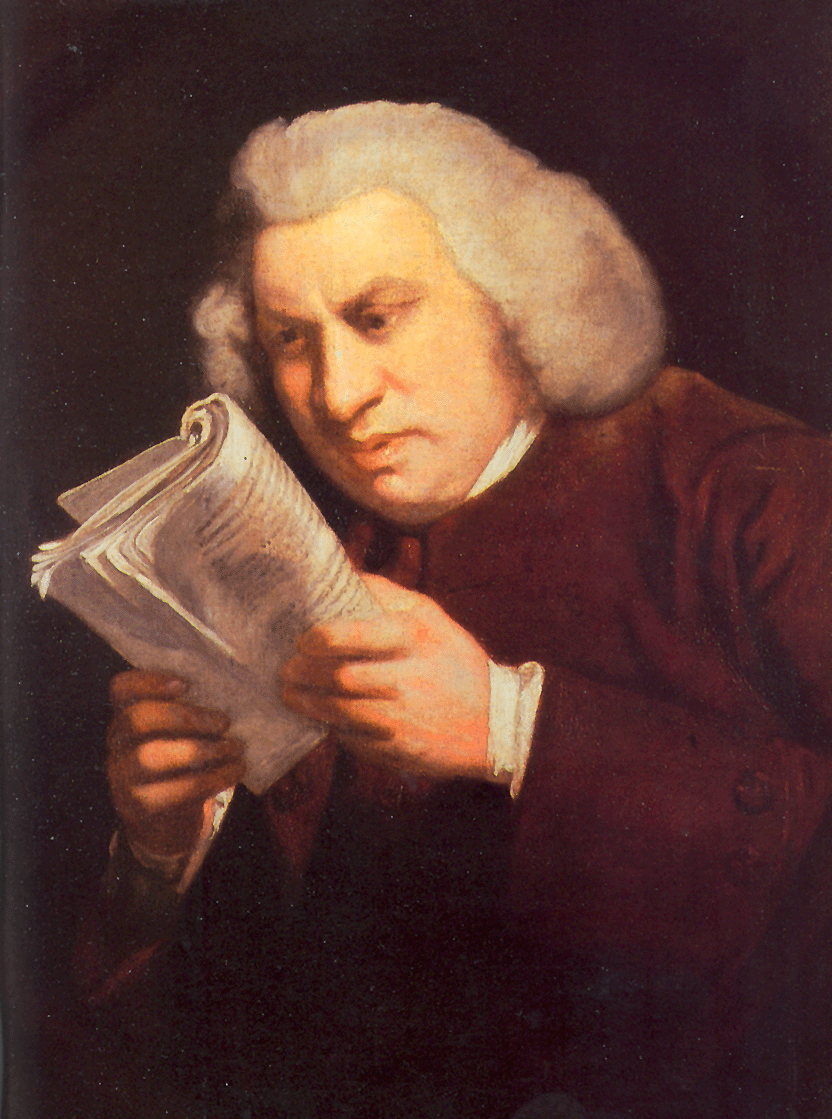
Some of you may have recognised the above quote, it’s taken from (with a few amendments from me) James Boswell’s, life of Johnson, the quote is from Samuel Johnson, and the year…..1791!

Lectures were once useful; but now, when all can read, and books are so numerous, lectures are unnecessary. If your attention fails, and you miss a part of a lecture, it is lost; you cannot go back as you do upon a book. . . . People have nowadays got a strange opinion that everything should be taught by lectures. Now, I cannot see that lectures can do as much good as reading the books from which the lectures are take.

Examples of lectures

If only more lecturers could be like this – watch this

And not like this

And although not entirely my thing, everyone should watch the last lecture by Randy Pausche. Although you need to put aside over an hour you will not be disappointed and when you have you will join the 16 million others who have done the same.

Thank you for the music – listening to music when revising

May and June are the traditional months when students around the world lock themselves away to revise for their exams.

In China for example over 9 million students will be sitting the university entrance exams.

Last May (2012) Teenagers at Xiaogang school in Hubei province were pictured hooked up to bags of intravenous fluids hanging from the classroom ceiling to boost energy levels during the revision period. An extreme action by anyone’s standards, but perhaps an example of how much pressure students feel this time of year.

As I mentioned in last month’s blog my daughter is currently caught up in this May/June exam frenzy. So once again I found myself looking to her for inspiration. What was she doing, how did she revise? This is not because she is a perfect example of a revision student, in many ways she is not, but I do think she is typical of many.

What does Beth do?

  • Makes notes from her notes – This is a standard exam skill, reducing content down into measurable and personal chunks. She does use mind maps (possibly my influence) but not exclusively.
  • Prepares as if she has to teach someone else – this I find interesting and has certainly not come from me. She writes on a white board the key points as if she was going to teach that subject. I like this idea, as many teachers and lecturers will tell you nothing focuses the mind nor motivates you more than having to teach it to others.
  • Practices past exam questions…of course!
  • Studies while listening to music – now this is the one that intrigued me and as a result I have devoted the rest of the blog to answering the question …..

Is it a good idea to revise whilst listening to music?

As ever the science needs much interpretation.

It’s a bad idea

Researchers from the University of Wales, tasked 25 students with memorising lists of consonants. Some were shown the letters while sitting in silence, others while listening to music by their favourite bands or by groups they had a strong aversion to. The conclusion was that listening to music, hampered their recall.

So it’s good then

Scientists at Stanford University, in California, believe there is a molecular basis for music known as the “Mozart Effect“. It was discovered that rats, like humans, perform better on learning and memory tests after listening to a specific Mozart Sonata in D.

But then there is the evidence that suggests that switching attention when trying to learn as might be the case with listening to music slows down the cognitive process.

Yet you cannot ignore the research that clearly shows music has the ability to alter your brain and induce relaxation which in turn helps create an ideal state for learning.

Watch what happens to your brain when you listen to music.

Hopefully you get the idea.

Conclusions

  • Listening to music puts you into a more relaxed frame of mind and that is of course good for learning. So listening to music before or after revising can help.
  • If you do want to listen to music, avoid music that requires you to shift your attention. This would suggest you should not listen to  music with lyrics  as it can mean you need to think about what is being said nor should you listen to something new that you may not have heard before. This is one of the reasons classical, in particular baroque music is the preferred choice of many students. Also don’t play the music too loud, keep it as background noise.
  • If there are specific facts that you simply need to know, then avoid listening to music completely, give it your full attention. But you can’t concentrate at this level all day, only for short periods.
  • On the whole be consistent don’t keep changing the type of music, you need familiarity.

Music to help you study

The internet has many websites that offer relaxing and helpful music, here are a few that might help.

You have to be joking – learning fun!

A famous scientist was on his way to a lecture in yet another university when his chauffeur offered an idea. “Hey, boss, I’ve heard your speech so many times I bet I could deliver it and give you the night off.” “Sounds great,” the scientist said. When they got to the auditorium, the scientist put on the chauffeur’s hat and settled into the back row. The chauffeur walked to the lectern and delivered the speech. Afterward he asked if there were any questions. “Yes,” said one professor. Then he launched into a highly technical question. The chauffeur was panic stricken for a moment but quickly recovered. “That’s an easy one,” he replied. “In fact, it’s so easy, I’m going to let my chauffeur answer it!”

Okay it might have made you smile rather than laugh out loud and it may not be the best joke you have ever heard, but it will have changed your mood and as a result made you more receptive to learning.

The facts

But how does this work? Dopamine is the chemical neurotransmitter most associated with attention, memory storage, comprehension, and executive function. Research indicates that the brain releases more dopamine when you play, laugh, exercise and listen to stories. (Depue and Collins 1999).

Interestingly making learning fun also reduces stress which can impede the learning process.

During periods of high stress or anxiety, functional MRI studies show increased blood flow to the “emotional” portion of the limbic system. When the amygdala (part of the limbic system) is in this state, neural activity in the rest of the brain is profoundly reduced (Xiao and Barbas 2002; Pawlak et al. 2003).

But learning is not fun!

Of course something that is fun to one person may not be fun to someone else. And what do people do to have fun? One answer to this is they play games, in fact there is a whole industry built around playing games to learn, unsurprisingly and somewhat disappointingly its called game based learning (GBL)

A game is said to have several key elements.

1. Competition – The score keeping element and/or winning conditions motivate the players and provide an assessment of their performance. Note that players are not necessarily competing against each other. In fact, a lot of games have players working as a team to overcome some obstacle or opponent.

2. Engagement – Once the learner starts, he or she does not want to stop before the game is over. This engagement is thought to come from four sources: challenge, curiosity, control, and fantasy.

3. Immediate Rewards – Players receive victory or points, sometimes even descriptive feedback, as soon as goals are accomplished

Can learning be fun, yes of course and making it into a game is a great way of doing it. It might be as simple as writing the questions for a quiz based on a subject to be examined and testing a group of friends. Setting the quiz from a learning perspective is probably better than answering the question. Keep to the rules above though, so make sure you offer a reward.

Also it might be American football, which I have to admit I don’t understand, but if you do you will love Financial Football click here to play, its a free online game with cool graphics that aims to teach money management skills.

Have a revision party

Okay the idea might sound a little of the wall but watch this short video, it looks like fun to me…

Ps the loud one is my daughter.

And the outtakes 

Want to find out more then read this article by Dr. Judy Willis who is an authority in brain research and learning.

And just for fun Dawn French and the accounting joke.

There’s no such thing as a stupid question – Learning by questions

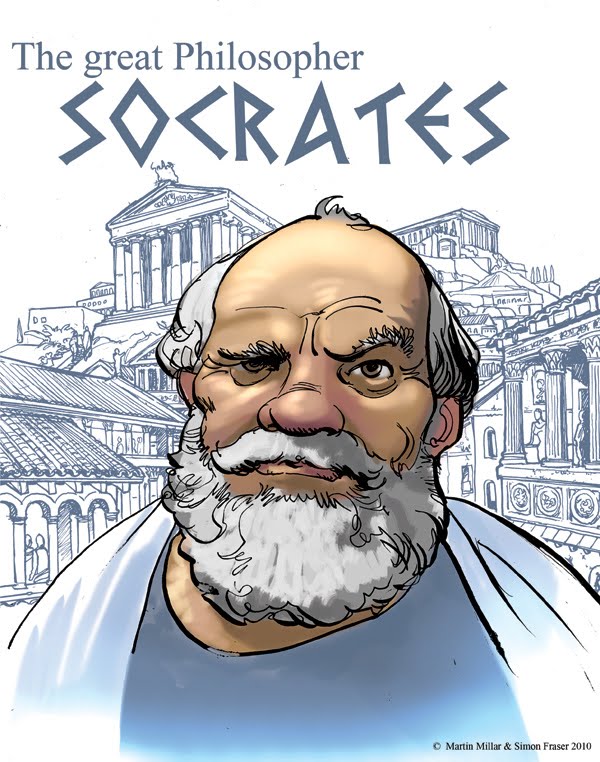
Ask questionsThe Greek philosopher Socrates was born 469 B.C in Athens, and died in 399 B.C. He is considered by many to be one of the world’s greatest thinkers. He is known for the Socratic Method and the pursuit of knowledge. The Socratic Method involves asking a series of questions until a contradiction emerges invalidating the initial assumption.

Socratic questioning does not seek to find THE answer, there are often many answers. The primary goal is to explore the contours of often difficult issues and to teach critical thinking skills. This method encourages you to go beyond the simple memorising of facts, enabling you to develop a higher level of understanding.

Socratic questions

1. Questions for clarification – Why do you say that?
2. Questions that probe assumptions – What could we assume instead?
3. Questions that probe reasons and evidence – What would be an example?
4. Questions about Viewpoints and Perspectives – What is another way to look at it?
5. Questions that probe implications and consequences – What are you implying?
6. Questions about the question – What was the point of this question?

If you can formulate a question – you have 60% of the answer
When you pass one exam the bad news is you are often faced with another. Exams at times can seem endless. But as you progress, what you are asked to do will change. When you first start studying a subject you will be asked relatively simple questions such as, what is the capital of FranceChildren are good at asking questions. To answer questions like this you need little more than a good memory. However when you get to the final level, examiners are more interested in understanding and application, not simply knowledge. What they really want you to do is think….

And so you may need to form an opinion, a view of your own. I am sure that you have many opinions now, but how informed are they, what facts support your view and how much have you thought around this view sufficient that you can deal with challenge.

This is where asking good questions can really help. When studying on your own, if you can formulate the right question you are more than half way to answering it yourself. Because to even get to this question, you will have had to think deeply about what you are trying to do, how it might work, what resources you might need, why has no one done this before etc. And only when you have thought this deeply will you be able to ask your question.

The next step is to post your question on the internet, someone will have the answer, the interesting thing is, by the time you come to do this, you may have the answer yourself!

Questions really are a great way of learning.

Judge a man by his questions rather than his answers.
Voltaire

The last word will go to Scott Adams
If there are no stupid questions, then what kind of questions do stupid people ask? Do they get smart just in time to ask questions?

Or should it!

Blogging to learn – Learn to Blog

12-bloggers-for-2012[1]Writing a blog can sometimes be a challenge, and sometimes a joy. Yet I have to admit I am not always sure as to my motives for writing one. Why would you want to share your thoughts on a particular subject with the world?

In years gone by it seemed everyone wrote letters or kept diaries. Now people keep in touch using social networks and only politicians keep diaries, needing them for the inevitable autobiography.
 

Never talk to strangers

Maybe blogging fills a void left by the letter writers and diarists of the past, being both a record of your thoughts and a means of communicating with others, even if you don’t know them.

Motives for blogging

There are said to be more than 180 million blog pages in existence, that sure is a lot of motivated people, but why do they bother?

Here are a few reasons and many of them are related to learning.

• Firstly It’s a great way to learn – one reason that making notes is so helpful when trying to learn is that you have to externalise your thoughts and physically write something down, blogging is no different.

• It helps clarify your thoughts – the process of writing also helps clarify exactly what you think, it gets you to question what you know, and as a result you begin to develop a deeper understanding of the subject or topic. Micro blogging (Twitter) is especially effective, not only do you need to be clear in what you want to say, you have to be incredibly concise, less than 200 characters in fact. And yes that includes spaces, full stops etc.

• It becomes a permanent record – others will of course be able to see what you have written but so can you. This means you can look back and reflect on what you thought at a point in time. A modern day diary! Published in weekly or monthly installments

• You become an expert – the more you think and write, the more you engage in something, the better you get. In order to support your views you will probably need to undertake a certain amount of research to check your facts. This again is something that will expand and deepen your knowledge. Remember you can add videos and pictures to the blog; it makes it far more interesting when you do.

• Do you have something to say – ever had a thought in your head and just needed to write it down? Ever had an opinion or a view and wanted to share it with others to get their reaction? A blog is a great medium to express your views and provides you with a much wider audience.

• You get feedback from others and intern learn from them – so having shared your view, the blog becomes a focal point for debate, allowing others to comment on what you have said. Perhaps challenging your views, teaching you new things and forcing you once more to think more deeply.

Learning blogs

You can blog about pretty much anything, but if your studying why not blog about the subjects or even the techniques you find work best when it comes to learning.

Every day you go to University, college or school you come across something new, let the events of your day inspire you. Happy Blogging!

Want to Learn more – wikis and blogs

Chunking

Whenever I deliver an exam technique or memory course I always come away feeling I have learned something, although I do of course hope it was not just me!

Last week was no exception; it was the memory technique course. Now I have written in the past about memory techniques, but last week one specific topic stood out, chunking.

One of the problems with learning any subject is that often you are faced with such large volumes of information it seems impossible to learn. This is not dissimilar to the position that memory champions find themselves, for example one of the tasks they have to undertake is to memorise a pack of cards.

How long would it take you, 30 minutes, 2 hours, maybe it’s not possible?

Well it is possible and you can do it in 24.97 seconds, don’t believe me, then watch this video.

So how is it done?

Well the first thing to say is it takes practice; secondly it uses some of the principles of memory, chunking, visualisation, and association. You break the task down into a series of smaller tasks, e.g. remember each separate card (chunking) then create a unique image of each card and finally put the events into a structure you are already familiar with, let’s say your journey to work (association).

Listen Professor Winston and Andi Bell world memory champion in 2002 explain more.

Chunking in a bit more detail

I have promoted the benefits of visulisation in previous blogs so let’s focus on chunking.

Look at these letters for 30 seconds

BAADHLWWFCBBACCA

Look away from the screen and write down as many as you can.

Now look at these letters

ACCA CBB WWF DHL BAA

Look away from the screen and write down as many as you can.

You should find that you did better at the second list, one because some of them are already familiar to you BAA – British Airways, but most importantly because they were broken down into smaller chunks.

It works for study as well

Chunking is not only a useful memory technique but a great way to study. When faced with a new subject, start by breaking it down into smaller chunks then priorities those chunks as to which is the most important. This would normally be the most examinable. You then focus on that chunk, don’t worry about all the other topics; just concentrate on that one, and when you have done that move onto the next etc.

And finally

The guy that broke the world record is Ben Pridmore from Derby in the UK

Enjoy the break

As July comes to an end and attempts to reprieve itself with a little sun it also means that the exam season is over for many, at least for a short time. But what should you do with this time off, what is the best use of time after exams?

I have always been interested by the idea that I am sure was in an updated version of Tom Peters and Bob Waterman’s book, In Search of Excellence, first published in 1988. This was a book about what made American companies great. But rather than building ideas from first principle, it looked at successful US companies and worked backwards in order to find common themes, a simple modeling exercise.

What I found of particular interest was the updated chapter that I believe was called, the price of excellence. In this chapter they argued that to be excellent you have to make sacrifices, having a balanced life was all well and good but it did not lead to excellence, excellence required to some extent obsession. As I watched the opening of the Olympic Games last night I wonder how many of those athletes had a holiday or were at home every night to kiss their children good night, how many sacrifices had they made.

“No man ever reached to excellence in any one art or profession without having passed through the slow and painful process of study and preparation”

Quintus Horatius Flaccus – Roman Poet

But this is not an argument for obsession, well maybe short spurts of obsession, with rest and variety in the middle. The brain needs sleep and ideas need fertilising, sometimes connections and understanding come when you are least expecting them.

So go on holiday, engage in different activates, and challenge your understanding of what is around you but most of all have a great holiday…

Final thoughts

Excellence in the opening of the London 2012 Olympic games.

And just for sheer entertainment a fabulous presentation by Marco Tempest telling the story of Nicola Telsa, “The greatest Geek who ever lived.”

Are you taught in the most efficient & effective way? – The flipped classroom

To pass any exam you need to learn in the most efficient and effective way but only part of that is down to you the student, much is about the way in which you are taught.

Little has changed in the way knowledge has been transferred over the years. Initially teaching was one person talking to a few people; let’s call this the Neanderthal approach, the first classroom? Then we had a major innovation the printing press, around 1450, which made it possible for knowledge to flow around the world, all be it slowly, no email in those days. But with the advent of the computer in 1837 (Charles Babbage) or 1942 (first digital computer) or the first PC, IBM 1953, the ability to store and transfer information to the masses was possible. Yet little changed in the way we were taught, until now.

Now we have both online and classroom learning. But what is best way to learn, what is the most efficient and effective way to transfer knowledge?

The lecture

If you think of a traditional lecture, the lecturer stands at the front and talks, the student makes notes and then goes away to read and perhaps actually learn something about the subject.

The online approach

A mass of content is available online, you can watch the very best lecturers from all around the world, stopping and starting the presentation to suite the speed in which you learn. Or perhaps you have a sophisticated e learning course where activities are carefully constructed to explain what you need to know. But this can be lonely and despite the claim that online is the same as being in a classroom, from my experience it is not, it is different.

The blend and the flip

But is the best method to have a blend of both online and Classroom / Lecture Theater. This is the idea behind the blended course. Attend the lecture and then watch some online instruction later in the day perhaps. However much thought needs to be given to how this works, directing students to random You Tube clips is far from ideal. Yet it feels like a move in the right direction.

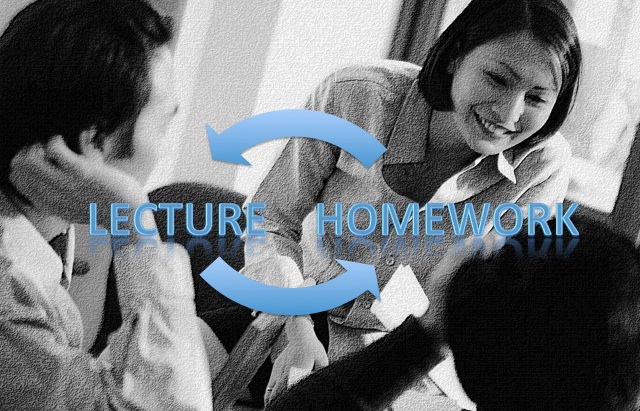
And now the Flip – The flipped classroom (2004 ish) takes its name from the idea that content has historically been taught in the day and students expected to apply that content in their own time for homework.  But is making notes in class the best use of that face to face time? Should students not watch the lecture on the evening, benefiting from studying at their own pace and then attend class the next day, where they can ask questions? Can we flip the process?

In class the lecturer or teacher can then bring the subject to life using real world examples, answer student questions and deal with individuals on a one to one basis.

It’s not perfect, but it is better

Okay it is far from perfect and it has yet to be proven over time. But it does seem to make a lot of sense and for the first time we may be seeing the power of the PC complementing rather than competing with the classroom.

Oh and it has some powerful supporters Sal Khan & Bill Gates

Watch this for a great explanation why flipping the class is a good idea

Sleep, picture, talk – learn smarter

Three stories caught my eye this month that I thought might be of interest.

They are all ways in which new research is providing evidence as to how it is possible to learn more effectively, a kind of smart brain learning.


Sleep is good for study

A new study from the University of Notre Dame suggest  that sleeping soon after learning new material is best for recall. This clearly has implications for students in those latter stages of revision and arguably the night before the exam.  The answer it would seem is that you can study right up to the last minute (probably memorising  facts) as long as you are getting a good night’s sleep after wards.

Although it is not known with certainty why sleep is so good, it is believed that it brings some form of consolidation of the facts, a kind of updating and reorganising of the brain while you rest.

The idea is not that new, this research was out in 2004

Pictures are better than words

This might come as no surprise to people who have read this blog before but it is reassuring that there is some science to support the view that the brain is more effective with pictures than words.

A story from the BBC about a group of people who had their brainwaves scanned while completing a series of tasks, individually and in groups, to see if data visualisation, presenting information visually, in this case a series of mind maps can help. The results showed that when tasks were presented visually rather than using traditional text, individuals used arround 20% less cognitive resources. In other words, their brains were working a lot less hard.

The research was carried out by Mindlab International, an independent research company that specialises in neurometrics – the science of measuring patterns of brain activity through EEG, eye tracking and skin conductivity, which tracks emotions.

This is not just another plug for mind maps, they are just one way in which information is presented visually. When reading a book or study manual, put information in boxes, use graphs, draw people and objects, make it look visual, it will all help.

The first sign of madness – talking to yourself out loud

Gary Lupyan, a cognitive psychologist at the University of Wisconsin-Madison often found himself talking out loud so he thought it might try to find out if it helped, and guess what it did.

In one experiment, volunteers were shown 20 pictures of various objects and asked to look for a specific one, such as a banana. In half of the trials, participants were asked to repeatedly say what they were looking for out loud to themselves, the others were asked to remain silent. The researchers found self-directed speech helped people find objects more quickly by about 50 to 100 milliseconds.

Most people talk to themselves when studying, but they don’t say the words out loud they keep it inside their heads. What this research suggests is that what you should do is say the words out loud, use different voices even. I know it sounds strange but it does work. Okay maybe you should do it behind closed doors; you don’t want to upset the neighbors…..


Deliberate reading – How to read technical content

In his book Five Minds for the Future Howard Gardner identifies one mind as the Synthesising Mind. He describes this as the mind that takes informationfrom disparate sources, understands and evaluates that information objectively, and puts it together in ways that make sense to the synthesiser and also to other persons.

We live in an age where knowledge is not hard to find, just Google something and you will find no shortage of information on any subject. The skill or mind that you need to develop is to be better able to filter information focusing only on what is important and ignoring what is not. 

But there is just too much!

As a student at some point you will find yourself having to read a book that contains masses of information that you need to learn but given the volume probably not able to absorb. You will need to filter the information, reduce it down into manageable chunks that can be understood and made sense.

As Gardner suggests, this understanding is initially for your benefit but eventually you will have to explain it to others, so the understanding needs to be deeper than simply knowing.

So we need a way in which you can both read and learn at a deep level. Children read instinctively using their finger, putting it under the words they are trying to say. Of course when they go to school using your finger to learn is not encouraged, so they stop. But there is good reason that children do this, you need to focus your attention and pointing or underlining is one way of doing it. Below is a step by step guide as to how to read technical stuff or in fact anything that you need to have a far better understanding than a few random facts.

How to read with your synthesising mind

1. Find the content page in your book and very loosely mind map or write out the chapter headings; see my previous blog on mind mapping. Do this IN THE BOOK, okay you will have to write on the book and that might feel uncomfortable, but you need the information all together and the book is the best place to store it. This will help you gain an overview of what is to come. Your brain will already begin to put some shape to what you are about to learn and begin to make linkages.

2. Read each chapter, but underline the key points, try to underline key words and not huge paragraphs. This in itself will help you start to focus on what is important. Yes it will slow you down but you are not just reading you are learning. Knowing what the key points are is not easy so you will have to concentrate, however don’t spend forever, often your gut instinct is the right one.

3. Write in the margin your understanding of the key points or even just copy out what is in the book. The purpose of this is to reinforce the knowledge and to make it stand out even more. It is better if you have to think about what is said in the context of what you are trying to learn and write it out in your own words. However you don’t always have time, so never be afraid to simply copy.

4. Mind map or summarise all the key points that you have written in the margin within the chapter at the front of that chapter. This is your chance to show how it all fits together. Double check your summary with the one that is in the back of the chapter, this will make sure you don’t miss anything. Now of course what you could do is just read the summaries at the end of each chapter and if you are really short of time this can be very effective, however you will not learn from this, but it can be a better way of getting a more detailed overview than you would from the contents page.

5. Look at each of the chapter summaries and add to your initial overview of the book or simply re write the whole thing. This final summary or mind map will help consolidate your thoughts on what the really important points were, the key messages and aid your understanding.

Also in a few years if you pick this book off your shelf, or when you come to revise, it will be this summary that will bring everything flooding back.

And just in case your curious – the other four minds are

The Disciplined Mind

The disciplined mind has mastered at least one way of thinking – a distinctive mode of cognition that characterizes a specific scholarly discipline, craft or profession.

The Creating Mind

The creating mind breaks new ground. It puts forth new ideas, poses unfamiliar questions, conjures up fresh ways of thinking, arrives at unexpected answers.

The Respectful Mind

The respectful mind notes and welcomes differences between human individuals and between human groups, tries to understand these “others,” and seeks to work effectively with them.

The Ethical Mind

The ethical mind ponders the nature of one’s work and the needs and desires of the society in which he lives. This mind conceptualizes how workers can serve purposes beyond self-interest and how citizens can work unselfishly to improve the lot of all.

It’s a Wonderful Life – lifelong learning

In 1946 Frank Kapra made what is arguably the best Christmas film of all time, it’s a Wonderful Life. It tells the story of George Bailey (Jimmy Stewart) who on Christmas Eve gets drunk after being told that there is a warrant out for his arrest for bank fraud.  In a moment of despair he threatens to throw himself into an icy cold river, believing that this will solve all his problems. He is interrupted by Clarence, his guardian angel (second class) who appears and jumps into the water before him. George is forced to rescue Clarence but does not believe that he is his guardian angel and wishes that he had never been born.

And so the scene is set for Clarence to show George that the world would be a very different place had he not been born. Had he not saved his brother from drowning, stopped Mr Gower (the local pharmacist) giving out a lethal prescription and put his dream of travelling the world on hold to run the local bank (Savings and loan).

George was a man with ambition and drive, he constantly put others before himself, in every way a good man. But as can often happen he found himself in situations that he had not expected, arguably did not deserve, that at the time seemed impossible to solve.

Lifelong learning

We often think that studying is something that you do when you are young and then when you have learned everything by the age of say 25/30, you sit back and relax!  Of course this is not true, learning is a lifelong pursuit. It may not always have an exam at the end, but there are lessons to learn and successes and failures to deal with in equal measure. A Wonderful Life follows the ups and downs of George Bailey and in one way is sad because he never does fulfil his ambition to travel. But he learns so many other things along the way, perhaps most importantly that some of the smaller things you do have a huge impact on others and that when faced with apparent failure or disappointment there is always a solution, and it’s not jumping off a bridge…

So perhaps you didn’t get the exam results you wanted or didn’t get a place at university but this is only a moment in time. It is not the end of the journey; it’s just a different beginning.

Steve Jobs tells a great story about “Joining the dots” how you can only join the dots backwards not forwards. Had he not dropped out of Reed College and wondered into a calligraphy class one day then in Steve’s words “the Mac would have never had multiple typefaces or proportionally spaced fonts. And since Windows just copied the Mac, it’s likely that no personal computer would have them.”

So wherever you are in your lifelong learning class, have a very Merry Christmas.

A lesson for today’s bankers

When faced with the bank collapsing George Bailey put in his own money to save it. A modern day lesson for some of today’s greedy bankers perhaps. Sir Fred Goodwin, please note….

A beautiful mind or just a different one – Personalised learning

My Daughter is sitting her mock exams at the moment, my wife is taking her to school just in case the train breaks down! And I have just finished teaching revision; only the dog seems unaffected by this November/December exams season.

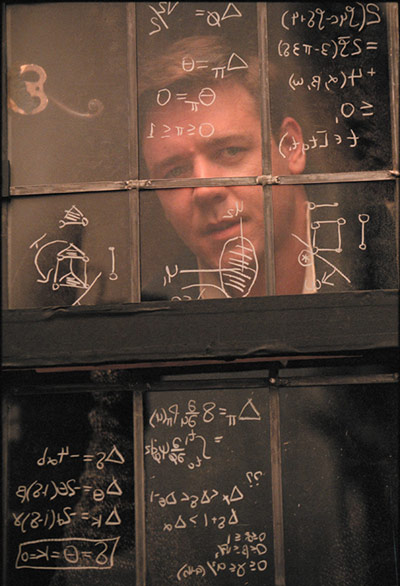
Watching my Daughter study was interesting, she has discovered that you don’t need a white board to make notes, and just like John Nash (A beautiful Mind) has been writing on our dining room windows with a marker pen.  She also created a game where the answer was under a flap of paper and found that she learned more effectively when teaching someone else, me. Go on ask me a question about respiration or stem cells…..

I have written on the merits of learning styles before,”learning styles don’t work or do they,” but in that blog I focused more on how you process information rather than using differing methods to learn. For example making notes using mind maps rather than in a linear format or writing on the window rather than on paper…..  Different people learn in different ways and at different speeds. This is why there is a big push in education to personalise learning, to make it sufficiently flexible for each individual to learn in their own way.

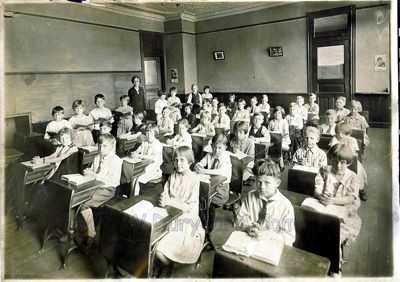
The argument is that in the last century education was delivered in a style needed to prepare people to work in factories. It required little in the way of individual thought just the ability to perform simple repetitive tasks, the same as everyone else. As a result pupils were all taught in the same way, sat in rows, repeating the same thing over and over again, and dressing alike. Okay a bit Orwellian and not entirely true, there have always been great teachers, but you get the point.

But now we live in a world that is constantly changing, problem solving is highly praised and keeping up to date with the latest information or developments is essential. So learning needs to change.

Different ways to learn

There are of course many ways to learn, but below are a few tips and hints.

  •  Making notes – writing something down is an incredibly powerful method of learning. Some people like mind maps, others prefer lists or bullet points and why not try Concept Mapping. The key point, just write it down.
  • Cards – reducing down what you have to learn and put it onto small cards. This is great for individuals who like to rearrange information, putting the most important first or eliminating what has been mastered.
  • Get a learning habit – make a routine out of what you do so that you perform a task without thinking. Learn one new fact before you go to bed, always have a book to hand or have notes on your mobile so that when you are on the train everyday you can study for 20/30 minutes.
  • Talk out loud – okay people may think you are a bit strange but listening to your own voice can really help.

Of course not all of the above will work for everyone that’s why you are you, an individual, the secret is not to give up if one method does not work.

Ps other great films about learning

Good will Hunting and the best of all Dead Poets Society

Let me know your favourites?

Not fast food – fast learning

Last week I presented a live on-line lecture to about 250 students who had registered to attend the course, the subject How to learn faster. 

So I thought it might be interesting to devote this blog to a summary of the key points from that presentation.


Accelerated or fast learning

Accelerated leaaning is a collective term for a series of practical approaches to learning. In many ways it is simply an explanation of the way in which you learn, the logic being that if you understand how information gets into your head you will be able to speed up individual parts of that process and so learn faster. Let’s have a look at what is involved in the accelerated learning process.

How we learn – or at least one version

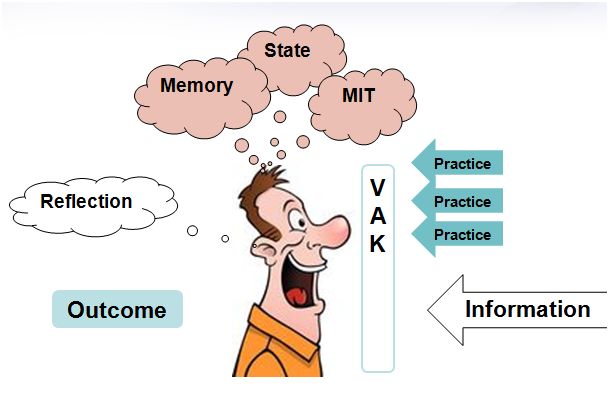
Take a look at the picture on the right, focus on the information arrow. This represents what you are trying to learn, you receive that information either Visually, Auditory or Kinaesthetically (smell touch taste) see July blog.

Learning tip 1 – Use all of your senses. When learning think about the best way of processing information, if it doesn’t make sense having read it a few times, then why not draw a picture?

One of the big problems with learning is motivation and the secret to motivation is to set goals and have Outcomes. Before you start learning think what your objectives are both short and long term then write them down.

Learning tip 2 – Write down your learning goals but make them positive and within your power. It is no good writing down I want to pass an exam when you cannot control that. Better to write that you will practice 4 questions tonight, now you can do that.

Next focus on the Practice arrows – Practice is vital. You can’t get away from the fact that the more you practice the better you get, see August blog on deliberate practice.

Learning tip 3 – Practice practice, practice….and practice again

Now look at the first of the 3 pink bubbles, MIT. MIT stands for Multiple Intelligence Theory – Don’t ask how intelligent you are, ask which intelligence you have. Howard Gardner suggested that there were 8 different intelligences, ranging from musical to logical to interpersonal.

Learning tip 4 – Don’t get hung up about intelligence, it doesn’t help, chances are your average. There are lots of types of intelligences and you may not like maths/logical subjects and are better at the written/linguistic papers. If you’re not good at maths just work harder at it, but have confidence that you are good at many other things. Intelligence is not one thing that you either have or don’t, it is more complicated.

Second of the pink bubbles is – State. State is another word for frame of mind. If you are not in the right frame of mind then you won’t learn quickly.

Learning tip 5 – If you don’t feel in the right mood for learning, then change your mood. Get up walk around, make a coffee or remind yourself you have the exam in only two weeks time. That normally works! 

Memory is the third of the bubbles – Memory is not the same as intelligence, you can improve the speed at which you learn by using memory techniques.

Learning tip 6 – Learn and begin to use some simple memory techniques, mind mapping, acronyms and acrostics are a good start.

And finally in the white bubble – Reflection. No learning process is complete without thinking back over what you have learned. What might you do differently next time, can you explain what you have learned to others?

Learning tip 7 – Keep a learning log or at least take some time out of your day to think back on what you have learned.

It’s not magic but it will work

Accelerated or fast learning is not a magic built or a pill that you can take that will require no effort from you, but it is an explanation
of learning, that stops you thinking of learning as something that happens sometimes. It is just a process and the more you understand about that process the
faster you can learn.

As they say learning is not a spectator sport…..


I have just discovered twitter. You can follow me by clicking on the panel to the right. My initial thoughts were that it was a waste of time but I have found it very demanding to make your point in 140 characters and have picked up lots of new information from others, see everyone is learning.

Exam results – what to do if you fail!

August is an interesting month, for some it is the time to take a well earned holiday and so de-stress for others it is the month in which the exam results drop through the letter box or inbox and so a time to get stressed.


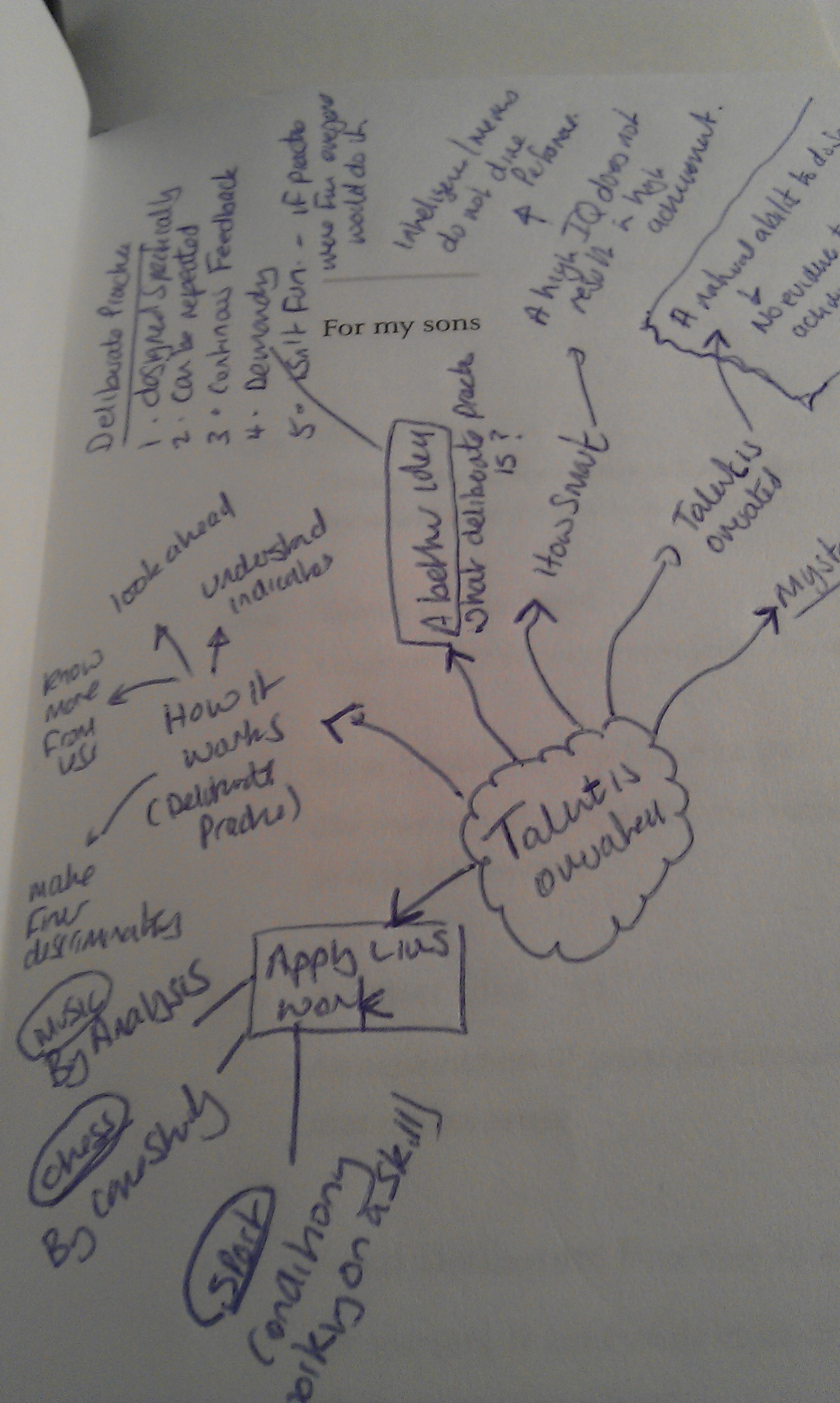
I have taken the easier of these two options and so have been on holiday, which for me is always a chance to read a couple of books. One of them was called Talent is overrated by Geof Colvin, senior editor for Fortune magazine. In the book Geof puts forward some interesting arguments as to the role talent plays in the success of people who by many would be considered exceptional, even gifted. He argues not so much that innate talent does not exist, more that successful people, those at the top of their respective tree, Tiger Woods (okay not personally – but he is still a great golfer) Warren Buffet, Bill Gates for example have other qualities, they worked hard, and practised a lot…..

Greatness does not come from DNA but from practice and perseverance honed over decades. The key is how you practice, how you analyse the results of your progress and learn from your mistakes.

What has this got to do with exam failure?

If you looked around your class and picked the best, brightest, most talented students, I bet they passed their exams. And the reason you failed was because you are not good enough, you are not talented!

Well here is the bad news, what Geof Colvin and in fairness many others have found is that it is often not down to talent, it is down to hard work and practice, and we are all capable of that. If you believe that your poor exam results were because of your lack of innate abilitiy then you are wrong. You are in fact creating what is called a fixed mindset, you begin to believe that you can’t affect your performance and so don’t try. What’s more it’s not all that good to believe you are naturally talented. Research has proven that if you believe that you do well because you are talented, when faced with failure you are more likely to give up. If you believe that you did well because of hard work and then you fail, you carry on but just work harder next time.

So what should you do?

Geof goes on to say that it is not just practice that matters but how you practice, you need to practice deliberately. He calls it deliberate practice and it should;

  • Be designed to improve performance
  • Be repeated a lot
  • Enable you to get feedback continuously
  • Be highly demanding mentally
  • Not be much fun

But what satisfies the above criteria…….. yes practicing using past exam questions. So if you were not successful in your exams, find out when you can re-sit then;

1. Take a deep breath, get out your notes from last time and draw a mind map or review the one you did for revision, sometimes it’s best to make a fresh start. This will remind you of what you have to cover and get you thinking about the subject again.

2.  Analyse the past exam questions (including the last exam) and find out what is examined the most then identify the areas you need to improve.

3. Start to practice these past questions using the answers for feedback, and no it may not be much fun but then you now that.

Failure – the only way to learn

Here is a great video by a guy called Derek Sivers, Derek is a professional musician and founder of a company called CD baby in the US. He makes an argument as to why we need failure because it is a major factor in how we learn and grow.

Final thought

I know at the moment that failing an exam can feel like the biggest disappointment in the world and that it may seem that your career is over before it really got started. But it is what you do next that really matters

As Michael Jordon once said “I can accept failure, everyone fails at something. But I can’t accept not trying”

Inspirational true story…Never give up!

Congratulations on failing from one failure to another…

Learning styles – don’t work or do they?

Much has been written about learning styles and in the world of education the very idea that there might be one “good way” to learn remains controversial.

The term which refers to the many ways in which we learn is often used interchangeably with ‘thinking styles’, ‘cognitive styles’ and ‘learning modalities’.


However, a number of researchers have attempted to break down the concepts and processes that underlie the term into three inter-related elements:

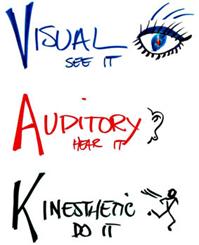
  • How you process Information – How you perceive, store and organise information, for example, VAK, visually, auditory, kinaesthetic.
  • The environment in which you learn – Your preference towards learning in a certain way, perhaps with others or on your own or in a certain setting or at a particular time of day.
  • Learning Strategies – Your use of differing methods to learn specific subject matter in a particular way. For example making notes using mind maps rather than in a linear format.

In this blog I want to concentrate on the first of these, how we process information, in particular VAK, however the observations are just as relevant to other learning styles.

 VAK – a preferred learning style

The argument is simple, everything you have learned at some point has come to you through your senses, but have you got a preference, is there one method that you as an individual are more receptive to than another? Do you for example prefer to look at pictures and diagrams  (visual) rather than listen to someone explain how it might work (auditory) or would you like to do something rather than talk about it (kinaesthetic).

Find out your learning style by taking this simple test

Learning style How we learn Learning tip
Visual seeing and reading Use mind maps and colours
Auditory listening and speaking Make an audio of your notes
Kinaesthetic touching and doing Practice questions.Build it….fix it….

But do learning styles work?

Watch this clip as Professor Daniel Willingham describes research showing that learning styles are a myth and that learning styles dont exist.

Baroness Susan Greenfield, Professor of Pharmacology at Lincoln College, Oxford University and ex Director of the Royal Institution has even been brought into the debate.

Writing in the Times Educational Supplement Magazine (29th July 2007), Susan Greenfield said that “from a neuroscientific point of view is nonsense” (the learning style approach to teaching) was nonsense. Humans evolved to build a picture of the world through our senses working in unison , exploiting the immense interconnectivity that exists in the brain, It is when the senses are activated together that brain cells fire more strongly than when the stimuli are received apart.” Abridged

Its learning about learning that matters

So, given this lack of consensus amongst researchers, why bother to consider learning styles at all?

The reason I would suggest that knowing about learning styles is helpful is not so that you can label yourself an “auditory learner” “theoretical learner” etc, this can narrow your ability to learn and even provide an excuse for poor performance, “I did not do very well at that because I am not that theoretical”. No it is to broaden your horizons and give you alternative ways of learning should you get stuck when trying to understand something.

Understanding more about how you (might) learn can really help. Imagine you are sat there at night reading and re reading a chapter in a book, clearly getting nowhere, becoming more frustrated at your own abilities. What if you stopped reading to yourself and begin reading out loud, thus changing a visual internal auditory style to a visual external auditory one. Susan Greenfield is right, we learn best when we stimulate the brain with all our senses and not just one of them. Understanding about learning styles is about creating more choice and flexibility, if one method isn’t working then change to another.

No excuses FREE knowledge – The Khan Academy

I look to do one blog a month, not  that demanding I know but enough for me. However I am so excited about what I am going to show you next I wanted to post something now!

Check out this link to something called the Khan Academy. The Khan Academy is a not-for-profit organisation with the goal of changing education for the better by providing a free world-class education to anyone anywhere, okay their words not mine but an impressive mission none the less. All of the site’s resources are available to anyone. It doesn’t matter if you are a student, teacher, or parent. The Khan Academy’s materials and resources are available to you completely free of charge.

This is a great example of open or free content, knowledge that is available on the internet for free, so now you have no excuses you can learn anything for free………

Okay you can’t learn everything, there are ONLY 2,100 videos and there are issues, how good are the lessons, are they of the right standard and quality, are they up to date, how relevant are they in helping you pass your exam?

Equally the Khan Academy is not meant to be a substitute for structured learning. There is more to a course or a well written text book than simply knowledge.  Teachers motivate and focus attention, they identify what is important and what is not, they will link topics together in such a way that makes the whole subject easier to understand and follow. But this material can really help, it can complement a structured course so that teachers can free their time to support and show how the knowledge can be applied. And if there are specific topics that you have never understood, just check out one of the lectures from the library.

This is not of course the first website to provide free content and it is American, do they not know that Math’s has an S on the end! But it is pretty good and it’s not just me who thinks that, Bill Gates does too.

In a time when universities are increasing their fees to teach stuff, it might be that they need to reassess exactly what they are charging for, because if its knowledge, well why pay for that when you can get it for nothing! 

Watch this TED lecture given by Sal Khan the founder

And for my students not sure about earning per share EPS

Or the PE ratio

Or what market capiltalisation (wth an S) might mean