
Concentration – the war in the brain

Concentrating

One of the most important skills in learning is the ability to concentrate. If you could focus your attention on a specific task for long periods of time you would be able to absorb more content, more quickly.

But concentrating is not easy. The reason is partly because we lack the ability to manage distraction. I have written before about focus, information overload and the problems with multi-tasking, but this is a large and fascinating subject.

The war in the brain

Improving concentration has a lot to do with attention, which in some ways is an invisible force, but as we have found before neuroscience can help us gain insight into the previously unknown. For example, most of us will have what is called a priority map, a map of the most visited places in our brain. Its value is that it can be used to identify how we prioritise incoming information and as such where we place our attention. It’s worth stating that attention a is a limited resource so how we use it is important.

Take this attention test and find out your level of attention.

The problem is that these maps change based on how “relevant” the information is, and relevancy itself is dependent on three systems that continually compete with each other. I know this is getting complicated but stick with it, concentrate!

The executive system – Sitting in the frontal lobe, this is the main system and orients attention according to our current goals. For example, I need to learn about double entry bookkeeping, so I will place my attention on page 4 and start reading.

The reward system – As you might imagine this is the system that offers us rewards. A reward can be as simple as the dopamine rush you get when checking your mobile phone, the problem is, you should be reading page 4! And its made worse by the fact that the brain’s attention naturally moves to flashing lights, which you often get when a text comes in.

The habit system – This system operates using fixed rules often built up over time by repetition, perhaps it’s the reason you keep looking at your phone just to check that you haven’t had a text even though you know you haven’t because you would have seen the flashing light….But most importantly the habit of checking, created by you has once again distracted your attention, when you should still be reading page 4!

Hence the term, war in the brain, these systems are in competition for your attention. The result is exhausting, you don’t finish reading page 4, and feel tired even though you have achieved very little.

How to improve concentration  

Some of the methods below will seem obvious and there is of course no magic bullet, however because there is a scientific reason as to why these might work I hope you will be more likely to give them a go.

  1. Reduce distraction –  if you have to make a huge amount of effort to check your mobile phone, the reward you get from checking it will diminish. The simple advice is don’t have your phone with you when studying or anything else that might occupy your thoughts. Also have a space to study that is quiet, with simple surroundings and nothing interesting that might be a distraction. Finally, although there is mixed evidence on playing music or listening to white noise in the background, it may be worth a try.
  2. Set goals – this is to support your executive system, write down your goal and don’t make them too ambitious.
  3. Relax and stay calm – it’s hard to concentrate when you are feeling high levels of anxiety. Methods to help with relaxation include, deep breathing, click this video its very helpful, and of course exercise which I have written about in the past, because of it being a natural antidote for stress.
  4. Avoid too much stimulation – novelty seeking behaviours for example playing video games can become imbedded in your reward system. They can make studying appear very dull and unrewarding especially if you have played a game immediately before getting down to study. Keep it for afterwards, by way of a reward perhaps.

And if you would like to find out more watch these:

What’s the use of lectures?

Robot lecturerThe title of this month’s blog is not mine but taken from what many would consider a classic book about what can realistically be achieved by someone stood at the front of a classroom or lecture theatre, simply talking. Written some 25 years ago but updated recently Donald A. Bligh’s book takes 346 pages to answer the question, what’s the use of lectures?

What makes this book interesting is the amount of research it brings to bear on a topic some consider an art form and so not easily measured or assessed.

With many in Higher education questioning what they get for their £9,250 per annum, and contact time being one way of measuring value, it’s as important a question as ever.

For clarity, we should define what we mean by lecturing, as ever Wikipedia can help –  A lecture (from the French meaning ‘reading’) is an oral presentation intended to deliver information or teach people about a particular subject.

What should happen in a lecture?

If you’re a student attending a lecture you would hope to learn something, however as many of my past blogs have discussed, learning is a complicated process and so we may need to break this question down a little further by asking, what should a lecture actually achieve?

A lecture should….

  • Transmit information
  • Promote thought,
  • Maybe change opinion or attitude
  • Inspire and motivate
  • Help you be able to do something i.e. develop a behavioural skill

Well here is the bad news, according to Mr Bligh, a lecture is only really good for one of the above, to transmit information. And it’s not even better than many other methods e.g. reading, it’s simply as effective, but no more.

Promoting thought, changing opinions

Lectures are relatively passive whereas a discussion requires that people listen, translate what is said into their own words, check if it makes sense with what is already understood, construct a sentence in response etc. In effect, a discussion is far more effective than a lecture in developing thought.

In addition, putting the student in a situation where they have to think is important, for example by giving them a problem or asking a question as is the case when you have to answer a past exam question for example. A discussion can also help change opinions, especially where you can hear other people’s views, often different to your own. It has a longer-term impact when the group comes to a consensus.

Inspiration and motivation

Bligh also argues that on the whole lectures are not an effective means of inspiring or motivating. He suggests that it should certainly be the objective of the lecturer to try, it’s just they rarely succeed. I find myself slightly disagreeing, lecturers can be inspirational, and yet maybe this is just my personal bias from having watched Sir Ken deliver his “do schools kill creativity“  or the last lecture delivered by Randy Paush.

But perhaps, these are just the exceptions that prove the rule.

Developing skills

And finally, if you want to help people become good at a particular behaviour, you don’t tell them how to do it, you get them to practice, over and over again, with good feedback.

The end of the lecture?

I don’t think this is the end of the lecture, these criticisms have been around for many years. But I can’t help thinking that with new technologies and online learning, lectures are going to have to get a whole lot better in the future.

And what will Universities point to as value for money then?


E Learning, without the E


It’s as if putting the letter E in front of the word ‘learning’ has in some way created a brand new concept, it of course has not. If that were the case we should have B learning to show that you have learned from a book or maybe P learning to indicate what you learned from your parents. In fact a search of the Internet reveals some degree of uncertainly as to exactly what E learning is, the common denominator however is that it involves the use of electronic resources. I personally favour the term ‘online learning’ as it seems somehow more descriptive.

The classroom trap

In trying to more closely understand E learning it is easy to fall into the classroom trap, that is clarification by comparing with classroom. This is largely unhelpful because it ultimately leads to the question as to which one is best, and that very much depends on what you want, how you learn and the circumstances in which you find yourself. So let’s avoid the trap and accept that they are both methods of delivering knowledge or skills using a formal process, as apposed to an informal one.


Different experience

‘Learning online’, sorry but it just sounds better……is not the same as learning from a book or in a classroom. Classroom, online and text books are all structured to take the learner from a point of ignorance to one of being informed, but the way, and environment in which you learn is different. Let’s explore these differences with the top three positives and negatives of online learning.

Positives of online

Flexible
– this is perhaps one of the biggest advantages of online, I am in fact writing this blog sat on a sun lounger surrounded by blue sky, the only interruption being a welcome breeze, and it’s the technology that allows me to do this. That same technology gives you the ability to learn on your terms, which means when you want and where you want. This has great advantages in maximising time, utilising moments in a busy day that might otherwise be lost. For example, when traveling to work by train, spare time in your lunch hou r or even making the most of the rush hour by choosing to stay at work and study rather than sit in a traffic jam.


Self paced
– another very important one. Referring to individual learning styles is often picked upon by academics as being something of an urban myth. But few would disagree that knowledge acquisition is personal, with some people able to pick up a topic quickly whilst others might take longer. Online learning allows the individual to study at their own pace, quickly when something is easily understood and slowly for the tricky areas, oh and you can keep going over the topic again and again.


Personalised
– with online, personalisation is far more than working through the content at your own pace, it offers the ability to truly personalise the experience. But be careful with this one, many courses will headline with the term personalisation, yet not deliver, it’s very much a spectrum. At the one end it is little more than a standard pathway with tests that direct you back to content to be studied again.

In the middle is the same process but the direction as to what needs studying is far more precise. It can include specific tips and hints bespoke to that topic written in a different way to the original text even using new and more suitable instructional techniques e.g. video, diagrams, interactive activities etc. To add something truly personal it might also provide an opportunity to speak to real people with access to your prior learning experience and academic record

We have yet to see what lies at the other end of the spectrum, an online learning experience that can adapt the pathway using big data and analytics, learning both from you as an individual as well as all other students with one objective, to offer the best personalised learning experience possible.

Click this link to find out more about adaptive.

Negatives of online

Motivation and procrastination
– recently we have seen that having more choice is not as desirable as you might imagine. Studying when you want is great, unless you keep putting it off. This is contributing to students taking longer to pass exams. And of course procrastination goes hand in hand with a lack of motivation, another problem often associated with online. There have been partial solutions to this for online students but they are rarely as effective as having your own personal trainer, a teacher who you meet with face to face to put you through your paces.

Isolation – learning is ultimately a solitary experience, yes you can learn with and from others but to develop a deep understanding you need to reflect on what you have learned, manipulating the knowledge until you make it yours . But doing this on your own can be uninspiring and leads to a sense of isolation, which makes the whole process seem a lot harder than perhaps it is.

Learning style – this is a simple one, some people just don’t like learning using a computer. I think its possibly because they have never given it a go or if they have, it wasn’t a very good online course in the first place. That said it is a reason, and needs to be respected.


Is Online for you?

1. Read through the pros and cons above and give them all a number between 1 and 5, for example if you think flexibility is very import give it a 5. On the other hand if you find it very hard to motivate yourself, give that a 5, etc. Add up your scores and if the positives come out higher than the negatives, online is probably for you.

2. Look to the quality of the learning provider, new innovations require both investment in terms of time, money and experience of learning. Initially at least go for the bigger companies with a solid reputation.

3. Try before you buy, ask if you can have a trail period to see if this type of learning works for you.

One last thought, this is not an irreversible decision, if you don’t like it change your mind. Also why not study different subjects in different ways, some online, others maybe in the classroom or simply from the book?

Putting the context into case study

Context

I am still reading Sensemaking by Christian Madsbjerg and as I always tend to do I have been trying to reduce the 216 pages down to something that is both meaningful and memorable. The rational for this is that if I can summarise the essence of what is being said into a single statement, then my level of understanding is reasonably good, and it makes it easier for me to use what I have learned in other situations.

So here goes, if I was to summarise what Sensemaking is all about, in one word it would be..….Context. In essence, in a world of complexity and abundance of information we are in danger of thinking that the “fact” we see on our computer screen, offered up by a search engine, driven by an algorithm is the truth, when in reality it’s only one version of it. Without the context from which this information came we are fooling ourselves as to its true meaning.

As a result of this discovery, I wondered into an area I  have wanted to write about before, the importance context plays in changing what something means, especially in examinations. Getting the meaning wrong could be the reason you fail the exam rather than pass it.  Even objective tests will have some form of context setting just before the actual question. But the type of exam where you are most likely to have a problem with context, is a case study.

Jokes play with context

A hamburger and a french fry walk into a bar.

The bartender says, “I’m sorry we don’t serve food here

The importance of context in case study

I have written about case studies before, “passing case study by thinking in words,” but focussed more on the process of how you think and write rather than how you interpret the information presented.  Case studies are becoming an increasingly popular way of assessing a student’s ability to apply knowledge from several different subjects (synoptic) in the context of a real-life situation.  This shift towards case studies is understandable given the need for improved employability skills. Here is a great story to illustrate how context changes the decision you would make or as often in a case study, the advise you would give.

A battleship had been at sea on its routine manoeuvres under heavy weathers for days. The captain, who was worried about the deteriorating weather conditions, stayed on the bridge to keep an eye on all activities.

One night, the lookout on the bridge suddenly shouted, “Captain! A light, bearing on the starboard bow.”

“Is it stationary or moving astern?” the captain asked.

The lookout replied that it was stationary. This meant a collision would result unless something changed. The captain immediately ordered a signal to be sent to the other ship: “We are on a collision course. I advise you to change course 20 degrees east.”

Back came a response from the other ship: “advise you change your course 20 degrees west.”

Agitated by the arrogance of the response, the captain asked his signalman to shoot out another message: “I am the captain of one of the most powerful battleships in the British navy, you change course 20 degrees east now.”

Back came the second response: “I am a second-class seaman, you had still better change course 20 degrees west.”

The captain was furious this time! He shouted to the signalman to send back a final message: Change course 20 degrees east right now or you will leave me no choice!

Back came the flashing response: “I am a lighthouse – your move.”

How to deal with context

It is easy even in the example above to think you know what is going to happen or what you would do. But when the context is revealed, your advice fundamentally changes. Case studies are created to see how well you respond in certain situations, so it’s important not to jump to conclusions.

And this is where sensemaking plays its part, use your senses, don’t just look at what is there, think in opposites, what is not there, what’s missing? Use visualisation, see yourself in that situation, look around, free up your thoughts, what do you see now? But most of all, be curious, ask questions of the scenario, how big is the ship, how long has the captain been in charge, what is the weather like, are there others close by?

Another excellent tool to use in these situations is called perceptual positions. Think of the event from different positions, firstly yours, what does the event look like through your eyes, secondly, the other person(s), what would you do if you were them, and thirdly what would the event look like if someone was looking in, observing both parties.

Case studies in the future will become even more sophisticated. Virtual reality offers up so many opportunities to create real world environments in which to tests students. And when that happens, you will definitely need to use all of your senses to get you through – take a look at this 360 VR surgical training, amazing.

And one last joke

Thomas Edison walks into a bar and orders a beer.

The bartender says, “Okay, I’ll serve you a beer, just don’t get any ideas.”


People are all the same but students are all different

ayam-titaniumThis month’s blog is coming from Malaysia, I have been presenting at the ICAEW learning conference in KL. The only relevance of this, is that as with any lecture/presentation or lesson you have to put yourself in the shoes of your audience and ask, what do they want to get out of this, why are they giving up their valuable time and in many instances money to listen to what you have to say?


The difference in presenting to a group of people from another country is that you start to question the way they think and perhaps learn, is it the same or could you be making a big mistake by assuming it is.

Neurologically we are all the same

What gave me confidence was that I was talking about how you learn and examinations. And although there will certainly be many differences in culture, language, opinion, even what is considered funny, our brains are all made exactly the same, and as a result the process of learning is the same.

Malaysian jokes

Q: What is Malaysians’ favourite dish? – A: Astro

Q: What is the strongest chicken in the world? – A: Ayam Titanium

So everything I said about memorising content using spaced repetition, the importance of having bite sized chunks of information, the need to present an overview at the start of each session etc was met with nods of approval.

Students are different

ctcnyapxyaamd0c

However just because we have the same neurological components does not mean they are all used in the same way. And so it would have been a mistake for me to have presented trends observed in the UK as to the attitude of students towards learning as if they were the typical attitudes of all students, in particular Malaysian ones. The reason being, I have little knowledge of the Malaysian education system, parenting skills, culture etc, these are what help shape the beliefs, values and attitudes of students in Malaysia and in turn give every student their own unique learning style.

Learning styles are unique

The generalisation about Malaysian learning styles was that there was a tendency to rank passing exams as being the most important aspect of education. This had resulted in a number of issues, one being a lack of leadership skills. Who did they blame, well they blamed the teachers for being uninspiring and measuring students by the grades they had historically achieved rather than the grades they might achieve. The point here is not in any way a criticism of the Malaysian system, there are equally many problems in the UK but to highlight why learning has to be personalised. It of course goes even deeper than nationalistic trends, clearly not all Malaysian students are focused only on passing exams and some will make great leaders, everyone is unique.

But are the teachers to blame?

If you agree with the research produced by John Hattie from the University of Auckland, the answer is yes, the teachers are to blame. His research which was built up over 15 years suggest that an individual students inherent qualities account for 50% of their ability to achieve, but on the basis this cannot be changed it would be better to look at the next biggest attribute that can be influenced. Interestingly this had little to do with who you went to school with, the so called peer effect, your home life, the school you went to, and certainly not the technology used. It was all about the teacher or type of teacher you had. It is what teachers do, know and care about that makes the difference, 30% of the difference in fact.

I am sure that advocates of on-line will suggest that this is not about the teacher but the type of instruction, but at this stage of the debate that will only cloud the issue. This simply highlights the importance teaching or instruction as being the most important aspect of learning wherever you are in the world. Of course your peers, classrooms, technology all contribute but if you want to make investment in learning, spend it on developing the teachers.

My time in Malaysia comes to an end this evening but even if my presentation did not achieve all I had expected, and I hope it did, I feel I have learned a little more, as the Malay saying goes….. Everyday a thread, soon a cloth.

And if you would like to read more about John Hatties research, read the Click the link.


Reflections on Understanding ……Brexit

great briitain leaves european union metaphorI have to admit in the last few months I have spent a fair bit of time looking into the facts behind the EU and checking on some of the statements made by both the remain and leave sides, attempting to discover truths or otherwise so that I could make a more informed decision. It proved difficult; much was opinion dressed up as fact by using numbers open to interpretation. Another technique used on the face of it to offer clarity, but in reality did just the opposite, was to state the “facts” forcefully, with conviction and repeat them often, giving the impression that what was being said was not only true but believed to be true.
But this blog is not really about Brexit, well kind of, I couldn’t let the most important decision made in this country for over 40 years go without some mention.

Following the announcement of the results on Friday the 24th of June I found myself going through what Elizabeth Kubler-Ross described as the five stages of grief. Denial, no that can’t be true. Anger, WHO was it that voted like that, they must be MAD or words to that effect. Bargaining, let me break down the statistics and find out who voted and what group they came from, old/young, North/South, maybe they could be persuaded to change their minds, or better still perhaps we will have a second referendum. Depression, we are all doomed, and finally Acceptance, it is what it is, we now need to make the most of it.

Reflection

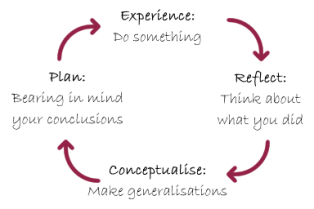
What I have described above is not simply the ramblings of a disgruntled and disenfranchised supporter of the in campaign but goes some way towards illustrating the process of reflection, one of the most important components of learning and a key technique in developing a deeper understanding.  It was David A Kolb who in 1984 put forward the argument that we learn from reflecting on our experiences.

KolbModelStep one in Kolb’s learning cycle is to have the experience. Step two, reflect, think back on what we have experienced. Step three, conceptualise, generate a hypothesis about the meaning of the experience, what is it we have learned, and step four, test that the hypothesis is supported by the experience, does it confirm that what we have learned is correct.



By three methods we may learn wisdom: First, by reflection, which is noblest; Second, by imitation, which is easiest; and third by experience, which is the bitterest. Confucius

Reflection – purposeful thought

Getting students to do this consciously is however difficult, in fairness I didn’t reflect consciously myself, it was part of a process in trying to understand why I was feeling the way I did. I felt angry but on one level didn’t know why, so I had to reflect on what had happened to find out.

The point being simply asking a student to complete say a reflection log, no matter how much you state the value of keeping one, will probably result in little more than blank pages. You need to have a reason to reflect, this might be to identify the cause of an emotion as was the case for me or to answer a question, which may be as simple as, “thinking back on the last essay you submitted, what have you learned?” it just needs to have a purpose. Of course the reflection log may still remain blank but that is more to do with motivation than the power of the exercise.

One simple technique to help with reflection is to think back on what has happened, identify the impact that it will have today on the present and what the implications will be for the future.

Lessons learned

So having passed through the stages of grief, rather too quickly I am sure some will say and reflected on the experience, what have I learned? Well, some has been confirmation of what I already knew. Firstly, that Politicians will make statements that they may or not believe at the time but will back away from after the event. This can be achieved whilst still retaining an internal level of integrity by pointing out that they never used those exact words, standing in front of a bus that has them blazoned across it, is not the same. Did anyone really believe that £350m would be spent on the health service or that Europe would not trade with us at all, after Brexit. Secondly that I like democracy as long as it comes up with the answer I want, but not when it doesn’t. Thirdly, the electorate does not make decisions using in-depth analysis and reflection but by deep held beliefs built up over time, often reinforced by the people closest to them. And lastly that the status quo is not sustainable and that happiness is a comparative process thus making change inevitable and with change comes risk.

Will it be for the better, only time will tell, we will have to wait for the historians to reflect on what the UK looked like in 2016 and whether it was better in 2026, as you can see reflection has many uses!

Let me leave you with my favourite quote of the campaign, not from one of the leading politicians involved, but Abraham Lincoln.

 “Elections belong to the people. It’s their decision. If they decide to turn their back on the fire and burn their behinds, then they will just have to sit on their blisters.”


Video killed my teacher – metaphorically speaking

Video killed the radio star

What did you do the last time you needed to repair, cook or dare I say learn something? Did you google it and follow the link to YouTube? If so you are no different to the over one billion people who actively use YouTube every month.

This blog is not actually about YouTube but the medium of video and the increasingly important role it plays in our daily life and how we use it to learn.


Social learning and the bobo doll

Albert Bandura is the Professor Emeritus at Stanford University and is widely regarded as one of the greatest living psychologists. He is perhaps most famous for his Social learning theory, the theory of how people learn by observing others, and the bobo doll experiment. Click here to listen to Bandura himself explain.

Behavioral theories of learning suggested that all learning was the result of associations formed by conditioning, reinforcement, and even punishment, see Skinner and Pavlov. Bandura’s social learning theory proposed that learning can also occur simply by observing the actions of others. And that is where the true value of video lies, it is in the ability of people to watch what others do and learn from them.

What makes a good learning video?

Firstly, as with any form of delivery it needs to planned and structured. What is the purpose of the video, why use video and not send an email? Think about the audience, why will they want to watch it, what makes it relevant for them? Break it into three sections, a beginning, where you tell the audience what you are going to tell them, the middle, where you actually tell them, and the end where you tell them what you have told them.

Secondly It has to be relatively short, 10 minutes is a maximum. Even 6 minutes of good video takes a lot of planning, equally it wont test concentration levels too much. This does not mean you can’t record many hours of video, it just needs to be chunked, labeled and structured so it can be easily followed.

And lastly think about your delivery. Pace, tone of voice and body language all help the learner. This is where you manage the mood of your audience, if your happy they will be happy. Generally, speak more slowly than you would normally but be careful toooo slowww can be boring, vary how you say something depending on what you’re saying. Also think about the visuals and if it would be better to show an image rather than talk. But don’t go mad and put too much on screen all at the same time, it gets confusing.

Examples of good video 

But of course the best way to explain the power of video in learning is to show the videos.

1.The queen of cooking Delia is also the expert of slow deliberate, perfectly planned presenting. Here she explains how to cook an omelet, notice the attention to detail.  Ps Delia left school at 16 without a single GCE O-level. 3.43 minutes in length.

2.Here is someone who breaks the presenting rules, certainly the one that says don’t talk too fast. However, CGP Grey is great at using visuals, his dialogue is fast but incredibly informative, its packed with information, and it’s funny. If you are confused by the US elections, you won’t be after watching this.  5.19 minutes in length.

3.Crash course is a little like Khan academy which I have written before, what makes it different is the humour and how it is shot to camera using powerful visuals. Watch this clip if you want to learn about supply and demand. This pushes the boundaries time wise at 10.21 minutes.

4.This is the big one certainly as far as hits are concerned. James Stevens, Vsauceis watched by 19 million people. This one answers the questions as to, what would happen if everyone jumped at once? 7.12 minutes in length.

Why cramming works and making stuff up is okay

Will making stuff up

Will making stuff up

To a certain extent I have spent much of my career making things up. When I was a student that was not the case, I listened and learned and so when I spoke, I spoke with confidence that what I was saying was correct, because someone had just told me it was. Yet knowing is only the start, and in some ways a poor relative of the “figuring it out for yourself” technique.  I am reminded of quote from the film Good Will Hunting, which along with Dead Poets capture some really magical moments in learning.

Will Hunting – “See, the sad thing about a guy like you is in 50 years you’re gonna start doing some thinkin on your own and you’re gonna come up with the fact that there are two certainties in life.” “One, don’t do that.” “And Two, you dropped a hundred and fifty grand on a f***in education you coulda got for a dollah fifty in late charges at the public library.”

 Question practice – the secret to exam success

Having had no real formal educational training I have been exploring ideas as to why some techniques work and others don’t, why it is that student A passes yet student B who did exactly the same, failed. One clear observation from over twenty years in the high stakes exam world is that the most important activity that a student can engage in is, question practice. As a lecturer I would make statements, explain them using real world examples, get students to laugh, and maybe even enjoy the subject. But, the very best learning seemed to happen when the student was required to do a question. So it was with great interest that I read of some research that came out of the US in 2011, it’s called Retrieval Practice.

 Retrieval practice – the power of cramming

Retrieval practice is simply the process of retrieving something from memory.  So for example if I asked you, who was the Prime Minister that took us into the European Economic Community in 1973, you might say, on reflection Edward Heath. You already knew the answer but were forced to recall it. If however you were not sure who it was and were subsequently told (given feedback) it was Edward Heath and that Harold Wilson in 1975 held the first referendum, you are likely to remember both. But the most interesting and perhaps surprising aspect of this research is that not only can you recall the facts, it also leads to a deeper learning in so much that you can answer questions on related information. This in some ways gives credence to the idea that cramming information, maybe not at the last minute could be beneficial, not simply because you will remember it for a few hours’ but that it will lead to deeper learning.

Mark McDaniel is a psychology professor at Washington University in St. Louis

“We think of tests as a kind of dipstick that we insert into a student’s head, an indicator that tells us how high the level of knowledge has risen in there when in fact, every time a student calls up knowledge from memory, that memory changes.” “Its mental representation becomes stronger, more stable and more accessible.”

Jeffrey Karpicke, a professor of cognitive psychology at Purdue University

“Retrieving is the principal way learning happens.” “Recalling information we’ve already stored in memory is a more powerful learning event than storing that information in the first place,” he says. “Retrieval is ultimately the process that makes new memories stick.” “Not only does retrieval practice help students remember the specific information they retrieved, it also improves retention for related information that was not directly tested.”

Final thoughts

And so I am pleased to say that what I have observed in the classroom, that question practice improves exam results might be a little simplistic and that not only does it help students pass exams they might actually have been learning something at the same time 🙂

If you want to read more follow these links

To Really Learn, Quit Studying and Take a Test (New York Times)

Researchers Find That Frequent Tests Can Boost Learning (Scientific American)

A Nostradamus moment – Predicting learning in the future

Top-5-Nostradamus-Predictions-That-Came-TrueLast year along with a colleague I looked into some of the key trends that were shaping the world of Professional Education. The result was the production of a Learning Strategy completed in December 2014. The document highlighted some of what we thought might impact our organisation in the future. Taking the technologies, attitudes and resources of today and guessing how they might change is certainly brave, possibly foolish, but reading what others think is always interesting.

Tomorrow I will be visiting the Digital Education show in Earls Court; guest speakers include Sugata Mitra, Richard Gerver and Sir Ken Robinson. The topics up for debate are current, wide reaching and of course equally prophetic.  Add to this the publication of the 2015 Horizon higher education report and you get an irresistible mix of views on the future, some of which I have highlighted below.

The measurement of learning will increase

Good teachers have always tracked student performance. It may have been in their head, summarised at the end of term in the form of a report but measuring student performance is certainly not new. The difference is now the results are more public, displayed in league tables showing winners and losers. In addition we have data not just on one student but thousands and once you have data, big data in fact, you analyse it, learning analytics is born. This allows you to make recommendations for improvement and predictions based on the observed trends and patterns. Given that new technologies make the gathering of data relatively easy, measuring student performance and the methods by which they learn will only increase.

All classroom courses will become a blend

The genie is out of the bottle, learning in a classroom complimented by the use of instructionally sound online resources offers so many benefits. It enables a more personalised learning experience, makes effective use of student time outside the classroom and is often mobile resulting in greater convenience.  It is hard to see why you would ever have just classroom only courses again. Yet not all courses are a blend or to be precise although they have online resources they are little more than a classroom course with some online PDF’s or links that are not used due to poor quality, relevance or support from the teacher, so we still have some way to go.

Informal learning will emerge from the shadows

So wrong!

So wrong!

Informal learning or as it sometimes called student/curiosity led learning has always existed but is now more easily recognised. Teachers and educators are also beginning to invest time into using it more effectively.  Once again technology is playing an important role by making knowledge more accessible and facilitating greater collaboration via online forums and social networks.

Video is an incredibly successful example of social learning, it’s hard to imagine but YouTube didn’t exist before 2005, that’s only 10 years ago. It now has 1 billion users, 300 hours’ of video are uploaded every minute and is available in 61 languages. A very practical example of learning with video can be found by clicking the banana – trust me you won’t be disappointed.

And that’s just three

I could equally have mentioned:

  • More money will be spent on personalisation and adaptive technologies
  • Greater acceptance of BYOD – your own devise that you take from home to class to work
  • Wearable learning technologies – think how wearable sports devices have expanded recently
  • Internet of things (IoT) – a network of connected objects that link the physical world with the world of information through the web could provide a wealth of new ways of learning

How did I do?

A similar blog from 2011


Blended – taking responsibility for your own learning

Taking responsibilityBlended course programmes are here to stay. The idea that studying comprises of both time in the classroom with others and time learning on your own using online or even traditional learning materials is certainly not new. Of course the purist will argue that blended learning has to or exclusively use online materials rather than a text book – no matter.

This blog is not about blended learning, more the implications of what studying on blended programmes means i.e. you have to study on your own and as a result take responsibility for how you learn.

Instructor led – easier

In a traditional classroom the teacher (instructor) stands at the front of the classroom and leads the learning. They tell you what to learn, when to learn, even how to learn.  They also dictate the pace and mood of the delivery. There is of course nothing wrong with this and many students really value it, in fact it’s their preferred method of learning. Of course its far from perfect, not everyone learns at the same pace or in the same way, but let’s put that debate, or blog aside for another day.

With a blended programme the student has to leave the security of the classroom and enter the world of self managed learning (SML).

Student led (SML) -harder but more effective

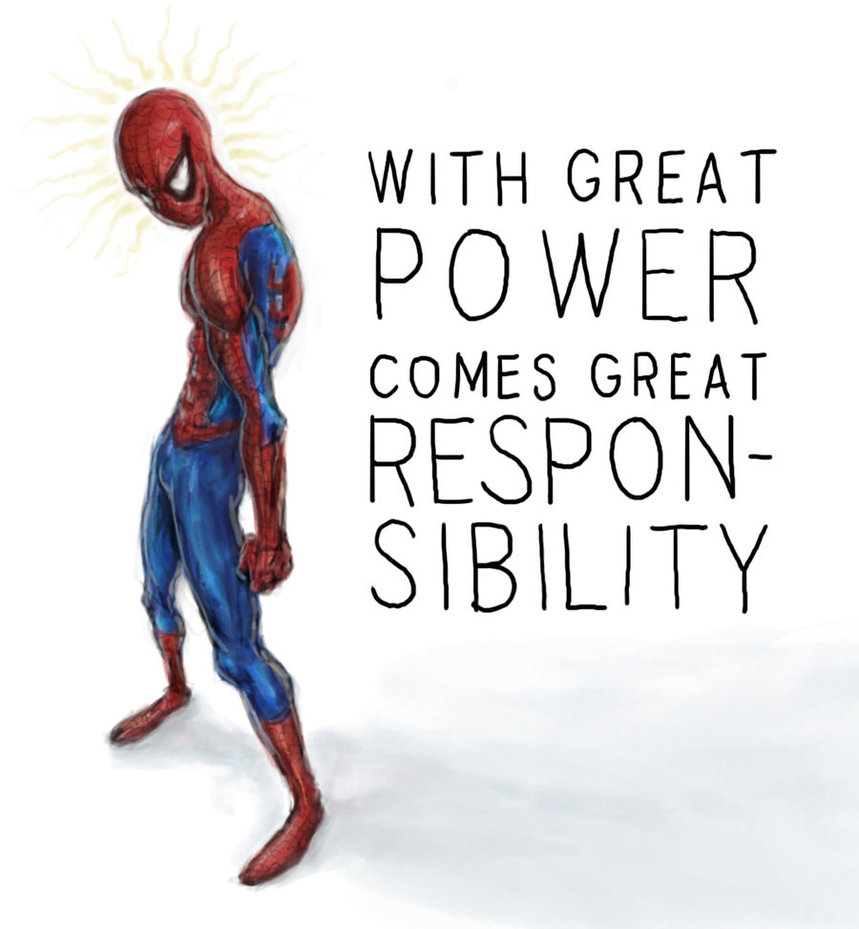
Self managed learning gives the student great power, they can study what they want, perhaps not the subject matter but certainly the order, when they want, how they want etc. However as Spiderman* once said, with great power comes great responsibility. You now have to take responsibility for the result. This means if something doesn’t make sense it’s not the teacher’s fault it’s yours!

Its perhaps even more basic than that, you are also responsible for how long you spend studying, you don’t have to do anything if you don’t want to. You can study on a Monday or Wednesday, or just the weekend. You can study for one hour or for 20 minutes. And there lies the problem, when it’s up to the individual a lot of people take the easy way out, the route of least resistance and put it off for another day.

However when you do take responsibility, the quality of the learning is significantly improved. Listening to the teacher is easy but not always that effective. The SMLearner has to set goals, monitor their performance and finally reflect, how well did they do compared with how well they thought they would? It is partly this process that makes the learning so good, but it will feel harder.

How to be a SML

These may all be worth covering in more detail in another blog but for now think of this as a check list.

  • Use a timetable – Google calendar is great for this. Put in all your key dates including exactly what you will do e.g. read chapters one to three – make notes – answer question 2,3 and 4.
  • Have a place to learn. This might seem obvious but you need somewhere that is quiet, plenty of space, good lighting, with little distraction. Perhaps most important is that you know that when you are in this room you feel ready to study.
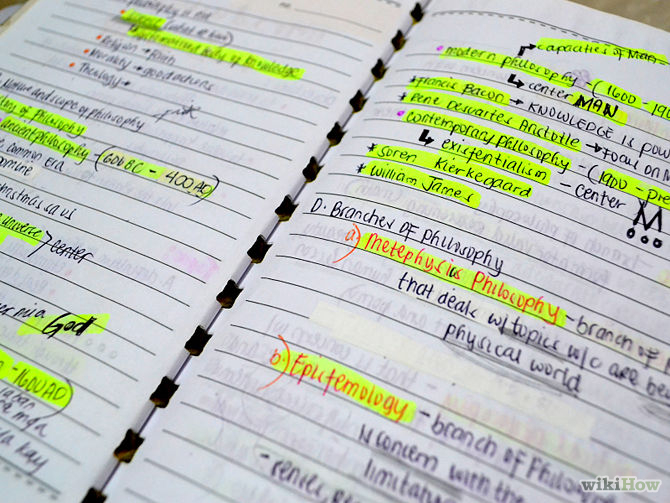
  • Read carefully, I have written on this before. Underline key points as you go. Don’t just read, you have to think as well.
  • Make notes, even if you have pre- prepared ones. Once again I have written on the best way to do this. If you are following an e learning module make notes as you work through the online guidance.
  • Listen to your internal dialogue. When you are working alone just make sure that what you are saying to yourself is positive. Remember this is not about telling yourself everything will be fine, it’s about moving forward e.g. I just don’t understand this, what I need to do is read it again perhaps from another book.

Taking responsibility

Want to find out more about taking responsibility for learning – watch video 1video 2video 3. They are all less than three minutes long and well worth it.

PS *Of course Spiderman can’t really talk it was Stan Lee the writer of Spiderman, although Franklin D Roosevelt and others have also been quoted as saying this or something similar.


Turn off the mobile – multi tasking doesn’t work

Information every whereThe background to Dr Daniel J Levitin latest book, “Thinking Straight” is that the information age is drowning us with an unprecedented deluge of data and we need to develop strategies to cope. Information overload and distraction are two problems we face when it comes to learning. How easy do you find it to concentrate when studying? Do you sit in a quiet room with no distractions and focus your attention on one task or is your mobile phone, PC or tablet sat close at hand waiting to deliver the worlds information in a second.

In the past books were precious due to their scarcity and knowledge hard to acquire the result of people’s inability to read. Following the invention of the printing press in 1450 books became more readily available but even then the amount of information any one individual was exposed to was very small. In addition the pace of life was slower, expectations as to what could be achieved balanced against the practicalities of what was humanly possible.

information_overloadBut look at the situation today, we live in an information rich society, all of it accessible at the press of a button. The problem now is not availability of knowledge (western world centric I know) but curation, synthesis and prioritisation. Yet how well is our brain programmed to cope with this new world?

Good job we can multi task

Levitin argues that multi tasking is inefficient, it’s a myth. The idea that one solution to this deluge of data is to do several things at the same time is simply wrong.  When you are doing two things at once, reading a book whilst monitoring your Twitter feed or face book account for example you are not in fact doing two things at once, you’re switching between neurones very quickly and this is giving the illusion of multi tasking. The downside of this process is it drains energy, neurones need glucose and the constant switching depletes it, resulting in poor concentration and an inability to learn as effectively. Multi tasking

I have written before (Attention Breach of duty as a student) on the importance of focusing your attention on one thing at a time and Levitin is supporting doing just that. However he does add something that I think is of interest. When you flit between two competing information sources the brain will reward you with a shot of dopamine, the pleasure drug. The result being you will enjoy the experience. This was valuable for Stone Age man because discovering a new food source at the same time as avoiding being eaten was helpful but in a modern world it is just problematic.

Externalise the information – organise, reduce and prioritise

What Levitin suggests is that you need to externalise, get the information out. In simple terms write it down, making lists is an example of externalising. He also states that you should write rather than type as this requires deeper processing.

So if you want to follow a more brain friendly approach to learning you should:

  • Break information down (A common message) into chunks and write out the key points. This will help you focus and process the information at a deeper level.
  • Find a place that is free from distraction, turn off all mobile devises. This is probably the most important message; your brain does not deal well with doing two things at once.
  • Make a list of what you have to do. Interestingly this is where technology can help. Google calendar can set up simple reminders so that you don’t have to keep distracting yourself by thinking about something you need to do later.

And if you’re interested click this link to read – Why the modern world is bad for your brain.

Ps Beth this ones for you!

And the cow said – MOOOOCS

MOOOOCIn October I decided I would find out first hand exactly what it was like to study online so I joined a MOOC. For those that don’t know what these are, a Massive Open Online Course is a free or at least normally free online course that has the capacity to have thousands of students in the same virtual classroom.

In fact only last month the British Council launched its first MOOC on English language attracting over 100,000 students. In essence a MOOC provides “education” at scale, accessible globally for free, and what could be wrong with that? Well in essence nothing, having a well educated society not only helps with social mobility but as has been well documented adds significant economic value.

Problems with MOOCS

But as you can imagine not everyone is happy, most of the concerns centre around quality.

If MOOCS are so good why is it that despite the large numbers of students enrolling there are very few, around 8% who actually complete the course.

Is this the result of poor instructional design, the fact that some MOOCS have very little student/ teacher engagement and are simply a series of videos linked together with reference to materials available elsewhere on the web. Is it because no one person is accountable for the students, there is no “teacher” to motivate the student if they fall behind. And due to the scale, feedback has to be automated or assessed by peers who are clearly not experts.

Well it might be all of the above and the course completion rate is clearly of concern yet some would argue that having a less teacher centric course is exactly what you need for students to develop a much deeper understanding. This is something *George Siemem’s argues.

Making sense of the chaos is what learning is all about, if teachers plot the route it reduces the value of what is being or could be learned.”

 “The great thing about MOOCS is that the learning does not end when the course ends, because the students have built their own communities, the learning becomes life long.”

M+O+O+C+S

People talk about MOOCs in so many different ways, in fact the name itself can be confusing when trying to understand exactly what a MOOC is.

  • Massive – A MOOC works on a platform that enables thousands of students to see and hear the same thing at the same time. The technology behind this is impressive and using one tutor to deliver the course enables the most to be made of the expertise.
  • Open – its open to anyone, there are no prior learning requirements. It is also open in the context of being free, and the learning not being restricted to the views of one person, the community are also teachers.
  • Online – it is online but is not what some would class as an online course. An online course unlike a MOOC would be instructionally designed to ensure the learning is consistent with the learning outcomes and incorporates the latest developments from the field of learning science.
  • Course – It has a cohort, a subject matter and a beginning, middle and end. But as outlined above, at its simplest it could be little more than linked video with no overall instruction and some would argue this is not a course.

A MOOC on one level is the next generation text book

Listen to Anant Agarwas on TED 

Providers

It is important to say that as MOOCs are so new, the first ones established around 2011, it is hard to pin them down as they are constantly changing. But if you are interested here is a note of the key providers.

  • Future Learn – owned by Britain’s Open University Offers MOOCs from many UK Universities. The newest of the MOOCs with approximately 750,000 plus users.
  • Coursera has around 10 million users and is by far the biggest, a for-profit founded by two Stanford University Professors.
  • edX  have around 3 million users, a not for profit MOOC founded by MIT and Harvard University.
  • Udacity have around 1.6 million users.  A for -profit backed by Sebastian Thun (co founder) and two Venture capitalist. It is currently repositioning its offering to be more vocational, targeted at professionals. Listen to Peter Norvig early observations in 2012 on TED. Peter taught one of the first classes with Sebastian Thun on artificial intelligence with over 100,000 online.

My MOOC – conclusions

edX

My edX course with MIT

The course I chose was with one of the leading provider’s edX and is called Design and Development of Educational Technology. Okay not for everyone but so far I have found it very impressive.

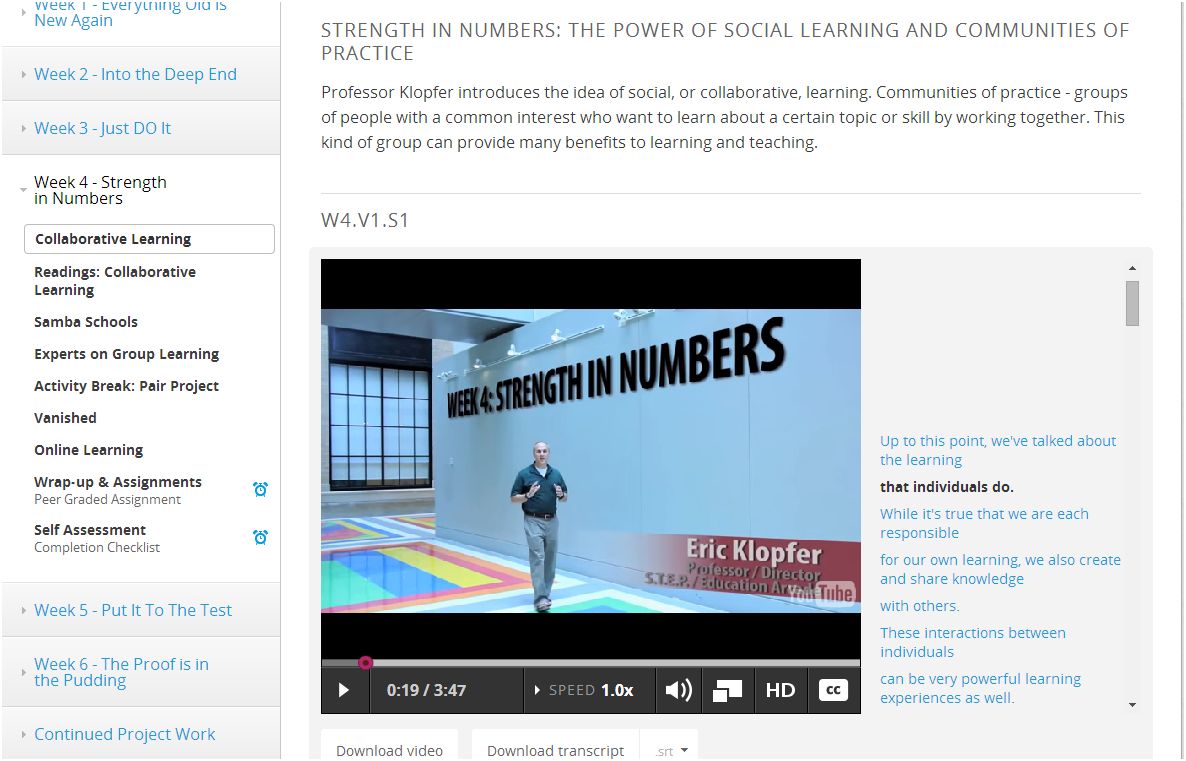
The course was delivered over 6 weeks. It consisted of video lectures with a designated tutor Professor Eric Kloper introducing many of them himself.

There were links to further reading and sessions requiring a hands on approach, in some instances “playing” with software to find out how it works. In addition there were tasks and projects to complete, all recognised by the awarding of a certificate at the end. And yes it was free. Like my students however I have already fallen behind, but I do plan to complete the programme as so far I have found it both engaging and rewarding.

But what of the future – What we can say is that some MOOCS have responded to the criticisms and are now delivering first class courses to thousands of students, online and for free. But MOOCS are still evolving; blending MOOCs with traditional face to face courses is gaining in popularity for example.

There is however still the big question as to how they are funded, and for me this is about quality. Anyone can put information that is already freely available online in a thoughtless way and leave it for the students to curate. But a well thought through MOOC takes considerable time and skill to design and deliver. This is of course no different to an online or classroom course. A good course needs good people and they cost money. But I see no reason why MOOCs can’t charge, I would gladly have paid for mine. The cost would be low given the volumes, say £1 – £500 but the reach would still be global. And the monies would enable the providers to continually invest in order to deliver the best courses possible.

Bill Gates talks about MOOCS well worth watching, its only 4 minutes “the information has been in the textbook for hundreds of years….online does not enhance knowledge…” 

Ps I promise no more animal pictures next month.

*Author of Connectivism: A Learning Theory for the Digital Age


Sleep is for wimps – oh and successful students

Get some sleepAlthough I am sure someone is preparing for an exam this very minute, July/August are the traditional months to take a holiday and get some well earned rest. A holiday can be exactly what you need especially if you have just come to the end of a long period of study followed by in some instances, weeks of exams.

I have to express a personal bias in so much that I believe holidays are essential if you are to be at your best. For me this years holiday has to provide some degree of relaxation after what has been a particularly busy 6 months. I am looking forward to a change of scene, meeting different people and the freedom to wake naturally, feeling rested after a good nights sleep. Holidays are of course very personal and for some an adventure holiday, travelling to new places every day, might be far more desirable.

But one thing that all holidays should provide is the ability to relax and catch up on sleep, even if that means you climb two mountains, swim for three hours before crashing out in a state of satisfied exhaustion on the evening.

Sleep is essential for learning 

Of course sleep is something you should do “properly” every day, it’s just that we don’t. Modern life steals that vital rest time, this is acutely the case when trying to balance both work and study. Studying is often undertaken on an evening and sometimes late into the night as you effectively try to do, too much in too little time.   We now sleep less than we did 50 years ago, it used to be around 8.5 hours, it’s now only 6.5. The sleep should also be of high quality, yet our sleep is interrupted by the lights of mobile phones, and sounds made when texts arrive late into the night. In order to sleep better it is a good idea to avoid light approximately 30 minutes before going to sleep, yet how many read in bed from iPads or equivalent with the bright light emitted from the screen telling your brain to stay awake.

Why sleep is important

We have known that sleep has been important for many years but we didn’t know why, cognitive scientists now have some of the answers. There are three views as to why sleep is beneficial:

One restoration – some of our genes only turn on when we sleep, their role being to make essential repairs.

Two conservation – we sleep to conserve energy, and

Three consolidation – our brain revisit events and experiences, and begins to make sense of them, moving data into long term memory and solving complex problems.

Susanne Diekelmann at the University of Tubingen in Germany says “sleep helps stabilise the memories and integrate them into a network of long-term memory, it also helps us to generalise what we’ve learnt, giving us the flexibility to apply the skills to new situations. So although you can’t soak up new material, you might instead be able to cement the facts or skills learned throughout the day.”  Bodies need rest – the brain needs sleep Sometimes you may find yourself having to push sleep to one side and in specific situations thats fine.

It’s when lack of sleep becomes the norm that problems arise, the result is greater stress, poor judgement and ineffective learning.   So now the exams are over, take a break, get some quality sleep and try and make a few simple adjustments in you life so that sleep takes more of a priority.

It is a common experience that a problem difficult at night is resolved in the morning after the committee of sleep has worked on it.

John Steinbeck  

Music to help you sleep and two video to watch but not just before you go to sleep

TED neuroscientist Russell foster  explains more about why we sleep  

Arianna Huffington talks about the importance of sleep

An illogical great idea – Tips for making study notes

Illogical my dear WatsonLogic is a process driven by reasoning. Here is a logical argument: Everything I need to know is in this book, if I read this book I will know everything.

And yet this is what most students do. Read the book, then begin the laborious and time consuming process of re writing some of it, which bits are chosen can at times be a little random.

On the face of it this, dare I say is illogical. If the book contains everything you need to know then why re write it, and why only parts?

The answer – because as every student knows, if they are to stand any chance of learning what’s in the book rewriting is essential. This is one of the arguments for taking notes. But notes are not just made from a book they are also used to capture what is said by the lecturer or teacher.

But first……

Here is a simple example borrowed from a colleague (thanks Gareth). Below are four opposites, can you find the missing letters?

  • Pa-s & Fail
  • Amate-r & -rofessional
  • -ccid-ntal & Intenti-na-
  • Co-p-ls-r- & V-lun-a- –

I will come back to this at the end.

Student own notes?

Making notesThere are two reasons for making notes, one because it helps with learning (Encoding) and secondly so that you have a copy for reference later (External storage). I will focus on the encoding in this blog.

Encoding – Three factors have an impact on the effectiveness of students making their own notes.

  • The amount of effort If you take notes but make very little effort to understand what is being said, simply recording the lecturer’s words, the value of taking your own notes is limited.  It is far better to identify and highlight the key points being made and add your views and inferences.
  • The nature of the input – If the lecturer is speaking quickly or giving little time to consolidate what is being said then the quality of the notes will be affected. The most effective rate for speaking is thought to be around 84 words per minute. A second factor is the density of facts to words, if the density is low, 106 facts to 2,000 words then student notes are far better than if the density is higher at say 206 facts to 2,000 words.
  • The learner’s purposes and goals – Of course each student will have an objective for being in the lecture in the first place; often this is to pass the exam.  Research shows that students will take down what the lecturer  says  and therefore learn more if, the topic is believed to be examinable, is written out by the lecturer, dictated or repeated.

Pre-prepared (lecturer) notes

What the above shows is that making your own notes is probably the most effective way of learning as long as you are not simply recording what is said without thought. The more you add and personalise the notes with your own views the better. However as can be seen taking notes in class has its problems, the quality is affected by the speed and density of delivery and the learner’s goals. So maybe the best notes are those prepared by the lecturer?

Although I was not able to find any definitive research on this very point, Fisher and Harris (1973) did conclude that students “who reviewed (used for revision) their own notes outperformed those who reviewed the lecturer’s notes.”

What we can say is that pre-prepared (lecturer notes) can help overcome some of the problems with students own notes. But they should not be complete; they should not contain everything the student needs to know. If they do not only will the notes become too large but they will leave the student with few opportunities to add their own thoughts and as a result learn.

And last…….

At the start of this blog I asked you to find the missing letters. I hope the task itself was not too onerous, it was meant to show that when you have to think and make an effort you are far more likely to remember at a later date. So tomorrow when you reflect back on this blog, ask yourself which ones do you remember – it should be the ones lower down the list.


I have written before on making notes and mind maps – click the links below

Mind Mapping unplugged – How to Mind Map from beginning to end

The De Vinci code – Mind Mapping to pass exams

Also to read more about the research used to write this blog click here

The answers just in case

Pass & Fail – Amateur & Professional – Accidental & Intentional – Compulsory & Voluntary

Carrots and sticks – Motivation and the thinking Donkey

Donkey carrot and stickMotivation is one of those topics that is so important to learning and passing exams that we will constantly keep coming back to it.

If you are motivated when studying then you will study for longer, more frequently and be more focused.

As a result I have written about motivation in the past Motivation – How to want to study, Rocky boxing No – it’s about motivation to name but two.

I have always liked the simple idea that if you want to motivate someone to do something then you give them a reward (carrot) or a punishment (stick). You will probably have used carrot and stick techniques on yourself. If I answer these exam questions by the weekend I will have Sunday off or if I don’t answer these exam questions by the weekend then I won’t have Sunday off.

But are we more complicated?

In his book Drive – the surprising truth about what motivates us, Daniel H Pink (a former Al Gore speech writer) argues that there are in fact three motivational systems. One survival , motivated to eat, drink and reproduce. Two, seek reward and avoid punishment, the so called carrot and stick and three, intrinsic  motivation, the idea that motivation comes from within not from external stimuli.

These are not mutually exclusive, you are still motivated to eat, drink and reproduce, equally carrots and sticks do work, but what are these intrinsic motivators.

Type X and Type I

Type X behaviour is fuelled more by extrinsic desire, how much money will I get, I don’t want to have to work Sunday, this fits with carrot and stick. Type I behaviour requires intrinsic motivation and is concerned with the satisfaction gained from an activity. Pink argues that extrinsic motivation works better for algorithmic/routine tasks that require little cognitive processing. But if you have to think, understand, create then intrinsic motivation is more effective. Got it……

And the point is……

Studying and learning require a huge amount of cognitive processing (It is a type I behaviour) and so rather than using carrot and stick motivators you would be better using intrinsic ones. Pink explains that intrinsic motivators can be broken into Autonomy, Mastery and Purpose.

  • Autonomy – This can be achieved by making your own decisions as to how you study when you study, rather than listening to others or being rewarded for doing it. It’s about taking ownership.
  • Mastery -This is a mind set and involves you believing that what you are learning is not something in isolation but contributing to a greater and longer term skill set.
  • Purpose – This links nicely back to goals, which has been the topic of previous blogs. You must feel that what you are learning has some value and purpose possibly beyond simply passing the exam. Will it help you do your job better etc

Motivation can be difficult to understand, personally I feel that it does come from within (intrinsic), it’s my desire to do something not someone else’s and so the argument that you should not use carrot and stick (extrinsic ) type rewards makes a whole lot of sense.

Let me know what you think….?

Listen to Daniel H Pink at TED And an RSA animated lecture 

Reflection/Goals/Planning……Inspiration and bravery

2013_time100_yousafzaiIt’s nearly the start of a New Year 2014, traditionally a time for both reflection, taking stock of what went well/not so well and looking forward to what the future might hold. On the whole this is a healthy process, looking back gives you chance to put things into perspective and hopefully learn a few lessons, whilst looking forward gets you thinking about what you might like to happen and set goals to make those events more likely.

Looking back on 2013, one event that stood out for me was the nomination of Malala Yousufzai for the Nobel peace prize in November 2013*. It is not the nomination that is important but the fact it provided a reason to revisit the incredible story of one little girls determination to have an education, something that many of us are fortunate enough to be given for free or at least freeish!

Reflection – The story in brief

By 1997, the year in which Malala was born her father Ziauddin Yousufzai had been running a private girls school for several years in the Swat

A classroom in Swat valley

A classroom in Swat valley

district of Pakistan. This was before the Taliban took over. At the end of 2008 the local Taliban leader, Mullah Fazlullah, issued a warning, all female education had to cease within a month, or schools would suffer consequences. Malala was 11 and supported by her father started an anonymous blog for the BBC Diary of a Pakistan school girl.”  The blog stopped after only 10 weeks as Malala had to leave Swat. Although clearly influenced and inspired by her father Malala had a voice of her own and one that was now being heard outside Pakistan, she was passionate about education, especially for women. A documentary by the New York Times bought the story to a wider audience.

 All I want is an education, and I am afraid of no one. 

But on the 9th of October 2012 when Malala was just 15 two men boarded her school bus and asked “Which one of you is Malala? Speak up, otherwise I will shoot you all” The other girls looked at Malala, innocently identifying her; she was shot in the head and neck and left for dead. She was initially flown to a military hospital in Peshawar and then onto the Birmingham Queen Elizabeth hospital in the UK where she had further operations and continued her recovery.

They cannot stop me. I will get my education, if it is in (the) home, school or any place. 

On 12 July, nine months after the shooting, came a major milestone. Malala stood up at the UN headquarters in New York and addressed a specially convened youth assembly. It was her 16th birthday and her speech was broadcast around the world.

Goals and Planning

Malala wanted to be a Doctor, but wanting to be a Doctor is not an effective goal, it’s a wish or desire, it was outside her control. What was within her control was to work hard, motivate herself and fight for the education she deserved.

Malala wanted to be a Doctor but events changed all that, a bullet intended to kill her sent her down a different path. Now she wants to be a politician, not a goal but a wish, driven perhaps by a deep routed desire to help people less fortunate than herself. Yet those same goals of hard work, motivation and learning will equally help turn this wish into a reality.

Let us make our future now, and let us make our dreams tomorrow’s reality.

And so to 2014

When thinking back on 2013, learn from your mistakes, maybe the exams (life in general) didn’t go as well as you might have hoped. But don’t Happy New Yearask why, ask what have I learned and so need to do differently in 2014. Remember when setting those goals make sure they are within your control and take inspiration from the story of a brave little girl who worked hard, motivated herself and most of all believed in the importance of education.

  Let us remember: One book, one pen, one child, and one teacher can change the world. 

Ps

Malala is now working hard for her GCSE’s incidentally at the same school as my daughter.

Well worth watching – BBC – Shot for going to school.

And the *Nobel Peace Prize 2013 was awarded to Organisation for the Prohibition of Chemical Weapons “for its extensive efforts to eliminate chemical weapons.

Intelligence and IQ – does it matter?

Yesterday Boris Johnson delivered the annual Margaret Thatcher lecture at the Centre for Policy Studies in London, in it he said:

Whatever you may think of the value of IQ tests, it is surely relevant to a conversation about equality that as many as 16 per cent of our species have an IQ below 85, while about 2 per cent have an IQ above 130.”

Mr Johnson (Boris) uses the measure of IQ to make the point that if we don’t have equality in intelligence then economic equality is not possible. Effectively he is saying we should accept that some animals are more equal than others, apologies for the Animal Farm digression…..

What is Intelligence?

Yet a large part of Boris’s argument hinges on the term intelligence and that it has some meaning or value, but what is intelligence? The word itself is derived from the Latin verb intelligere, to comprehend or perceive. A good start, but that’s all it is a start, here are a few more definitions:

  • Judgment, otherwise called “good sense,” “practical sense,” “initiative,” the faculty of adapting one’s self to circumstances  (Alfred Binet the creator of the IQ)
  • The ability to learn or understand or to deal with new or trying situations (Merriam-Webster dictionary)
  • To my mind, a human intellectual competence must entail a set of skills of problem solving, enabling the individual to resolve genuine problems or difficulties that he or she encounters. (Howard Gardner, Multiple Intelligence Theory)

The last of these is my personal favourite as it gives purpose to having intelligence, to solve problems. The bottom line, there is no one single definition and experts disagree on how it should be tested/measured. Interestingly the IQ (intelligent quotient) developed by Alfred Binet was only ever intended to be used to identify intellectual disability not to form the basis of an elitist club or for Boris to hijack for his Margaret Thatcher lecture.

Does it matter?

People often have a personal view of their own intelligence, this can sometimes be empowering when you find out “You’re a god Dammed Genius” or limiting if “you discover your IQ is only 75.” Just for the record, 91-110 is average, 80-90 is dull normal, 66-79 borderline and 65 and below, defective.

The very fact that you believe you are intelligent can be motivational, resulting in you putting in more effort. The self belief that you can solve any problem will often result in you solving most of them, and of course proving you are not only intelligent but a genius!

I know that I am intelligent, because I know that I know nothing.

Socrates

Contrast that with the behaviour of someone who believes they are not intelligent or maybe not as intelligent as others. Faced with a problem they will give up, believing the solution is beyond them, and of course proving that they were also right and not a genius.

But Does Boris have a point?

Boris uses IQ (The measure of intelligence) to illustrate the point that we are all different, something that most people would readily accept. What I find uncomfortable is the deterministic nature of his proposition, it implies having a high IQ predicts success and by the exclusion of the many other factors that contribute to success, suggests is the only thing that matters. The Telegraph headline made this point very strongly.

Boris Johnson: some people are too stupid to get on in life

Natural differences between human beings will always mean that some will succeed and others will fail, the Mayor of London says in a speech

Yet on the basis that there is little agreement as to what Intelligence is, the testing and what should be tested is subjective, it would appear a poor basis on which to hang his argument.

Lessons for learning

What I do agree with is that we are all different and that some of this is the function of genetics. (Research indicates that 60% of intelligence is genetic) yet on the basis that you can do very little about this, does it matter?

It is always better to work on what you can change rather than what you can’t. I am sure many of us know people who seem to grasp principles, concepts’ etc and solve problems pretty quick. If you compare yourself to them it’s easy to conclude that they are better and you will always be second rate, so stop trying. The simple answer is don’t compare yourself with them, compare only with yourself, are you getting better and if you are then your improving, and that’s a result.

So forget about measuring intelligence and whether your better than someone else and get on with trying hard and being the best you can.

More on intelligence

Human intelligence, BBC Horizon. An interesting programme that evaluates the intelligence of different high performers.

And the smartest man in the world is…...click here

Thinking in box’s – Cracking case study

Put it in a boxExaminations come in many shapes and sizes, short form, multiple choice, essay, case study etc. I know there are other methods of assessment but I am thinking here of the most common. Of these one stands out as being very different, the case study. Developed by Harvard in the 1920s the  case study involves giving the student a  real life, normally business situation and asking relatively broad Socratic type questions e.g. what do you think, why etc.

It not only puts the student in a realistic situation but also requires them to think far more deeply.  The cognitive process involved in answering a question such as what is the capital of France or can you add 2+2, on the whole is very simple and may need little more than memory. However giving student a real life business to analyse and asking them to give an opinion as to what the company should do next requires higher level thinking as well as effective communication skills.

Too much to read

One other aspect of a case study is that it often involves large amounts of narrative, all will need reading digesting and putting into context. On the face of it this can seem daunting, but it can be done and as with so many aspects of learning there is a process that can help. I have written about, having too much to read and the benefits of chunking before but I want to bring these together with another powerful technique “thinking in box’s”.

Thinking in box’s 

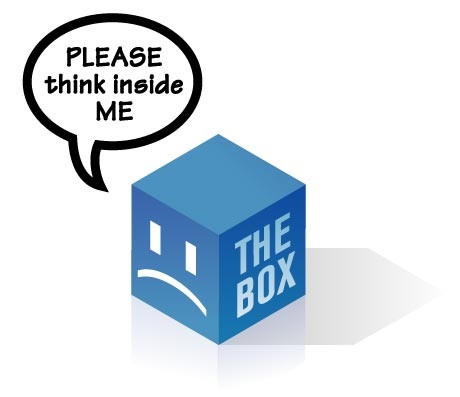
Volume and lack of direction is the main problem here, so we need to find our own direction and reduce the volume. Thinking in box’s refers to the natural process we have in compartmentalising thoughts. In order to make sense of the world we often put “stuff” into box’s, work, study, relationships etc. We can then open the box’s when we are best able to deal with them. The  point being that  we can’t deal with everything all at once. If this whole idea sounds a bit odd, then just consider the saying “Thinking outside the box”. This refers to the imaginary frame we put around something that restricts our ability to solve a problem and think more creatively. Strange isn’t it…..

Case study

Imagine that you have 10 pages of narrative to read based on a particular industry, a case study. There are a few sub headings and some paragraphing. You are required to provide guidance to the board of Directors as to what the companies strategy should be in the next five years.

The process 

In order to give the advice required by this question, you need to fully grasp the current situation, which means you have to  read, understand and comprehend what is written on the 10 pages. To add structure to the case firstly take chunks of content and put a frame around it, this will help focus just on this chunk of information, it also reduces the volume. A chunk will often be information under a heading or specific paragraphs. Once you have the content in a box, sift through it looking for the “key words” and underline them.  Focusing only on the key words but taking into account the context, ask yourself, what do I think about this? What does it mean, what is it telling me etc. Then write down your thoughts. Do this for every chunk of information, then number each chunk.

At the end of this process you should have read and thought about each chunk, captured those thoughts and have a numerical reference by which to structure them. The final part of the process is to read each of those chunks again and produce a SWOT. This brings all 10 pages down to just one. And by using the SWOT supported by your detailed analysis you should be able to give the advice required by the question.

watch_this_videoIn this short video I demonstrate the thinking in box’s approach.

      Thinking in box’s

And finally – A few words from Terry Pratchet

I will be more enthusiastic about thinking outside the box when there is some evidence of thinking inside it!

The lecture -When does learning happen?

“Lectures were once useful; but now the internet and online content are freely available, lectures are unnecessary. If your attention fails, and you miss a part of a lecture, it is lost; you cannot go back as you can with online content. “

The above quote makes the point very forcefully that lectures may not be that effective, and certainly not as good as online. But let me ask a broader question, what is the purpose of a lecture in the first place, does it help you learn and if so when does the learning begin?

The lecture – step by step

In its most simple form the lecture involves little more than a lecturer standing at the front of the class reading from a set or prepared notes or reciting from memory, the student then listens and copies down what the lecturer is saying, presumably to read and absorb later.

So let us break down this process and consider how a lecture helps with learning. Firstly the student has made the effort to attend, this in itself means there is some motivation involved. Secondly they are in an environment designed for learning and with other like minded individuals. All of this helps to put the student in the right frame of mind.

The lecturer will however play a very important part. How well they explain the subject, their level of knowledge, passion and genuine interest can all make a dull topic seem fascinating. And if it is fascinating the student will find it easier to learn. But how much of this can you get from a book, and can this all be achieved online?

And when is the real learning taking place? True the lecturer may ignite a flame and create a sense of curiosity in the student, but the real learning takes place in private, by the student as they revisit the book, video or notes, rewrite, talk out loud and practice questions.  As I have heard student’s say many times, “I need to go over this latter and get it into MY head.”

I am reminded of an Ali quote.

The fight is won or lost far away from witnesses – behind the lines, in the gym, and out there on the road, long before I dance under those lights.

Conclusion

A lecture is a poor method of transferring information, a book or video can explain a topic as easily as a lecturer if well written/filmed. The book and video are both good at providing technically accurate information, but can they transfer the passion, maybe…… but I would argue not as well as the lecture.

You will get a far better view of a sporting event with expert commentary and the ability to watch again on TV, but you are more likely to get a life changing experience if your there watching it unfold live.

So if the only reason you are going to the lecture is to capture information then don’t bother. Stay in bed and get a good book, copy your friends notes or watch the lecture online. But if you want to be inspired/motivated, possibly get a unique view, then go to the lecture.

There is of course a message here for lecturers, your job is to be unique, to inspire and ignite the flame. If not you should also stay in bed, after recording all of you lecture of course.

And for the avoidance of doubt, I do not think this can all be achieved online, a live lecture is different, but the lecturer has to play their role, they have to entertain.

The debate is of course not new – the twist in the tale

Some of you may have recognised the above quote, it’s taken from (with a few amendments from me) James Boswell’s, life of Johnson, the quote is from Samuel Johnson, and the year…..1791!

Lectures were once useful; but now, when all can read, and books are so numerous, lectures are unnecessary. If your attention fails, and you miss a part of a lecture, it is lost; you cannot go back as you do upon a book. . . . People have nowadays got a strange opinion that everything should be taught by lectures. Now, I cannot see that lectures can do as much good as reading the books from which the lectures are take.

Examples of lectures

If only more lecturers could be like this – watch this

And not like this

And although not entirely my thing, everyone should watch the last lecture by Randy Pausche. Although you need to put aside over an hour you will not be disappointed and when you have you will join the 16 million others who have done the same.

Thank you for the music – listening to music when revising

May and June are the traditional months when students around the world lock themselves away to revise for their exams.

In China for example over 9 million students will be sitting the university entrance exams.

Last May (2012) Teenagers at Xiaogang school in Hubei province were pictured hooked up to bags of intravenous fluids hanging from the classroom ceiling to boost energy levels during the revision period. An extreme action by anyone’s standards, but perhaps an example of how much pressure students feel this time of year.

As I mentioned in last month’s blog my daughter is currently caught up in this May/June exam frenzy. So once again I found myself looking to her for inspiration. What was she doing, how did she revise? This is not because she is a perfect example of a revision student, in many ways she is not, but I do think she is typical of many.

What does Beth do?

  • Makes notes from her notes – This is a standard exam skill, reducing content down into measurable and personal chunks. She does use mind maps (possibly my influence) but not exclusively.
  • Prepares as if she has to teach someone else – this I find interesting and has certainly not come from me. She writes on a white board the key points as if she was going to teach that subject. I like this idea, as many teachers and lecturers will tell you nothing focuses the mind nor motivates you more than having to teach it to others.
  • Practices past exam questions…of course!
  • Studies while listening to music – now this is the one that intrigued me and as a result I have devoted the rest of the blog to answering the question …..

Is it a good idea to revise whilst listening to music?

As ever the science needs much interpretation.

It’s a bad idea

Researchers from the University of Wales, tasked 25 students with memorising lists of consonants. Some were shown the letters while sitting in silence, others while listening to music by their favourite bands or by groups they had a strong aversion to. The conclusion was that listening to music, hampered their recall.

So it’s good then

Scientists at Stanford University, in California, believe there is a molecular basis for music known as the “Mozart Effect“. It was discovered that rats, like humans, perform better on learning and memory tests after listening to a specific Mozart Sonata in D.

But then there is the evidence that suggests that switching attention when trying to learn as might be the case with listening to music slows down the cognitive process.

Yet you cannot ignore the research that clearly shows music has the ability to alter your brain and induce relaxation which in turn helps create an ideal state for learning.

Watch what happens to your brain when you listen to music.

Hopefully you get the idea.

Conclusions

  • Listening to music puts you into a more relaxed frame of mind and that is of course good for learning. So listening to music before or after revising can help.
  • If you do want to listen to music, avoid music that requires you to shift your attention. This would suggest you should not listen to  music with lyrics  as it can mean you need to think about what is being said nor should you listen to something new that you may not have heard before. This is one of the reasons classical, in particular baroque music is the preferred choice of many students. Also don’t play the music too loud, keep it as background noise.
  • If there are specific facts that you simply need to know, then avoid listening to music completely, give it your full attention. But you can’t concentrate at this level all day, only for short periods.
  • On the whole be consistent don’t keep changing the type of music, you need familiarity.

Music to help you study

The internet has many websites that offer relaxing and helpful music, here are a few that might help.