Concentration – the war in the brain

Concentrating

One of the most important skills in learning is the ability to concentrate. If you could focus your attention on a specific task for long periods of time you would be able to absorb more content, more quickly.

But concentrating is not easy. The reason is partly because we lack the ability to manage distraction. I have written before about focus, information overload and the problems with multi-tasking, but this is a large and fascinating subject.

The war in the brain

Improving concentration has a lot to do with attention, which in some ways is an invisible force, but as we have found before neuroscience can help us gain insight into the previously unknown. For example, most of us will have what is called a priority map, a map of the most visited places in our brain. Its value is that it can be used to identify how we prioritise incoming information and as such where we place our attention. It’s worth stating that attention a is a limited resource so how we use it is important.

Take this attention test and find out your level of attention.

The problem is that these maps change based on how “relevant” the information is, and relevancy itself is dependent on three systems that continually compete with each other. I know this is getting complicated but stick with it, concentrate!

The executive system – Sitting in the frontal lobe, this is the main system and orients attention according to our current goals. For example, I need to learn about double entry bookkeeping, so I will place my attention on page 4 and start reading.

The reward system – As you might imagine this is the system that offers us rewards. A reward can be as simple as the dopamine rush you get when checking your mobile phone, the problem is, you should be reading page 4! And its made worse by the fact that the brain’s attention naturally moves to flashing lights, which you often get when a text comes in.

The habit system – This system operates using fixed rules often built up over time by repetition, perhaps it’s the reason you keep looking at your phone just to check that you haven’t had a text even though you know you haven’t because you would have seen the flashing light….But most importantly the habit of checking, created by you has once again distracted your attention, when you should still be reading page 4!

Hence the term, war in the brain, these systems are in competition for your attention. The result is exhausting, you don’t finish reading page 4, and feel tired even though you have achieved very little.

How to improve concentration  

Some of the methods below will seem obvious and there is of course no magic bullet, however because there is a scientific reason as to why these might work I hope you will be more likely to give them a go.

  1. Reduce distraction –  if you have to make a huge amount of effort to check your mobile phone, the reward you get from checking it will diminish. The simple advice is don’t have your phone with you when studying or anything else that might occupy your thoughts. Also have a space to study that is quiet, with simple surroundings and nothing interesting that might be a distraction. Finally, although there is mixed evidence on playing music or listening to white noise in the background, it may be worth a try.
  2. Set goals – this is to support your executive system, write down your goal and don’t make them too ambitious.
  3. Relax and stay calm – it’s hard to concentrate when you are feeling high levels of anxiety. Methods to help with relaxation include, deep breathing, click this video its very helpful, and of course exercise which I have written about in the past, because of it being a natural antidote for stress.
  4. Avoid too much stimulation – novelty seeking behaviours for example playing video games can become imbedded in your reward system. They can make studying appear very dull and unrewarding especially if you have played a game immediately before getting down to study. Keep it for afterwards, by way of a reward perhaps.

And if you would like to find out more watch these:

What’s the use of lectures?

Robot lecturerThe title of this month’s blog is not mine but taken from what many would consider a classic book about what can realistically be achieved by someone stood at the front of a classroom or lecture theatre, simply talking. Written some 25 years ago but updated recently Donald A. Bligh’s book takes 346 pages to answer the question, what’s the use of lectures?

What makes this book interesting is the amount of research it brings to bear on a topic some consider an art form and so not easily measured or assessed.

With many in Higher education questioning what they get for their £9,250 per annum, and contact time being one way of measuring value, it’s as important a question as ever.

For clarity, we should define what we mean by lecturing, as ever Wikipedia can help –  A lecture (from the French meaning ‘reading’) is an oral presentation intended to deliver information or teach people about a particular subject.

What should happen in a lecture?

If you’re a student attending a lecture you would hope to learn something, however as many of my past blogs have discussed, learning is a complicated process and so we may need to break this question down a little further by asking, what should a lecture actually achieve?

A lecture should….

  • Transmit information
  • Promote thought,
  • Maybe change opinion or attitude
  • Inspire and motivate
  • Help you be able to do something i.e. develop a behavioural skill

Well here is the bad news, according to Mr Bligh, a lecture is only really good for one of the above, to transmit information. And it’s not even better than many other methods e.g. reading, it’s simply as effective, but no more.

Promoting thought, changing opinions

Lectures are relatively passive whereas a discussion requires that people listen, translate what is said into their own words, check if it makes sense with what is already understood, construct a sentence in response etc. In effect, a discussion is far more effective than a lecture in developing thought.

In addition, putting the student in a situation where they have to think is important, for example by giving them a problem or asking a question as is the case when you have to answer a past exam question for example. A discussion can also help change opinions, especially where you can hear other people’s views, often different to your own. It has a longer-term impact when the group comes to a consensus.

Inspiration and motivation

Bligh also argues that on the whole lectures are not an effective means of inspiring or motivating. He suggests that it should certainly be the objective of the lecturer to try, it’s just they rarely succeed. I find myself slightly disagreeing, lecturers can be inspirational, and yet maybe this is just my personal bias from having watched Sir Ken deliver his “do schools kill creativity“  or the last lecture delivered by Randy Paush.

But perhaps, these are just the exceptions that prove the rule.

Developing skills

And finally, if you want to help people become good at a particular behaviour, you don’t tell them how to do it, you get them to practice, over and over again, with good feedback.

The end of the lecture?

I don’t think this is the end of the lecture, these criticisms have been around for many years. But I can’t help thinking that with new technologies and online learning, lectures are going to have to get a whole lot better in the future.

And what will Universities point to as value for money then?


E Learning, without the E


It’s as if putting the letter E in front of the word ‘learning’ has in some way created a brand new concept, it of course has not. If that were the case we should have B learning to show that you have learned from a book or maybe P learning to indicate what you learned from your parents. In fact a search of the Internet reveals some degree of uncertainly as to exactly what E learning is, the common denominator however is that it involves the use of electronic resources. I personally favour the term ‘online learning’ as it seems somehow more descriptive.

The classroom trap

In trying to more closely understand E learning it is easy to fall into the classroom trap, that is clarification by comparing with classroom. This is largely unhelpful because it ultimately leads to the question as to which one is best, and that very much depends on what you want, how you learn and the circumstances in which you find yourself. So let’s avoid the trap and accept that they are both methods of delivering knowledge or skills using a formal process, as apposed to an informal one.


Different experience

‘Learning online’, sorry but it just sounds better……is not the same as learning from a book or in a classroom. Classroom, online and text books are all structured to take the learner from a point of ignorance to one of being informed, but the way, and environment in which you learn is different. Let’s explore these differences with the top three positives and negatives of online learning.

Positives of online

Flexible
– this is perhaps one of the biggest advantages of online, I am in fact writing this blog sat on a sun lounger surrounded by blue sky, the only interruption being a welcome breeze, and it’s the technology that allows me to do this. That same technology gives you the ability to learn on your terms, which means when you want and where you want. This has great advantages in maximising time, utilising moments in a busy day that might otherwise be lost. For example, when traveling to work by train, spare time in your lunch hou r or even making the most of the rush hour by choosing to stay at work and study rather than sit in a traffic jam.


Self paced
– another very important one. Referring to individual learning styles is often picked upon by academics as being something of an urban myth. But few would disagree that knowledge acquisition is personal, with some people able to pick up a topic quickly whilst others might take longer. Online learning allows the individual to study at their own pace, quickly when something is easily understood and slowly for the tricky areas, oh and you can keep going over the topic again and again.


Personalised
– with online, personalisation is far more than working through the content at your own pace, it offers the ability to truly personalise the experience. But be careful with this one, many courses will headline with the term personalisation, yet not deliver, it’s very much a spectrum. At the one end it is little more than a standard pathway with tests that direct you back to content to be studied again.

In the middle is the same process but the direction as to what needs studying is far more precise. It can include specific tips and hints bespoke to that topic written in a different way to the original text even using new and more suitable instructional techniques e.g. video, diagrams, interactive activities etc. To add something truly personal it might also provide an opportunity to speak to real people with access to your prior learning experience and academic record

We have yet to see what lies at the other end of the spectrum, an online learning experience that can adapt the pathway using big data and analytics, learning both from you as an individual as well as all other students with one objective, to offer the best personalised learning experience possible.

Click this link to find out more about adaptive.

Negatives of online

Motivation and procrastination
– recently we have seen that having more choice is not as desirable as you might imagine. Studying when you want is great, unless you keep putting it off. This is contributing to students taking longer to pass exams. And of course procrastination goes hand in hand with a lack of motivation, another problem often associated with online. There have been partial solutions to this for online students but they are rarely as effective as having your own personal trainer, a teacher who you meet with face to face to put you through your paces.

Isolation – learning is ultimately a solitary experience, yes you can learn with and from others but to develop a deep understanding you need to reflect on what you have learned, manipulating the knowledge until you make it yours . But doing this on your own can be uninspiring and leads to a sense of isolation, which makes the whole process seem a lot harder than perhaps it is.

Learning style – this is a simple one, some people just don’t like learning using a computer. I think its possibly because they have never given it a go or if they have, it wasn’t a very good online course in the first place. That said it is a reason, and needs to be respected.


Is Online for you?

1. Read through the pros and cons above and give them all a number between 1 and 5, for example if you think flexibility is very import give it a 5. On the other hand if you find it very hard to motivate yourself, give that a 5, etc. Add up your scores and if the positives come out higher than the negatives, online is probably for you.

2. Look to the quality of the learning provider, new innovations require both investment in terms of time, money and experience of learning. Initially at least go for the bigger companies with a solid reputation.

3. Try before you buy, ask if you can have a trail period to see if this type of learning works for you.

One last thought, this is not an irreversible decision, if you don’t like it change your mind. Also why not study different subjects in different ways, some online, others maybe in the classroom or simply from the book?

The 5 top EdTech trends – summer of 2017

Glastonbury a marginally more interesting gathering….but only just.

We are in the season when many learning and technology leaders gather to discuss what’s new and what’s trending in the world of education. And at two recent conferences, Learning Technologies and EdTechXEurope there was plenty to see. Generally, the role of technology in learning seems to have found its place with many acknowledging it should support learning not drive it. However it’s still very easy to look at the latest shiny new offerings and think, this is great how can I use it, rather than, what learning problem does it solve.

Here are a few of the most notable developments.

1. Video is getting even better – fuelled by the YouTube generation of learners, those who would rather watch a video than read a book as a means to consume knowledge, we have some new developments.

Firstly, using video to deliver micro learning.  Not just small chunks of video but untethered, JIT, 3 minute courses that offer the learner digestible easy to remember information. Think of micro learning as a series of very short courses that could be linked to each other or not, and can even include assessment.

Secondly, interactive video. TV is no longer the all commanding medium it once was, it like other technologies has had to evolve. In recent years the shift has been towards better engagement, offering spin off programmes where there is a live audience, web sites that showcase the backstory to the characters and programmes that require the audience to vote and so influence events. Now we have interactive video, where the individual can choose what they would do and so change the future. Check out this amazing example, used by Deloitte to attract new talent.

2. Gamification is becoming better understood. For the uninitiated gamification is the use of game based principles to improve motivation, concentration and more effective learning. Gamification uses Points (P) as a measure of reward, Badges (B) as a visual record of success, and leader boards (L) to create competition.

We now believe Dopamine, the pleasure induced neurotransmitter (chemical) is not created as a result of a reward e.g. by being given a badge, it is the challenge and subsequent achievement that releases the dopamine which in turn leads to pleasure. This might seem obvious, with hindsight, no one gets pleasure from being top of a leader board, if they did nothing to get there.  In addition, dopamine is released when you have a new experience, so think about changing pathways, setting different questions and tasks, it’s certainly not very motivational to go over the same content again.

3. Information overload is leading to a need for Knowledge Curation – we are living in an age where  information is abundant. You can learn anything from the internet. But there lies the problem, we have too much information, we suffer from information overload. Curation is the collecting and sorting of meaningful content around a theme, and it is now in some instances being thought of as more valuable than the content itself.

Arguably curation is not so much about what you curate and share but what you don’t share. In addition to the organisation of content the curators need to have an expertise in the subject and an understanding of their audience and what they want.

Steven Rosenbaum in his book Curation Nation, offers up a good summary. “Curation replaces noise with clarity. And it’s the clarity of your choosing; it’s the things that people you trust help you find.”

4. The market is becoming more accepting of user generated content (UGC) – organisations are beginning to see the benefits of UGC for a whole host of reasons. It’s a very fast way of generating content, there is a lot of expertise that can be uncovered by allowing individuals to share what they know, it’s often user friendly, and importantly its cheap. It is of course not perfect, and there are concerns about quality, but by allowing the users to rate the content, the quality might just look after itself.

5. Virtual reality (VR), Augmented Reality (AR) and Artificial intelligence (AI) – not that these are all related, but just a simple way of me summarising three areas to keep an eye on in the not too distant future. All of these technologies are becoming cheaper, largely because of the investment made and experience being gained in the gaming industry.

By way of a footnote Google have released an open source software called Tensorflow which can help with machine learning, something that they believe will help drive new initiatives in AI.

What to do if you fail the exam? – growth mindset

failure-sucess

Back in 2011 I wrote about what to do if you fail an exam, it’s one of my most read blogs. Last week I delivered an online presentation for the ACCA, (Association of Chartered Certified Accountants) on how having a growth mindset can help improve your chances of passing an exam, the very opposite of failing. But that is partly the point, very few successful people have never failed, in fact coping with failure is one of the reasons they ultimately succeed.   Having the “right mindset” can not only help you pass, it can give direction and motivation if you fail.

Mindset

The term “growth mindset” was coined by Carol Dweck, Professor of Psychology at Stanford University. She became fascinated as to why some children shrink in the face of problems and give up, while others avidly seek challenges, almost as a form of inspiration. What she discovered was that the type of mindset students held was at the heart of these two differing views. This search for resilience in the face of challenge and adversity has become her life’s work and something that has guided her research for over 40 years.

Fixed – When students have a fixed mindset, they tend to believe abilities are carved in stone, that you have a certain amount of let’s say talent or intelligence and that’s that. They perceive challenges as risky, that they could fail, and their basic abilities called into question. And the fact that they hit obstacles, setbacks, or criticism is just proof their views were correct in the first place.

Growth – In contrast, when students have more of a growth mindset, they believe that talents and abilities can be developed and that challenges were one way of doing this. Learning something new and difficult was in fact the way you get smarter. Setbacks and feedback are not seen as confirmation of frailty but as information that could be used to improve.

This does not mean that people with a growth mindset think talent doesn’t exist or that everyone is the same. To them it’s more a belief that everyone can get better at whatever they do, and improve through hard work and learning from mistakes.

How can you develop a growth mindset?

The good news is that you can develop a growth mindset, but just to be clear, the world is not divided into those with a growth mindset and those with a fixed one, a mindset is not a character trait. Everyone is a mixture of fixed and growth mindsets. You could have a predominant growth mindset in one area but there can still be a thought or event that acts as a trigger and moves you into a fixed one. The secret is to work on understanding your triggers so that you’re able to stay in a growth mindset more often.

Beliefs – ask, what you believe about yourself and the subject you are studying. Do you believe you are below average, not very clever or that the subject or topic you are studying too hard? If this is the case you have wandered into a fixed mindset. What you believe is neither true nor false. What we can say is that it’s certainly not “helpful” to believe you are not clever, and is not what someone with a growth mindset would do.

Talent and effort – thinking that people are either naturally talented or not, is a classic example of being in a fixed mindset. You may never be top of your class but you can improve, and this is achieved by making more effort and working harder.

Positive self-talk – we all have voice inside our head, it’s called your inner speech. It has a significant impact on what you believe and how you behave. If you find your inner speech is telling you to give up or that you will never understand a particular topic or subject, change your voice, tell it off, and then say something more positive. Dweck says that just by adding NOT YET to the end of your statement can help. For example, I don’t understand portfolio theory – at least NOT YET.

The importance of mindset and failure

If you have failed an exam or just sat one and believe you have failed, I have two pieces of advice.

Firstly, on the whole students are not the best judge of their own performance. They tend to reflect on what they didn’t understand or thought they got wrong rather than what they might have got right. As a result, you may have done better than you think and are worrying about nothing.

Secondly, if you do fail, you have a choice as to what this might mean. On the one hand, it might simply be confirmation of what you already know, that you are not very good at this subject or clever enough to pass. Alternatively, you could move to a growth mindset, recognising that you have slipped into a fixed one.  Find out what areas you need to work harder on, and start again.

Everyone has to deal with failure, it’s what you do when you fail that matters most.

Putting the context into case study

Context

I am still reading Sensemaking by Christian Madsbjerg and as I always tend to do I have been trying to reduce the 216 pages down to something that is both meaningful and memorable. The rational for this is that if I can summarise the essence of what is being said into a single statement, then my level of understanding is reasonably good, and it makes it easier for me to use what I have learned in other situations.

So here goes, if I was to summarise what Sensemaking is all about, in one word it would be..….Context. In essence, in a world of complexity and abundance of information we are in danger of thinking that the “fact” we see on our computer screen, offered up by a search engine, driven by an algorithm is the truth, when in reality it’s only one version of it. Without the context from which this information came we are fooling ourselves as to its true meaning.

As a result of this discovery, I wondered into an area I  have wanted to write about before, the importance context plays in changing what something means, especially in examinations. Getting the meaning wrong could be the reason you fail the exam rather than pass it.  Even objective tests will have some form of context setting just before the actual question. But the type of exam where you are most likely to have a problem with context, is a case study.

Jokes play with context

A hamburger and a french fry walk into a bar.

The bartender says, “I’m sorry we don’t serve food here

The importance of context in case study

I have written about case studies before, “passing case study by thinking in words,” but focussed more on the process of how you think and write rather than how you interpret the information presented.  Case studies are becoming an increasingly popular way of assessing a student’s ability to apply knowledge from several different subjects (synoptic) in the context of a real-life situation.  This shift towards case studies is understandable given the need for improved employability skills. Here is a great story to illustrate how context changes the decision you would make or as often in a case study, the advise you would give.

A battleship had been at sea on its routine manoeuvres under heavy weathers for days. The captain, who was worried about the deteriorating weather conditions, stayed on the bridge to keep an eye on all activities.

One night, the lookout on the bridge suddenly shouted, “Captain! A light, bearing on the starboard bow.”

“Is it stationary or moving astern?” the captain asked.

The lookout replied that it was stationary. This meant a collision would result unless something changed. The captain immediately ordered a signal to be sent to the other ship: “We are on a collision course. I advise you to change course 20 degrees east.”

Back came a response from the other ship: “advise you change your course 20 degrees west.”

Agitated by the arrogance of the response, the captain asked his signalman to shoot out another message: “I am the captain of one of the most powerful battleships in the British navy, you change course 20 degrees east now.”

Back came the second response: “I am a second-class seaman, you had still better change course 20 degrees west.”

The captain was furious this time! He shouted to the signalman to send back a final message: Change course 20 degrees east right now or you will leave me no choice!

Back came the flashing response: “I am a lighthouse – your move.”

How to deal with context

It is easy even in the example above to think you know what is going to happen or what you would do. But when the context is revealed, your advice fundamentally changes. Case studies are created to see how well you respond in certain situations, so it’s important not to jump to conclusions.

And this is where sensemaking plays its part, use your senses, don’t just look at what is there, think in opposites, what is not there, what’s missing? Use visualisation, see yourself in that situation, look around, free up your thoughts, what do you see now? But most of all, be curious, ask questions of the scenario, how big is the ship, how long has the captain been in charge, what is the weather like, are there others close by?

Another excellent tool to use in these situations is called perceptual positions. Think of the event from different positions, firstly yours, what does the event look like through your eyes, secondly, the other person(s), what would you do if you were them, and thirdly what would the event look like if someone was looking in, observing both parties.

Case studies in the future will become even more sophisticated. Virtual reality offers up so many opportunities to create real world environments in which to tests students. And when that happens, you will definitely need to use all of your senses to get you through – take a look at this 360 VR surgical training, amazing.

And one last joke

Thomas Edison walks into a bar and orders a beer.

The bartender says, “Okay, I’ll serve you a beer, just don’t get any ideas.”


Sensemaking, humility and the humanities

human-being-girl-picture

For a variety of reasons, I have been engaged this month in thinking not so much about examinations but what subjects should be examined.

Whilst the news has been dominated by terrorism, Trump and Brexit, we may be facing a far bigger problem, of which these news stories are a good example, how can we be sure of making the right decisions in a world of mass information, complexity and change.

People voted Brexit for a whole variety of reasons, many “facts” were presented in simple terms, we will save £350m a week and this money will go into the NHS, immigration will be reduced as we gain control over our borders. Yet these facts are far too simplistic, any level of analysis, critical thinking and challenge would have revealed the difficulty of delivering them, and in many instances they won’t be delivered. If this is the case, did people vote to leave, or stay not on the facts as presented but using other criteria, maybe they were just naive and placed far too much trust in Politicians or perhaps they had never been taught about sensemaking, humility or studied the humanities.

Sensemaking

An interesting article caught my eye earlier in the month, “Silicon Valley needs to get schooled”. it was by Christian Madsbjeg, author of the book Sensemaking and senior partner in ReD, a strategy consulting company based on the human sciences. In the article Madsbjeg argues that the reason for a lack of new and exciting products from Silicon Valley is not because of a shortage of ideas but a complete failure to understand people.

In the book Sensemaking he expands on the problem. In order to cope with complexity, we look to science, logic and the algorithm (a rules based process) for a solution. On the face of it crunching big data so that it spews out the correct answer seems perfect, but, and this is a quote from the book, Madsbjeg makes a very important point, he says we stop seeing numbers and models as a representation of the world and we start to see them as the truth – the only truth”.  We are in fact looking at the numbers without the context of the world from which they came or a sufficiently deep understanding of the behaviours we are measuring.

We rely on science and the scientific method for so much of what we do but where people are involved we need a different approach. To put it another way “When human beings enter the equation, things go non-linear” Neil deGrasse.

Sensemaking is “how we make sense of the world so we can perform better in it”. It recognises that situations are complex and information ambiguous. It requires people to make a continuous effort to understand the connectivity that exists between people, places, and events in order to anticipate their trajectories and act accordingly.

Humility

trumpwillwin-notextIntellectual humility as defined by the authors of a recent paper entitled, Cognitive and Interpersonal Features of Intellectual Humility is the opposite of intellectual arrogance or conceit. It is in effect, recognising that you could be wrong. One of the findings from the research was that people who displayed intellectual humility were better than the control group at evaluating the quality of evidence they had been presented with. A very useful skill indeed, given the world of false news in which we currently find ourselves.

Humanities

And what job will you get after studying History for three years……

The humanities (English, History, Philosophy etc) have been given a bad press in recent times. Overshadowed by the drive to develop coding skills and with the constant chanting of STEM (Science, Technology, Engineering and Mathematics) in the background, it’s not surprising that less people are studying them. They were at an all-time low in 2014 at 6.1% of all bachelor’s degrees, a long way of the 1967 record of 17.2%.

But it is generally recognised that the humanities can teach us a lot. In another reference from Christian Madsbjeg’s book, Sensemaking, he suggests the humanities can teach us, one that other worlds exist, two that they are different and three, we learn how to imagine other worlds that in turn helps us better understand our own.

As with sensemaking and humility, are these not the types of skills we need to learn?

Examinations – what to examine?

What subjects should be examined depends to a large extent on what job you would like to do. But with the claim that 60% of 11 year olds will leave school to do jobs which have not yet been invented it’s hard to know the answer. What we do know is that the world is unlikely to slow down, change not happen, data become less available and complexity give way to simplicity. As a result, we need to teach people and so examine the skills that will help them better navigate this world. Maybe when those primary school children go onto higher education they will be studying sensemaking, humility and the humanities.

Even though the ink is barely dry on the letter sent by Theresa May bringing about our formal negotiations to exit Europe, the interesting thing is we will never know if this was a good or bad decision. Because post Brexit people will behave differently, some will work hard to make the impossible possible whilst others will continue to frustrate the process, and none of that could have been foreseen at the time.

So, let’s hope the basis for the original decision to leave was not because of the headline – We will save £350m a week and this money will go into the NHS!

And the badge goes to …….

la-la-land

And the winner is ……La La land……..you have to feel a little sorry for Warren Beatty and Faye Dunaway at this year’s Oscars, after all they only read out what was on the card, which is kind of what actors do. And I have to share some of the responsibility, it does seem as if my own profession played no small part in the mistake.

But what is it that makes 3,500 of the most well paid, successful people in their industry give up an evening to watch, on the whole other people receive an award. And why does anyone want an Oscar or the Academy Award of Merit to give its correct name, after all it’s only a 13.5-inch badge, and it’s not even gold.

Why do people want badges?

Perhaps we can answer this question by taking a closer look at gamification, the use of game based incentives in education of which I have written before. PBL (Points, badges and leader boards) is the term most often used to describe some of the elements within games that make them so compelling and worthy of further investigation.

Points and leader boards are perhaps self-explanatory but what is it about the badge, why do people like/want them? They are of course not new, teachers have awarded good students with a star for an excellent piece of work for years, the Scouts offer a whole range of badges when certain skills have been demonstrated, and those with qualifications will proudly display letters after their name as if in some way it mattered. The point is of course, it does.

Social psychologist and research scientist Judd Antin together with Elizabeth Churchill, collaborated on a paper called “Badges in Social Media: A Social Psychological Perspective” antin-churchill. There work helps shed some light on the value of badges.

The 5 Primary Functions of badges

Antin and Churchill suggested that badges could serve several individual and social functions depending on the nature of the activities that the badge rewarded and the application of the badge in a particular context.

  1. Goal setting – desire is the first part, you have to want or need something. But then the best way of satisfying that desire is to make it into a goal, planning the smaller steps that will help you get there.  Wanting the badge is motivational.
  2. Instruction – badges are instructive, showing the individual what is available and most valued. This may help direct learning and move students out of their silos as they see what else they might work towards. E.g. giving a badge for the student who attempts more questions might encourage others to do the same.
  3. Reputation – badges are a physical means of storing experience, expertise and interest. In fact, some argue that badges will replace CV’s in the future as they are a more dynamic and current record of what an individual has achieved and a means of measuring their reputation.
  4. Status/affirmation – badges advertise past achievements, and communicate accomplishments without you having to say anything. They are also a form of personal affirmation, confirming to yourself that you are successful. When studying becomes more challenging its possible self-doubt might creep in, maybe when you get to this point you might want to look at your past achievements, and a badge is a great way of storing past success.
  5. Group identification – badges are clear indications that you belong to a certain group or club, you are the same as someone else and so will be accepted by them. Are you a qualified accountant, if so you must be the same as me. A classic example of social ranking.

Antin and Churchill go on to suggest that badges don’t work for everyone and more research should be undertaken in different contexts to explore the circumstances in which badges are the most effective. But on the whole badges offer an incredibly simple and motivational way of changing behaviors, and getting people to take action rather than not.

A unique badge

La La land will of course never get the ultimate badge, the Oscar, but in years to come it may achieve something far more important, a unique badge that is unlikely to be given to anyone else. The badge that everyone will remember who didn’t win the Oscar for best picture in 2017.

Teaching to the test – another point of view

point-of-veiw-2A point of view is a programme on radio 4 that allows certain well-read, highly educated individuals, usually with large vocabularies to express an opinion. It lasts 10 minutes and is often thought provoking, concluding with a rhetorical question that has no answer.


This week Will Self the novelist and journalist gave his point of view on teaching to the test, as you might imagine it caught my attention. Self starts by telling a story about the life of a “good student,” and how it would unfold. He describes the way in which their concentration intensifies when the teacher states that what they are going to learn next is important and often examined. The story continues, as a result of their diligence and technique, the “good student” gets the necessary grades to go to University. They don’t however select the University on the basis of the course of study or on what they passionately wish to learn, no its based on the Universities credibility in league tables.

Upon successfully gaining a degree the student, now an employee gets a desk job that rewards a similar style of rubric mentality. As an employee, they are assessed against targets, performing well only on the ones that promise promotion and a pay rise. Eventually they retire and die.

Self concludes that this ordinary, dull, uninspiring life started back in the classroom all those years ago, when the teacher failed to educate and inspire, and simply taught to the test.

Over egging the pudding

There is a logic to this story, and it sounds ever the more inevitable as Self narrates it in his black and grey voice. But that’s all it is, a story. It avoids detail and colour, offering little regard as to the individual’s ability to reflect at some point in their life and ask searching and probing questions. It is as if somehow because the teacher highlighted the importance of one piece of knowledge it somehow stifled the student’s capacity to one day think for themselves.  Self is how they say, overegging the pudding, taking an interesting question as to the impact teaching to the test might have and serving up an omelette.

Teaching to the test is not bad

Brunel university asked a question as to what makes an unmissable lecture. In addition to many arguably more commendable answers, including the passion of the tutor and because they wanted to learn, the likelihood of the subject being taught having a high probability of being in the exam was key. Suggesting that a specific topic might be on the exam paper firstly, ensured a good attendance and secondly guaranteed the student listened intently.

Attention is important but even for the diligent student focus is vital. Learning everything is simply not possible, faced with 20 chapters, the student needs some clue as to where they need to direct their energy and time. Of course, the educationist will say that everything is important, but saying that will not make it so. Knowing that something is examinable at least gives a starting point and helps guide the student through the material quickly and efficiently. It’s also worth adding that It does not exclude the need to be inquisitive, in fact by making the student read a particular topic it may inspire them to find out more.

Exams and exam answers also provide examples of what is expected and the standard the student must reach if they are to be successful, no amount of narrative in the student handbook or curriculum guidance will do this as effectively.

The type of assessment matters

Of course, in Selfs world, teaching to the test removes the need to do anything more than learn about what will be in the exam. He suggests that students need to think outside the box rather than simply tick them. I have to admit I like that sentence.

But he does have a point, if the test is so narrow that it only assesses memory or a very small part of the syllabus then that is all the student will focus on. But that is just a bad test, this is of course where I am in danger of becoming idealistic and painting a picture that is not a true reflection as to what is happening. Not all tests are good, and undoubtedly some students will pass with limited thought and little more than good memory skills. Yet with changes in technology it becomes ever more possible to build tests and simulations that asses the student ability to perform in real world situations, and for that matter think outside the box.

Teaching to the test has become a term used to describe bad teaching and poor assessment and no one would agree that either of these are desirable. But it is not the process that’s problematic, it’s the application. Testing in its many forms is part of learning but it needs done well and thoughtfully.

In conclusion

Having now read the blog I would encourage you to listen to Will Self – click. It is of course not for me to say who presents the right point of view, you need to make up your own mind. For those however who were taught to the test no matter how long ago, you probably won’t understand even what I am asking because to the best of my knowledge this question has never been tested before……………?


The Paradox of on demand exams

paradox-of-choice-1

But which one is best when there is so much choice?

It is more blessed to give than receive, so it says in the bible, and Christmas is a time when you get to do this in abundance. What better feeling can there be when you find exactly the right present for that special person. You can even imagine the smile on their face when on Christmas day they rip open the paper to reveal the gift they either never new they wanted but did, or in their wildest dreams believed they could have or own.paradox-wonderful-christmas-time-1

BUT…….its not as easy as it used to be. Deciding on what you want to buy is one thing, finding the “best” or most suitable gift is another.

Paradox of choice

Although Psychologist Barry Schwartz wrote his book called The Paradox of Choice over 12 years ago, most if not all of what he said is more relevant today with the explosion of choice created by the internet and advances in technology. He argued that choice rather than being good, and by the way the basis for freedom, was not necessarily bad, but did not always result in the best decisions being made or to be precise, the feeling that the best decisions had been made.

There were two reasons for this, firstly, too much choice creates paralysis, a delay in the decision-making process (see also Buridan’s ass) that can result in no decision being made at all, and secondly if you do decide, ultimately you will become less satisfied with your choice for a variety of reasons e.g. regret, opportunity cost and the escalation of expectation.

But what has this all got to do with examinations?

On demand exams result in their own paradox

In the world of professional examinations for many years’ students and employers have been asking for more choice as to when the exam can be sat. Its only tradition and inflexible systems that have created a need for testing to take place at specific times of the year. But with technology comes flexibility and that flexibility now means that some examinations can be sat when you want, not when the professional body or university decides. Driving tests have long followed the concept of, “on-demand” testing.

This choice is however resulting in a paradox. Students are taking longer to pass their exams but despite having more time results are not improving. You would expect that having additional time to study would improve exam success not reduce it.

One of the reasons for taking longer to pass is because it is now within the student’s power to change the exam date if they so wish. There are a number of good reasons for doing this, for example, work pressure, not feeling ready for the exam or that you dont know enough. Logical reasons but are they “good” reasons?

That all depends of course on the objective, but if the objective is to pass the exam quickly, then the answer is no.

The best of both worlds

Schwartz never concluded that having a choice was bad, just that it was not the end game. Ultimate choice is not the objective. He did say that we should perhaps stop thinking in terms of maximising choice but set some standards that can be used to help navigate the choices available.  In fact, this is borne out by some initial research into this area which shows that students increase their chances of passing if they set an exam date, (the choice) enable sufficient time to study but don’t change the exam date later (the standard). The choice when to pass can be set but neither the length of study nor the exam date should change.

Alternatively:

Consult an expert – What do people do when they are faced with such a wide range of options they cannot decide, how about asking an expert? In this instance the expert would be the educational establishment or the examining body, what do they recommend?

Follow the norm – Data is now more readily available than ever before, many technologies make use of historical trends to make predictions or to offer advice when there are lots of choices. Everyone will be familiar with the web sites that suggest books or other items you should buy based on past behaviours. What worked best for you in the past, what did you do before that was successful or what do the most successful people do?

Now that we have cleared up how to make better decisions in a world of endless choices – I need to begin thinking about my New Year’s resolutions, oh dear if only there were not so many choices.

Happy new Year to you all

Click to watch Barry Schwartz TED lecture.


Mr/Madam President – who has had the best education

trump-clinton

I would like to return to the idea that education has to play a part in forming an individual, their views and ultimately who they are. In April 2015 I considered the educational experiences of the leaders of the different political parties in the UK. I concluded that in my opinion, Nick Clegg followed by Nigel Farage probably had the “best” education. The logic being they had both been exposed to a variety of views, opinions and cultures, whilst many of the so-called career politicians had relatively insular academic journeys. Given the recent US elections I thought it might be interesting, post results to see how the two presidential wannabes Hilary Clinton and Donald Trump compared.

Donald Trump

young-donald-trump-military-schoolDonald John Trump was born on June 14, 1946, in Queens, New York, the fourth of five children of Frederick C. and Mary MacLeod Trump. Frederick Trump was of German descent, a builder and real estate developer, who left an estimated $250-$300m. His Mother was from the Scottish Isle of Lewis. Trumps early years were spent at Kew-Forest School in Forest Hills, a fee-paying school in Queens. From there aged 13 he went to the New York Military Academy, leaving in 1964. Fordham University was his next stop but for only two years before moving to the Wharton School of Finance at the University of Pennsylvania, from which he graduated in 1968 with a degree in economics. After leaving Wharton Trump went onto to focus full time on the family businesses, he is now said to be worth $3.7bn.

As to how good or successful Donald Trump was as a student or in fact as to his achievements whilst at school, it is difficult to establish. Trump claims he was best in his class, and yet there are no records of this being the case. What we can say is that he did not graduate with honours. In addition, some claim that the only reason he got into Wharton was after an interview with a “friendly” Wharton admissions officer who was a classmate of Trump’s older brother.

“I went to the Wharton School of Finance, I’m, like, a really smart person.”

The most telling comment, and one I will use by way of summary is that Trumps favourite lecture was from a Wharton Professor, who argued that the essence of good business was to understand the desires and even the psychologies of those on the other side of the negotiating table.

Hillary Clinton
hillory-cHillary Rodham Clinton was born October 26, 1947, Chicago, Illinois. She was the eldest child of Hugh and Dorothy Rodham. Her father, a loyal Republican, owned a textile business which provided a “comfortable income”. Hillary’s mother who met Hugh Rodham whilst working as a company clerk/typist did not have a college education unlike her father. However Dorothy Rodham is said to have had a significant impact on Hillary and believed that gender should not be a  barrier.

Clinton’s academic career is far more traditional:

  • Eugene Field Elementary School, Park Ridge, Illinois, 1953-1957.
  • Ralph Waldo Emerson Middle School, Park Ridge, Illinois, 1957-1961
  • Maine Township High School, East and South, Park Ridge, 1961-1965
  • Wellesley College, Wellesley, Massachusetts, 1965-1969. As Senior Class president, Hillary Clinton became the first student speaker at graduation. Click to listen to the speech
  • Yale Law School, New Haven, Connecticut, 1969-1972. It was at Yale that she met Bill hillary-clinton-schoolClinton, they married in 1975. She graduated with a JD in Law and had a paper published in the Harvard review, under the title  “Children Under the Law”.

 Ambitious at one point to become an astronaut, she wrote to NASA and received a response that stunned her when she was informed that women were not accepted for the astronaut program.

After leaving Yale, she joined a small law firm, and in 1979 became a full partner at the Rose Law Firm. She was twice named in the list of “The 100 Most Influential Lawyers in America.”

And the winner is……

This is a far more difficult decision than looking at the UK leaders. There it was easier to see a clear distinction between those that had a broader educational experience compared to the more insular establishment bubble.

Of course, it could be argued that Clinton has followed this more traditional/establishment path, but she is self-made, having come from a relatively ordinary background and given the evidence has a far broader academic journey and the better academic record. Trump on the other hand was born into a very wealthy family but has made his way in the business world, much like Nigel Farage, he went to the university of life. An interesting comparison!

Perhaps the answer lies not so much in what you learned at school but in your ability to continue learning. The one that has had the best education will be the one who is willing to listen and continually learn, and on that basis, I think I know who my winner would be. For Hillary Clinton there is clearly much to reflect upon, but for Donald Trump I worry he has forgotten what learning is all about, lets hope not.

Passing case studies by thinking in words

thinkingA case study is a relatively high level form of assessment used to test a student’s ability to apply knowledge from a whole range of different subjects set against the backdrop of a real-world situation, a case study is a simulation.

Thinking process

On the face of it the challenges set by a case study seem daunting, how can you remember everything you have learned in the past and be able to solve a problem in an environment you have potentially never seen before. The good news is that our brains are better suited to solving these types of problems than you might think. In fact, in some ways learning individual subjects can be more difficult due to their apparent theoretical nature and little use outside the classroom.

However, the process you have to go through in order to produce a good case study style answer is worth exploring in more detail, especially if you’re not getting the mark you want or in fact need. Here are six stages that set out what you have to do from the point when you open the exam paper to finally putting pen to paper or fingers to the keyboard.

  1. Read and absorb the narrative given in the context of the case
  2. Make the case real, visualise yourself in that context, play your role
  3. Search for knowledge that might help, thinking across a whole range of subjects
  4. Begin to formulate an answer in your head or at least a direction of travel by manipulating information
  5. Organise your thoughts in such a way that when communicating to others it will appear both logical and persuasive
  6. Write out your thoughts using clear heading’s and plain English

Individually nothing is difficult but if you don’t perform particularly well at any one of these stages, the chain will be broken and as a result the quality of the answer suffer.

Using words to think – start with general and go to specific

From my experience students begin to struggle at around stage 5 and certainly 6. The cognitive energy required to not simply know what to do but be able to turn those thoughts into something that can be understood by others is possibly the most difficult part. One technique that can help with this is to use key words and linguistic structuring.

Imagine the question asks you to offer advice to company A as to how it might improve its profitability. One solution that might come to mind is, increase sales. What you need to do next is drill deeper, ask how do we increase sales? Maybe, you think, selling more of product X is a good idea. Next ask, how do we sell more of product X, answer, by approaching company Z and asking them to advertise it along with their best selling product.

Okay, get the idea, firstly there is a degree of analysis and questioning, this is stage 4. You now need to organise your thoughts and put them on the page so that others will understand the point you are making, stage 5 and 6.

This is where the words come in, start with general and go to specific. General words or statement sit high up, by definition they apply to many situations and are vague but act as an umbrella under which the answer can be honed and defined, for example, you might make the following statement.

One way of improving profitability is to increase sales.

This is a very general statement and could apply to many companies. Next be more specific.

One possible solution to increasing sales for company A is to sell more of its product by approaching company Z to see if we could come to an arrangement where they would be willing to promote their bestselling product and ours at the same time.

This in some ways is the reverse of the thinking process, but by creating a general statement first it gives a real structure to the answer. Like any technique it will require practice, so don’t be surprised if it takes time to become really good at it. When answering case study style questions, you will be thinking and reorganising thoughts a lot, and this initially at least is just another aspect of the case you need to take into account. But with repetition comes the shifting of knowledge into behaviour, and the ability to do it without thinking at all.

In summary, e.g.

  • What I hope you have found from reading this blog is that you can improve your chances of passing any exam with some simple techniques. (very general)
  • On the face of it a case study may seem different, and exam techniques less applicable. (Case study specific but still general)
  • However, if the process of thinking can be set out into a series of stages, this can help identify an area that needs to be improved. (Getting more specific)
  • The most common point where students fall down is towards the end of the six stages, specifically stage 5 and 6. (Nearly there, but talking about any student)
  • But by drilling into the problem and continually asking questions you can drive out a solution, then if you write out that solution using the general to specific technique, the words and so your answer should appear on the page in a logical and easy to understand format. (Finally we get to the point, talking specifically to you the student)


People are all the same but students are all different

ayam-titaniumThis month’s blog is coming from Malaysia, I have been presenting at the ICAEW learning conference in KL. The only relevance of this, is that as with any lecture/presentation or lesson you have to put yourself in the shoes of your audience and ask, what do they want to get out of this, why are they giving up their valuable time and in many instances money to listen to what you have to say?


The difference in presenting to a group of people from another country is that you start to question the way they think and perhaps learn, is it the same or could you be making a big mistake by assuming it is.

Neurologically we are all the same

What gave me confidence was that I was talking about how you learn and examinations. And although there will certainly be many differences in culture, language, opinion, even what is considered funny, our brains are all made exactly the same, and as a result the process of learning is the same.

Malaysian jokes

Q: What is Malaysians’ favourite dish? – A: Astro

Q: What is the strongest chicken in the world? – A: Ayam Titanium

So everything I said about memorising content using spaced repetition, the importance of having bite sized chunks of information, the need to present an overview at the start of each session etc was met with nods of approval.

Students are different

ctcnyapxyaamd0c

However just because we have the same neurological components does not mean they are all used in the same way. And so it would have been a mistake for me to have presented trends observed in the UK as to the attitude of students towards learning as if they were the typical attitudes of all students, in particular Malaysian ones. The reason being, I have little knowledge of the Malaysian education system, parenting skills, culture etc, these are what help shape the beliefs, values and attitudes of students in Malaysia and in turn give every student their own unique learning style.

Learning styles are unique

The generalisation about Malaysian learning styles was that there was a tendency to rank passing exams as being the most important aspect of education. This had resulted in a number of issues, one being a lack of leadership skills. Who did they blame, well they blamed the teachers for being uninspiring and measuring students by the grades they had historically achieved rather than the grades they might achieve. The point here is not in any way a criticism of the Malaysian system, there are equally many problems in the UK but to highlight why learning has to be personalised. It of course goes even deeper than nationalistic trends, clearly not all Malaysian students are focused only on passing exams and some will make great leaders, everyone is unique.

But are the teachers to blame?

If you agree with the research produced by John Hattie from the University of Auckland, the answer is yes, the teachers are to blame. His research which was built up over 15 years suggest that an individual students inherent qualities account for 50% of their ability to achieve, but on the basis this cannot be changed it would be better to look at the next biggest attribute that can be influenced. Interestingly this had little to do with who you went to school with, the so called peer effect, your home life, the school you went to, and certainly not the technology used. It was all about the teacher or type of teacher you had. It is what teachers do, know and care about that makes the difference, 30% of the difference in fact.

I am sure that advocates of on-line will suggest that this is not about the teacher but the type of instruction, but at this stage of the debate that will only cloud the issue. This simply highlights the importance teaching or instruction as being the most important aspect of learning wherever you are in the world. Of course your peers, classrooms, technology all contribute but if you want to make investment in learning, spend it on developing the teachers.

My time in Malaysia comes to an end this evening but even if my presentation did not achieve all I had expected, and I hope it did, I feel I have learned a little more, as the Malay saying goes….. Everyday a thread, soon a cloth.

And if you would like to read more about John Hatties research, read the Click the link.


True Grit – Passion and persistence

True Grit“They say he has grit. I wanted a man with grit.” So says Mattie Ross in the 1969 film True Grit staring John Wayne. But what exactly does the young Mattie Ross actually mean, what is grit?

Well maybe Angela Duckworth can answer this, she is the author of a book called, Grit, the power of passion and perseverance.

IQ, EQ and Grit

Many will be familiar with IQ (The Intelligent Quotient). It was developed by Alfred Binet around 1911. Not to measure intelligence so that individuals can demonstrate superiority over others, but to identify under performers so that remedial action could take place. Then in 1995 Daniel Goleman wrote about the Emotional Quotient (EQ) or Emotional Intelligence. The idea that individuals can recognise their own, and other people’s emotions, discriminate between different feelings and use this emotional information to guide thinking and behaviour. This idea has enjoyed some success and helped people shift their focus towards valuing something other than simply being clever.

Grit in a way makes a similar point. If we took at a group of highly successful individuals, what qualities would they have, what would it be that made them so successful? Would it be intelligence, maybe a high EQ or is it something else. Angela Duckworth found that it was grit, which she defines as having a passion and persistence for long term goals.

Grit is sticking with your future, day in, day out, not just for the week, not just for the month, but for years, and working really hard to make that future a reality. Grit is living life like it’s a marathon, not a sprint.’

Gritty people work hard, but they are doing this with a long term goal in mind.  They also find their work meaningful, important and interesting.

I’ve never interviewed someone who was truly world class in what they do, who didn’t say in the first five minutes “I love what I do”.

You can become grittier

To learn how to become “more gritty” we need to bring in Carol Dweck. A professor of psychology from Stanford University. Dweck coined the phrase a growth mind set and identified two groups of people. One those who believe their success is based on innate ability, a fixed mindset and two, those who believe their success is based on hard work, learning, training and doggedness a growth mindset.

The logic being that you are more likely to develop grit if you have a growth mindset. This is because if you fail, rather than giving up, you see it as a learning experience and continue to work hard towards your long term goal. Dweck even uses the term doggedness, often described as someone who has an obstinate determination or persistence.

Grit and exam success

I would argue that examination success has far less to do with intelligence and more to do with grit. This is not to say that passing an exam does not require intelligence just that along the way most will face some form of failure and having a growth mindset together with a large dollop of grit is more likely to result in success.

Think about the following:

  • You don’t have to be the cleverest person to pass the exam
  • It is possible to learn most things – if you work hard
  • It’s a marathon not a sprint – failing an exam can be a setback but that’s all, pick yourself up and carry on
  • Be clear what your long term goal is – three years to pass an exam is a long time but your goal is probably much longer. Passing the exam is only part of the journey
  • You may not at first find the work meaningful, but almost everything you learn can be interesting

Find out your grit score

If you would like to find out what your grit score is then click here, it will take less than a minute and you get immediate feedback.

John Wayne also said

Tomorrow is the most important thing in life. Comes into us at midnight very clean. It’s perfect when it arrives and it puts itself in our hands. It hopes we’ve learned something from yesterday.

A growth mindset perhaps.

Test obsession and Test Anxiety

Tests anxiety

“We live in a test conscious and test giving culture in which the lives of people are in part determined by their test performance”

Sarason, Davidson, & Lighthall

What’s interesting about this statement is, it was first published in 1960 and was based on students in the US, yet would not seem out of place in describing the situation in the UK.  The UK, as with so many other things has unfortunately caught up with the US and become a nation that tests and measures…everything.

Where a person’s worth is judged only by the tests they have passed it is perhaps not surprising that examination success has become so important and test anxiety increased.

But it’s not just the UK, this is a global obsession, take China for example where the pressure to succeed has become so intense that cheating in the Gaokao, the nation’s A-Chinese-invigilator-sca-010university entrance exam is a major problem. The government has not been slow to react and for the first time anyone found cheating will face a possible seven year jail sentence. In Ruijin, east China’s Jiangxi Province, invigilators use instruments to scan students’ shoes before they entered the exam hall, while devices to block wireless signals are also used to reduce the opportunity to cheat.

Test anxiety or stress

Stress is a broad term that is experienced when you find yourself in adverse or demanding circumstances, sitting an exam perhaps. Test anxiety is a situation specific type of stress, experienced by people who find examinations threatening. Recently, there has been an increased interest in exam stress and test anxiety in the UK and a need for it to be given closer academic scrutiny.

The research so far shows that test anxiety can actually impair learning and hurt test performance. And this is the issue, are students underperforming in examinations, which as stated above can have a significant impact on their lives not because of their lack of knowledge or even their ability to apply knowledge, but simply because the medium used to assess them is an exam.

In simple terms test anxiety effects exams results and exam results play a major part in people’s lives.

There are three components of test anxiety (Zeidner 1998)

  • Cognitive – the negative thoughts you can have during tests e.g. “if I fail this I will fail all my examinations” and the performance limiting difficulties experienced as a result of anxiety e.g. inability to read questions clearly or solve problems.
  • Affective – physical symptoms e.g. trembling, tension etc.
  • Behavioural – test anxiety creates an environment that encourages students to avoid studying or best delay it.

The reason people develop test anxiety is thought to be rooted in certain social issues e.g. how you are judged by others and the fear of failure in the public domain. It may also be related to the type of anxiety people experience when they have to make a best man’s speech, for example. Another aspect is that it is not always what others think, but what you think of yourself that is the issue and so the expectation of exam failure could impact on an individual’s ego and self-esteem.

Phase one is OK BUT

I think in the UK we are through the worst part of this, let’s call it phase one, and by that I mean we know that examinations and testing are not the answer, and that people are not their exam result. We have learned this the hard way by producing groups of exam qualified students, releasing them into the world of work, ill prepared to cope with the demands of the workplace. In addition, we have developed helpful techniques that enable people to better cope with test anxiety. Some of these I have discussed in previous blogs, Stress or Pressure – Don’t let the bridge collapse, Exam stress – Mindfulness and the “7/11” to name but two.

BUT………we still have some way to go with phase two, which involves answering the question, what do we replace exams with if they are so bad? And until we solve that, helping good people perform in the system we have just now is the best we can do.


Reflections on Understanding ……Brexit

great briitain leaves european union metaphorI have to admit in the last few months I have spent a fair bit of time looking into the facts behind the EU and checking on some of the statements made by both the remain and leave sides, attempting to discover truths or otherwise so that I could make a more informed decision. It proved difficult; much was opinion dressed up as fact by using numbers open to interpretation. Another technique used on the face of it to offer clarity, but in reality did just the opposite, was to state the “facts” forcefully, with conviction and repeat them often, giving the impression that what was being said was not only true but believed to be true.
But this blog is not really about Brexit, well kind of, I couldn’t let the most important decision made in this country for over 40 years go without some mention.

Following the announcement of the results on Friday the 24th of June I found myself going through what Elizabeth Kubler-Ross described as the five stages of grief. Denial, no that can’t be true. Anger, WHO was it that voted like that, they must be MAD or words to that effect. Bargaining, let me break down the statistics and find out who voted and what group they came from, old/young, North/South, maybe they could be persuaded to change their minds, or better still perhaps we will have a second referendum. Depression, we are all doomed, and finally Acceptance, it is what it is, we now need to make the most of it.

Reflection

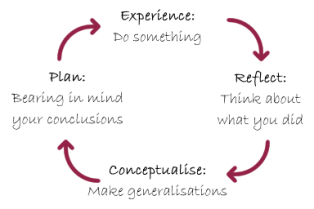
What I have described above is not simply the ramblings of a disgruntled and disenfranchised supporter of the in campaign but goes some way towards illustrating the process of reflection, one of the most important components of learning and a key technique in developing a deeper understanding.  It was David A Kolb who in 1984 put forward the argument that we learn from reflecting on our experiences.

KolbModelStep one in Kolb’s learning cycle is to have the experience. Step two, reflect, think back on what we have experienced. Step three, conceptualise, generate a hypothesis about the meaning of the experience, what is it we have learned, and step four, test that the hypothesis is supported by the experience, does it confirm that what we have learned is correct.



By three methods we may learn wisdom: First, by reflection, which is noblest; Second, by imitation, which is easiest; and third by experience, which is the bitterest. Confucius

Reflection – purposeful thought

Getting students to do this consciously is however difficult, in fairness I didn’t reflect consciously myself, it was part of a process in trying to understand why I was feeling the way I did. I felt angry but on one level didn’t know why, so I had to reflect on what had happened to find out.

The point being simply asking a student to complete say a reflection log, no matter how much you state the value of keeping one, will probably result in little more than blank pages. You need to have a reason to reflect, this might be to identify the cause of an emotion as was the case for me or to answer a question, which may be as simple as, “thinking back on the last essay you submitted, what have you learned?” it just needs to have a purpose. Of course the reflection log may still remain blank but that is more to do with motivation than the power of the exercise.

One simple technique to help with reflection is to think back on what has happened, identify the impact that it will have today on the present and what the implications will be for the future.

Lessons learned

So having passed through the stages of grief, rather too quickly I am sure some will say and reflected on the experience, what have I learned? Well, some has been confirmation of what I already knew. Firstly, that Politicians will make statements that they may or not believe at the time but will back away from after the event. This can be achieved whilst still retaining an internal level of integrity by pointing out that they never used those exact words, standing in front of a bus that has them blazoned across it, is not the same. Did anyone really believe that £350m would be spent on the health service or that Europe would not trade with us at all, after Brexit. Secondly that I like democracy as long as it comes up with the answer I want, but not when it doesn’t. Thirdly, the electorate does not make decisions using in-depth analysis and reflection but by deep held beliefs built up over time, often reinforced by the people closest to them. And lastly that the status quo is not sustainable and that happiness is a comparative process thus making change inevitable and with change comes risk.

Will it be for the better, only time will tell, we will have to wait for the historians to reflect on what the UK looked like in 2016 and whether it was better in 2026, as you can see reflection has many uses!

Let me leave you with my favourite quote of the campaign, not from one of the leading politicians involved, but Abraham Lincoln.

 “Elections belong to the people. It’s their decision. If they decide to turn their back on the fire and burn their behinds, then they will just have to sit on their blisters.”


Currywurst , apples and the £33,000 a year boarding school

currywurst

Currywurst fast becoming the most popular dish in Berlin

I have three relatively unrelated stories this month.

Berlin

The first follows a trip to Berlin this weekend and the obligatory city tour. Just of Unter den Linden you will find a sunken glass plate between the pavement that provides a view into a room full of empty bookshelves, sufficient to house the 20,000 books that were destroyed on this site on the 10th of May 1933. Some 70,000 people, many German university students gathered to burn books with “unGerman” ideas. Joseph Goebbels joined the students at the bonfire and declared: ” The future German man will not just be a man of books, but a man of character.” “It is to this end that we want to educate you.”

This was not only symbolic but practical. Without these books or to be precise only having the ones that remained, it might just be possible to create a nation of people who all think the same? Who all share the same ideals and live life by the same values. And yet of course this is not how you create an educated society, a society able to think for itself, the result will be compliance and idealism. Which was more likely what Goebbels had in mind.

Goodwill Hunting

When I got home one of my favourite movies had already started. Good Will Hunting tells the story of a maths genius, Will Hunting who struggles to come to terms with his past and as a result is unable to make a commitment for fear of being let down. But for me the best scene is where Will confronts a first year grad student who has been belittling his friend Chuckie.

Will: “Wood drastically underestimates the impact of social distinctions predicated upon wealth, especially inherited wealth…” You got that from Vickers. “Work in Essex County,” Page 98, right? Yeah I read that too. Were you gonna plagiarize the whole thing for us, you have any thoughts of your own on this matter? Or is that your thing, you come into a bar, you read some obscure passage and then you pretend, you pawn it off as your own, your own idea just to impress some girls? Embarrass my friend?

Will: See the sad thing about a guy like you, is in about 50 years you’re gonna start doin’ some thinkin’ on your own and you’re gonna come up with the fact that there are two certainties in life. One, don’t do that. And two, you dropped a hundred and fifty grand on a fxxxin’ education you coulda’ got for a dollar fifty in late charges at the Public Library.

Clark: Yeah, but I will have a degree, and you’ll be serving my kids fries at a drive-thru on our way to a skiing trip. Will: [smiles] Yeah, maybe. But at least I won’t be unoriginal.

This of course challenges the idea that knowledge is the same as thinking. Knowing something is not the same as having manipulated the information in your head, questioned and explored the arguments from many angles, the result should be an opinion, not someone else’s but your own.

Wellington college

And finally to bring my trilogy up to date. Only this week Wellington College who boast George Orwell and Sebastian Faulks as past students announced that have introduced a six-hour interview process to help teachers see beyond children’s over tutoring. They encourage families to spend more quality time instead of having their children tutored, Julian Thomas, Wellington’s head master, said: “When parents ask how should they prepare their children for our selection process, we tell them ‘have supper together and talk as a family; go to plays and good films and discuss them. Help them to think critically about the world around them; enjoy interesting conversations go out for walks and see the world”.

What Wellington are trying to do is encourage behaviours that will help children become thinking adults.

In conclusion

Knowledge like information is becoming increasingly accessible, unlike Germany in 1933 we have no restrictions, the internet has given us that power. But learning is more than knowledge you have to take the facts and make them your own, stitching them together carefully and thoughtfully, and that takes time and a considerable amount of effort. On the whole absorbing information will probably not come as easy to you as it did to Will Hunting, yet even with his genius he only knew what he had read. His learning had in fact only just begun as he went looking for the real life experiences that would test if he really understood anything at all.

Examinations are moving more towards tests that require you to think, asking that you provide an opinion or make recommendations given a set of circumstances, case studies are a good example. Of course you need knowledge as a foundation but the ability to sift quickly through the vast amount of information available may in time become more important than knowledge itself .

Ps apples is taken from Good Will Hunting – “How ya like those apples”


The tip of the iceberg – exam tipping is becoming obsolete

tip1

Assessment is changing, there was a time when all examinations were sat in a room, the answers would be hand written on a piece of paper and a retired English teacher would stand at the front reading out instructions as to what you could and couldn’t do in the next three hours.

Not any more…….you request a date that is convenient, turn up at the exam center, no longer is this a sports hall, it might be a driving school test center or the college you studied at. Then you log onto the PC and answer questions on the computer screen in front of you. The results may be immediate; it depends on if it is “human marked” or computer marked.

But in some ways these changes are only the tip of the iceberg!

What no past exam papers.

As examinations move into the digital world we are seeing other changes as well. There is a move towards objective testing, scaled scoring and examining bodies no longer providing past exam papers, what did you say, no past exam papers……!

This is partly down to the nature of the test i.e. you can’t provide an exact replica of a past exam question if it is an objective test. Remember objective test questions are randomly selected from a pool, and are different for each student. But there is also a shift towards some examining bodies only providing an example of the type of questions that could be set rather that a continuous flow of, the last exam papers.

If the test changes – how you study (and teach) has to change

Now for someone who has advocated that students analyse past exam questions in order to identify key areas so as to better direct their studies, this is a bit of a blow. It has also been the method I have used in the past to focus my own delivery in class and on line. Of course using past exam questions has always been much more than just spotting key areas, it is about focus, providing a place to start, showing content in the right context, helping with writing style etc.

There will still be past questions, sample questions will be provided. What we don’t know is how representative they will be of the examination. Or will it be as we have seen in the past with pilot and specimen papers, they change over time, drifting away from the original in terms of style and emphasis. Although I can see the logic in examining bodies not releasing papers, I hope they will continue to keep the sample papers fresh, in keeping with current thinking about the subject and how it will be examined.

What to do?

Students and tutors still need focus, there has to be emphases on key areas in order to chunk the content so that it can be more easily learned, it’s just that we won’t be able to use past questions or at least as much as we have in the past. That emphasis will now have to come from articles written by the examiners, examiner reports and syllabus weightings. If faced with a new subject where there is only one sample paper, it will be necessary to read the guidance from the body closely, noting reference to “this being a key part of the subject” or “one the examiner thought was answered badly in the past.” These together with the syllabus weightings and specific learning outcomes will have to be your guide. It is of course possible that the subject has not changed much from before and so some of the older past question can be used. As far as questions style is concerned then that will have to come from the questions and answers that are published, it may not be ideal but it’s the best we can do.

The overall impact of these changes is that students will have to know more, something that is hard to argue with. Students and tutors alike will have to devote far more time to the subject, which is fine if students have the time and can afford the extra costs involved in longer periods of study.

But it’s not all bad news, new technologies can help students make the most of dead time, studying on the train using their mobile phone for example. Also knowledge is more freely available than ever before as many top institutions provide a huge amount of free easy to access content online.

One final thought, examinations may change and they may not be fair but on the whole they are equal, everyone as before is in the same boat, and someone will always pass, wont they!

The future – Sitting the exam at home?

On line exams

An online student, all be it a mature one shows his ID to the online assessor

And maybe even the exam room will become obsolete. Proctur U is a US based company that also has a presence in the UK offering online invigilation. Watch this video to see how it works and judge for yourself


Video killed my teacher – metaphorically speaking

Video killed the radio star

What did you do the last time you needed to repair, cook or dare I say learn something? Did you google it and follow the link to YouTube? If so you are no different to the over one billion people who actively use YouTube every month.

This blog is not actually about YouTube but the medium of video and the increasingly important role it plays in our daily life and how we use it to learn.


Social learning and the bobo doll

Albert Bandura is the Professor Emeritus at Stanford University and is widely regarded as one of the greatest living psychologists. He is perhaps most famous for his Social learning theory, the theory of how people learn by observing others, and the bobo doll experiment. Click here to listen to Bandura himself explain.

Behavioral theories of learning suggested that all learning was the result of associations formed by conditioning, reinforcement, and even punishment, see Skinner and Pavlov. Bandura’s social learning theory proposed that learning can also occur simply by observing the actions of others. And that is where the true value of video lies, it is in the ability of people to watch what others do and learn from them.

What makes a good learning video?

Firstly, as with any form of delivery it needs to planned and structured. What is the purpose of the video, why use video and not send an email? Think about the audience, why will they want to watch it, what makes it relevant for them? Break it into three sections, a beginning, where you tell the audience what you are going to tell them, the middle, where you actually tell them, and the end where you tell them what you have told them.

Secondly It has to be relatively short, 10 minutes is a maximum. Even 6 minutes of good video takes a lot of planning, equally it wont test concentration levels too much. This does not mean you can’t record many hours of video, it just needs to be chunked, labeled and structured so it can be easily followed.

And lastly think about your delivery. Pace, tone of voice and body language all help the learner. This is where you manage the mood of your audience, if your happy they will be happy. Generally, speak more slowly than you would normally but be careful toooo slowww can be boring, vary how you say something depending on what you’re saying. Also think about the visuals and if it would be better to show an image rather than talk. But don’t go mad and put too much on screen all at the same time, it gets confusing.

Examples of good video 

But of course the best way to explain the power of video in learning is to show the videos.

1.The queen of cooking Delia is also the expert of slow deliberate, perfectly planned presenting. Here she explains how to cook an omelet, notice the attention to detail.  Ps Delia left school at 16 without a single GCE O-level. 3.43 minutes in length.

2.Here is someone who breaks the presenting rules, certainly the one that says don’t talk too fast. However, CGP Grey is great at using visuals, his dialogue is fast but incredibly informative, its packed with information, and it’s funny. If you are confused by the US elections, you won’t be after watching this.  5.19 minutes in length.

3.Crash course is a little like Khan academy which I have written before, what makes it different is the humour and how it is shot to camera using powerful visuals. Watch this clip if you want to learn about supply and demand. This pushes the boundaries time wise at 10.21 minutes.

4.This is the big one certainly as far as hits are concerned. James Stevens, Vsauceis watched by 19 million people. This one answers the questions as to, what would happen if everyone jumped at once? 7.12 minutes in length.

Why cramming works and making stuff up is okay

Will making stuff up

Will making stuff up

To a certain extent I have spent much of my career making things up. When I was a student that was not the case, I listened and learned and so when I spoke, I spoke with confidence that what I was saying was correct, because someone had just told me it was. Yet knowing is only the start, and in some ways a poor relative of the “figuring it out for yourself” technique.  I am reminded of quote from the film Good Will Hunting, which along with Dead Poets capture some really magical moments in learning.

Will Hunting – “See, the sad thing about a guy like you is in 50 years you’re gonna start doing some thinkin on your own and you’re gonna come up with the fact that there are two certainties in life.” “One, don’t do that.” “And Two, you dropped a hundred and fifty grand on a f***in education you coulda got for a dollah fifty in late charges at the public library.”

 Question practice – the secret to exam success

Having had no real formal educational training I have been exploring ideas as to why some techniques work and others don’t, why it is that student A passes yet student B who did exactly the same, failed. One clear observation from over twenty years in the high stakes exam world is that the most important activity that a student can engage in is, question practice. As a lecturer I would make statements, explain them using real world examples, get students to laugh, and maybe even enjoy the subject. But, the very best learning seemed to happen when the student was required to do a question. So it was with great interest that I read of some research that came out of the US in 2011, it’s called Retrieval Practice.

 Retrieval practice – the power of cramming

Retrieval practice is simply the process of retrieving something from memory.  So for example if I asked you, who was the Prime Minister that took us into the European Economic Community in 1973, you might say, on reflection Edward Heath. You already knew the answer but were forced to recall it. If however you were not sure who it was and were subsequently told (given feedback) it was Edward Heath and that Harold Wilson in 1975 held the first referendum, you are likely to remember both. But the most interesting and perhaps surprising aspect of this research is that not only can you recall the facts, it also leads to a deeper learning in so much that you can answer questions on related information. This in some ways gives credence to the idea that cramming information, maybe not at the last minute could be beneficial, not simply because you will remember it for a few hours’ but that it will lead to deeper learning.

Mark McDaniel is a psychology professor at Washington University in St. Louis

“We think of tests as a kind of dipstick that we insert into a student’s head, an indicator that tells us how high the level of knowledge has risen in there when in fact, every time a student calls up knowledge from memory, that memory changes.” “Its mental representation becomes stronger, more stable and more accessible.”

Jeffrey Karpicke, a professor of cognitive psychology at Purdue University

“Retrieving is the principal way learning happens.” “Recalling information we’ve already stored in memory is a more powerful learning event than storing that information in the first place,” he says. “Retrieval is ultimately the process that makes new memories stick.” “Not only does retrieval practice help students remember the specific information they retrieved, it also improves retention for related information that was not directly tested.”

Final thoughts

And so I am pleased to say that what I have observed in the classroom, that question practice improves exam results might be a little simplistic and that not only does it help students pass exams they might actually have been learning something at the same time 🙂

If you want to read more follow these links

To Really Learn, Quit Studying and Take a Test (New York Times)

Researchers Find That Frequent Tests Can Boost Learning (Scientific American)