There is a lot written today about the power of storytelling and how it can help persuade, influence and of course educate. Stories come in many shapes and sizes, sometimes they are true, but might be embellished, sometimes they are not true but include powerful messages hidden in the form of metaphor or allegory.
The simplest definition of a story is that “one thing happens in consequence of another,” and it can engage, motivate and inspire. But cognitively the brain is working very hard forming connections, asking questions, creating images and helping offer up opinion.
“If you want your children to be smart, tell them stories. If you want them to be brilliant, tell them more stories.” Albert Einstein.
Below is an allegory, arguably one of the most important in the whole of western philosophy, but its message for educators and students is sometimes lost. It’s called Plato’s cave, read it carefully, thinking about what it might mean.
Plato’s cave
 Although Plato is the author, it is Socrates who is the narrator talking to Plato’s elder brother Glaucon.
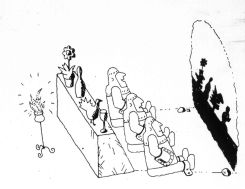
The story told is of a group of people who from birth have been chained up in a cave with their heads fixed in one direction so they can only look forward. They face a cave wall on which they can see moving images, shadows that they believe to be reality. Socrates’s explains that when the prisoners, because that is what they are, talk to each other they discuss the shadows as if they were real. But they are an illusion, created by shadows of objects and figures played out in front of a fire, manipulated by the puppeteers.
Socrates goes on to say that one of the prisoners breaks free of his chains and is forced to turn around and look at the fire, the light hurts the prisoner’s eyes but as they adjust, he can see the fire and the puppets he had believed to be real. He doesn’t want to go any further fearing what it might bring but once more is forced to go towards the mouth of the cave and into the blazing sunlight.
At first, he can only look at the reflections because as with the firelight the sun is too bright but as his eyes adjust once more, he finally looks at the sun, only then “is he able to reason about it” and think what it could mean. His thoughts are interrupted by the sorrow he feels for his fellow prisoners who have not seen what he has, have not learned the truth. So, he goes back into the cave to tell them everything. But when the prisoners look at him, they see a man stumbling, strained, no longer able to see in the dark cave. But worse when he begins to explain they think him dangerous because what he tells them is so different to what they know.
The prisoners do not want to be free, the effort is too great, the pain and apparent disability sufficient to stop them trying. They are content in their own world of ignorance and will fight anyone who wants to change that.
But what does that mean?
The answer of which should be, well what do you think it means? But sometimes you just don’t have time for that answer so here is one interpretation, it’s worth pointing out there are many.
- The puppeteers are those in power or authority. They prefer it if people don’t ask questions, remain content and are not causing trouble.
- The fire is knowledge and wisdom.
- The prisoners are society.
- The escaped prisoner is the student. The student who through education escapes and finds answers.
- The person that frees the student and drags him towards the light is the teacher.
If we put this all together, it gives us an insight into learning that has remained unchanged since Plato wrote the Republic in which this story sits in 514a–520a.
Learning is not easy, it can be difficult and hard work. Some people are happy to remain as they are, ignorant, after all it’s not pleasant having your beliefs challenged and finding out that what you thought was true in fact isn’t. Teachers can help take you towards knowledge and learning but you need to want it for yourself, and once you have knowledge you can’t go back to what you were before, education will have changed you forever.
To find out more about the power of stories watch this video – The rules to telling a story by the Filmmaker Andrew Stanton (“Toy Story,” “WALL-E”)
Plato’s cave at the movies
The Matrix and Plato’s Cave – Neo meets Morpheus and explains he is a slave
The Truman Show – Truman shows bravery by going towards the light

 A major new idea was presented to the world in 1991, to many it will mean very little but in terms of improving our understanding of the brain it was a milestone.
 The title of this month’s blog is not mine but taken from what many would consider a classic book about what can realistically be achieved by someone stood at the front of a classroom or lecture theatre, simply talking. Written some 25 years ago but updated recently Donald A. Bligh’s book takes 346 pages to answer the question,
 Intellectual humility as defined by the authors of a recent paper entitled,
  A point of view is a programme on radio 4 that allows certain well-read, highly educated individuals, usually with large vocabularies to express an opinion. It lasts 10 minutes and is often thought provoking, concluding with a rhetorical question that has no answer.
 Donald John Trump was born on June 14, 1946, in Queens, New York, the fourth of five children of Frederick C. and Mary MacLeod Trump. Frederick Trump was of German descent, a builder and real estate developer, who left an estimated $250-$300m. His Mother was from the Scottish Isle of Lewis. Trumps early years were spent at Kew-Forest School in Forest Hills, a fee-paying school in Queens. From there aged 13 he went to the New York Military Academy, leaving in 1964. Fordham University was his next stop but for only two years before moving to the Wharton School of Finance at the University of Pennsylvania, from which he graduated in 1968 with a degree in economics. After leaving Wharton Trump went onto to focus full time on the family businesses, he is now said to be worth $3.7bn.
 Hillary Rodham Clinton was born October 26, 1947, Chicago, Illinois. She was the eldest child of Hugh and Dorothy Rodham. Her father, a loyal Republican, owned a textile business which provided a “comfortable income”. Hillary’s mother who met Hugh Rodham whilst working as a company clerk/typist did not have a college education unlike her father. However Dorothy Rodham is said to have had a significant impact on Hillary and believed that gender should not be a barrier.
 Clinton, they married in 1975. She graduated with a JD in Law and had a paper published in the Harvard review, under the title “Children Under the Law”.
 This month’s blog is coming from Malaysia, I have been presenting at the ICAEW learning conference in KL. The only relevance of this, is that as with any lecture/presentation or lesson you have to put yourself in the shoes of your audience and ask, what do they want to get out of this, why are they giving up their valuable time and in many instances money to listen to what you have to say?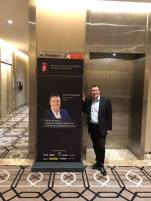








 Pedleysmiths Blog