
The Price is right? – Value for Money Education

The Price is RightThe idea behind the price is right was that you had to guess the price of an everyday object. Not a complicated game I admit but by game show standards a successful one, it ran from 1984 to 2007. But how do you know if something is the right price? What does “right price” even mean?


Easier in a market where there are many similar products all providing a similar service or experience, not so easy when assessing the value is subjective, comparability difficult  and getting it wrong  expensive. This is exactly the situation you might find when trying to choose a course provider, a college or university. How do you know if you’re getting value for money, if one provider is more expensive than another is it extra profit, inefficiency or a measure of quality and so value?

What do you want?

The first question to ask is, what do you want from the course provider and how will you measure success? On the face of it the answer may seem obvious – it’s to pass the exam or get as high a grade as possible. But learning is about so much more than the exam result, isn’t it?

What about the skills you develop and the knowledge you acquire, what about the people you will meet and the inspiration, motivation and direction you will receive? These are difficult to measure and are often ignored yet in the long run are probably far more valuable than the passing of an exam.  Also would you be happy with knowing just enough to pass and then afterwards forgetting everything, is that what you pay for, is that value for money?

A high quality provider will teach content and explain concepts so that you not only retain knowledge but develop a deeper understanding of the subject matter.

So it’s all about passing?

You may want to pass but what method of study will give you the best chance of passing? How much contact time do you The price of everythingexpect? Are you sufficiently self motivated that you need little or no help, do you want the convenience of studying online or the discipline of having to go to lectures? You may be aware of the method you prefer but many students aren’t. The better provider will know enough about you as an individual, and if they don’t they will ask before making any recommendations as to what method of study is best.

Risk and cost of failure

How important to you is passing, or passing as soon as possible? It could be a false economy to go with the provider who suggests the course can be covered in 10 weeks at a cost of £1,000 when another suggests 15 weeks at £1,500. The longer course with the higher price could well be good value for money if you pass first time. Equally when the stakes are high you don’t want to make a mistake,  consider something like eye surgery, would you go to the cheapest provider where the risk of getting it wrong could be life changing.  Of course expensive does not always mean value for money. You will need to do some homework first. Below is some advice as to what to look for when choosing a provider before you part with any money.

What to look for in a course provider

Fundamentally it’s about trust and confidence in the provider. Education is not a commodity, it’s not homogenous, it’s personal and too important to get wrong

Here are a few things to look out for and questions to ask.

  • Experience and quality of the Teachers/Lecturers – having a stable and experienced lecture team is an indication of quality. Ask how the college ensures their staff are up to date, do they have a formal training scheme? What research credentials do they have?
  • Long term player – How long has the organisation been in existence, ask them what their long term strategy is for learning or at least what they think the future might hold.
  • Where do they rank in league tables – maybe they have industry awards or accreditation by external bodies.
  • Investment in the future and level of innovation – what do the premises look like, are they well maintained? What technologies have they introduced recently?
  • What are the range of different study options (length of course/F2F contact time etc) and levels of personalisation – for you to have the best course the provider should be able to offer some degree of personalised learning.
  • Ask if you can try before you buy – What have you got to lose they can only say no. Oh and ask them how easy it is to transfer to other courses and get your money back if you’re not happy.
  • And finally one of the most useful ways in making any decision is to ask friends/colleagues what they think or experiences have been, and don’t forget to check them out on the social media sites.

Conclusion

There is a lot more to this debate and the topic is certainly worthy of another blog. Value for money is a big question in education. I have not for example even mentioned the cost of education in the context of employability and student debt. Nor which subjects have the highest employability statistics etc.

The purpose of this blog was to highlight the complexity of choosing a provider and to give some advice as to what to look for.

In summary, clarify exactly what you want from your course provider before you start looking, ask some of the questions above and dependant on the answers you get make your decision. And if all goes to plan you will you end up with the right provider, at the right price and so great value for money.

PS Happy New Year everyone – I think as far as learning and exams are concerned 2015 is going to be as interesting and as uncertain as 2014. I am looking forward to it.


And the cow said – MOOOOCS

MOOOOCIn October I decided I would find out first hand exactly what it was like to study online so I joined a MOOC. For those that don’t know what these are, a Massive Open Online Course is a free or at least normally free online course that has the capacity to have thousands of students in the same virtual classroom.

In fact only last month the British Council launched its first MOOC on English language attracting over 100,000 students. In essence a MOOC provides “education” at scale, accessible globally for free, and what could be wrong with that? Well in essence nothing, having a well educated society not only helps with social mobility but as has been well documented adds significant economic value.

Problems with MOOCS

But as you can imagine not everyone is happy, most of the concerns centre around quality.

If MOOCS are so good why is it that despite the large numbers of students enrolling there are very few, around 8% who actually complete the course.

Is this the result of poor instructional design, the fact that some MOOCS have very little student/ teacher engagement and are simply a series of videos linked together with reference to materials available elsewhere on the web. Is it because no one person is accountable for the students, there is no “teacher” to motivate the student if they fall behind. And due to the scale, feedback has to be automated or assessed by peers who are clearly not experts.

Well it might be all of the above and the course completion rate is clearly of concern yet some would argue that having a less teacher centric course is exactly what you need for students to develop a much deeper understanding. This is something *George Siemem’s argues.

Making sense of the chaos is what learning is all about, if teachers plot the route it reduces the value of what is being or could be learned.”

 “The great thing about MOOCS is that the learning does not end when the course ends, because the students have built their own communities, the learning becomes life long.”

M+O+O+C+S

People talk about MOOCs in so many different ways, in fact the name itself can be confusing when trying to understand exactly what a MOOC is.

  • Massive – A MOOC works on a platform that enables thousands of students to see and hear the same thing at the same time. The technology behind this is impressive and using one tutor to deliver the course enables the most to be made of the expertise.
  • Open – its open to anyone, there are no prior learning requirements. It is also open in the context of being free, and the learning not being restricted to the views of one person, the community are also teachers.
  • Online – it is online but is not what some would class as an online course. An online course unlike a MOOC would be instructionally designed to ensure the learning is consistent with the learning outcomes and incorporates the latest developments from the field of learning science.
  • Course – It has a cohort, a subject matter and a beginning, middle and end. But as outlined above, at its simplest it could be little more than linked video with no overall instruction and some would argue this is not a course.

A MOOC on one level is the next generation text book

Listen to Anant Agarwas on TED 

Providers

It is important to say that as MOOCs are so new, the first ones established around 2011, it is hard to pin them down as they are constantly changing. But if you are interested here is a note of the key providers.

  • Future Learn – owned by Britain’s Open University Offers MOOCs from many UK Universities. The newest of the MOOCs with approximately 750,000 plus users.
  • Coursera has around 10 million users and is by far the biggest, a for-profit founded by two Stanford University Professors.
  • edX  have around 3 million users, a not for profit MOOC founded by MIT and Harvard University.
  • Udacity have around 1.6 million users.  A for -profit backed by Sebastian Thun (co founder) and two Venture capitalist. It is currently repositioning its offering to be more vocational, targeted at professionals. Listen to Peter Norvig early observations in 2012 on TED. Peter taught one of the first classes with Sebastian Thun on artificial intelligence with over 100,000 online.

My MOOC – conclusions

edX

My edX course with MIT

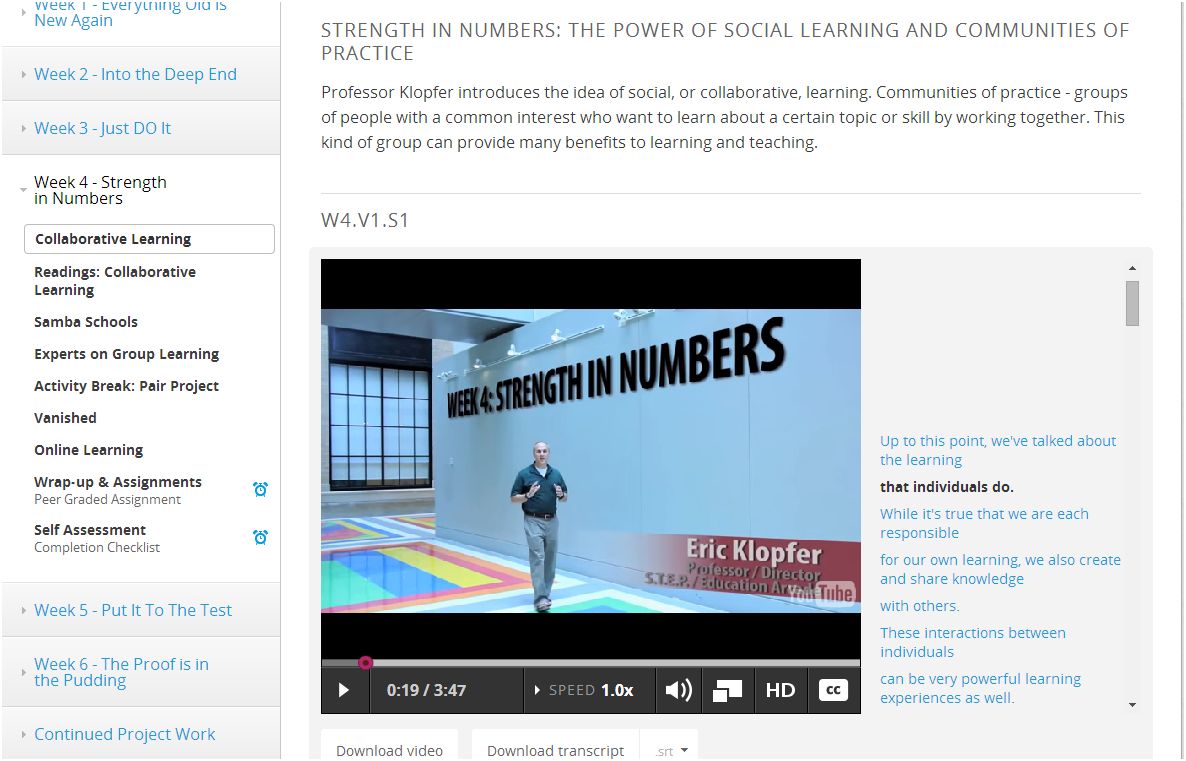
The course I chose was with one of the leading provider’s edX and is called Design and Development of Educational Technology. Okay not for everyone but so far I have found it very impressive.

The course was delivered over 6 weeks. It consisted of video lectures with a designated tutor Professor Eric Kloper introducing many of them himself.

There were links to further reading and sessions requiring a hands on approach, in some instances “playing” with software to find out how it works. In addition there were tasks and projects to complete, all recognised by the awarding of a certificate at the end. And yes it was free. Like my students however I have already fallen behind, but I do plan to complete the programme as so far I have found it both engaging and rewarding.

But what of the future – What we can say is that some MOOCS have responded to the criticisms and are now delivering first class courses to thousands of students, online and for free. But MOOCS are still evolving; blending MOOCs with traditional face to face courses is gaining in popularity for example.

There is however still the big question as to how they are funded, and for me this is about quality. Anyone can put information that is already freely available online in a thoughtless way and leave it for the students to curate. But a well thought through MOOC takes considerable time and skill to design and deliver. This is of course no different to an online or classroom course. A good course needs good people and they cost money. But I see no reason why MOOCs can’t charge, I would gladly have paid for mine. The cost would be low given the volumes, say £1 – £500 but the reach would still be global. And the monies would enable the providers to continually invest in order to deliver the best courses possible.

Bill Gates talks about MOOCS well worth watching, its only 4 minutes “the information has been in the textbook for hundreds of years….online does not enhance knowledge…” 

Ps I promise no more animal pictures next month.

*Author of Connectivism: A Learning Theory for the Digital Age


Are exams fit for purpose (part two) – what are the alternatives?

You dont fatten pigs 2

Last month’s blog came to the conclusion that examinations* are fit for purpose or at least “a purpose.”

They provide the student with a clear objective to which they can direct their efforts and focus attention and are a transferable measure of competency that can be assessed at scale. The “at scale” point is important as there are many ways of assessing competence but few that can cope with the need to test thousands of students all at the same time.

The main problem with examinations is that they don’t always examine what is most valued; the method of assessment often has significant limitations as to what it actually tests and the results are presented in league tables that give a far too simplistic view of success.

I am not sure we can resolve all of these but it might be worth exploring other options, specifically alternative methods of assessment. For example If you change the method of assessment from a formal, often timed written exam to say a portfolio of work, not only do you change the method of assessment but you will change what is being examined, two birds with one stone perhaps.

Different methods of assessing competence

Open book exams

Open book assessment offers a way of testing application rather than memory. Students have access to a text book that contains information relevant to what they are being asked. It’s the use of knowledge that is important, not the knowledge itself. The idea of open book could easily be adapted, why not allow students access to the internet during the exam, they could look up anything they wanted. Is this not more representative of what happens in the real world?

Take out exams

Similar to the above the so called “take out exam” allows the student to take the exam away to work on at home using whatever resources they prefer, books, internet etc. They return the next day with a completed answer. This can work better than you might at first think so long as you have a robust mechanism to detect plagiarism. There are several very good software packages that can spot the most sophisticated types of copying.

Case studies/simulations

A case study provides an environment for the student to demonstrate they can use their knowledge to solve problems and or offer advice in a virtual world. Most case studies tend to be written but this is one area that we could see some clever and affordable use of technology to better simulate the real world.

Performance tests

In a performance test students are required to demonstrate a skill/process, create a product etc while being observed by the assessor who will evaluate the performance. A great example of testing ability to apply knowledge but suffers from the subjectivity of the assessor and has limited application at scale.

Portfolios

Portfolios are most often collections of the student’s work that demonstrate their ability to perform a specific task. These can be simulations of the real world or portfolios of work actually undertaken on the job. A portfolio can include written documents, emails, audio or video recordings, in fact anything that provides evidence as required by the assessor.   Portfolios are perfect for assessing application but the process of assessment is expensive and not without bias.

Viva Vocal – (living voice) Oral exam

Often used to test PhD students, an oral exam gives the assessor chance to question the student. This is a very effective method where you are looking for higher level skill and depth of understanding. As identified last month it’s probably one of the oldest forms of assessment.

Digital badges – capturing the learning path

Being awarded a badge as recognition of achievement is something many will be familiar with especially if you were a boy scout or girl guide. But digital badging is new and becoming increasingly popular because of the internet. A good example would be linkedin and the badges awarded to you by others as recognition of certain skills.  Many of the assessment methods above provide a first past the post type of assessment, you pass and that’s it. Digital badging on the other hand is a form of lifelong assessment that evolves along with your career.

Digital badging for me is one of the most exiting forms of assessment and I am not alone Nasa have been using digital badging since 2011. Read more about digital badging.

Assessment in the future

Scanning for competenceThe list above is far from comprehensive and many other equally valid types of assessment exist e.g.  Role plays, Slide presentations, Assignments etc but what might assessment look like 15 years from now. Well how about using MRI scans to identify which parts of the brain are being used?  Not sure it will catch on but it would provide some interesting evidence as to how the student is getting to the answer, simple memory or a genuine and deep understanding .

*Examinations defined as a written test administered to assess someone’s level of understanding, knowledge or skills

Are exams fit for purpose? (part one)

take-the-same-testI have written in the past about what passing an exam proves but have never questioned if exams achieve what they were originally designed to do, are they fit for purpose?

Firstly let me define what I mean by an exam. A written test administered to assess someone’s level of understanding, knowledge or skill that results in a qualification if successful. This is in contrast to a test which is a method of assessing someone’s level of understanding, knowledge or skill often as part of a course in order to provide feedback. A test does not have to be written. Although exams don’t have to be written either, many are and initially at least I would like to keep the definition as narrow as possible.

In order to answer the question, are exams fit for purpose we must first take a step back and look at how we got to where we are now.


A brief history of examinations

The first standardised test is believed to have been introduced by the Chinese in 606 AD to help select candidates for specific governmental positions. However most examinations around this time would have been oral, requiring the candidate to recite a dissertation or answer questions. Although there is evidence of written exams being used as early as 1560*, it was not until the 1820’s that many Universities began to adopt the practice. From 1850 onwards the written exam became the norm in most UK Universities. In 1854 under the Gladstone government selection of Civil servants was based on their ability to pass an exam, this time however it was written.

Bureaucracy – In 1917 to help bring some order to what had been described as chaotic the Certificate and the Higher School Certificate were introduced. Then in 1951 we had the General Certificate of Education (GCE) examinations, more commonly known as Ordinary ‘O’ level and Advanced ‘A’ level , these were normally taken at 16 and 18.

In the 1960’s the CSE (Certificate of Secondary Education) was born, opening up qualifications for all, not just those that went to Grammar school. However this two tier system was thought divisive and so in 1988 under the guidance of the then Education Secretary Sir Keith Joseph both sets of examinations were replaced by the GCSE. The GCSE was graded and contained credit for course work.  In 1991 the General National Vocational Qualifications, (GNVQS) were established intended to incorporate both academic and vocational elements, by 1995 these were accepted as ‘equivalent’ to GCSE.

In 2014 we find change again, gone is the course work and written examinations once again become the main method of assessment, although there will be grading, 1 to 9 with 9 being the higher mark. The exams will still be called GCSE’s, although officially they are known as GCSE (England). This is to avoid confusion with Wales and Northern Ireland, who are not changing.

Yes they are

Historically at least it would appear the purpose of the exam was to provide a recognised and transferable measure of competency in a given subject or discipline. The lack of transparency and consistency of the oral exam resulted in them being replaced with written ones and a more formal bureaucratic structure was developed to administer the process.

And in many ways there is very little wrong with this.

The problem is not with the exam itself, but with what is being examined. If as a society we value “thinking and creativity” for example, then should we not be examining these rather than subjects that require the candidate to do little more than rote learn facts.  Perhaps we should explore different methods of assessment, the written exam has its uses but hand written papers are looking increasingly outdated in a world that communicates electronically not only in short texts and tweets but with video and photos . In addition the way exam results are used in league tables to show winners and losers is divisive. It looks like a measure but has in fact become a target that schools and teachers must hit or be considered failures.

Please watch this it’s very funny…..and thought provoking

Not on the test


In the second blog about exams I want to look more closely at some of these points, in particular what other ways we can assess what people know.

*Assessment around this time was through debate between a number of learned people all at the same time and lasting for two hours or more.

Big fish – little pond

Best be a Big fish in a Small pond

It’s taken me a little time to get round to reading the latest Malcolm Gladwell (MG) book, David and Goliath, underdogs, misfits and the art of battling giants. Although consisting of three separate sections they all examine the idea of what it means to have an advantage and how we account for the success of the underdog.

Of all the ideas MG lays before the reader, the one I felt was of most interest is something called the big fish little pond effect (BFLPE) and the theory of relative deprivation.

Relative deprivation theory (RDT)

Relative deprivation refers to the discontent people feel when they compare their positions to others and realise they have less. e.g. I judge BMW ownermyself to be successful on the basis I have a brand new car that cost £15,000.  That is until my neighbour pulls on the drive with a brand new BMW costing £30,000, now how successful do I feel?

MG applies this theory to the world of academia. If you take Harvard’s Economics PhD programme and consider the number of times each PhD graduate was published in the last 6 years, Harvard’s top students will do this 4.31 times. Those that are about 5th or 6th in the class publish .71 times and those that are about average .07 times. If however you compare these results to a “mediocre” school, say the University of Toronto, where MG went,  the top students will publish 3.13 times, those that are 5th or 6th .29 times and those that are average .05 times. The point being that students who attend a much lesser university but where they are top of their group perform considerably better than the 5/6th best at Harvard. The question is why?

The smarter your peer group the dumber you feel…..

This is where RDT comes in, we tend to judge our ability by comparing with others, and if you are in a class with very smart people who always do better than you, your perception of your own ability will be effected. The second problem is that this self perception will have a significant impact on your behaviour and ultimately what you achieve, hence the results above. The implication, you will achieve more if you are in a class with others of equal or less ability than yourself.

Bottom line, your performance will improve if you are a big fish in a small pond. It’s even called, the big fish little pond effect (BFLPE)

But what to do?

Admittedly you can’t always pick and choose your peer group, but you can be aware that comparing yourself with the very best may be having a detrimental impact on your own performance, so stop doing it! Instead be inspired by the best but compare your performance with those that are the same as you. Better still compare your current performance with what YOU have achieved in the past and if you are doing better you must be improving…..

David-and-Goliath-Malcolm-Gladwell


Listen to MG talking about relative deprivation theory or if you prefer the Big Fish little pond theory….


Listen to MG being interviewed about the book

Sleep is for wimps – oh and successful students

Get some sleepAlthough I am sure someone is preparing for an exam this very minute, July/August are the traditional months to take a holiday and get some well earned rest. A holiday can be exactly what you need especially if you have just come to the end of a long period of study followed by in some instances, weeks of exams.

I have to express a personal bias in so much that I believe holidays are essential if you are to be at your best. For me this years holiday has to provide some degree of relaxation after what has been a particularly busy 6 months. I am looking forward to a change of scene, meeting different people and the freedom to wake naturally, feeling rested after a good nights sleep. Holidays are of course very personal and for some an adventure holiday, travelling to new places every day, might be far more desirable.

But one thing that all holidays should provide is the ability to relax and catch up on sleep, even if that means you climb two mountains, swim for three hours before crashing out in a state of satisfied exhaustion on the evening.

Sleep is essential for learning 

Of course sleep is something you should do “properly” every day, it’s just that we don’t. Modern life steals that vital rest time, this is acutely the case when trying to balance both work and study. Studying is often undertaken on an evening and sometimes late into the night as you effectively try to do, too much in too little time.   We now sleep less than we did 50 years ago, it used to be around 8.5 hours, it’s now only 6.5. The sleep should also be of high quality, yet our sleep is interrupted by the lights of mobile phones, and sounds made when texts arrive late into the night. In order to sleep better it is a good idea to avoid light approximately 30 minutes before going to sleep, yet how many read in bed from iPads or equivalent with the bright light emitted from the screen telling your brain to stay awake.

Why sleep is important

We have known that sleep has been important for many years but we didn’t know why, cognitive scientists now have some of the answers. There are three views as to why sleep is beneficial:

One restoration – some of our genes only turn on when we sleep, their role being to make essential repairs.

Two conservation – we sleep to conserve energy, and

Three consolidation – our brain revisit events and experiences, and begins to make sense of them, moving data into long term memory and solving complex problems.

Susanne Diekelmann at the University of Tubingen in Germany says “sleep helps stabilise the memories and integrate them into a network of long-term memory, it also helps us to generalise what we’ve learnt, giving us the flexibility to apply the skills to new situations. So although you can’t soak up new material, you might instead be able to cement the facts or skills learned throughout the day.”  Bodies need rest – the brain needs sleep Sometimes you may find yourself having to push sleep to one side and in specific situations thats fine.

It’s when lack of sleep becomes the norm that problems arise, the result is greater stress, poor judgement and ineffective learning.   So now the exams are over, take a break, get some quality sleep and try and make a few simple adjustments in you life so that sleep takes more of a priority.

It is a common experience that a problem difficult at night is resolved in the morning after the committee of sleep has worked on it.

John Steinbeck  

Music to help you sleep and two video to watch but not just before you go to sleep

TED neuroscientist Russell foster  explains more about why we sleep  

Arianna Huffington talks about the importance of sleep

Teaching to the test – Interesting research but the fat lady is still in good voice

Fat lady still singingThis week researchers from the University of East Anglia released some very interesting findings that resulted from testing 594 bio-science students in their first week of term at five universities.

The students selected would be considered by many more than competent in their subject, almost all had a grade A*, A or B in biology at A-level. Yet when they were given 50 minutes to answer 38 multiple choice questions on cells, genetics, biochemistry and physiology from their A level core syllabus, they only got 40% correct. The period of time between the students sitting their A levels and the test was three months.

Lead researcher for the study, Dr Harriet Jones, said: “What our research shows is that students are arriving at university with fantastic A-level grades, but having forgotten much of what they actually learned for their exams.”  She went on to say that the trend to teach to the test, to ensure good results for schools’ reputations, was the problem.

The schools are to blame then

The facts of the research are clear, students who had successfully passed a test, were unable to pass a similar test three months later. The conclusion reached is that the students did not understand (see my blog on understanding) their subject well enough and passed their A levels probably using little more than memory. And who is to blame, the schools of course, for teaching to the test. Why the school do this is worthy of further debate, but government pressure and the impact of league tables will certainly be in the mix.

But do employers not accuse Universities of delivering up similar ill prepared students. The test is different but from the employers perspective the result is the same. A University student who professes to know something but when tested “in the real world” doesn’t.

Does this mean that Universities are also teaching to the test!

It’s about the test etc

The problem is not in teaching to the test; the problem is with the test, the pass mark and possibly the marking. If the test was more Testing but for what!aligned to what the student needs to know/do at a fundamental level, the pass mark sufficiently high and the marker having some degree of autonomy to form judgements, then the results would probably be different. It could of course be that the exams are easier – Exam chief: ‘you don’t have to teach a lot’ for our tests.

The big criticism of teaching to the test is, it results in a narrowness of understanding, little in the way of depth and does not push students to think in abstract and creative ways. But if the test, which incidentally does not have to be in the exam hall or on paper/PC was able to “test” for these qualities then teaching towards it would perhaps be more acceptable.

Bottom line

Teaching to the test is unlikely to change, in fact given the popularity of league tables  in education just now it may well increase, but with more effective testing the results might be better students, happy Universities and even happier employers.


Twas the night before ………..the exam – but what to do?

keep-calm-and-study-all-night-5 Well not exactly all night

For students May and June are the main exam months. Studying and learning can be enjoyable…. honestly, but the fun has to come to an end and it does, with the exam. It cannot be avoided and so is best embraced, treat the exam as a game and you the player. What you need to do is give yourself the very best chance of winning.

Become a professional exam taker, someone who follows a process of preparation, very much like a top sportsperson. This means you personally need to be in the best physical and mental shape and have a series of exercises that will get you match fit.

Below is your training regime from the night before the exam – good luck

The night before

You should by now have:

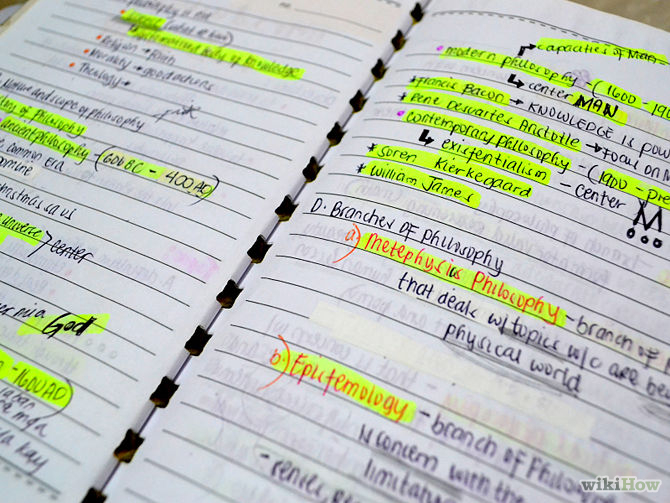
  • Read through and reduce your class/tuition notes down to approximately 10 pages (20 max) of revision notes, see March Blog on how to prepare notes. You may have some professionally produced revision notes, but it is still best to make your own.
  • Practiced past questions on the key examinable areas both under exam and non exam conditions.
  • Started the process of memorising the revision notes.

Be realistic – The key to the night before the exam is to be realistic. You don’t have much time, so don’t think you can cover everything. Let’s assume you have 3/4 hours, 6.00pm – 10.00pm maybe.

Put to one side the large folder that contains all your notes taken throughout the term/year, and concentrate only on the 10-20 page revision notes.

Focus and memorise – In the 3/4 hours that you have you want to get an overview of the subject and focus on the areas that need memorising. These should be the key examinable areas and are most likely to be standard formats, definitions, lists, formulas s not given in the exam etc.  Memorising should include some rewriting of notes, but very little, focus on talking out loud, drawing pictures, writing out mnemonics etc. See my blogs on memory, in particular: Thanks for the memories  and To pass an exam do and exam.

Admin – make sure you have set to one side everything you will need the next day. This includes your exam entry documents, calculator, gum, mints etc. You don’t want to be thinking of these in the morning. And of course make sure you know exactly what time you need to leave to get to the exam with about 1 hour to spare.

Physical and mental preparation – Drink lots of water, avoid tea, coffee etc as you will need to get a good night’s sleep. Exercise is an incredibly effective method of reducing tension and stress. So you may want to build into your 4 hours, 30 minutes for a run or brisk walk. This could be at the half way point of your evening, combining a well earned break with the exercise maximises your time.

Getting sleep is important, so avoid reading your notes and then going straight to sleep. Pack you notes away, put them ready for the morning, then physically go into another room if possible or even outside, watch TV for 10 minutes, something trivial or read a book. You need to break the state of mind from that of studying, relaxation leads to sleep not stress.

And finally keep a positive attitude, think about what you know and are good at and not what you don’t know and are bad at. Keep telling yourself that you have done everything possible, and if you follow these steps you will have. Thinking you know nothing and should have done more will not help at this stage, it’s a pointless thought strategy and not what the professional exam taker does.

The morning before

Set your alarm sufficiently early to give you at least another hour of revision. You don’t need to get out of bed, just continue memorising your notes. This is now about little and often, short 10 minute intervals. Don’t worry about falling to sleep in the exam; the adrenalin won’t let you.

1 hour before

What you do after arriving at the exam centre/School etc  is personal. Some will prefer to sit on their own going over the revision notes; don’t bother taking your folder of course notes. This is still very much about short term memory. Others will prefer to talk, chatting about nothing, just to stop them worrying. Both are fine.

After the examExam post it!

Afterwards is also a little personal, most will go home, but some will want to talk through what was in the exam, looking perhaps for some conformation they have not made a complete mess of it. Most importantly, if you have another exam, go home, put your old revision notes to one side, forget everything and start on your next subject.

The American basket ball player Art Williams had a good saying that I will leave you with. I’m not telling you it is going to be easy — I’m telling you it’s going to be worth it”

And although personally I found exams difficult I have never regretted the hard work, it was for me worth it.

And something to watch

How to: Cram the night before a test and PASS

Or you could try this

This blog is for Beth – good luck xx

Eureka – I Understand Understanding!

I Understand!If you understand the subject you are studying your chances of passing the exam must be good.

A simple and perhaps obvious statement but what does understand mean and what do you have to do to truly understand something? Of course understanding is a key part of passing but it is not enough on its own, you can understand something yet fail because you run out of time, misinterpret the question, thought you understood but didn’t! etc.

To understand

The dictionary defines to understand as, to know what someone or something means, to grasp the meaning, to be familiar with, make sense of etc. Understanding is clearly different to knowing, for example, you may know that gravity is a force that pulls objects to earth but that does not mean you understand what gravity is or how it works. Of course you need both knowledge and understanding, the one is no good without the other. Examiners try to test for understanding by asking questions that require you to compare, contrast, explain, interpret etc.

Understanding is not a Eureka moment, it has different levels. It might seem that there is a point where you didn’t understand and then suddenly you did, a Eureka moment. In reality what you have done is move closer to gaining a better and fuller understanding. Ask any lecturer or teacher, often they will tell you they never fully understood something until they had to teach it, they just thought they did.

Proving you understand – The 6 facets of understanding

Understanding by design, Wiggins and McTighe (1998) is one part of an instructional design process that provides a very helpful framework we can use to explore the depth of understanding and perhaps more importantly what you can do to develop a deeper understanding. Think of it as a hierarchy with the easiest one first, the greater you’re understanding the higher the number.

1. Explain, the classic exam question – Explain to someone what the concept/idea means and say why. Explaining out loud to yourself or making a recording can be just as effective.

2. Interpretation – Relate the concept/idea to your own experiences, tell a meaningful story. Try to add something personal into your explanation. To do this you will need to reflect on past events, whilst attempting to find parallels with the concept/idea.

3. Application – Use the concept/idea in a different context. The ability to apply knowledge in different contexts (transfer) is a key milestone in learning as well as understanding. It should result in you never being caught out by a difficult exam question. Understand to this level and it doesn’t matter what the examiner asks.

4. Perspective – Read around the concept/idea, get other people’s views, and see the big picture. If your struggling with understanding, read another text book or my favourite is to go onto you tube and watch a video. The internet is great for discovering alternative views.

5. Empathy – Try to get inside another person’s feelings about the concept/idea. This is difficult as it requires you to put aside your feelings about the concept/idea and accept that it is not the only way of thinking about it.

6. Self Knowledge – Ask questions about your understanding, ask what are the limits of your understanding, what are your prejudices, become aware of what you don’t understand. Often called metacognition, the ability to think about thinking.

The Eureka moment

Understanding, like Eureka moments are not of course the result of sitting in a bath and suddenly finding you understand something you had previously found confusing. It is the gift of hard work and long hours of study, hopefully by trying some of the techniques above your depth of understanding will only improve.

Ps apparently the jeweller was trying to cheat the king….

Understanding by Design

Want to know more about understanding by design, watch this. 


An illogical great idea – Tips for making study notes

Illogical my dear WatsonLogic is a process driven by reasoning. Here is a logical argument: Everything I need to know is in this book, if I read this book I will know everything.

And yet this is what most students do. Read the book, then begin the laborious and time consuming process of re writing some of it, which bits are chosen can at times be a little random.

On the face of it this, dare I say is illogical. If the book contains everything you need to know then why re write it, and why only parts?

The answer – because as every student knows, if they are to stand any chance of learning what’s in the book rewriting is essential. This is one of the arguments for taking notes. But notes are not just made from a book they are also used to capture what is said by the lecturer or teacher.

But first……

Here is a simple example borrowed from a colleague (thanks Gareth). Below are four opposites, can you find the missing letters?

  • Pa-s & Fail
  • Amate-r & -rofessional
  • -ccid-ntal & Intenti-na-
  • Co-p-ls-r- & V-lun-a- –

I will come back to this at the end.

Student own notes?

Making notesThere are two reasons for making notes, one because it helps with learning (Encoding) and secondly so that you have a copy for reference later (External storage). I will focus on the encoding in this blog.

Encoding – Three factors have an impact on the effectiveness of students making their own notes.

  • The amount of effort If you take notes but make very little effort to understand what is being said, simply recording the lecturer’s words, the value of taking your own notes is limited.  It is far better to identify and highlight the key points being made and add your views and inferences.
  • The nature of the input – If the lecturer is speaking quickly or giving little time to consolidate what is being said then the quality of the notes will be affected. The most effective rate for speaking is thought to be around 84 words per minute. A second factor is the density of facts to words, if the density is low, 106 facts to 2,000 words then student notes are far better than if the density is higher at say 206 facts to 2,000 words.
  • The learner’s purposes and goals – Of course each student will have an objective for being in the lecture in the first place; often this is to pass the exam.  Research shows that students will take down what the lecturer  says  and therefore learn more if, the topic is believed to be examinable, is written out by the lecturer, dictated or repeated.

Pre-prepared (lecturer) notes

What the above shows is that making your own notes is probably the most effective way of learning as long as you are not simply recording what is said without thought. The more you add and personalise the notes with your own views the better. However as can be seen taking notes in class has its problems, the quality is affected by the speed and density of delivery and the learner’s goals. So maybe the best notes are those prepared by the lecturer?

Although I was not able to find any definitive research on this very point, Fisher and Harris (1973) did conclude that students “who reviewed (used for revision) their own notes outperformed those who reviewed the lecturer’s notes.”

What we can say is that pre-prepared (lecturer notes) can help overcome some of the problems with students own notes. But they should not be complete; they should not contain everything the student needs to know. If they do not only will the notes become too large but they will leave the student with few opportunities to add their own thoughts and as a result learn.

And last…….

At the start of this blog I asked you to find the missing letters. I hope the task itself was not too onerous, it was meant to show that when you have to think and make an effort you are far more likely to remember at a later date. So tomorrow when you reflect back on this blog, ask yourself which ones do you remember – it should be the ones lower down the list.


I have written before on making notes and mind maps – click the links below

Mind Mapping unplugged – How to Mind Map from beginning to end

The De Vinci code – Mind Mapping to pass exams

Also to read more about the research used to write this blog click here

The answers just in case

Pass & Fail – Amateur & Professional – Accidental & Intentional – Compulsory & Voluntary

50 Shades Darker – How much to test

How much to test

In August last year I wrote how Professional accountancy bodies believe that competency can be measured by a candidate scoring 50% and failure if scoring 49%. This all or nothing approach seems neither fair nor useful; hence the idea that grades of competence could be introduced e.g. 50% pass, 65% commendation, 75% distinction etc.

But the mark a student gets in an exam is only part of the story when it comes to measuring competence. Can a student be considered competent if the exam they pass only includes questions from say 75% of the syllabus? Yes the whole syllabus might be covered in an 18 month period but in any one exam 25% is not tested. Equally the 75% is often considered core and so examined every sitting, this means that a student need only focus on the 75%. Admittedly if the pass mark is 50% they need to score 50% out of 75% (67%) but with practice this is possible. One final observation, it is unlikely the student will score 0% on the non-core part of the syllabus. They may get say 5% or even 10% out of 25%. Not a great score but the 67% pass mark now becomes 58%. This logic sits at the heart of the exam driven approach.

Objective testing might be the answer?

Objective tests (OT) – test that are relatively short and can be unambiguously marked, are considered by some to be a weaker form of assessment, they are part of the dumbing down of examinations. The beauty of an OT question is that the marking is completely accurate, no marking bias at all. This is often ignored in traditional exams and not seen as a problem largely because it’s not that visible. But the OT does not solve the “how much to test” problem, in fact it makes it worse. If you are asking for less then you are examining less. So if the only benefit is the avoidance of marker bias why are more examining bodies using OT style exams, is it just about saving money…….?

An example

Imagine that you have 4,500 OT style questions that cover every aspect of the syllabus, let’s also assume that the student only has to answer 50. The 50 questions are randomly picked from the 4,500 in the question bank. Is it fair that a student is considered competent if they are only being tested on 1% of what they need to know?

I think the answer is Yes, because in order to be sufficiently prepared to answer 50 questions from a bank of 4,500 when there are no core topics you have to have be capable of getting all 50 correct (assuming a 100% pass mark) and because you don’t know which 50 are coming up this effectively means you have to be able to get all 4,500 correct. The examining body can of course control  the effectiveness and level of difficulty by changing the pass mark.

All OTs would be OTT

This is not an argument to suggest that all examinations should be assessed using OT type questions, they should not. For example they are not Less-is-Morevery effective at measuring a student’s ability to communicate or evaluate complex and ambiguous situations, but they should be considered part of the tool kit that examining bodies have in assessing competence.

So on the face of it OT’s may look like a soft option, anyone can tick a box but they are certainly not easy to get right. Maybe less is actually more…..

Carrots and sticks – Motivation and the thinking Donkey

Donkey carrot and stickMotivation is one of those topics that is so important to learning and passing exams that we will constantly keep coming back to it.

If you are motivated when studying then you will study for longer, more frequently and be more focused.

As a result I have written about motivation in the past Motivation – How to want to study, Rocky boxing No – it’s about motivation to name but two.

I have always liked the simple idea that if you want to motivate someone to do something then you give them a reward (carrot) or a punishment (stick). You will probably have used carrot and stick techniques on yourself. If I answer these exam questions by the weekend I will have Sunday off or if I don’t answer these exam questions by the weekend then I won’t have Sunday off.

But are we more complicated?

In his book Drive – the surprising truth about what motivates us, Daniel H Pink (a former Al Gore speech writer) argues that there are in fact three motivational systems. One survival , motivated to eat, drink and reproduce. Two, seek reward and avoid punishment, the so called carrot and stick and three, intrinsic  motivation, the idea that motivation comes from within not from external stimuli.

These are not mutually exclusive, you are still motivated to eat, drink and reproduce, equally carrots and sticks do work, but what are these intrinsic motivators.

Type X and Type I

Type X behaviour is fuelled more by extrinsic desire, how much money will I get, I don’t want to have to work Sunday, this fits with carrot and stick. Type I behaviour requires intrinsic motivation and is concerned with the satisfaction gained from an activity. Pink argues that extrinsic motivation works better for algorithmic/routine tasks that require little cognitive processing. But if you have to think, understand, create then intrinsic motivation is more effective. Got it……

And the point is……

Studying and learning require a huge amount of cognitive processing (It is a type I behaviour) and so rather than using carrot and stick motivators you would be better using intrinsic ones. Pink explains that intrinsic motivators can be broken into Autonomy, Mastery and Purpose.

  • Autonomy – This can be achieved by making your own decisions as to how you study when you study, rather than listening to others or being rewarded for doing it. It’s about taking ownership.
  • Mastery -This is a mind set and involves you believing that what you are learning is not something in isolation but contributing to a greater and longer term skill set.
  • Purpose – This links nicely back to goals, which has been the topic of previous blogs. You must feel that what you are learning has some value and purpose possibly beyond simply passing the exam. Will it help you do your job better etc

Motivation can be difficult to understand, personally I feel that it does come from within (intrinsic), it’s my desire to do something not someone else’s and so the argument that you should not use carrot and stick (extrinsic ) type rewards makes a whole lot of sense.

Let me know what you think….?

Listen to Daniel H Pink at TED And an RSA animated lecture 

Reflection/Goals/Planning……Inspiration and bravery

2013_time100_yousafzaiIt’s nearly the start of a New Year 2014, traditionally a time for both reflection, taking stock of what went well/not so well and looking forward to what the future might hold. On the whole this is a healthy process, looking back gives you chance to put things into perspective and hopefully learn a few lessons, whilst looking forward gets you thinking about what you might like to happen and set goals to make those events more likely.

Looking back on 2013, one event that stood out for me was the nomination of Malala Yousufzai for the Nobel peace prize in November 2013*. It is not the nomination that is important but the fact it provided a reason to revisit the incredible story of one little girls determination to have an education, something that many of us are fortunate enough to be given for free or at least freeish!

Reflection – The story in brief

By 1997, the year in which Malala was born her father Ziauddin Yousufzai had been running a private girls school for several years in the Swat

A classroom in Swat valley

A classroom in Swat valley

district of Pakistan. This was before the Taliban took over. At the end of 2008 the local Taliban leader, Mullah Fazlullah, issued a warning, all female education had to cease within a month, or schools would suffer consequences. Malala was 11 and supported by her father started an anonymous blog for the BBC Diary of a Pakistan school girl.”  The blog stopped after only 10 weeks as Malala had to leave Swat. Although clearly influenced and inspired by her father Malala had a voice of her own and one that was now being heard outside Pakistan, she was passionate about education, especially for women. A documentary by the New York Times bought the story to a wider audience.

 All I want is an education, and I am afraid of no one. 

But on the 9th of October 2012 when Malala was just 15 two men boarded her school bus and asked “Which one of you is Malala? Speak up, otherwise I will shoot you all” The other girls looked at Malala, innocently identifying her; she was shot in the head and neck and left for dead. She was initially flown to a military hospital in Peshawar and then onto the Birmingham Queen Elizabeth hospital in the UK where she had further operations and continued her recovery.

They cannot stop me. I will get my education, if it is in (the) home, school or any place. 

On 12 July, nine months after the shooting, came a major milestone. Malala stood up at the UN headquarters in New York and addressed a specially convened youth assembly. It was her 16th birthday and her speech was broadcast around the world.

Goals and Planning

Malala wanted to be a Doctor, but wanting to be a Doctor is not an effective goal, it’s a wish or desire, it was outside her control. What was within her control was to work hard, motivate herself and fight for the education she deserved.

Malala wanted to be a Doctor but events changed all that, a bullet intended to kill her sent her down a different path. Now she wants to be a politician, not a goal but a wish, driven perhaps by a deep routed desire to help people less fortunate than herself. Yet those same goals of hard work, motivation and learning will equally help turn this wish into a reality.

Let us make our future now, and let us make our dreams tomorrow’s reality.

And so to 2014

When thinking back on 2013, learn from your mistakes, maybe the exams (life in general) didn’t go as well as you might have hoped. But don’t Happy New Yearask why, ask what have I learned and so need to do differently in 2014. Remember when setting those goals make sure they are within your control and take inspiration from the story of a brave little girl who worked hard, motivated herself and most of all believed in the importance of education.

  Let us remember: One book, one pen, one child, and one teacher can change the world. 

Ps

Malala is now working hard for her GCSE’s incidentally at the same school as my daughter.

Well worth watching – BBC – Shot for going to school.

And the *Nobel Peace Prize 2013 was awarded to Organisation for the Prohibition of Chemical Weapons “for its extensive efforts to eliminate chemical weapons.

Intelligence and IQ – does it matter?

Yesterday Boris Johnson delivered the annual Margaret Thatcher lecture at the Centre for Policy Studies in London, in it he said:

Whatever you may think of the value of IQ tests, it is surely relevant to a conversation about equality that as many as 16 per cent of our species have an IQ below 85, while about 2 per cent have an IQ above 130.”

Mr Johnson (Boris) uses the measure of IQ to make the point that if we don’t have equality in intelligence then economic equality is not possible. Effectively he is saying we should accept that some animals are more equal than others, apologies for the Animal Farm digression…..

What is Intelligence?

Yet a large part of Boris’s argument hinges on the term intelligence and that it has some meaning or value, but what is intelligence? The word itself is derived from the Latin verb intelligere, to comprehend or perceive. A good start, but that’s all it is a start, here are a few more definitions:

  • Judgment, otherwise called “good sense,” “practical sense,” “initiative,” the faculty of adapting one’s self to circumstances  (Alfred Binet the creator of the IQ)
  • The ability to learn or understand or to deal with new or trying situations (Merriam-Webster dictionary)
  • To my mind, a human intellectual competence must entail a set of skills of problem solving, enabling the individual to resolve genuine problems or difficulties that he or she encounters. (Howard Gardner, Multiple Intelligence Theory)

The last of these is my personal favourite as it gives purpose to having intelligence, to solve problems. The bottom line, there is no one single definition and experts disagree on how it should be tested/measured. Interestingly the IQ (intelligent quotient) developed by Alfred Binet was only ever intended to be used to identify intellectual disability not to form the basis of an elitist club or for Boris to hijack for his Margaret Thatcher lecture.

Does it matter?

People often have a personal view of their own intelligence, this can sometimes be empowering when you find out “You’re a god Dammed Genius” or limiting if “you discover your IQ is only 75.” Just for the record, 91-110 is average, 80-90 is dull normal, 66-79 borderline and 65 and below, defective.

The very fact that you believe you are intelligent can be motivational, resulting in you putting in more effort. The self belief that you can solve any problem will often result in you solving most of them, and of course proving you are not only intelligent but a genius!

I know that I am intelligent, because I know that I know nothing.

Socrates

Contrast that with the behaviour of someone who believes they are not intelligent or maybe not as intelligent as others. Faced with a problem they will give up, believing the solution is beyond them, and of course proving that they were also right and not a genius.

But Does Boris have a point?

Boris uses IQ (The measure of intelligence) to illustrate the point that we are all different, something that most people would readily accept. What I find uncomfortable is the deterministic nature of his proposition, it implies having a high IQ predicts success and by the exclusion of the many other factors that contribute to success, suggests is the only thing that matters. The Telegraph headline made this point very strongly.

Boris Johnson: some people are too stupid to get on in life

Natural differences between human beings will always mean that some will succeed and others will fail, the Mayor of London says in a speech

Yet on the basis that there is little agreement as to what Intelligence is, the testing and what should be tested is subjective, it would appear a poor basis on which to hang his argument.

Lessons for learning

What I do agree with is that we are all different and that some of this is the function of genetics. (Research indicates that 60% of intelligence is genetic) yet on the basis that you can do very little about this, does it matter?

It is always better to work on what you can change rather than what you can’t. I am sure many of us know people who seem to grasp principles, concepts’ etc and solve problems pretty quick. If you compare yourself to them it’s easy to conclude that they are better and you will always be second rate, so stop trying. The simple answer is don’t compare yourself with them, compare only with yourself, are you getting better and if you are then your improving, and that’s a result.

So forget about measuring intelligence and whether your better than someone else and get on with trying hard and being the best you can.

More on intelligence

Human intelligence, BBC Horizon. An interesting programme that evaluates the intelligence of different high performers.

And the smartest man in the world is…...click here

Just answer the question!!! – but how?

Last month I looked at the best way to tackle a case study, but case study is only one type of exam, what about the more traditional style of exam question?

The world is full of great advice, lose weight, exercise more, stop smoking, just answer the question ….all these statements are very clear with regard to WHAT you should do but terribly unhelpful as HOW to do it.

The reason that students fail exams is simple, every examiner since the beginning of time will have made some of these comments.

Students fail exams because?

  • They don’t know the subject – inexcusable and the only reason you should fail
  • They don’t read the questions properly – and as a result  misunderstand what was being asked
  • They don’t  manage their time – so only complete 50% of the paper
  • They don’t write good answers – true this might be due to lack of knowledge but could also be the result of not knowing how much to write

The last three of these can be overcome with the use of good exam techniques. In this blog I want to share with you two simple techniques that I think will help.

How to read questions properly – Tip one, the rule of AND

Below is an exam question worth 12 marks. You don’t need to know anything about the subject so don’t worry.

Using the information given for DT Co, calculate the adjusted present value of the investment and the adjusted discount rate, and explain the circumstances in which this adjusted discount rate may be used to evaluate future investments. (12 marks)

The rule of AND is simple, where there is an AND in the question simply put a line through the AND then make the next statement the start of a new question.

Now read the question

1. Using the information given for DT Co, calculate the adjusted present value of the investment. and

2. (calculate) The adjusted discount rate, and

3. Explain the circumstances in which this adjusted discount rate may be used to evaluate future investments.                                                                                  

There are now three questions and because we have broken it up, it is so much clearer what you have to do.  If we were really clever we might be able to guess how many marks out of 12 relate to those three questions, a tip for another day perhaps.

How to write a good answer – Tip two, Define. Explain and Illustrate

Define Explain and Illustrate is a technique to help you write more using a simple structure.

Read this question

Discuss the proposal to repurchase some of the company’s shares in the coming year using the forecast surplus cash. Other implications of share repurchase for the company’s financial strategy should also be considered. (10 marks)

Firstly Define the technical words. In this example the technical word is repurchase, so firstly we need to say what a share repurchase is.

E.g.  a share repurchase is where a company buys back its own shares and as a result reduces the number of shares available on the market.

Secondly Explain in more detail.

E.g. the share buy back has to be financed in some way so one implication is that it will result in a reduction in the company’s cash balance. It also means that because there are fewer shares, earnings per share (eps) will increase.

And lastly and in many questions most importantly, Illustrate. This could be by way of a diagram an example or by referencing to the question in more detail. The reason this is so important is that this is how you will demonstrate to the examiner that you can apply the knowledge. If you don’t understand something you will not be able to apply it. The application section of the answer will often carry the most marks.

E.g. in the example above it is clear that the company is forecasting surplus cash, i.e. they have more money in the future than they need. Leaving this money in the bank is not considered sensible partly because the level of return that can be earned from the bank will be less than the shareholders require, it can also be interpreted as a lack of ambition on the part of the Directors. Blah blah blah

Depending on the detail provided in the question this final illustration section can go on and on. How much you write will depend on the marks available.

I hope you have found these two tips helpful, if you want more in the coming months just add a comment to this blog and I will oblige.

Epic exam failure – what not to put on your exam paper

And finally a short video showing students real exam answers – funny

Click here


Thinking in box’s – Cracking case study

Put it in a boxExaminations come in many shapes and sizes, short form, multiple choice, essay, case study etc. I know there are other methods of assessment but I am thinking here of the most common. Of these one stands out as being very different, the case study. Developed by Harvard in the 1920s the  case study involves giving the student a  real life, normally business situation and asking relatively broad Socratic type questions e.g. what do you think, why etc.

It not only puts the student in a realistic situation but also requires them to think far more deeply.  The cognitive process involved in answering a question such as what is the capital of France or can you add 2+2, on the whole is very simple and may need little more than memory. However giving student a real life business to analyse and asking them to give an opinion as to what the company should do next requires higher level thinking as well as effective communication skills.

Too much to read

One other aspect of a case study is that it often involves large amounts of narrative, all will need reading digesting and putting into context. On the face of it this can seem daunting, but it can be done and as with so many aspects of learning there is a process that can help. I have written about, having too much to read and the benefits of chunking before but I want to bring these together with another powerful technique “thinking in box’s”.

Thinking in box’s 

Volume and lack of direction is the main problem here, so we need to find our own direction and reduce the volume. Thinking in box’s refers to the natural process we have in compartmentalising thoughts. In order to make sense of the world we often put “stuff” into box’s, work, study, relationships etc. We can then open the box’s when we are best able to deal with them. The  point being that  we can’t deal with everything all at once. If this whole idea sounds a bit odd, then just consider the saying “Thinking outside the box”. This refers to the imaginary frame we put around something that restricts our ability to solve a problem and think more creatively. Strange isn’t it…..

Case study

Imagine that you have 10 pages of narrative to read based on a particular industry, a case study. There are a few sub headings and some paragraphing. You are required to provide guidance to the board of Directors as to what the companies strategy should be in the next five years.

The process 

In order to give the advice required by this question, you need to fully grasp the current situation, which means you have to  read, understand and comprehend what is written on the 10 pages. To add structure to the case firstly take chunks of content and put a frame around it, this will help focus just on this chunk of information, it also reduces the volume. A chunk will often be information under a heading or specific paragraphs. Once you have the content in a box, sift through it looking for the “key words” and underline them.  Focusing only on the key words but taking into account the context, ask yourself, what do I think about this? What does it mean, what is it telling me etc. Then write down your thoughts. Do this for every chunk of information, then number each chunk.

At the end of this process you should have read and thought about each chunk, captured those thoughts and have a numerical reference by which to structure them. The final part of the process is to read each of those chunks again and produce a SWOT. This brings all 10 pages down to just one. And by using the SWOT supported by your detailed analysis you should be able to give the advice required by the question.

watch_this_videoIn this short video I demonstrate the thinking in box’s approach.

      Thinking in box’s

And finally – A few words from Terry Pratchet

I will be more enthusiastic about thinking outside the box when there is some evidence of thinking inside it!

50 shades of Grade…..Measuring students worth

I don’t often write specifically about the market that I am most closely involved, that of accountancy training and education. But there does seem to be an anomaly in the way the accountancy world measure success that isn’t the case in many other professions and examinations.

To become a qualified accountant in the UK (ACCA, ICAEW,CIMA etc,  yes there are more) you have to pass a number of demanding examinations and submit evidence of practical experience. The exams are taken over 3 years and everything rests on a number of exams of 100 marks each, of which you need to get 50%. The pass rate for accountancy students varies from paper to paper but is around 60% In training and education terms these exams are often referred to as High stake exams. For some failure is not simply a setback in terms of time, it could result in a lost job.

50% good – 49% bad

The purpose of such exams (including the practical experience) is of course to ensure that those that pass are competent. But how competent….?  It seems that you are either competent or not, if you get 49% you are not competent, if you get 50% then you are. This makes the margin for error very high, many a career has taken a dramatic turn based on 1 mark. Now of course in any exam there has to be a point where someone succeeds and another fails but does competence not have many shades to it, is it not a continuous process rather than a discreet one.

Shades of Grade

You may be one of thousands of students (>300,000 actually) who have just had your A level results. But of course you don’t just pass or fail, in fact this has not been the case since 1963, even before then there was an indication of the mark. You are given a grade from A through to E and all are considered a pass, 98.1% passed their A levels this year.

And the grades refer to the marks e.g. E is 40%, a D is 50%, a C is 60%, a B is 70% and an A is 80%. A similar grading exists for Degrees, 2.1, 2.2 etc and for Law exams, Pass, Commendation, Distinction.

No pressure for excellence

So why is this not the case in accountancy? To be honest I am not sure. But by introducing grades above a pass you not only provide employers with a better indication of competency, you encourage colleges to teach to a higher and deeper level, motivated by the students who want to learn more. And that for me is the most important point; you create an incentive for students to try harder. At the moment if you are scoring 55% then why put in more work, a pass is a pass, but a distinction well that will make you stand out from the crowd.

Of course the market will adjust its perception of what a pass means, for example employers may only want students with a distinction rather than a simple pass, but they have always looked and will continue to look for differentiation, at least this is a meaningful one.

What it does not do is fix the 49% you fail problem, and careers will still hinge on 1 mark, but that unfortunately is the way with exams and the reason exam technique is so important.

So to all the accountancy examining bodies why not introduce grades – grey is good and isn’t it an accountants favourite colour?

Tipping the exam is bad….right?

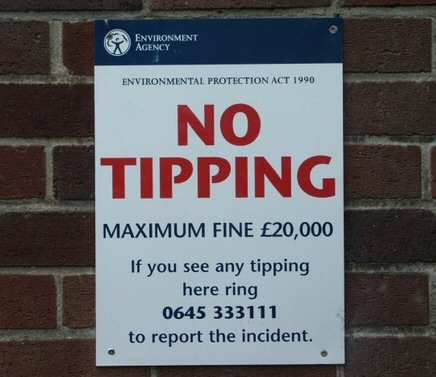
No TippingFor me holidays are not a treat, they are an essential way of  recharging your batteries and provide an opportunity to re think ideas and put things into perspective. I am writing this particular blog whilst visiting Washington DC for a few days before moving onto the real America, Disneyland!


Exam tipping
Now whether its because I was having to get my head around the whole US tipping culture I don’t know, but I found my mind wondered to a conversation I had just before I came away as to the merits of predicting topics that will be on the next exam, so called tipping. This is a fascinating question, and one that is at the heart of the exam focused approach. The logic of the exam focused approach is simple (see  earlier blog for more detail) if the main objective is to pass the exam then the best preparation is to practice The questions that will be on that exam. But on the basis we don’t have The actual exam, then the next best preparation is to practice questions that “you think” will be in that exam, hence the tip.
In many other training environments this approach is common and well accepted. My daughter was taken on the routes most used by the driving test examiner. Although on the day she didn’t know exactly which route it was going to be. As a result of the training and familiarity she felt well prepared, more relaxed which in turn built her confidence, and I am sure this improved her performance on the day.
So what’s the problem?
The problem is that if taken to an extreme, teachers might only teach what they think will be on that particular exam, the so called “teaching to the test”. This results in students not receiving a sufficiently broad or in-depth coverage of the subject and exposing them and their chances of passing to risk, heads you pass, tails you fail.
Application – Focus – Prioritisation 
However exam questions are great tools for application, focus and prioritisation. If a student is taught something and then set a question on that topic, they very quickly appreciate its relevance and value. It certainly helps with concentration, focus and  putting topics in order of importance. The, you can’t learn everything so stop worrying and get on with this question approach…..
Its all about time
If students have sufficient time they should of course learn everything. Although if you think about it you can’t learn “everything”, so there is always some degree of prioritisation.  But in the professional education sector, they don’t. Many hold down demanding jobs by day and study is part time. They look to the educator to give them some degree of priority in what to learn. This comes into sharp focus in the last few days before the exam, and that’s why they will ask for what is most likely to be on the exam, the tip.
So should the teacher tip
It’s all about degrees, at one end of the spectrum, it is very risky and narrows a students learning, at the other it gives focus and application in the last few days before the exam. Personally I would like to see  research on this area some solid evidence to focus the debate. There may be something out there but I have not read anything on this specific question.
But in the absence of such research my view is not to be too dismissive of tipping, it is very easy to completely write it off, leaving the choice of what to focus on just before the exam to the student, when the teacher is probably in a better position to give advice.
and if your interested – How to predict exam questions


And finally my  Holiday books 
I have just started Sal Khans The one world school house – very easy to read summary of how Salman Khan got to become “Bill Gates favourite teacher” and the logic behind what the Khan Academy does.
Thinking fast and slow and The chimp paradox are still as yet to be read.


Now where’s that bill or is it cheque….20% tip!

The lecture -When does learning happen?

“Lectures were once useful; but now the internet and online content are freely available, lectures are unnecessary. If your attention fails, and you miss a part of a lecture, it is lost; you cannot go back as you can with online content. “

The above quote makes the point very forcefully that lectures may not be that effective, and certainly not as good as online. But let me ask a broader question, what is the purpose of a lecture in the first place, does it help you learn and if so when does the learning begin?

The lecture – step by step

In its most simple form the lecture involves little more than a lecturer standing at the front of the class reading from a set or prepared notes or reciting from memory, the student then listens and copies down what the lecturer is saying, presumably to read and absorb later.

So let us break down this process and consider how a lecture helps with learning. Firstly the student has made the effort to attend, this in itself means there is some motivation involved. Secondly they are in an environment designed for learning and with other like minded individuals. All of this helps to put the student in the right frame of mind.

The lecturer will however play a very important part. How well they explain the subject, their level of knowledge, passion and genuine interest can all make a dull topic seem fascinating. And if it is fascinating the student will find it easier to learn. But how much of this can you get from a book, and can this all be achieved online?

And when is the real learning taking place? True the lecturer may ignite a flame and create a sense of curiosity in the student, but the real learning takes place in private, by the student as they revisit the book, video or notes, rewrite, talk out loud and practice questions.  As I have heard student’s say many times, “I need to go over this latter and get it into MY head.”

I am reminded of an Ali quote.

The fight is won or lost far away from witnesses – behind the lines, in the gym, and out there on the road, long before I dance under those lights.

Conclusion

A lecture is a poor method of transferring information, a book or video can explain a topic as easily as a lecturer if well written/filmed. The book and video are both good at providing technically accurate information, but can they transfer the passion, maybe…… but I would argue not as well as the lecture.

You will get a far better view of a sporting event with expert commentary and the ability to watch again on TV, but you are more likely to get a life changing experience if your there watching it unfold live.

So if the only reason you are going to the lecture is to capture information then don’t bother. Stay in bed and get a good book, copy your friends notes or watch the lecture online. But if you want to be inspired/motivated, possibly get a unique view, then go to the lecture.

There is of course a message here for lecturers, your job is to be unique, to inspire and ignite the flame. If not you should also stay in bed, after recording all of you lecture of course.

And for the avoidance of doubt, I do not think this can all be achieved online, a live lecture is different, but the lecturer has to play their role, they have to entertain.

The debate is of course not new – the twist in the tale

Some of you may have recognised the above quote, it’s taken from (with a few amendments from me) James Boswell’s, life of Johnson, the quote is from Samuel Johnson, and the year…..1791!

Lectures were once useful; but now, when all can read, and books are so numerous, lectures are unnecessary. If your attention fails, and you miss a part of a lecture, it is lost; you cannot go back as you do upon a book. . . . People have nowadays got a strange opinion that everything should be taught by lectures. Now, I cannot see that lectures can do as much good as reading the books from which the lectures are take.

Examples of lectures

If only more lecturers could be like this – watch this

And not like this

And although not entirely my thing, everyone should watch the last lecture by Randy Pausche. Although you need to put aside over an hour you will not be disappointed and when you have you will join the 16 million others who have done the same.

Thank you for the music – listening to music when revising

May and June are the traditional months when students around the world lock themselves away to revise for their exams.

In China for example over 9 million students will be sitting the university entrance exams.

Last May (2012) Teenagers at Xiaogang school in Hubei province were pictured hooked up to bags of intravenous fluids hanging from the classroom ceiling to boost energy levels during the revision period. An extreme action by anyone’s standards, but perhaps an example of how much pressure students feel this time of year.

As I mentioned in last month’s blog my daughter is currently caught up in this May/June exam frenzy. So once again I found myself looking to her for inspiration. What was she doing, how did she revise? This is not because she is a perfect example of a revision student, in many ways she is not, but I do think she is typical of many.

What does Beth do?

  • Makes notes from her notes – This is a standard exam skill, reducing content down into measurable and personal chunks. She does use mind maps (possibly my influence) but not exclusively.
  • Prepares as if she has to teach someone else – this I find interesting and has certainly not come from me. She writes on a white board the key points as if she was going to teach that subject. I like this idea, as many teachers and lecturers will tell you nothing focuses the mind nor motivates you more than having to teach it to others.
  • Practices past exam questions…of course!
  • Studies while listening to music – now this is the one that intrigued me and as a result I have devoted the rest of the blog to answering the question …..

Is it a good idea to revise whilst listening to music?

As ever the science needs much interpretation.

It’s a bad idea

Researchers from the University of Wales, tasked 25 students with memorising lists of consonants. Some were shown the letters while sitting in silence, others while listening to music by their favourite bands or by groups they had a strong aversion to. The conclusion was that listening to music, hampered their recall.

So it’s good then

Scientists at Stanford University, in California, believe there is a molecular basis for music known as the “Mozart Effect“. It was discovered that rats, like humans, perform better on learning and memory tests after listening to a specific Mozart Sonata in D.

But then there is the evidence that suggests that switching attention when trying to learn as might be the case with listening to music slows down the cognitive process.

Yet you cannot ignore the research that clearly shows music has the ability to alter your brain and induce relaxation which in turn helps create an ideal state for learning.

Watch what happens to your brain when you listen to music.

Hopefully you get the idea.

Conclusions

  • Listening to music puts you into a more relaxed frame of mind and that is of course good for learning. So listening to music before or after revising can help.
  • If you do want to listen to music, avoid music that requires you to shift your attention. This would suggest you should not listen to  music with lyrics  as it can mean you need to think about what is being said nor should you listen to something new that you may not have heard before. This is one of the reasons classical, in particular baroque music is the preferred choice of many students. Also don’t play the music too loud, keep it as background noise.
  • If there are specific facts that you simply need to know, then avoid listening to music completely, give it your full attention. But you can’t concentrate at this level all day, only for short periods.
  • On the whole be consistent don’t keep changing the type of music, you need familiarity.

Music to help you study

The internet has many websites that offer relaxing and helpful music, here are a few that might help.