The most important skill – Critical Thinking

There seems little doubt that there is a gap between the skills needed to do a particular job and those that are available, the so called “skills gap”, and it’s one of the biggest challenges facing the economy.

The skills Gap
According to the Office for National Statistics, “the number of job vacancies increased sharply to a record 1.2 million in the three months to November 2021, having reached a record low of 340,000 in the three months to June 2020”. As with most real-world problems the reasons as to why this has happened is complex, requiring a good understanding of individual sectors of the employment market. However, we can make a few generalisations, firstly there is a shortage of qualified candidates. This is the results of a number of factors including a lack of specific skills, the right work experience and or educational qualifications. And secondly there are less people in employment. The Institute for Employment Studies estimates there are 600,000 fewer people in work than before the pandemic. This is because there are less migrants, (Brexit), older people (Boomers) are retiring, more younger people are going into further education and the pandemic has resulted in changing lifestyles e.g. the great resignation.

What skills are lacking?
This is another tricky one to navigate but a good way of approaching it is to break it down, splitting the skills between technical (hard) and people (soft). Technical skills in say the Digital sector would include the ability to write code or use a particular type of software, whereas people skills include thinking (critical), communicating, problem solving etc. With regards to people skills the one employers often consider the most important is critical thinking.

As an aside, personally, I think the terms hard and soft skills is misleading, from a learning perspective it’s much easier to teach hard skills than soft ones, and in terms of which is the most valuable or important, they both are.

Critical thinking
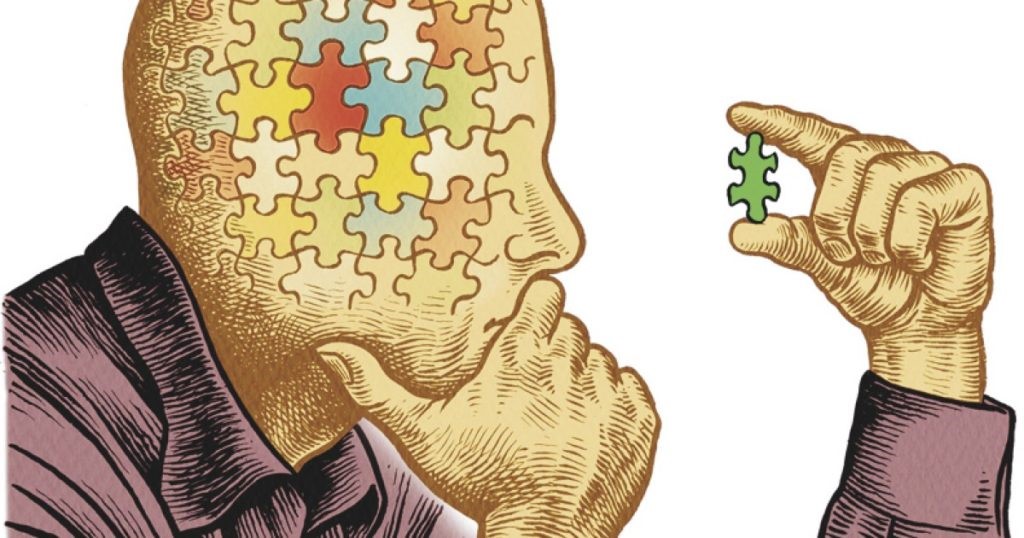
Wikipedia tells us that Critical thinking is the analysis of available facts, evidence, observations, and arguments to form a judgement. There are however many definitions but they all have the same basic concept – the ability to reason by asking questions in order to from an opinion.

“People can be extremely intelligent, have taken a critical thinking course, and know logic inside and out. Yet they may just become clever debaters, not critical thinkers, because they are unwilling to look at their own biases.” Carol Wade Phycologist.

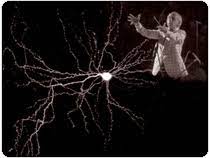
Everyone thinks, you’re probably doing it right now but the process of thinking is both complex and simple and, in some ways beautiful. Individual neurons sit next to each other in the brain similar to members of an orchestra, when instructed to do so they each perform individually but what emerges is something new, the orchestra create music, the brain a thought. My thanks to Henning Beck from the University of Tübingen for this great analogy, here is the link to his Ted lecture, How we think. Watch out for his example as to how the brain can transfer the outline image of a tree and turn it into a child.

The problem with our orchestra of neurons is that together they are biased, emotional and suffer from prejudice, and left to their own devices will form opinions that although appearing to be true are distortions made to fit prior beliefs and personal values.

“The opinions that are held with passion are always those for which no good ground exists; indeed, the passion is the measure of the holder’s lack of rational conviction.” Bertrand Russell, Philosopher.

An Orchestra of Neurons

They need a conductor – And this is where critical thinking comes in.
Here is an example, imagine a situation where an individual tells a story that resonates with many people, they create sounds bites such as Make America Great Again (MAGA) or Take Back Control. There is something in the simplicity of this, a clarity that resonates, and as a consequence the brain latches on to the storyteller, making them the conductor. However, remember the brain, our collection of neurons is not rational, its often selfish, lazy and emotional, there is no interview process for our conductor, the brain will simply pick one, often without much thought.

But what if we don’t leave the brain to its own devises, what if we insist it follows a few simple protocols before making a decision.

The critical thinking process
Below is how critical thinking might work using the MAGA example.

  1. Formulate the question – what problem(s) are you trying to solve?
    e.g. What do we know about the storyteller, what does MAGA actually mean?
  2. Gather information
    e.g. find out more about the storyteller, what bias might they have, are they qualified to make such comments?
  3. Analyse and Evaluate – ask challenging questions, consider implications and prioritise.
    e.g. what does great mean, was America great in the past, a logical question given that the idea is to do it again, what makes a country great, what are the pros and cons of being great?
  4. Reach a conclusion, form an opinion and reflect.
    e.g. This is what I think and this is the reason why. – let me think about that, does it make sense?

When you put this process in place you will be able to form your OWN opinion as to the credibility of the conductor and their story, this is independent thinking, its what employers value most and its what we need to close the skills gap.

If you accept the argument I have put forward as to the value of critical thinking, and of course you should think critically about it, the next question is probably:
Can you teach critical thinking? – this will have to be the subject of another blog, but by way of a spoiler the answer is maybe not or if you can it’s not easy.

A few more blogs to make you a better thinker – Sensemaking, humility and the humanities – Becoming a better thinker – Edward de Bono learning leader – Lessons from lies – Fake news.

Gagne’s style – Nine steps to delivery

Robert Gagne was an American educational psychologist who pioneered the science of instruction in the second world war working with the Army Air Corps, training pilots. His focus was on simplifying and explaining what he and others believed to be good instruction.

Like many academics he wrote and published papers on different areas, for example he developed a hierarchy of learning, similar to Bloom with behavioural aspects at the bottom and cognitive ones at the top. But he is probably most well-known for his Nine levels of learning or as it is referred to here, The nine steps of delivery.

Now the only problem with this is that there are nine steps and anyone who has read this blog before will know, nine is just to The answer is simple, chunk it down into smaller sections.

Why is this important?
Gagne’s objective was to provide a systematic process to help teachers and trainers better structure what they do in order to keep students engaged and help them retain knowledge. But the process he created also provides an insight as to how learning works and can be used by students to structure their own learning. Below are the nine steps broken down under three headings. As well as explaining how each step works, I will also add comments as to what it means for a student who might be studying on their own.

Preparation

  1. Gaining attention
    Start the learning experience by gaining the attention of your learners. The change in stimulus tells them that learning will soon take place. For the student this means you need to create a break from what you are doing and get into a mood to start studying. This might involve going to the library or setting an alarm on your phone to create a trigger telling you something different is about to happen.
  1. Informing the learner of the objective
    Share the learning objective with students early on. What should they know at the end of the session that they didn’t before. For the student it’s important you also know what you are trying to learn, what will you be aware of at the end of this session that you don’t know now. It also helps if your aware of why its important e.g. maybe it’s a very popular exam area or is developed in more detail later so you need to learn it now.
  1. Stimulating recall of prior learning
    Relate the new learning back to something learned before or a similar experience your learners have had, this forms a link between the old and new. For the student this is a reflective process, how does this topic relate to what you have learned in the past, how does it fit in?

Instruction and practice

  1. Presenting the content
    Present the new content to the learners. For the student this is where you start reading or listening to the new content.
  1. Providing learning guidance
    Explain to the learners what something means by giving examples, highlight what’s difficult and what’s not. For the student this is where you have to rely on the instruction provided in the learning materials
  1. Eliciting performance
    Here the learner has to practice what they have been taught in order to demonstrate understanding. For the student this is the equivalent to attempting a question or by way of analogy, trying to turn the theory of how to bake a cake into a reality by actually baking one.

Assessment and transfer

  1. Providing feedback
    Provide guidance to the learner as to what the difference was between their answer and the correct one, what do they need to do to close that gap? For the student this is where it is helpful to work with others, perhaps you mark their answer and they mark yours. To follow the cake example, take it out of the oven and look at it, is it the right texture and colour, then taste it. What do you need to do to make it the best cake ever?
  1. Assessing the performance
    Assessing learner performance is usually demonstrated by asking them to take a test. For the student its very similar this time, take the test and see what score you get.
  1. Enhancing retention and transfer
    The learner now needs to demonstrate this by applying it to their job or by teaching others. This last stage often requires continual practice and feedback to become competent. For the student who thinks their objective is to do little more than pass the exam it may not seem important, however in the medium to long term applying learning is the main goal.

And that’s all you have to do, nine steps that break down instruction and in so doing providing a roadmap to effective study. It has been argued that the process doesn’t work so well for more creative subjects, after all it was designed around training airline pilots. However, it can teach you to fly and most importantly land a plane it’s probably good enough for most areas of learning.

Who needs a teacher – the power of self-explanation

One of the great skills of a teacher is that they explain things you don’t understand, that’s really helpful – right?

Well maybe not, a meta study entitled, Inducing Self-Explanation published back in 2018 concluded that it is better to ask a student to try and explain something to themselves, than for a teacher to do that for them. Although in fairness the teacher’s explanation was better than no explanation, which might seem an obvious point but it shows that the content is important and it’s not just the process. However, the process does help because it forces the student to recognise links between the knowledge or skills they have already learned and identify the gaps in their understanding which need to be bridged. In further defence of teachers, there is some evidence to show that the technique is more effective following an initial explanation, with the student asked to explain it to themselves afterwards.

In simple terms self-explanation requires the learner to try to explain concepts, ideas and processes in their head to themselves prior to answering a question. However there is a little more to it than that.

Self-explanation and elaborative interrogation
Elaborative interrogation is similar to self-exploration but not exactly the same. If you ask someone “why that makes sense” or “why is this true”, this is an example of elaboration, it generally relies on a specific chunk of prior knowledge that you are elaborating on. Self-explanation is more generic in that you could ask “what does this mean to you” or “explain what you have just read”. To answer these questions there is no need for past knowledge as the paragraph may only just have been read. As a result, self-explanation is better suited to knowledge acquisition.

But for all intent and purposes they are both techniques that force reflection, requiring the learner to assemble the component parts of process or argument in their head, challenge the conclusions and ask further questions to narrow the gap in their understanding. One last point, we also know that more effective learners (although you may think they are just really smart) are likely to engage in self-explaining naturally.

Learning requires effort – desirable difficulty
If this process sounds like hard work, it is, learning is not meant to be easy, it can be enjoyable and rewarding but not necessarily easy. Compare, trying to explain something to re-reading the textbook or highlighting key words. My guess is that you would much rather re-read or highlight, but they are both far less effective learning techniques.

The greater the difficulty, the greater the glory.
Marcus Tullius Cicero

This is yet another example of what Robert Bjork’s referred to as desirable difficulty (Bjork, 1994; McDaniel & Butler). It is the idea that having certain difficulties in the learning process greatly improves long-term retention. Other examples include, spacing, interleaving and retrieval practice which I have written about before. It’s the effort and reflection that helps transfer the knowledge from short term to long term memory and without that it would be forgotten.

More effective
The key point is not about the difficulty of learning but the effectiveness of the methods used to learn, and developing the confidence that when something is hard it’s probably a good thing. So, the next time you are asked a question that requires an explanation and you can’t give one, don’t jump straight back into the textbook to reread the entire chapter. Think and reflect on what it is you don’t understand, create a sentence that captures that lack of understanding, maybe even saying it out loud, find the answer and then attempt to explain it again.

A little more difficult of course but you will be learning and not just sitting there thinking you are.

My thanks to John Eaton for his observations on this topic and for the fab picture of Less Dawson.

Reduce test anxiety – with help from Amy G Dala

Whether you call it test anxiety or exam stress, they are both terms used to describe a combination of physical symptoms and emotional reactions that can impact your ability to do well in exams. It’s hard to measure how many people suffer from it, although there are estimates of between 10% and 40%, with some correlation with the increased testing in schools.

The physical symptoms include headache, nausea, sweating, shortness of breath etc, whilst the emotional ones are fear, helplessness, disappointment and negative thoughts brought on by self-doubt and the reinvention of past failures. Both of which contribute to an inability to concentrate and think clearly which fuels procrastination. It’s a condition that can result in someone failing an exam which in turn may significantly reduce their career options, my point, it’s a really important subject.

Amy G Dala or Amygdala (uh·mig·duh·luh)
Not a person of course but a group of nuclei found deep in the brain’s temporal lobe and part of the limbic system. The amygdala was initially thought to be responsible for fear and negative responses that feed the fight or flight reaction, but work by Professor Lisa Feldman Barrett who specialises in affective science (The study of emotion) suggest this is not the case. She argues that the Amygdala sends signals of ambiguity and novelty which are then combined with past experiences, information from your body, such as a pounding heart and context to construct an emotion, such as anxiety. The context here might be sitting in the exam room in complete silence waiting for the invigilator to say, “you can now turn over your paper.”

You are not born with emotions; they are constructed by the brain based on a prediction as to what might happen next. For example, if you were walking down the road and a group of young adults are coming towards you, the amygdala will signal this as something ambiguous and novel, your body will respond by increasing your heart rate and the brain will then attempt to find out if this has happened before. If it has and you had your mobile phone stolen it might trigger the emotion of fear. If the group simple walk past chatting and laughing the emotion will fade.

“Emotions are not reactions to the world – they are your constructions of the world.”
Professor Lisa Feldman Barrett

Although it may not be obvious at this point understanding how emotions are constructed is going to help reduce our feelings of anxiety.

You have control over your emotions
Many people believe emotions are uncontrollable “arriving unbidden and departing of their own accord”, but this is not the case as Professor Barratts work has identified. There is a point where the brain has to predict what will happen and create an emotion to match that prediction. If we can effectively step in at the point of prediction, we can change the emotion.

“Emotions that seem to happen to you are created by you”
“You are the architect of your experience”
Professor Lisa Feldman Barrett

If for example you are about to take a test, your amygdala will sense uncertainly and ambiguity, you might start to breath more deeply, and at this point your brain will begin to race ahead so that it can make a prediction and offer up a suitable emotion. But if you step in and interpret the emotion ahead of the prediction you can change the way you feel. In this example just tell yourself that the deep breathing is helping you get sufficient oxygen into your lungs which will help you think more clearly, or maybe the slight shaking of your hand is an indication that you are not too relaxed, you are just at the right point to take a test. This is effectively a reframe or reinterpretation that turns a bad situation into a good one.

This gets even better, the next time you take a test your brain will once again race ahead looking to make a prediction and find the experience that happened last time, e.g. that the heavy breathing was perfectly normal and made you feel calm and motivated. As a result, it will take this as the prediction and replicate the emotion. But like so many things, it can take time, building neuroglial pathways is not always easy, so don’t lose confidence if it doesn’t immediately work.

People already use this technique but don’t realise it, have you ever heard someone say that they like to feel a “little bit nervous” because it helps them perform better.

And this is all made possible by a better understanding of two small almond-shaped regions deep in the brain, thank you Amy G Dala.

Want to know more, listen to Lisa Feldman Barrett – How Emotions are Made. The theory of constructed emotion. And her TED lecture – You aren’t at the mercy of your emotions, your brain creates them

Blooms 1984 – Getting an A instead of a C

When people see the year 1984 most think of George Orwell’s book about a dystopian future, but a few other things happened that year. Dynasty and Dallas were the most popular TV programs and one of my favorite movies, Amadeus won best picture at the Oscars. You can be excused for missing the publication of what has become known as the two Sigma problem by Benjamin Bloom, of Blooms taxonomy fame. He provided the answer to a question that both teachers and students have been asking for some time – how can you significantly improve student performance?  

One of the reasons this is still being talked about nearly 40 years later is because Bloom demonstrated that most students have the potential to achieve mastery of a given topic. The implication is that it’s the teaching at fault rather than the students inherent lack of ability. It’s worth adding that this might equally apply to the method of learning, it’s not you but the way you’re studying.

The two-sigma problem
Two of Bloom’s doctoral students (J. Anania and A.J. Burke) compared how people learned in three different situations:

  1. A conventional lecture with 30 students and one teacher. The students listened to the lectures and were periodically tested on the material.
  2. Mastery learning – this was the conventional lecture with the same testing however students were given formative style feedback and guidance, effectively correcting misunderstandings before re-testing to find out the extent of the mastery.
  3. Tutoring – this was the same as for mastery learning but with one teacher per student.

The results were significant and showed that mastery learning increased student performance by approximately one standard deviation/sigma, the equivalent of an increase in grading from a B to an A. However, if this was combined with one-to-one teaching, the performance improved by two standard deviations, the equivalent of moving from a C to an A. Interestingly the need to correct students work was relatively small.

Bloom then set up the challenge that became known as the two-sigma problem.

“Can researchers and teachers devise teaching/learning conditions that will enable the majority of students under group instruction to attain levels of achievement that can at present be reached only under good tutoring conditions?”

In other words, how can you do this in the “real world” at scale where it’s not possible to provide this type of formative feedback and one to one tuition because it would be too expensive.

Mastery learning – To answer this question you probably need to understand a little more about mastery learning. Firstly, content has to be broken down into small chunks, each with a specific learning outcome. The process is very similar to direct instruction that I have written about before. The next stage is important, learners have to demonstrate mastery of each chunk of content, normally by passing a test scoring around 80% before moving onto new material. If not, the student is given extra support, perhaps in the form of additional teaching or homework. Learners then continue the cycle of studying and testing until the mastery criteria are met.

Why does it work?
Bloom was of the opinion that the results were so strong because of the corrective feedback which was targeted at the very area the student didn’t understand. The one to one also helped because the teacher had time to explain in a different way and encourage the student to participate in their own learning which in turn helped with motivation. As you might imagine mastery is particularly effective in situations where one subject builds on another, for example, introduction to economics is followed by economics in business.

Of course, there are always problems, students may have mastered something to the desired level but forget what they have learned due to lack of use. It’s easy to set a test but relatively difficult to assess mastery, for example do you have sufficient coverage at the right level, is 80% the right cut score? And finally, how long should you allow someone to study in order to reach the mastery level and what happens in practice when time runs out and they don’t?

The Artificial Intelligence (AI) solution
When Bloom set the challenge, he was right, it was far too expensive to offer personalised tuition, however it is almost as if AI was invented to solve the problem. AI can offer an adaptive pathway tracking the student’s progression and harnessing what it gleans to serve up a learning experience designed specifically for the individual. Add to this instructionally designed online content that can be watched by the student at their own pace until mastery is achieved and you are getting close to what Bloom envisaged. However, although much of this is technically possible, questions remain. For example, was the improvement in performance the result of the ‘personal relationship’ between the teacher and student and the advise given or the clarity in explaining the topic. Can this really be replicated by a machine?

In the meantime, how does this help?
What Bloom identified was that in most situations it’s not the learner who is at fault but the method of learning or instruction. Be careful however, this cannot be used as an excuse for lack of effort, “its not my fault, it’s because the teacher isn’t doing it right”.

How to use Blooms principles.

  • Change the instruction/content – if you are finding a particular topic difficult to understand, ask questions such as, do I need to look at this differently, maybe watching a video or studying from another book. Providing yourself with an alternative way of exploring the problem.
  • Mastery of questions – at the end of most text books there are a number of different questions, don’t ignore them, test yourself and even if you get them wrong spend some time understanding why before moving on. You might also use the 80% rule, the point being you don’t need to get everything right

In conclusion – It’s interesting that in 1985 Bloom came up with a solution to a problem we are still struggling to implement. What we can say is that personalisation is now high on the agenda for many organisations because they recognise that one size does not fit all. Although AI provides a glimmer of hope, for now at least Blooms 2 Sigma problem remains unsolved.

Listen to Sal Khan on TED – Let’s teach for mastery, not test scores

When a horse might be a cow – the importance of Schema

Although there is a difference between learning, “the process of acquiring knowledge” and remembering, “the process of recording, storing and retrieving knowledge”, they are symbiotic, the one having little purpose without the other. Which goes someway to explaining why I have written so much about memory over the years. Here is one such example Never forget – improving memory.

In some of these blogs I have referred to the word schema but have not really explored it in much detail, it’s time to put that right.

It’s easy to think that when the brain transfers information from short to long term memory it just sits there floating in a vacuum, waiting for the day it will be needed. But it doesn’t work like that, the brain cannot simply pluck something from this vast space without having structured the information in the first place, effectively having filed it away correctly.

The packets that organise information and make sense of experience are ‘schemas’, the building blocks of cognition. Daniel Goleman

Schema – how information is stored
Schema can be derived from the word’s Greek origin, which means to shape or plan, but it wasnt until 1923 that the child developmental psychologist Jean Piaget used it in the context of learning.

Nine years later Frederic Bartlett described schema in more detail by saying that people organise concepts into mental constructs, models, or frameworks that help them process and remember information. The implication being that when faced with information that fits an existing schema, it will be remembered but if not, it is easily forgotten.

Schemas contribute to our understanding as to how information is stored in the brain and provide insight as to what we can do to learn more effectively. They are built through experience, for example a child may have been told that a cow is an animal that has four legs, eats grass and lives in a field, they may even have seen one. When they next come across a cow, they will associate what they see with that schema and say “cow”. However, if in the next field they see a horse which also has four legs, eats grass and lives in a field, they may believe that is also a cow. It’s at this point the child’s parents intervene by telling the child “No that’s a horse, can you see its taller and runs faster”, this leaves the child with two choices either, build a new schema or adapt the existing one.

Piaget gave us the answer as to what’s happening here, he called it Assimilation and Accommodation. Assimilation is when you make the new information fit with an existing schema for example, the child can adapt their schema by adding – not all animals that live in a field with four legs and eat grass are cows, some are horses. Alternatively, they create a new schema for horses, being fast, tall animals with four legs, that eat grass and live in a field, this is accommodation.

People who do well in maths are those that make connections and see maths as a connected subject.
Jo Boaler, 2014

Chess players use schemas
There is a general assumption that chess players have good memories, which on the face of it is true. But it’s not necessarily an innate ability, they have been building up information of past games and storing them in schemas for years. This is why an expert chess player is able to beat a novice, not because they are processing each move individually, they suffer from cognitive load like everyone else, they are simply accessing past schemas. (Chase & Simon, 1973 et al).

The reason experts remember more is that what novices see as separate pieces of information, experts see as organised sets of ideas. Donovan & Bransford, 2005

How does this help with learning?
If you aware of how your brain stores information you can change the way you study to work with your brain not against it. Below are a few tips you might want to consider.

  • Pre-Assessment or subject review – It’s a good idea before starting a new subject to test yourself or review the underpinning content. This is not so much about finding out what you know, although this might be helpful, it reminds you of prior knowledge and schemas that can be adapted to fit the new information you will learn.
  • Look for analogies and comparisons – when new information is presented think how this might fit with what you now. For example, if you have already learned about income tax, when you come to capital gains tax ask, what are the differences and similarities. They both fit into the schema of taxation.
  • Put Information Into context – when trying to understand something new, consider the context from which it comes, its possible that although the knowledge is new the context is familiar. For example, if you were learning about people who break the law, it might be a good idea to ask yourself in what context you would do this. This could help fit the new information into an existing schema.
  • Challenge your existing schemas – like many things’ schemas can be good or bad. Here is a riddle, a father and son have a car accident and are both badly hurt. They are both taken to separate hospitals. When the boy is taken in for an operation, the doctor says ‘I cannot do the surgery because this is my son’. How is this possible?

The answer is of course that the doctor is the son’s mother, but because we have a schema that tells us doctors are male, we get it wrong.

And one last big tip for teachers, inside your head you have created schemas that work, share them with your students, they have probably taken you many years to create making them hugely valuable in terms of knowledge transfer.

For more information here is a really good video that explains Memory Schemas in more detail.

Chatter – why talking to yourself matters

If you are reading this, think for a moment as to what you are doing……… are you sounding out the words in your head or did you pause, reflect and ask yourself “what exactly am I doing?”, either way you have been using your inner voice, your internal dialogue or have been experiencing what Ethan Kross calls Chatter.

Ethan is the Professor of Psychology and Management at the University of Michigan and author of a book called Chatter, the voice in our head and how to harness it.

On the one hand this might all seem a little strange, how many people would you ask what they have been talking to themselves about today, perhaps you wouldn’t because it’s too personal a question or maybe you don’t want to admit you do it all of the time. The good news is its perfectly normal and the vast majority of people talk to themselves. It’s worth adding however that not everyone has an internal voice, with some suggesting that this might be more likely for people with dyslexia.

Where does it come from?
Evolution would suggest that if we have this ability, it must serve a purpose. Mark Scott from the University of British Columbia has found evidence that a brain signal called “corollary discharge” plays an important role in our experiences of internal speech. Corollary discharge arises when the brain generates an internal copy of the sound of our voice in parallel to the external sound we hear. Its purpose is to prevent confusion between a self-caused sound or sensation for example, a dog growling noise inside our head and an externally-caused sound, for example a real dog growling who is about to bite. If both are the same, we run pretty fast, if not the brain will cancel the internal sound. This is the reason we can’t tickle ourselves; the brain sends a signal that we are going to tickle ourselves before we actually do, effectively cancelling the sensation.

Interestingly children don’t develop this skill until around 6 or 7 although its gradual and starts much earlier. This is the reason a young child will just say what they think, regardless of the consequences!

“Don’t let the noise of others’ opinions drown out your own inner voice.” Steve Jobs

Why it matters and what you can do?
One of the most powerful tools to help manage stress, wellbeing and self-esteem is your inner voice, and examinations provide a rich environment where without support all of these can bring you down. Heightened dialogue is not of course just experienced when studying or in the exam room, how was it possible that Marcus Rashford, Jadon Sancho and Bukayo Saka missed penalties in the Euros. Maybe it was the result of too much chatter, telling themselves that they must score, they have to score, the country is relying on them?

“Non-judgment quiets the internal dialogue, and this opens once again the doorway to creativity.” Deepak Chopra

And this is where Ethan Kross offers a whole raft of advice. He talks about having the ability to step back from the Chatter by adopting a broader, calmer and more objective perspective. You also need to listen to what your saying, low self esteem for example can easily develop if you are continually criticising yourself, perhaps as a thoughtless parent might do, always finding fault no matter what.

Here are a few of the practical tools in the book.

  1. Use distanced self-talk – rather than saying “why can’t I do this”, use your name in the second person “why is it that Stuart can’t do this”. This results in reduced activation in brain networks associated with negative thoughts.
  2. Imagine advising a friend – this has a similar impact in that it helps you view the experience from a distance. “I know this is a tricky question but you’ve been in a similar situation before and you figured it out”. This is also an example of what Kross calls time travel, (temporal distancing) either going forward in time to look in the rear-view mirror at the problem, effectively leaving it behind or travelling back to a time when you were successful.
  3. Broaden your perspective – in this situation, compare what you’re worrying about with other adverse events or ask what other people would do in the same situation. A variation on the “what would Jesus do?” question.
  4. Reinterpreted your bodies chatter response – when you experience stress its likely your heart rate will increase and you will begin to sweat. Becoming aware of this can lead you to conclude that you are stressed which in fact makes the situation worse. Kross suggest you tell yourself that this is not bad news but the body doing what it has to in order to help you.

And finally, if you want to find out more, check out this video, Do you have an inner voice?

Old Marley was as dead as a door nail – the power of analogy

“Marley was dead, to begin with. There is no doubt whatever about that. The register of his burial was signed by the clergyman, the clerk, the undertaker, and the chief mourner. Scrooge signed it. And Scrooge’s name was good upon ‘Change for anything he chose to put his hand to. Old Marley was as dead as a doornail.”

A Christmas Carol was written by Charles Dickens in October 1843 and published on December 19th the same year. By Christmas’s Eve it had sold 6,000 copies at 5 shillings each, unfortunately Dickens only made £230 due to the elaborate illustrations and a not so lucrative deal with Chapman and Hall, the publishers. Today you could by an original copy for around £40,000.

Although Dickens might not have struck a particularly good business deal, he used an excellent analogy to describe exactly how dead Marley, his business partner was. Incidentally the reason a doornail is considered so dead is to do with the way it is bent over and hammered flat, making it unusable. Click for a more detailed explanation.

Analogy
Put simply, analogies highlight shared characteristics between two things. It’s an umbrella term for a cognitive process where we transfer meaning or information from one subject to another and as a result improve understanding. For example, “life is like a box of chocolates – you never know what you’re gonna get” is an analogy from Forrest Gump that makes the connection between the choices and surprises you face when deciding on what chocolate to have…. and life. It helps illustrate the uncertainty of life, the fact that faced with choice you don’t always make the best one and sometimes when you “bite” into life you might be pleasantly surprised. Many analogies are used in everyday speech, for example “doing that will be as about as effective as rearranging deck chairs on the Titanic”, meaning it will make no difference. Similes and metaphors can be used in the same way, in many instances providing the infrastructure to support the analogy. Life is like a box of chocolates, is a simile.

But the distinction between, analogy, metaphor and similia doesn’t really matter, the important point is that all of these can be used to improve understanding, navigate complexity and help with problem solving by using what is called analogical reasoning.

Making abstract concrete
There are many reasons as to why analogies work so well. They often require the use of images, connect existing information with new and encourage reflection, retrieval and the manipulation of ideas. All of which help move information from short to long term memory. There is also a strong connection with the 6 evidenced based learning strategies covered in previous blogs, in particular using concrete examples to make concepts more real. This is one of the most powerful ways to use an analogy.

How do you explain the dual concept in accounting? Here is the answer – the dual concept tells us that every transaction affects the business in at least two ways which are equal and opposite in nature.

Even though you have an explanation, because it’s a concept, an abstract idea, it has no form which makes it difficult for the brain to grasp. But if you can relate it by way of an analogy, perhaps thinking of the dual concept as a set of scales where whatever you put on one side you have to put on another, it becomes more tangible and an understanding develops.

Designing an analogy
Sometimes an analogy will just emerge, from my own experience this is often the case when I have thought about a particular topic or taught it for many years. The catalyst might be someone saying, I don’t understand. As a result, you rack your brains to come up with an alternative way of explaining, and the analogy just appears. However, when studying, you don’t have time for this but coming up with your own analogy might really help. Here is one way of doing it.

Pick two objects, ideas or domains
e.g. a carrot and learning
Write down the main characteristics
– Carrots – are orange, grow from a seed, need water, good for you etc
– Learning – requires effort, takes time, builds on prior knowledge, helps you in life etc
Evaluate by looking for commonalities
Learning is not dissimilar to a carrot, it starts very small, takes time to grow, needs nurturing and is good for you. A slightly silly example but hopefully it shows how the process could work.

A word of warning, as powerful as analogies can be they aren’t the answer to everything. Research shows they can cause learners to create incorrect mental models and as such draw the wrong conclusions, so always keep a check on the logic behind the analogy and at what point it stops working.

A few more analogies
– “A good speech should be like a woman’s skirt; long enough to cover the subject and short enough to create interest.” Winston S. Churchill
– “You see, wire telegraph is a kind of a very, very long cat. You pull his tail in New York and his head is meowing in Los Angeles. Do you understand this? And radio operates exactly the same way: you send signals here, they receive them there. The only difference is that there is no cat.” Albert Einstein
– “Truth, like gold, is to be obtained not by its growth, but by washing away from it all that is not gold.” Leo Tolstoy
They can also make you laugh – “When I die, I want to go peacefully like my Grandfather did, in his sleep – not screaming, like the passengers in his car.”

And as Tiny Tim said, “A Merry Christmas to us all; God bless us, every one!”
Happy Holidays and here’s to a much better 2022.

Simulations, Case Studies and Games – Strictly Take 2

Last month’s blog looked at the difficult balancing act that has to be struck between knowledge and skills. It concluded that skills learned in one domain are not always transferable to another, making it important to have as realistic an environment in which to learn as possible.

The UK government believe, as set out in their skills for jobs white paper that by giving employers a central role in the design of technical courses it will ensure the education and training is directly linked to the skills needed in the world of work. Although this should result in a curriculum valued by employers, these skills won’t be learned unless they can be applied in a real-world environment. This is the reason the government promote apprenticeships and have built work experience into the new T levels.

But perhaps there is more that could be done, what if the transition between what is learned in the “classroom” and the real world was somehow smoother, almost as if it was the obvious next step.

Simulations, a type of rehearsal
One answer might be to use a simulation, an instructional scenario where the learner is placed in a world similar in some aspects to the real one. It is a representation of reality within which the student has to engage and interact. It’s controlled by the teacher who uses it to achieve a desired learning outcome.

Simulations are most effective when there is a need to explore relatively complex topics with many dimensions and factors. And because the student is placed in a situation of uncertainty, they are forced to navigate confusion, consider different possibilities, problem solve, think critically and in so doing develop those all-important higher-level skills so valued in the workplace. Despite there being good evidence, (Bogo et al, 2014, Cooper et al, 2012) as to the efficacy of simulations, in practice PowerPoints and chalk and talk are still all too common.

In terms of timing, simulations work best at the later stages of learning, after students have been taught theoretical concepts and the fundamental underpinning knowledge, effectively prior knowledge matters. The reason for this is our old friend “cognitive load” and the need not to overwhelm learners with too much information at any one time. (Kirschner et al., 2006).

Technology of course has a role to play, in particular Virtual Reality (VR) which although expensive has much to offer in areas where mistakes can be costly. This is perhaps most evident in the medical profession where VR can place students in realistic life and death situations but in an environment that is safe, controlled and allows for mistakes.

Case studies and games
Both case studies and games provide opportunities for a similar learning experience to simulations.

Case studies – are effectively real-world stories in which the student applies what they have been taught with the objective of solving a problem or offering alternative solutions. In the business world these are not new, for example Harvard Business School are celebrating their 100 years of teaching using the case study method this year.

Although it’s possible to study on your own using case studies, because of the absence of a single right answer it is beneficial to engage with other students, exchanging ideas, discussing different theoretical topics and listening to alternative answers.  After which if you require a group consensus there is a need to prioritise and persuade others within the group, all of which are valuable skills.

Games – Wikipedia defines a game as a structured form of play, usually undertaken for entertainment or fun, and sometimes used as an educational tool. Most games have the same components, rules, an objective, challenge and competition. As with case studies if used for teaching they can allow the student to explore and test themselves with different problems, many of which have alternative courses of action. Having a competitor adds another dimension, perhaps sometime they are rational which might make them predictable but on other occasions they are irrational and illogical.

“We do not stop playing because we grow old, we grow old because we stop playing!”

Benjamin Franklin

Just to give some idea as to the scale of gaming and its popularity, in 2020 the video gaming Industry was estimated to be worth $160 Billion and by 2025 this figure is set to increase to $270 Billion. Now of course these aren’t educational games but it does show how valuable they could become if educators could somehow tap into their magic. And if you’re not familiar with how these games might be used, take a look at this short video that showcases the new and upcoming management games of 2021.

Realistic environments are not enough
Simulations, case studies and games all provide the opportunity to place the learner in a realistic environment to help them develop valuable work-based skills, but there is a caveat. Research has shown that simply putting the learner into a realistic environment is not enough (Clark, 2019), unless the very same evidence-based learning theories that are used in the classroom are also applied, that is deliberate practice, spaced practice, interleaving etc.

Like any form of teaching, these training environments need to be carefully constructed with the desired learning outcomes clearly identified and placed up front when designing the simulation or game. Yes, they can be fun, yes, they can be engaging but they won’t help you develop the required skills unless the evidence-based practices are used.

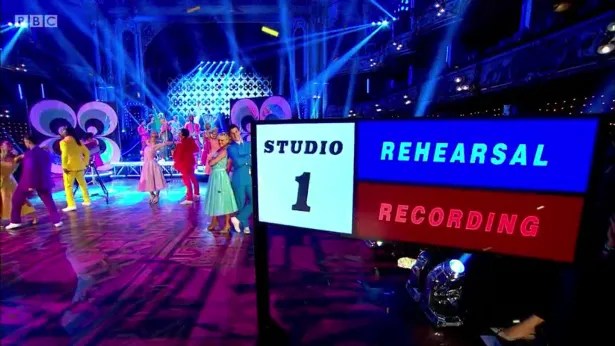
Strictly take 2 – How are contestants on strictly prepared for their real-world task, they have a rehearsal (simulation) on the Friday and two dress rehearsals (simulations) on the Saturday morning just before the show goes out live on the evening.

A few skills you can learn from a simulation

The knowledge verses skills debate – Strictly speaking

The skills gap
Although it is estimated that by 2030 there will be more people than jobs for those with lower skills, research conducted by the Learning and Work Institute estimated that England faces a deficit in higher level skills of around 2.5 million people, this is why we have a skills gap.

It’s not that we don’t have enough people it’s that we don’t have enough people with the right skills. It’s an education problem not a resource one…..

The solution is of course easy, train more people, but its skills we need not knowledge, right?

What are skills
A skill is the knowledge and ability that enables us to do something well. There are many definitions of skills but I like this one because it highlights the importance knowledge plays. Although knowledge is valuable, on its own it has limitations. For example, knowing the steps to the Argentinian Tango doesn’t mean you will be able to dance it. Knowledge is theoretical, whereas skills are practical. There is arguably no better place to see how skills are learned than Strictly, the BBC’s hugely successful dance show. Celebrities with differing abilities are given a dance that they need to perform each week, the process they go through is however always the same, and involves practice, practice and more practice.

What is knowledge
Most people will assume that knowledge relates to something written in a text book, be it words, facts, dates, numbers etc, and they would be right. To be precise this type of knowledge is called explicit or declarative knowledge. You will also “know that you know it”, which on the face of it might sound strange but some types of knowledge (implicit and tacit) are unconscious. You have the knowledge but “don’t know” that you do, for example, “I can hit a golf ball straight down the fairway, but don’t ask me to explain how I do it, because I have no idea, I guess I’m just naturally talented”. One final point, for knowledge to be understood it should be applied in a specific context or illustrated by way of example, which lifts the words from the page, often putting the learner in a more practical environment where they can “see” what they need to learn.

The Knowledge V Skills debate
Often knowledge and skills are put into conflict, with some promoting knowledge as being the more important. The current national curriculum in England as set out by the then Education Secretary Michael Gove requires that pupils should be taught a robust “core knowledge” of facts and information.

“Our new curriculum affirms – at every point – the critical importance of knowledge acquisition”.
Michael Gove

Whilst others promote the value of skills over knowledge, suggesting that technology provides knowledge for free.

“The world no longer rewards us just for what we know – Google knows everything – but for what we can do with what we know.”
Andreas Schleicher, Special Advisor on Education Policy at the OECD

But like so many things this type of dichotomy is not helpful, with evidence on both sides attesting to the importance of each. The truth is you need both, you can’t learn skills without knowledge and although knowing something has value, it’s what you can do that is most highly prized.

How do you learn skills?
To learn a skill, you first need knowledge, for example here is some of the knowledge required to help dance the Argentinian Tango.

Every dance has its own unique music, and you can’t master it without developing a feel for the music. Tango is a walking dance, meaning that all the steps are based on walking. When you start learning, you must first master some basic movements. Beginners usually start with 8-Count Basic or simply Tango Basic. The rhythm is slow, slow, quick, quick, slow.

We can then follow what is called the four-step approach to learning skills:
One – Demonstrate the skill with little or no explanation (demonstration)
Two – Repeat with an explanation whilst encouraging questions (deconstruction)
Three – Repeat again with the learner explaining what is happening and being challenged (formulation)
Four – Learner has a go themselves with support and coaching (performance)

Skills are developed through continual practice and repetition, learning by trial and error, asking questions whilst receiving advice to improve performance. An analogy or metaphor can sometime help e.g. Finding your balance is about feeling stable like a ship with an anchor.

Transferable skills are not that transferable
The ultimate goal of those that promote skills development is that once learned they can be taken with you from job to job, they are in effect transferable. However, research suggests that this is not the case. In July 2016 the Education Endowment Foundation in the UK released the results of a two-year study involving almost 100 schools. The experiment looked at the benefits of teaching chess as a means of developing generic skills, in this instance mathematical ability. It concluded, that there were no significant differences in mathematical achievement between those who had the regular chess class and the control group. Playing chess, does not make you better at maths, on the whole it only improves your ability to play better chess.
This supports the argument that skills are domain specific and that critical thinking learned whilst studying medicine does not necessarily help you become a better critical thinker in other areas. One reason for this may be that to become a good critical thinker you need large amounts of knowledge on which to practice. Which brings us full circle, skills need knowledge and knowledge becomes more valuable when applied in the form of a skill.

Strictly foot note – there is an argument that the celebrities on Strictly are only skilled in one dance at a time, and what is learned from one dance does not transfer easily to another.

Sniff your way to exam success – well almost

Malcom Gladwell the author of Outliers and Tipping Point to name two of his most well known books, has a curiosity with no limits, he wanders from topic to topic littering his insightful observations with facts and statistics. His podcast Revisionist History, which I would recommend if you would like to hear stories from the past that have been overlooked and or misunderstood, has an episode called, “The dog will see you now”, in which he discusses the incredible sense of smell that dogs have, apparently, it’s between 10,000 and 100,000 times more sensitive than ours. I will leave you to listen to that but it got me thinking about how powerful and valuable our sense of smell is when it comes to memory and learning. The classic and now debunked learning styles analysis promotes, Visual, Auditory and Kinesthetic but makes no specific refence to smell or taste.

Sense of smell – Olfactory
Your sense of smell is thought to be the oldest of our senses, providing the brain with information about food, potential partners and even danger. Women actually have a better sense of smell than men, which may have evolved to help them identify and bond with their new born. Interestingly it is also the only fully developed sense a fetus has in the womb and goes on to become the most developed in a child through to the age of around 10 when sight takes over. This is one of the reasons that childhood memories appear almost instantly when a smell from your past wafts into your unconscious, think candy floss, bubble gum or newly sharpened pencils. Your sense of smell is so strong it has an impact on how we experience taste, accounting for as much as 80%, try holding your nose and tasting something by way of an experiment. Although there is some debate about the actual percentage, all are agreed that smell and taste are connected.

The Proust Effect
The Proust effect refers to the power of smell and taste to evoke memories and emotions. Marcel Proust the famous French writer finds that his childhood memories come flooding back after tasting the tea-soaked crumbs of a madeleine (A French cake).

“… I carried to my lips a spoonful of the tea in which I had let soften a bit of madeleine. But at the very instant when the mouthful of tea mixed with cake crumbs touched my palate, I quivered, attentive to the extraordinary thing that was happening inside me.”. An exquisite pleasure had invaded my senses, something isolated, detached, with no suggestion of its origin.”

This was not a conscious process it resulted in an “involuntary memory” a term Proust created but is now widely used to describe this phenomenon.

Why is smell so powerful?
Smell and memory are so closely linked because of the brain’s anatomy. They are handled by the olfactory bulb, the structure in the front of the brain that sends information to other areas of the body’s central command for further processing. Odors take a direct route to the limbic system, including the amygdala and the hippocampus, these are the regions related to emotion and memory.

Smells, sleep and studying
Memory can be thought of as a process of encoding, consolidation and recall, anything that improves the encoding or consolidation will aid recall. It was therefore of some interest when Franziska Neumann & Jürgen Kornmeier from the Department of Psychiatry and Psychotherapy at the University of Freiburg Medical Center published a paper that concluded, if we smell an aroma while we take on new knowledge and then sleep next to a source of that same odor, we will find it easier to recall the information at a later date. What they effectively did was link the encoding process with a smell, in this instance rose-scented incense sticks which was on their desks while learning English vocabulary with consolidation by having the same rose scented smell on their bedside table when sleeping.

What they found was “students showed a significant increase in learning success by about 30% if the incense sticks were used during both the learning and sleeping phases”. Franziska Neumann.

However, the overall message is not to replicate this in your own studies, it’s very early days and the study was relatively small, although part of me thinks why not! What we can take away is that smells are incredibly powerful and play an important part in memory consolidation, and you should be aware of this when studying. It’s another technique in the memory toolkit, along with mind maps, mnemonics, effective note taking etc.

Frustration
It has always been a frustration for me that we have not been able to harness the memory enhancing qualities of smell, incorporating them into the general learning process, and that’s partly the reason I have not written at length about this topic before. That said there has been some interesting research around using smells to enhance the learning environment in terms of both memory and mood.

In 2003, psychologist Mark Moss, at Northumbria University, carried out a range of cognitive tests using lavender which is associated with relaxation, and rosemary, linked to enhanced memory. The results showed that students who were subjected to the lavender aroma preformed significantly worse in working memory tests but those in the rosemary group did much better than the controls.

And this is something you can replicate, when learning why not experiment with some of these in your study room.

  • Citrus – increases energy levels, improve your mood and to some extent concentration
  • Peppermint – improves concentration and helps reduce anxiety
  • Lavender – slows the heart rate and calms the nervous system
  • Rosemary – improves retention, clarity and alertness

There’s rosemary, that’s for remembrance; pray, love, remember; and there is pansies, that’s for thoughts…

W. Shakespeare

Inquiry based learning is harmful – ouch!

Can I ask you a question, would you prefer to discover something for yourself or be told what you should know?

Choices as to how you want to learn are to a certain extent personal, perhaps even a learning style, but shouldn’t we be asking which is the most effective, and when it comes to that, we have evidence.

The problem is you might not like the results, I’m not sure I do.

The headline for this month’s blog is not mine but an edited one from John Sweller, of cognitive load fame, in a paper published this August by the Centre for Independent Studies in Australia. Although I have written about some aspects of Inquiry based learning before (IBL), it’s worth taking a closer look, especially given the impact Sweller believes IBL type methods have had in Australia. He suggests that the countries rankings on international tests such as PISA have reduced because of a greater emphasis on IBL in classrooms across the country.

But first…..

What is inquiry-based learning?
Inquiry based learning can be traced back to Constructivism and the work of Piaget, Dewey, Vygotsky et al. Constructivism is an approach to learning that suggests people construct their own understanding and knowledge of the world, through experiencing it and reflecting on those experiences. This sits alongside Behaviourism (see last month’s blog) and Cognitivism to form three important theories of learning.

As a process IBL often starts with a question to encourage students to share their thoughts, these are then carefully challenged in order to test conviction and depth of understanding. The result, a more refined and robust appreciation of what was being discussed, learning has taken place. It is an approach in which the teacher and student share responsibility for learning. There are some slight variations to IBL that include Problem-based learning (PBL), and Project-based learning (PjBL), in these rather than a question being the catalyst, it’s a problem.

This method is intuitively attractive and promoted widely in schools and higher education institutions around the world. Which is what makes Swellers argument so challenging, how can someone “learn better” when they are being told as opposed to discovering the answer for themselves?

What’s wrong with it?
To answer this question, I will quote both Sweller and Richard E Clark who challenged enquiry-based learning fifteen years ago in a paper called, Why Minimal Guidance During Instruction Does Not Work.

Unguided and minimally guided methods… ignore both the structures that constitute human cognitive architecture and evidence from empirical studies over the past half-century that consistently indicate that minimally guided instruction is less effective and less efficient than instructional approaches that place a strong emphasis on guidance of the student learning process.

The cognitive architecture they are refereeing to is the limitation of working memory and the need to keep cognitive load to a minimum e.g. 7+-2. In the more recent paper Sweller goes onto explain how the “worked example effect” demonstrates the problems of IBL and the benefits of a more direct instructional approach. If one group of students were presented with a series of problems to solve and another group given the same problems but with detailed solutions, those that had the worked example perform better on future common problem-solving tests.

“Obtaining information from others is vastly more efficient than obtaining it during problem solving“. John Sweller

In simple terms if a student (novice) has to formulate the problem, position it in a way that they can think about it, bring to bear their existing knowledge, challenge that knowledge, the cognitive load becomes far too high resulting in at best weak learning, and at worst confusion.

“As far as can be seen, inquiry learning neither teaches us how to inquire nor helps us acquire other knowledge deemed important in the curriculum.” John Sweller

What’s better – Direct instruction?
Sweller is not simply arguing against IBL, he is comparing it and promoting the use of direct instruction. This method you might remember requires the teacher to presents information in a prescriptive, structured and sequenced manner. Direct Instruction keeps cognitive load to a minimum and as a result makes it easier to transfer information from working to long term memory.

Best of both worlds
It may be that so far this blog has been a bit academic and does little more than promote direct instruction over IBL, my apologies. The intention was to showcase IBL, clarify what it is and point out some of the limitations. In addition to highlight how easy it is to believe that something must be good because it feels intuitively right. And in that IBL is compelling, we are human and learn from asking questions and solving problems, it’s what we have been doing for thousands of years. But that alone does not make it the best way to learn.

The good news is these methods are not mutually exclusive, and for me John Hattie, coincidentally another Australian has the answer. He says that although IBL may engage students, which can give an illusion of learning, if you are new to a subject (a novice) and have to learn content as opposed to the slightly deeper relationship between content, then IBL doesn’t work. Also, if you don’t teach the content, you have nothing to reason about.

But, there is a place for IBL…..its after the student has acquired sufficient knowledge that they can begin to explore by experimenting with their own thoughts. The more difficult question is, when do you should do this, and that is likely to be different for everyone.

One for another day perhaps.

Motivation by Reward and Consequence – Behaviourism

Motivation is one of the most important aspects of learning and as a result has featured in many previous blogs. In its simplest form motivation can be defined as something that you want; you want to get fit or you want to pass the exam, and as a result that want directs your behaviour. For example, if I want to pass the exam, a good behaviour would be to attempt 5 more questions.

But do we ever really know what is motivating someone? We could ask Tom Dean, the gold medal winner in the 200-meter freestyle at this year’s Tokyo Olympics. What motivated him to train even harder after he contracted Covid for a second time? I’m sure he would give us an answer, the problem is it could well be something he has constructed to explain it to himself rather than the real reason.

Maybe we should think less of the cognitive reasoning behind motivation and consider only the actions of a motivated person? It’s likely Tom had a few early mornings and went through some pretty painful training sessions in order to get fit for the games, but it could be that his ability to do this is more a consequence of conditioning rather than his desire for a gold medal. There is also the question as to why a gold medal is motivational, after all its not even gold, they are 92.5% silver. Interestingly the Tokyo medals include recycled metal from electrical devises. Maybe its because he associates it with success and or pride, something that he has been conditioned to over many years.

Behaviourism
Behaviourism, is a theory of learning which states that all behaviours are learned through interaction with the environment by a process called conditioning. The implication is that your behaviour is simply the response to a stimulus, a cause and effect.

The environment shapes people’s actions. B.F. Skinner

Its highly likely you will have experienced and even been involved in motivating someone in this way. For example, were you ever put on the naughty step as a child or told your dog to sit and when he does, reward him? These are examples of how changing the environment results in a different behaviour. The dog is motivated to sit not because it’s a lifelong ambition but because he wants the reward. Tom Dean may well have got up early to go training but that might have more to do with the conditioning resulting from his alarm going off, than a burning desire to get out of bed.

It is effectively motivation as a result of reward and consequence, if you do something you get something.

Classical conditioning – association
Ivan Pavlov, a Russian physiologist, discovered that dogs could “learn” to salivate at the sound of a bell that rang before they were fed. He called this classical conditioning, the dog associating the bell with food. These types of associations can be the reason people are afraid of spiders or chewing gum, yes, it’s real, Oprah Winfrey is a sufferer. It also explains why having a designated study area can help you feel more like studying, you associate it with getting work done. Here are a few more examples, your smart phone bleeps and you pick it up, celebrities are used to associate a product with glamour, Christmas music makes you feel Christmassy and an exam hall brings on exam anxiety.

Operant conditioning – reinforcement
In contrast to classical conditioning, operant conditioning encourages or discourages a specific behaviour using reinforcement. The argument being that a good behaviour should be reinforced by a repeated reward or a bad behaviour stopped by a repeated punishment. The person who developed this type of conditioning is B.F. Skinner, who famously used pigeons in what became known as “Skinner boxes”.

There are four types of reinforcement

  • Positive reinforcement – The behaviour is strengthened by adding something, a reward (praise/treats/prizes) which leads to repetition of the desired behaviour e.g. “Well done, Beth, that was a great question”. Here praise is added to encourage students to ask questions.
  • Negative reinforcement – The removal of something to increase the response e.g. “I can’t study because, everyone is shouting”. The shouting stops which encourages the behaviour of studying.
  • Punishment – The opposite of reinforcement, it adds something that will reduce or eliminate the response. e.g. “that’s probably the worse answer I have ever heard Beth, were you listening at all”. Here humiliation is added that will reduce the likelihood of students asking questions.
  • Negative punishment (Extinction) – This involves removing or taking something away e.g. “You can have your mobile phone back when you have done your homework”. In this situation removing access to the mobile phone results in the homework being completed.

A person who has been punished is not thereby simply less inclined to behave in a given way; at best, he learns how to avoid punishment. B.F. Skinner

Limitations
Skinner remained convinced anything could be taught with operant conditioning and went on to invent a teaching machine using the principles of reinforcement. It required students to fill in the blank, if the answer was correct, they were rewarded if incorrect they had to study the correct answer again to learn why they were wrong.

Give me a child and I’ll shape him into anything. B.F. Skinner

However, there are many limitations, the motivation is not always permanent, it’s too basic to teach complex concepts, punishment can lead to a reinforcement of the undesirable behaviour and its possible the person is just pretending.

Operant conditioning is still a hugely influential in the modern world, for example have you ever watched someone play a fruit machine, the required behaviour rewarded to extract more money. What about online gaming where points and leader boards provide rewards in terms of status and prizes.
Then then there are the ideas surrounding behavioural economics popularised by Nudge theory which suggest that you can influence the likelihood that one option is chosen over another by changing the environment.

And finally, have ever seen how the military train, check out this video.

So next time you think you are making a decision of your own free will, maybe you’re just responding to an external stimulus!

Becoming a better thinker – Edward de Bono learning leader

There are a number of people who have changed the way I think but no more than Edward de Bono who died this month aged 88, a great example of a learning leader.

Born in 1933, he graduated as a doctor from the University of Malta before studying physiology and psychology at Oxford as a Rhodes Scholar. He represented Oxford in polo, set two canoeing records and later gained a PhD in medicine from Trinity College, Cambridge.

But he is probably best known for two things, firstly as the creator of the term lateral thinking and secondly for his six thinking hats strategy that went on to influence business leaders around the world.

Lateral thinking

To understand lateral thinking, we first need to figure out what thinking is. There are many definitions but my own take is that it’s a reflective process involving the manipulation of knowledge, feelings and experiences as we seek to connect what we know with new information, normally focused on a problem.

There are two or maybe three modes of thinking!

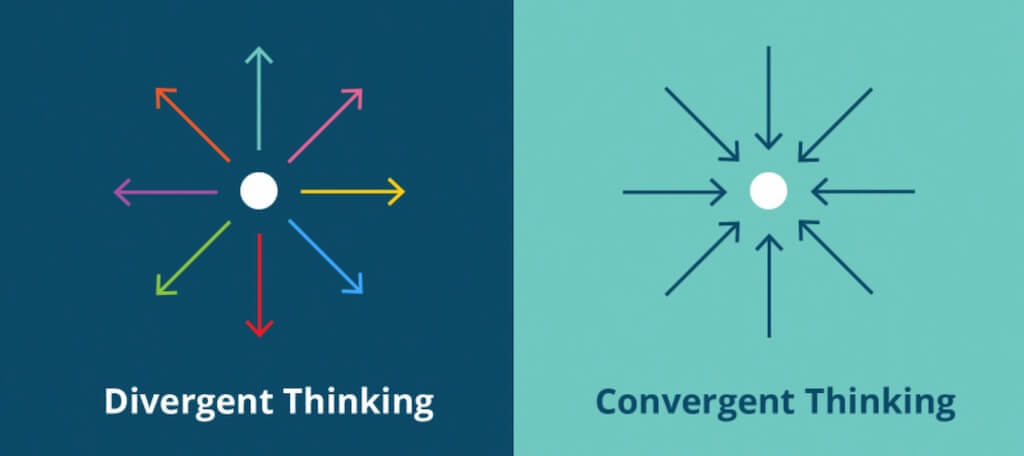
1. Convergent – focuses on coming up with a single, “correct” answer to a question or problem. Examples of convergent thinking would include critical thinking, a logical process that involves challenging underpinning assumptions, questioning accuracy, motivation and purpose in order to make sense of a situation or solve a problem. Its origins can be traced back to Socrates, Plato and Aristotle, or as De Bono disparagingly referred to them, the gang of three.  Also, analytical thinking, where you break down complex information into its component parts, this can and is often used in conjunction with critical thinking. Convergent thinking is logical thinking, meaning its rule based, systematic and linear. If for example we concluded that 2 + 2 = 4 and we decided to add another 2, logically the answer would be 6. 

But logic can still be challenging, there is a logical answer to this question yet 80% of people get it wrong.

Jack is looking at Anne, but Anne is looking at George. Jack is married, but George is not. Is a married person looking at an unmarried person?
A: Yes
B: No
C: Cannot be determined

The correct answer is A. (click here for the explanation)

The need to be right all the time is the biggest bar to new ideas.

2. Divergent – is the opposite of convergent and involves coming up with many possible solutions, acknowledging that there may be no single correct answer. This type of thinking is often emergent, free flowing, illogical and requires creativity. Convergent and divergent thinking can be used together, divergent to generate ideas and convergent to make sense of those ideas and find a practical application. Click here for a video that explains how these two types of thinking work together.

3. Lateral thinking – is a way of solving problems by taking an indirect and creative approach by looking at the problem from different perspectives. Although there are similarities with divergent thinking it is not the same. Divergent thinking starts with a problem at the centre and random ideas are generated branching outwards in all directions, lateral thinking requires the individual to come up with a solution by generating different ideas that result from changing perspective. De Bono writes that lateral thinking forces the brain to break set patterns, it’s a pattern switching technique.

Let’s consider one of his examples, Granny is sitting knitting and three-year-old Susan is upsetting Granny by playing with the wool. One parent suggests putting Susan into the playpen, a relatively creative (divergent) solution. A logical (convergent) answer might be to tell Susan not to do it, but anyone with a three-year-old will know how effective this will be, but that won’t stop them trying!

The other parent suggests it might be a better idea to put Granny in the playpen to protect her from Susan, this is lateral thinking, looking at the problem from a different perspective. Its illogical because granny is bigger and surely you don’t need to protect granny from a three-year-old, but it is still a solution and would work.

I am reminded of a question I was once asked whilst visiting Berlin. “Why did the East Germans build the Berlin wall?” ………“To keep people in of course”, it was a prison not a defence. It’s all about perspective.

Lateral thinking is not a substitute for logical thinking and can be used as a way of generating new divergent solutions, they complement each other and are interchangeable. Lateral thinking is generative, logical thinking selective.

In summary lateral thinking is about changing perspective……

Most of the mistakes in thinking are inadequacies of perception rather than mistakes of logic.

My own personal favourite perspective story

This is the transcript of a radio conversation of a US naval ship with Canadian authorities off the coast of Newfoundland in October, 1995. Radio conversation released by the Chief of Naval Operations 10-10-95.

Americans: Please divert your course 15 degrees to the North to avoid a collision.

Canadians: Recommend you divert YOUR course 15 degrees to the South to avoid a collision.

Americans: This is the Captain of a US Navy ship. I say again, divert YOUR course.

Canadians: No. I say again, you divert YOUR course.

Americans: This is the aircraft carrier USS Lincoln, the second largest ship in the United States’ Atlantic fleet. We are accompanied by three destroyers, three cruisers and numerous support vessels. I demand that YOU change your course 15 degrees north, that’s one five degrees north, or countermeasures will be undertaken to ensure the safety of this ship.

Canadians: This is a lighthouse. Your call.

Lateral thinking for learning

But what has this got to do with learning? Well learning is not just about facts and knowing stuff, the reason we go to school is to gain an understanding of a wide range of issues, concepts and ideas that when faced with a problem we can manipulate and cross check in order to form opinion and come up with a solution. Learning is a consequence of thinking.

Learning without thinking is useless. Thinking without learning is dangerous.
Confucius

De Bono believed that thinking was a skill that could be learned and because lateral thinking helps people develop creative ideas, creativity could also be learned. It is not an innate trait, a type of intelligence that you are borne with, it’s something we all possess, we just need the techniques to do it. He did however distinguish between artistic creativity and idea creativity, Michael Angelo and Shakespeare are artistically creative, lateral thinking will only ever make you idea creative.

As to the techniques, maybe they will feature in another blog but if you can’t wait, here is a short video, but beware De Bono was the master of acronym.

We tend to take thinking for granted, believing we are good at it or maybe never even questioning our ability. But what De Bono made popular was the idea that it was a skill and that we can improve. We live in a time when information is more accessible and freely available than ever, so the real value has to be in what we do with it.

Thank you, Edward De Bono 1933 – 2021.

And lastly….the blog would not be complete without one of De Bono’s lateral thinking puzzles.

A man lives on the tenth floor of a building. Every day he takes the elevator to go down to the ground floor to go to work or to go shopping. When he returns, he takes the elevator to the seventh floor and walks up the stairs to reach his apartment on the tenth floor. He hates walking so why does he do it?

The man is a dwarf and cant reach the higher buttons.

Note making, not note taking – it’s about effort

I have always been a believer in the idea that much of what you need to know is accessible, the answer is staring you in the face and yet you can’t always see it. Maybe because you’re not asking the right question or looking at it from the wrong perspective.

Figuring out how learning works and the best way to study can seem complicated and yet if you watch what people do when they are trying to learn and ask the right questions there is much to see.

For example, watch a group of students in class or a lecture, (remember that pre-Covid) what do they do? Where are they looking, what are they concentrating on and most importantly what activity are they engaged in? The answer to this last question is easy, they will all be making notes. Going forward these notes will become the single most important learning resource the student has.

Why is note making important
There are two basic reasons why you make notes, firstly it improves concentration and cognition, making notes gives you something to do that requires attention, you become more focussed. Secondly you will have created a permanent record of what was said to review later. Interestingly if you asked students, they probably think capturing the information is the sole reason for notes, when in reality it’s the effort involved in making them that mattes in terms of learning.

Its worth adding that making notes works just as well from a book as it does a lecture.

How to make notes?

Blank paper notes – The simplest form of note making is to start with a blank piece of paper. Unfortunately, research tells us that most students notes are incomplete, on average they only capture one third of what was deemed to be important. In addition, they are often inaccurate, in one study, Crawford (1925) found that only 53% of noted information was fully correct, 45% was vague, and 2% inaccurate.

Conclusion – making notes in class is a good idea but if you use those same notes afterwards, not only will you be missing some important information but some of what is there may well be wrong.

Full notes – An alternative to a blank piece of paper is to give students a full set of notes. In 1987 a study by Kiewra and Benton showed that students who reviewed full notes achieved 17% higher scores than students who reviewed their own. This of course may not be surprising given the lack of information captured by students in the first place. Interestingly there is even some evidence to show that reviewing a full set of notes is better than attending the lecture!

Just to be clear, the best way of learning is to attend the lecture, make notes but then review a full set of notes not your own. Unless of course there is another way….

Partial, Scaffolded, Skeletal and Gapped notes
Partial notes may offer the best solution, helping keep the student engaged when in class but providing them with a sufficiently complete set of notes from which to study later. Partial notes contain the main ideas but leave blank spaces for students to complete, for example producing or labelling a diagram, adding in key definitions, working calculations etc. More research in 1995 from Kiewra and Benton but this time in collaboration with Kim, Risch, and Christensen showed a marked increase in completeness from 38% for those who used a blank piece of paper to 56% for those that were given partial notes. What we don’t know from this research is the level of detail that was missing, but it proves the point.

Note taking cues – One tip for teachers, the more cuing or signposting that is deployed the better. This might involve pausing and telling students they must pay attention to a particular point or simply writing out a key phrase or definition on the whiteboard. In one study, students recorded 86% of the information written on a blackboard (Locke, 1977).

Handwritten or typed?
This is a difficult one to answer, with some research to support both forms. We know that most students can type more quickly than they can write and as a result they should have more comprehensive notes to study from. But in 2014 Mueller & Oppenheimer cast doubts on the viability of laptop note taking. They concluded that “whereas taking more notes can be beneficial, laptop note takers’ tendency to transcribe lectures verbatim rather than processing information and reframing it in their own words is detrimental to learning”. In addition, laptop users did not capture diagrams that well, this was thought to be the result of the difficulty of doing this digitally. Copying and pasting certainly captures information but is a relatively mindless activity and leads to a certain amount of unnecessary information being recorded which is off little value.

Conclusion
It would be wrong to conclude that making notes on a computer is worse than writing them out by hand. Its more that a computer makes it easier for students to disengage or become distracted, and if that happens, the learning is less effective. To a certain extent learning has to be difficult, it’s all about the effort, the more you try the more you learn.

We can however say that partial notes are a very good compromise, offering the best of both worlds, helping students capture sufficient information to review later but requiring them to concentrate whilst sitting in class.

I’m now off to — in the —— and have a cold —-

For more links to the research, here is an excellent summary, Note-taking: A Research Roundup by Jennifer Gonzalez – The cult of Pedagogy

Who are you when learning? – Personality

Being a very agreeable kind of a person, I was encouraged to find a piece of research that appears to be unanimously supported in terms of evidence as to its validity, it’s called the Five Factor Model or the Big Five model of personality. Developed by McCrae and Costa in 1987 it simplifies personality, suggesting that we are all biologically predisposed towards the following five traits, Openness, Conscientiousness, Extraversion, Agreeableness, Neuroticism, easily remembered by the acronym OCEAN.

For those who are curious and would like to learn more about themselves there is a test at the end of the blog to help you identify your preferences. But some may have little interest in finding out how well they perform, the reason for these two different attitudes could well be personality. What should however be of interest to everyone, partly because you are reading this blog is to find out what personality has to do with learning.

What is personality?
The term Personality is derived from the Latin word ‘persona’ meaning mask or character. An actor might for example wear a mask (persona) to promote a particular quality in a character as part of a performance or simply use it so as not to reveal too much of themselves.

The term is now more commonly used to describe an individual’s characteristics, patterns of thoughts, feelings and behaviours. In other words, your personality is what makes you, you!

Although intelligence is one of the strongest predictors of student success, there is evidence to show that personality is also responsible for individual differences in how well people learn.

“intellectual ability refers to what a person can do, whereas personality traits may provide information on what a person will do”.
O’Connor & Paunonen, 2007 and Furnham and Chamorro-Premuzic 2004

The Five Factor model
Many people will have heard of the Myers Brig’s Type Indicator, MBTI for short, it’s one of the most well-known profiling techniques. In fact, you may well have been asked to take an MBTI test at some point in your career, although strictly it’s not a test as there is no right or wrong answer. It requires the completion of a self-regulated questionnaire in an attempt to capture how people perceive the world, gather information and make decisions. It’s based on Jung’s theory of psychological types. The main problem with MBTI is that its binary by design, meaning that a person is either an introvert or extrovert which on one level is helpful because it gives you an answer but even Jung admitted that “there is no such thing as a pure extrovert or a pure introvert.”

In contrast the Five Factor Model provides its results in the form of a measure as to how much of the trait you possess, it’s a personality trait rather than a type. But although this is more accurate it’s difficult to interpret, for example you may be 55% agreeable, but what conclusions can you draw from that?

However, many academics and practitioners consider the five-factor model superior partly because there is a lack of evidence to support the MBTI and the results can be unreliable. If you retake the test after 5 weeks, there is a 50% chance you will fall into a different type.

OCEAN

Openness to experiences – this personality trait denotes how receptive you might be to new ideas and new experiences, a willingness to try out the unknown. People who have low levels are generally sceptical about the unknown and happy with the status quo. It might be worth adding that there is no opposite to being open, you are not for example a closed person, just less open.

Conscientiousness – Individuals who are conscientious are able to control their impulses. They are more likely to be successful both in the classroom and in their careers, largely because they are organised, hardworking and determined in the pursuit of their goals.  People with low conscientiousness have a tendency to procrastinate and deviate from their objectives. They can also be impetuous and impulsive. As with openness there is no opposite, you are just less conscientious.

Extraversion – Unlike the above you can be introverted. However, the term introvert refers to where you get your energy from and has nothing to do with being shy. Extroverts gain their energy from activities and other people whereas Introverts prefer the world of ideas and internal thoughts.

Agreeableness – if you are agreeable, you are more likely to get along with others and be cooperative. People on the low end of agreeableness can at times be blunt and sometimes even rude, although they will probably view themselves as being honest and not afraid to call “a spade a spade”.

Neuroticism – this refers to how emotionally stability you are as a person. It often manifests itself in being confident and comfortable in your own skin as opposed to suffering from anxiety, worry, and low self-esteem. Instinctively it feels as if this is the worst trait to be strong in, and you would be right. But we all have some aspects of neuroticism and higher levels are often associated with people who are very creative.

Personality and the connection with learning
It may come as no surprise that the research identifies two personality traits as being the most important from a learning perspective, conscientiousness as a positive and neuroticism as a negative. Students who are conscientious perform well academically whilst those that display higher levels of neuroticism can sometimes struggle, for example they are more likely to suffer from test anxiety and self-doubt. This particular aspect of personality might go some way to explaining why “clever” students don’t do so well.

Conscientious learners are more likely to engage in and succeed at learning.

Students with higher levels of Anxiety (a quality of Neuroticism) will face greater learning challenges than less Anxious students.

It was also found that agreeableness and openness helped students academically suggesting that in addition to being conscientious, cooperation and inquisitiveness was also of value.

Interestingly some research has even shown that personality accounts for a greater part of the variance in academic achievement over and above intelligence,and that personality may be better at predicting academic success at the post-secondary levels of education 2.

However, the more important message is that few of us sit at the extreme of any of these personality traits and as individuals have elements of them all. And by recognising that we have a weakness in one and a strength in another can adapt, whilst at the same time acknowledging that these traits are important because they are what makes us who we are.

Take the test – if you are open and conscientiousness you may want to find out more about your personality.

And here is a fun quiz (Buzz quiz) based on MBTI popularised by long term career advisor David Hodgson. Rather than a 4 letter code David’s idea is to presents the results in the form of an animal.

1 (Bratko et al. 2006; Gilles and Bailleux 2001; Noftle and Robins 2007; Poropat 2009)
2 (Conard 2006; Di Fabio and Busoni 2007; Furnham and Chamorro-Premuzic 2004; Furnham et al. 2003; Petrides et al. 2005).

Feedback – The breakfast of champions

There was an interesting piece of research that came out recently, it referred to something called “Temporary mark withholding”. This as the name might suggest is providing students with written feedback but without marks. On the face of it this might seem odd and frankly unhelpful, how can you judge your performance if you don’t know how you compare against what is expected?

To answer that question, you need to ask a far more fundamental one, what’s the purpose of giving feedback in the first place?

Feedback – task or ego
We need to separate feedback from criticism which often implies that the person giving it is trying “to find fault”, although it’s possible to make it sound a little more positive by calling it constructive criticism. In simple terms criticism is more about what was wrong in the past whilst feedback directs you towards what you should do to improve in the future. But when we are thinking in terms of learning it gets a little more complicated, Dylan William talks about whether its ego involving or task involving feedback. The first of these would include offering praise such as “well done you have produced an excellent answer” but he states this is rarely effective and can actually lower achievement. However when the feedback focuses on what the student needs to do to improve, and explains how they can do it, then you get a significant impact on student achievement.

He goes on to say that “good feedback causes thinking, the first thing a student needs to do when they receive feedback is not to react emotionally, not disengage – but think”. It might be worth adding that Dylan William is talking about the impact of feedback on student learning not on how the student might feel in terms of motivation, self-confidence etc. There is clearly a place for ego type feedback it’s just not that effective when sat alongside a direct instruction because the emotional response often blocks or detracts what needs to be understood for the student to improve.

Formative and Summative assessment
There is one last piece of information that will help us make sense of the reasons why temporary mark withholding might work, the difference between formative and summative assessment.

Summative – The purpose of summative assessment is to “sum up” student learning at the end of a chunk of learning or completion of a course and compare it against a standard, normally a pass rate. This is why exams are often criticised, it’s not that testing is bad, it’s how the results are used, often polarising and narrowing opinion as to an individual’s performance, pass and you’re a hero, fail and you’re a villain. It gets worse when you then put those results into a league table and publish them, with the winners at the top and losers at the bottom for all to see and draw often incorrect conclusions.

Summative assessment is however valuable, if you score below the target, it tells you that more effort or work is needed, also that you are not performing well on a particular topic, but it provides no guidance as to what you need to do to improve.

Formative – The purpose of formative assessment is to monitor progress on an ongoing basis in order to help the teacher identify the “gap” between what the student knows and needs to know. This is where the magic happens, firstly in finding out where the gap is e.g. Where is the student currently compared to where they need to be, then figuring out the best way of getting them to that higher standard e.g. what do they need to do to improve. Formative assessment can be a test, a quiz or simply observation.

Lessons for students
And this is why holding back the marks works, what the piece of research (et al) highlighted, is that when students get their marks, they effectively prioritise the grades over the written comments. The good students ignore the comments because they don’t think they have anything to learn, and the weaker students are demotivated so also ignore them.

The key point for students is this, by all means look at the mark but resist that emotional (ego) reaction to pat yourself on the back or beat yourself up. Read all the comments with an open mind, asking two simple questions, can I see that there is a gap between my answer and the model answer and secondly do I know exactly what to do next to close it? The feedback, if it is good of course should make this as easy a process as possible.

The fact that your script might only say “see model answer” or have a cross with the correct number written next to it, is more an example of poor marking with little or no feedback. Perhaps you should return your script providing the marker/teacher with some feedback highlighting the gap between good marking and bad marking but most importantly what they should do to improve…..

And if your interested, here is the link to Dylan William explaining the importance of formative assessment.

Reference – Kuepper-Tetzel & Gardner – Jackson & Marks, 2016 – Taras, 2001, Winstone et al., 2017 – Ramaprasad, 1983

The single most important thing for students to know – Cognitive load

Back in 2017 Dylan Williams, Professor of Educational Assessment at UCL described cognitive load theory (CLT) as ‘the single most important thing for teachers to know’. His reasoning was simple, if learning is an alteration in long term memory (OFSTED’s definition) then it is essential for teachers to know the best ways of helping students achieve this. At this stage you might find it helpful to revisit my previous blog, Never forget, improving memory, which explains more about the relationship between long and short-term memory but to help reduce your cognitive load…. I have provided a short summary below.

But here is the point, if CLT is so important for teachers it must also be of benefit to students.

Cognitive load theory
The term cognitive load was coined by John Sweller in a paper published in the journal of Cognitive Science in 1988. Cognitive load is the amount of information that working/short term memory can process at any one time, and that when the load becomes too great, processing information slows down and so does learning. The implication is that because we can’t do anything about the short-term nature of short-term memory, we can only retain 4 + or – 2 chunks of information before it’s lost, learning should be designed or studying methods changed accordingly. The purpose of which is to reduce the ‘load’ so that it can more easily pass into long term memory where the storage capacity is infinite.

CLT can be broken down into three categories:

Intrinsic cognitive load – this relates to the inherent difficulty of the material or complexity of the task. Some content will always have a high level of difficulty, for example, solving a complex equation is more difficult than adding two numbers together. However, the cognitive load arising from a complex task can be reduced by breaking it down into smaller and simpler steps. There is also evidence to show that prior knowledge makes the processing of complex tasks easier. In fact, it is one of the main differences between an expert and a novice, the expert requires less short-term memory capacity because they already have knowledge stored in long term memory that they can draw upon. The new knowledge is simply adding to what they already know. Bottom line – some stuff is just harder.

Extraneous cognitive load – this is the unnecessary mental effort required to process information for the task in hand, in effect the learning has been made overly difficult or confusing. For example, if you needed to learn about a square, it would be far easier to draw a picture and point to it, than use words to describe it. A more common example of extraneous load is when a presenter puts too much information on a PowerPoint slide, most of which adds little to what needs to be learned. Bottom line – don’t make learning harder by including unimportant stuff.

Germane cognitive load – increasing the load is not always bad, for example if you ask someone to think of a house, that will increase the load but when they have created that ‘schema’ or plan in their mind adding new information becomes easier. Following on with the house example, if you have a picture of a house in your mind, asking questions about what you might find in the kitchen is relatively simple. The argument is that learning can be enhanced when content is arranged or presented in a way that helps the learner construct new knowledge. Bottom line – increasing germane load is good because it makes learning new stuff easier.

In summary, both student and teacher should reduce intrinsic and extraneous load but increase germane.

Implications for learning
The three categories of cognitive load shown above provide some insight as to what you should and shouldn’t do if you want to learn more effectively. For example, break complex tasks down into simpler ones, focus on what’s important and avoid unnecessary information and use schemas (models) where possible to help deal with complexity. There are however a few specifics that relate to the categories worthy of mention.

The worked example effect – If you are trying to understand something and continual reading of the text is having little impact, it’s possible your short-term memory has reached capacity. Finding an example of what you need to understand will help free up some of that memory. For example…….…if I wanted to explain that short term memory is limited I might ask you to memorise these 12 letters, SHNCCMTAVYID. But because this will exceed the 4+ or – 2 rule it will be difficult and hopefully as a result prove the point. In this situation the example is a far more effective way of transferring knowledge than pages of text.

The redundancy effect – This is most commonly found where there is simply too much unnecessary or redundant information. It might be irrelevant or not essential to what you’re trying to learn. In addition, it could be the same information but presented in multiple forms, for example an explanation and diagram on the same page. The secret here is to be relatively ruthless in pursuing what you want to know, look for the answer to your question rather than getting distracted by adjacent information. You may also come across this online where a PowerPoint presentation has far too much content and the presenter simply reads out loud what’s on the slides. In these circumstances, it’s a good idea to turn down the sound and simply read the slides for yourself. People can’t focus when they hear and see the same verbal message during a presentation (Hoffman, 2006).

The split attention effect – This occurs when you have to refer to two different sources of information simultaneously when learning. Often in written texts and blogs as I have done in this one, you will find a reference to something further to read or listen to, ignore it and stick to the task in hand, grasp the principle and only afterwards follow up on the link. Another way of reducing the impact of split attention is to produce notes that reduce the conflict that arises when trying to listen to the teacher and make notes at the same time. You might want to use the Cornel note taking method, click here to find out more.

But is it the single most important thing a student should know?
Well maybe, maybe not but its certainly in the top three. The theory on its own will not make you a better learner but it goes a long way in explaining why you can’t understand something despite spending hours studying, it provides guidance as to what you can do to make learning more effective but most importantly it can change your mindset from – “I’m not clever enough” to, “I just need to reduce the amount of information, and then I’ll get it”.

And believing that is priceless, not only for studying towards your next exam but in helping with all your learning in the years to come.

Motivated ignorance – is ignorance better than knowing?

If it’s true that the cat wasn’t killed by curiosity and that ignorance was to blame (see last month’s blog) then it follows that we should better educate the cat if it is to avoid an untimely death. But what if the cat chooses to remain ignorant?

Ignorant – lacking knowledge or awareness in general; uneducated or unsophisticated.

In a paper published last February, Daniel Williams puts forward a very challenging and slightly worrying proposition, that when the costs of acquiring knowledge outweigh the benefits of possessing it, ignorance is rational. In simple terms this suggests that people are not “stupid”, or ignorant, when they are unaware of something, they are in fact being logical and rational, effectively choosing not to learn.

“Facts do not cease to exist because they are ignored.” – Aldous Huxley

Beware the man of a single book St. Thomas Aquinas
In terms of education this is clearly very important, but it has far wider implications for some of the challenges we are facing in society today. There is an increasing divergence in opinion across the world with people holding diametrically opposite views, both believing the other is wrong. We can probably attach personas to these groups, on the one side there are the knowledgeable and well educated, on the other those who may not be in possession of all the facts but trust their emotions and believe in community and identity. The two groups are clear to see, those that believe in climate change and those that don’t, Trump supporters and anyone but Trump supporters, take the vaccine or anti-vaccine.

The stakes could not be higher.

“Ignorance is a lot like alcohol. The more you have of it, the less you are able to see its effect on you.” – Jay Bylsma

Motivated ignorance
The idea that choosing to be ignorant could be both logical and rational is not new. In his book An Economic Theory of Democracy first published in 1957 Anthony Downs used the term “rational ignorance” for the first time to explain why voters chose to remain ignorant about the facts because their vote wouldn’t count under the current political system. The logic being that it was rational to remain ignorant if the costs of becoming informed, in this case the effort to read and listen to all the political debate outweigh the benefits, of which the voters saw none.

“If you think education is expensive, try ignorance.” – Robert Orben

Daniel Williams is making a slightly different point; he argues that motivated ignorance is a form of information avoidance. The individual is not remaining ignorant because the costs of obtaining the information are too high, they are actively avoiding knowledge for other reasons. He also goes on to say that if you are avoiding something it follows that you were aware of its existence in the first place, what the US Secretary of Defense Donald Rumsfeld so eloquently referred to as a known unknown.

We need one final piece of the jigsaw before we can better understand motivated ignorance, and that is motivated reasoning. Motivated reasoners reach pre-determined conclusions regardless of the evidence available to them. This is subtly different to confirmation bias, which is the tendency to only notice information that coincides with pre-existing beliefs and ignores information that doesn’t.

If motivated reasoning is the desire to seek out knowledge to support the conclusions you want, motivated ignorance is the opposite, it is the desire to avoid knowledge in case it gives you the “wrong” answer. For example, although you might feel ill, you avoid going to the doctors to find out what’s wrong because you don’t want to know what the doctor might say.

The question that we should ask is, why don’t you want to know the answer? The implication here is that something is stopping you, in this instance perhaps the emotional cost of the doctor’s prognosis is greater than the gain. Similar examples can be found in other domains, the husband who doesn’t ask as to his wife’s whereabouts because he is afraid, she is having an affair, and doesn’t want it confirmed, although in reality she might have just been late night shopping!

“If ignorance is bliss, there should be more happy people.” – Victor Cousin

The idea that we should always seek out knowledge to be better informed clearly has its limitations and that far from being illogical motivated ignorance has some degree of rationality.

What have we learned?
Human beings do not strive to answer every question nor have within their grasp all the knowledge that exists. We are selective based on how much time we have available, how we might like to feel and, in some instances, the social groups we would like to belong. There is always a sacrifice or trade-off for knowledge and sometimes the price might be considered too high.

The answer to ignorance is not to throw more information at the problem in an attempt to make the ignorant more enlightened. If you don’t believe in climate change, not even a well-crafted documentary by David Attenborough is likely to help If the motivation for choosing ignorance is not addressed. This over supply of information was evident in the Brexit debate here in the UK. For those who had “made up their mind”, providing very powerful arguments by equally powerful captains of industry as to why leaving Europe was a bad idea failed to educate because most chose not to listen.

The role of education and learning has to be inspiration and curiosity, we need to get closer to those underlying motivational barriers and break them down. We have to help people appreciate the feeling you get as a result of challenging your views and coming out the other side with a better and possibly different answer. There is a need to move away from the competitive nature of right and wrong and the idea that changing your mind is a sign of weakness.

“When the facts change, I change my mind. What do you do, sir?”- attributed to J Maynard Keynes

And maybe we have to accept that although there is a price to pay whatever it is, it will be worth it.

“no people can be both ignorant and free.” – Thomas Jefferson

If it wasn’t curiosity, what did kill the cat?

In 2006 Professor Dr. Ugur Şahin, an oncologist was working on a curiosity-driven research project to help find out if it might be possible to develop a vaccine to control and destroy cancerous tumours by activating the body’s own immune system. This approach was fundamentally different to the more common treatments of radiation and chemotherapy. Curiosity driven projects often have no clear goal but allow scientists to take risks and explore the art of the possible.

In 2008 Dr. Ugur Sahin and his wife Ozlem Tureci founded a small biotech company called BioNTech who you may never have heard of, if it wasn’t for COVID-19. Because together with Pfizer, BioNTech are the suppliers of the first Covid vaccine to be used in the UK. That early curiosity driven research in 2006 provided Sahin and Tureci with the answers to our 2020 problem.

Curiosity is the wick in the candle of learning – William Arthur Ward
Curiosity is the desire to know or learn something in the absence of extrinsic rewards. The point being, there is no reward other than the answer itself. It is a psychological trait and because of that, has a genetic component, some people are just born more curious. However, nurture has an equally important role to play, and although it’s argued you can’t teach curiosity you can encourage people to become more curious by using different techniques. See below.

Sophie von Stumm, a professor of Psychology in Education from the University of York believes that curiosity is so important in terms of academic performance that it should sit alongside intelligence and effort (conscientiousness) as a third pillar. Her research found that intelligence, effort and curiosity are key attributes of exceptional students.

Curiosity follows an inverted U-shape when shown in graphical form. Imagine a graph, along the horizontal axis we have knowledge and on the vertical, curiosity. When we first come across a new subject, we know very little and as such our curiosity rises as does the level of dopamine, but as we find out more and more our curiosity will reach a peak before ultimately falling.

“When you’re curious you find lots of interesting things to do.” Walt Disney

Curiosity types – it would be far too simplistic to think that there is only one type of curiosity. Mario Livio, an astrophysicist talks about a few of them in his book Why? What Makes Us Curious.

  • Epistemic curiosity is the one we have been talking about so far and relates to the type of curiosity that drives research and education. It’s generally a pleasurable state, the result of a release of dopamine that comes from mastery and the anticipation of reward.
  • Perceptual curiosity is primal and exists on a continuum between fear and satisfaction, it’s the curiosity we feel when something surprises us or when we get an answer that doesn’t quite fit with what we expected. The motivation is to seek out something novel although the curiosity will diminish with continued exposure.
  • Diversive curiosity is transient and superficial and is often experienced when swiping through your Twitter feed. Its effectively a means of jumping from topic to topic and normally fails to result in any form of meaningful insight or understanding.

You might think that as we grow older, we become less curious simply because we know more. However, although we may lose some elements of diversive curiosity or the ability to be surprised, research shows that epistemic curiosity remains roughly constant across all age groups

But why?
The roots to curiosity can be traced back to a form of neoteny, an evolutionary condition that means although we reach maturity, we retain juvenile characteristics. Effectively we are more childlike than other mammals, continuing to be curious and playful throughout our lives. You can often tell if people are curios by looking at their eyes, which will become more dilated. This indicates that noradrenaline, a neurotransmitter has been released in the brainstem’s locus coeruleus, the part of the brain most strongly linked to arousal, vigilance, and attention. In addition, noradrenaline is also integral to a number of higher cognitive functions ranging from motivation to working memory and therefore hugely valuable for learning.

This may well be a slightly complicated way of saying that if you are curious about something, you are more likely to pay attention, making it easier to remember and in so doing learn.

How to become more curious

“Millions saw the apple fall, but Newton asked why.” Bernard Baruch

Research into curiosity has confirmed some of what we might have already assumed to be correct, for example in a paper published in 2009, it concluded that people were more likely to recall answers to questions they were especially curious about. However it also showed that curiosity increased when answers were guessed incorrectly, suggesting that surprise was a factor in improved retention.

“I know you won’t believe me, but the highest form of human excellence is to question oneself and others.” Socrates

The concept that curiosity is based on an Information gap was first put forward by George Loewenstein in 1994 which leads to one of the most powerful tools we can use to improve curiosity, asking questions. The best question to ask is probably WHY, but don’t forget Kipling’s other 5 honest serving men, WHAT, WHEN, HOW, WHERE and WHO. Below are a few more ideas.

  • Ask Socratic questions. This involves asking open ended questions that provoke a meaningful exploration of the subject, this process sits at the heart of critical thinking.
  • Create environments that promote curiosity. Challenges that need solving require a curious mind. Case studies are also more of interest, providing several different routes to explore.
  • Guess the answer first. As mentioned above, if you guess first it increases the surprise factor. Loewenstein also argued that guessing with feedback stimulates curiosity because it highlights the gap between what you thought you knew and the correct answer.
  • Failure is feedback. Finding out why you got something wrong can be just as interesting as knowing that you are right, it certainly increases curiosity.
  • Start with the curious part of a subject. You may not be curious about the whole subject, but try to find the part you are interested in and start there.

And if you would like to find out more

What’s the answer, what did kill the cat?

it was IGNORANCE…………