
To pass an exam – do an exam

To ride a bike - Ride a bike

Although the debate around the value of examinations (testing) is set to continue, new research from Kent State University in the US suggests that examinations aid learning by making the brain develop more efficient ways of storing information. Dr. Katherine Rawson, associate professor in Kent State’s Department of Psychology, and former Kent State graduate student Mary Pyc published their research findings in the Oct. 15, 2010, issue of the journal Science. 

“Taking practice tests – particularly ones that involve attempting to recall something from memory – can drastically increase the likelihood that you’ll be able to remember that information again later,” Rawson said. 

In the article titled “Why Testing Improves Memory: Mediator Effectiveness Hypothesis,” Rawson and Pyc reported an experiment indicating that at least one reason why testing is good for memory is that testing supports the use of more effective encoding strategies. In particular the brain comes up with mental keywords – called mediators – which trigger memories which they would not do when studying only.

 I have to say that this comes as no surprise to me nor would it to any student or anyone who has ever read a book on memory techniques.   It does however add some significant evidence to support the use of testing or mock examinations as a means of preparation for the real thing.

 To pass examinations you require much more than just memory techniques, and in many ways all this research* has done is show that you can recall certain words far more easily if you link them via another word, the mediator, and then test to find out if you can in fact remember them. But because you can’t pass an exam without remembering what you have learned it does mean that by spending a little more time in encoding the information and by testing yourself afterwards you must improve your chances of passing.

 To my mind the research still has some way to go in recognising the other benefits of doing practice exams or tests, and I should add looking at the answers. For example do they not give a very clear indication of the standard required, provide focus as to what is important and what is not, give a concise summary of key parts of the syllabus, show how the knowledge should be applied in the context of the question and improve your level of concentration knowing that you will be tested latter, I could go on.

 How does this help – some tips

 When trying to get something into your head, don’t just read it, although reading is a method of learning, it is not very effective when it comes to remembering. Reading is largely an auditory process; you say the words in your head. Ever heard the saying “I hear and I forget, I see and I remember, I do and I understand”. At the same time as reading, underline the key words and make notes with those key words. The very process of extracting them from the text will help. Next you need to remember those key words, well why not link them with a story (A mediator) or with single words as illustrated in the study. There are several memory techniques that use the principle of association to link words, check out the “stack and link and number rhyme” systems. See video below for an example of how to use the number rhyme system.

 And then of course you need to test yourself and your ability to recall those key words afterwards.

 So be in confident and inspired that what you new has now been proven and that  tests are not just about finding out if you will pass or fail the exam, they are an integral and vital part of the learning process, and that’s a fact.

 *In the research they asked students to remember Swahili-English word pairs, such as ‘wingu – cloud and use a mediator (wingu’ sounds like ‘wing’ – the mediator, birds have wings and fly in the ‘clouds) to link the two.

For more thoughts on what this means – click 

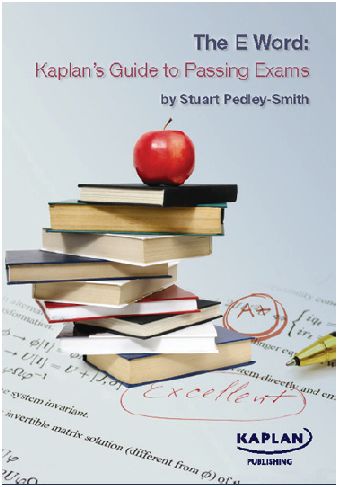
The E word – the book about how to pass exams

E for Exam


I have to say that I feel a little self conscious writing about a book that I have written, yet it has taken up such a large part of my life for the last four years, I cannot let its publication go without saying something.

The E word is a book about exams and how to pass them, and part of my motivation to write it came from the simple observation that success or failure in the exam room was becoming increasingly important. Increasingly important because unlike in the past, when there were jobs and opportunities available regardless of your academic record, this was not the case anymore.
My daughter was 11 at the time and was just about to sit her first really important set of exams. It seemed then and is becoming a reality that this was the start for her of 10 to 15 years, perhaps even longer, of sitting exams! That is a huge chunk out of someone’s life, and for my daughter and many others it was also the first time that her success and failure would be so ruthlessly measured.

There was also this somewhat elitist attitude to rank people in accordance with their exam record, pass and you are in the club, fail and you are not. And from there it gets worse; people begin to plan out your whole life based on what you did on a piece of paper for 3 hours. In some instance elevating you to the highest position, with comments like “he/she will go far”, “very bright, they have a great future ahead”, which is fantastic, but not so motivational if they say “not cut out for an academic career”, “not really bright enough”. It was as if the exam result was a crystal ball that people stared into to predict your destiny.

And based on what, the performance in an exam, and the result you get…….

This is not an argument to change the system nor am I suggesting that we do not need exams; it just brought home to me the importance of passing and the implications of failing.

But I had another motive; my job is to get accountancy students through their final level professional exams. To do this we use a whole raft of techniques that together with a lot of hard work by the students had proved very successful over many years. I was convinced that the techniques we used at this level could be of benefit to anyone who has to sit an exam. So I thought I would write them down and find out.

Run Forest run
Although not explicit in the book, there is a theme on which it is based and one that is important to me. In the film Forest Gump, Forest, the main character (Tom Hanks) is born with learning difficulties, he has an IQ of only 75 (90-110 is normal) yet despite this he manages to excel and ultimately achieve success, because of hard work, determination, clarity in his objectives, oh and with a little luck.

And that’s what this book is about, anyone can be successful, you have to play with the cards you have been dealt. To pass exams, intelligence (whatever that means) is just one factor. Everyone has it in them to pass, you just need the right mental attitude, knowledge of how the exam system works and techniques that will improve your performance.

And if you don’t have them, then buy the book………please

Available for £10.00 from all good book stores, or by following the link to Kaplan publishing

Just in case you forget the many ways that you can eat shrimp
Bubba: Anyway, like I was sayin’, shrimp is the fruit of the sea. You can barbecue it, boil it, broil it, bake it, saute it. There, uh, shrimp kabobs, shrimp creole… shrimp gumbo, panfried, deep fried, stir fried. There’s pineapple shrimp, lemon shrimp, coconut shrimp, pepper shrimp… shrimp soup, shrimp stew, shrimp salad, shrimp and potatoes, shrimp burger, shrimp sandwich… that’s, that’s about it.

Exam focused learning

Exam paper 1On the 20th and 22nd of October I will be delivering a one and a half hour webinar on exam focused learning.  So what this is and how it can help with passing exams is on my mind. It therefore seemed appropriate that this blog should be devoted to explaining a little bit more about it. For those that did attend the presentation and may well be logging on after the event, welcome back, I hope you will find this a useful reminder that may prompt you to add your thoughts or ask some questions. You can do this by clicking on the leave a comment link at the bottom of this blog.

Exam focused learning is a way of studying that places a much greater emphases on looking at specific topics rather than the whole syllabus and using examination answers as a key way to both learn and focus attention. I should also say that this approach is best suited for what I would call more traditional exam formats rather than multi choice questions and case studies.

Imagine you are about to begin studying a new subject, one that you have little or no knowledge. Let’s also assume that you are studying from home. What do you look at first, maybe the text book, you turn to the contents page and look at the 22 chapters that you are required to read and understand. Perhaps you then get a blank pad of paper, a pen, a coffee and begin by reading chapter one. You probably make notes as you go through so that you have something to re-read and revise from later. You go through the entire book making notes in this way and so in theory at least have begun to learn the subject.

The problem with this approach is that it takes a lot of time and although you feel that you are covering everything, you of course aren’t. You will almost certainly have to miss some things out or move more quickly through certain areas just to keep up with your timetable.  The other problem with this “Traditional approach” is that you will spend so much time learning you will have little time left for practicing exam questions.

Exam focused learning does not start with the text book; it starts with your objective. Let’s assume that this is to pass the exam, not learn the subject.  If you wish to pass, on the day of the exam you will have to answer the questions set by your examiner. Now imagine if you knew what these exam questions would be. If you did would you stand a better chance of passing, yes or no. I think yes. The only problem is that you don’t have the actual exam questions……but you do or can obtain lots of past exam questions, questions that have been set by your examiner before.

So here is the first important point, better to learn the answers to these than to learn pages of content from a text book that may or may not be relevant. Now of course this will not work in the complete absence of some understanding of the subject which will have to come from a tutor, lecturer or text book. But the clarity of direction that a question gives, the specific way it shows what you are meant to learn and the context in which something needs to be understood is invaluable.

The next problem, there are just too many past questions.  We really need to have fewer questions to study, at least to start with. By analysing past questions you should be able to identify which topics have consistently come up in the past, these we must learn. Then we look at topics that are likely to come up in this exam. We should be able to spot these in our analysis as being important topics that have not been examined for some time.  These should be learned. And finally we look at those topics that might come up, these are nice to learn.

And here is the second important point, on the face of it this sounds like question spotting but really it’s about focus it simply gives you a point from which to start.  By all means learn everything, but if you can’t or don’t have time, better to have studied and practiced questions on the most important areas and the ones most likely to be examined.

If you change your way of studying to this exam focused approach you will enter the exam room knowing what the three or four most important topics within your subject are. More importantly you will have practiced answering past exam questions on these areas and so will be very well prepared for what might come up. You should also have practiced some questions on the next three/four most likely topics for this exam. Now compare that with the student who has gone through the text book making notes but who due to time pressure had little or no time to practice past questions. Who do you think stands a better chance of passing……?

Exam focused learning….Done

Ps – next year my book currently entitled “The E (Exam) word” should be published. In it I explain in far more detail exactly how to follow the exam focused approach, what to do in the exam, how to cope with exam stress and  how to improve your chances of passing by using effective memory techniques.

Watch this space for more details 

Attention! – Breach of duty as a student

Beam of light

Once again the FT has provided me with some food for thought. An article entitled why e-mail must disappear from the boardroom, Monday 27th July 2009, suggested that main board Directors should give all their attention to the meeting and less to the email that has just arrived on their Blackberry or similar electronic device.

In fact it suggested that by not giving all their attention to the meeting they could be in breach of their fiduciary duty to shareholders.  How would you feel if the surgeon who was about to cut you open was concentrating on an email rather than on you?

It went on to quote some research from Rene Marois a neuroscientist and Director of the Human Information Processing Laboratory at Vanderbilt university that the brain has an inability to concentrate on two things at once. The researchers even have a name for it “inattention blindness”.

Now think about this in the context of learning, if you are in a classroom or any other learning environment for that matter and you move your attention from the classroom to another event, a text or email perhaps, then although you are in the room you have put your attention elsewhere.

Yes you can hear what is going on and yes if someone called your name you could respond all be it slowly, but would your ability to learn and recall the facts from the lecture be as good, somehow I think not.  This is not to say that periodically you should not let your concentration drift as you begin to think about coffee or what you want to do at the weekend, this is a perfectly natural and in some instances a necessary form of relaxation that can help with learning. This is about being engaged, giving The Event your full attention.

Think of your attention as a single beam of light, able to shine on only on one thing at a time, it illuminates and makes clear that one thing but when you move the light what you were looking at becomes dark or at best not as clear, something in your periphery.

And so to the point, when you have an opportunity to learn, attend a lecture or meeting, give it your full attention. You are not being efficient by doing two things at once you are in fact only ever doing one. So if you do have two things to do but only time to do one, look carefully at what they are and prioritise. And if the email is more important give it all your attention and only after you have dealt with it come to class or attend the meeting.

One other point, you do not become invisible when on your mobile, everyone can see that you have your shoulders slumped in the so called “Blackberry prayer”. Now you might think that this sends a very clear message as to how busy and important you are, in fact it does the complete opposite. People think that you are not in control, probably fire fighting, a poor delegator and a poor manager. And yes it’s bloody rude……

Return of the accountant

There was a time when people thought being an accountant was a particularly dull and boring profession. However the face of finance has changed, finance professionals are no longer required to simply crunch numbers or come up with reasons why projects won’t work. They are a key ingredient in the success of the company, required to develop ideas and look for new opportunities.  For this reason it is vital that both students and members look at the events around them in a more positive way, that is positive in the sense of what direction does this now take us and what opportunities do we know have rather than “I am sure this will work out fine”

Take an article written in the Sunday Times 7 June 2009 The video – Game Empire strikes back. In it Dominic Rushe reports on E3, the video games industry annual shin dig, where numbers have been falling and an industry that once thought to be immune from recession seems like an example of an industry living in its own virtual world and not the real one. 

In the article there are many lessons if only you look closely, for example, there is an implication that even though times are hard and yes the industry has had to make redundancies to cope with falling sales, if you continue to innovate and remain focused on your customers there is still much money to make. For students it is a great example of how the product life cycle operates – the gaming industry does seem to be moving into a mature market. It raises the issue that despite the confidence and great creativity in the industry, one of the main limitations is the industry’s ability to raise finance; games development can cost $30m. How many students whilst offering advice in their final level examinations put forward brilliant arguments as to why the company should do something yet forget to answer the very practical question of where will the money come from, we can’t have qualified accountants doing that.

And so to the point, we are living in changing times, with many challenges, companies need there finance team to be at their very best.  To be good, you still have to pay attention to the fundamentals, do we have the finance, will this add value, do our financial statements reflect our true position. But take inspiration from what you read and hear and think about it in the context of your objectives, be that to pass an exam or solve a particularly difficult business issue. Read with focus and direction and maybe one day you will be as good as Luke in return of the Jedi.

No more training do you require. Already know you, that which you need.

Yoda