

One of the most valuable parts of learning is discovering new ideas and different ways of thinking. While some of this comes from formal teaching, we all have access to a vast library of knowledge that can help us learn some of these skills for ourselves. We just need to ask the right questions and look in the right place. Oh, and you might find it helpful to have pen and paper.
Simply reflect on a specific experience and critically examine it by asking yourself questions such as, what did I learn from this? What aspects were unclear or confusing? What approaches were effective, and which ones fell short? Reflection not only deepens understanding but will help identify ways in which you can improve.
By three methods we may learn wisdom: First, by reflection, which is noblest; Second, by imitation, which is easiest; and third by experience, which is the bitterest. Confucius
The value of reflection is well understood and encouraged within education, and although students may not initially see its importance they will be asked to produce reflective statements or keep a journal in at attempt to get them to appreciate its worth. From a cognitive perspective your brain isn’t just opening a file, its actually reconstructing (ironically like an LLM) and rewiring the information. The process will strengthen the synaptic path, develop new associations, which in turn helps integrate different types of information into a “big picture.” Before finally being resaved as a stronger, more complex version of the original idea or thought.
Education begins the gentleman, but reading, good company and reflection must finish him. John Locke
But enough of what it is, let me see if I can put it into practice by reflecting on 2025 and coming up with a few ideas for 2026.
Reflections on 2025
This time last year I set out some predictions as to what might happen in learning from 2025 onwards with the caveat that making predictions is a “mugs game.” Looking back, there was nothing particularly radical in what I suggested. In that sense, if I was being critical, it may be that the ideas themselves may not have helped that much. Even so, I hope that by narrowing the field of possibilities it made the future seem a little less confusing.
The 2025 predictions:
1. Learning will not change but learners will. A reference to how learners will develop different behaviours as a result of AI. This year research from MIT confirmed what many had suspected that using AI has an impact on brain activity, causing what they called “cognitive debt” e.g. saving effort now, but weakening cognitive abilities over time. This will remain a challenge in 2026 and beyond requiring educators to get ahead of the technology rather than simply acknowledging its existence and use.
2. AI (GenAI) will continue to dominate. An easy one perhaps, of course AI was going to play a hugely important part in learning. But there was specific reference to it becoming the “go to” tool for students and the emergence of teaching chatbots. A survey by Hepi and Kortext early in 2025 found that the proportion of students now using AI has jumped from 66% last year to 92% this year. Which seems conclusive, AI has become an ever-present aspect of student life and one that cannot be ignored. Teacher bots have also advanced significantly, with research showing they now deliver consistently high‑quality learning experiences. Expect these trends to continue as well as the big tech companies developing AI integrated solutions for learners and educators e.g. Gemini for Education, Copilot for Education, ChatGPT Edu, Pearson +.
3. Watch out for sector disruption, the result of, a reduced need for textbooks, a different approach to assessment and data becoming even more important. In 2025 Chegg, the US publisher reported first-quarter 2025 revenues down 30%! naming Googles GenAI intelligent summaries, as significantly contributing to the sharp decrease in its traffic. And they are not the only ones impacted, Pearson et al are changing their plans, hoping that AI‑enhanced textbooks are the solution to declining sales, personally I’m not convinced.
By late 2025, large companies were finding access to quality data was stopping them getting value from AI. In fact, Gartner found that 30% of GenAI projects fail because of poor data. As for assessment, in a somewhat backward and reactive step some have reverted to the use of more traditional assessment methods. These include oral exams, handwritten exams and portfolios to combat plagiarism. The smarter more proactive solution would be to build AI into the assessment process, with appropriate guardrails for novice leaners. Some have begun to make changes and will continue to do so into next year but its patchy.
4. Regulation will be in conflict with innovation. This year governments have been working hard to balance innovation with responsible oversight. In the UK and EU, policymakers recognise AI’s potential but are introducing strict rules creating a tension for schools and colleges that want to innovate. In contrast, the US are taking a more flexible approach, offering federal guidance rather than strict regulation. Expect this tension to continue well into 2026, and there’s no simple resolution. While slowing down may feel defeatist, the answer isn’t to rush implementation it’s to accelerate the validation process itself. Meet weekly to assess new tools, prioritise solutions based on the biggest challenges, implement, then move on to the next.
Reflections and projections for 2026 – The level of investment in AI has driven what feels like an arms race in technological development. This has meant keeping up to date with new AI solutions has become increasingly difficult, as has understanding why the latest tool is better than the one, you’re currently using. Technology is advancing faster than individuals or institutions can sensibly integrate and manage within their existing practices. There is no single pathway forward, no consensus on best practice, and little time to evaluate what actually works before the next wave of tools arrive. This mismatch creates risks. Without proper integration, barriers may emerge, whether through poorly designed policies that restrict innovation or the development of tools that undermine rather than support learning. Personalisation and more authentic methods of assessment will remain the North Star for many in navigating this disruptive environment. Keep them in mind, but remember to look down every now and again, you dont want to trip up.
Personally, I’m excited about 2026. AI is opening doors we couldn’t have imagined even a few years ago, and the potential to do good things, to truly make a difference, feels within reach. However, the pace of development is uneven and the world remains unpredictable. More realistically, we are likely to see parts of the education sector make genuine breakthroughs, while others hold back and wait, the result of indecision, or taking a more cautious approach. There is of course no way of knowing which one will succeed in the long run.
Whatever the reason, 2026 looks set to intensify the “Jagged frontier”.
Perhaps Winston Churchill should close out 2025.
Christmas is a season not only of rejoicing but of reflection.
Merry Xmas and a Happy New year everyone – put your running shoes on, but make sure the race is worth running and the prize worth having!

 I have to admit in the last few months I have spent a fair bit of time looking into the facts behind the EU and checking on some of the statements made by both the remain and leave sides, attempting to discover truths or otherwise so that I could make a more informed decision. It proved difficult; much was opinion dressed up as fact by using numbers open to interpretation. Another technique used on the face of it to offer clarity, but in reality did just the opposite, was to state the “facts” forcefully, with conviction and repeat them often, giving the impression that what was being said was not only true but believed to be true.
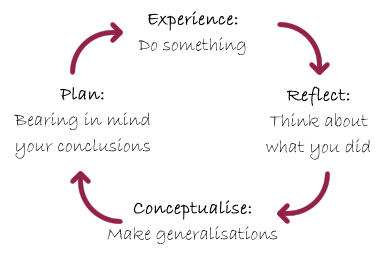 Step one in Kolb’s learning cycle is to have the experience. Step two, reflect, think back on what we have experienced. Step three, conceptualise, generate a hypothesis about the meaning of the experience, what is it we have learned, and step four, test that the hypothesis is supported by the experience, does it confirm that what we have learned is correct.
 Pedleysmiths Blog