
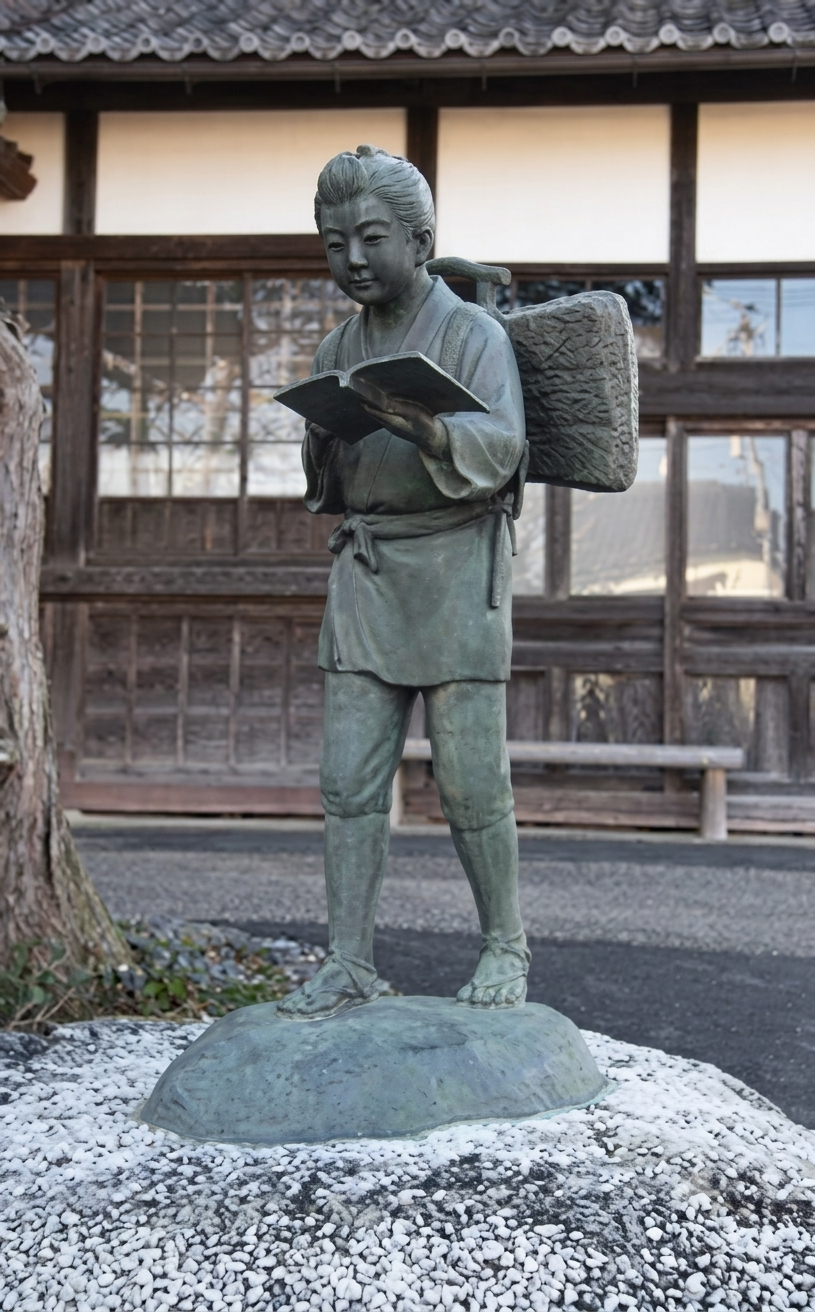
On a recent trip to Japan, I noticed a bronze statue outside some primary schools. It features a young boy walking with a heavy bundle of firewood strapped to his back, his eyes glued to an open book.
TL;DR – the short audio version
The boy is Ninomiya Sontoku (Kinjiro), a 19th-century philosopher and economist. Born into poverty, he lost his parents as a teenager and had to spend his days doing hard manual labour. Because he couldn’t afford lamp oil to read at night, he studied mostly by reading on his walks up and down the mountains to chop wood. It is there to remind children of the desire for relentless self-improvement and that learning requires effort but is possible even in difficult circumstances. He eventually used his self-taught wisdom in maths, economics, and agriculture to save over 600 villages across Japan from poverty and famine.
However, Sontoku’s life points to a broader truth. He didn’t seek knowledge to collect titles or because someone told him to do so. He believed it would help him better navigate the world and understand his surroundings. His motives were to become self reliant and show that a peasant, armed with a book and a sharp mind, could control their own destiny.
Transactional learning
It also has a message for us today. AI is challenging the traditional motivation for learning, which has long been more about acquiring knowledge simply to pass a test. We have become conditioned to see a qualification as the goal and learning a necessary evil. It’s a purely transactional relationship.
If you learn like a machine, a machine will take your place.
That said, this arrangement has worked incredibly well for many years. Motivation is rarely sustained by abstract reasoning, and is most effective when there are concrete short-term goals to provide personal relevance and reward. How many people would commit to learning something on the strength of its intrinsic value, with no immediate incentive – not many!
But as AI cheapens knowledge and answers become readily available, the emphasis needs to shift from simply acquiring information to developing deeper capabilities such as, judgment, critical thinking, and the ability to navigate ambiguity. This calls for a different approach to motivation, one grounded not in short-term incentives, but in the desire to remain in control of your own destiny and not to become reliant on the technology to map this out for you.
Intellectual agility
In the post AI world, the ultimate competitive advantage isn’t what you know, it’s how fast you can adapt. The future belongs to the agile learner, someone who sees each new subject as a challenge that carries its own reward. AI models can now explain the basic facts of almost any field in seconds, knowledge that used to take years to acquire and a career to monetise. This doesn’t make expertise worthless, but it does remove the advantage of simply having it. What AI still can’t do well is judge which knowledge matters right now, or apply it to a messy, real-world situation. So, the value of a person shifts from what they know to the judgment required in figuring out what they need to learn next.
The agile learner also treats unfamiliarity as being interesting and not a problem to overcome. Instead of waiting until they feel confident, they ask questions early and adjust as they go. And they don’t mind looking like a beginner and having to start all over again. Over time this mental attitude builds a level of resilience to change that gets stronger the more challenges they face.
Continual learning
My trip to Japan reminded me that learning was never meant to be a game with a beginning and an end. If we want to thrive alongside AI, we have to drop the obsession with credentials and fall in love with the process of continual learning. I know this is Idealistic, and should not in any way be seen as an argument to remove tests and exams, they are as important as ever for the reasons I mentioned above. However, they cannot be thought of as standalone goals but as part of a much bigger and longer-term plan of continual improvement.
“In times of change, learners inherit the earth, while the “learned” find themselves perfectly equipped for a world that no longer exists.” Eric Hoffer
Like the boy with the firewood, the real goal was never to finish the book, it was to develop the skills he needed to have choices and control over his life. AI can now read the book for us, but it can’t give us the skills needed to maximise the potential of AI and ensure we still remain relevant and in control.
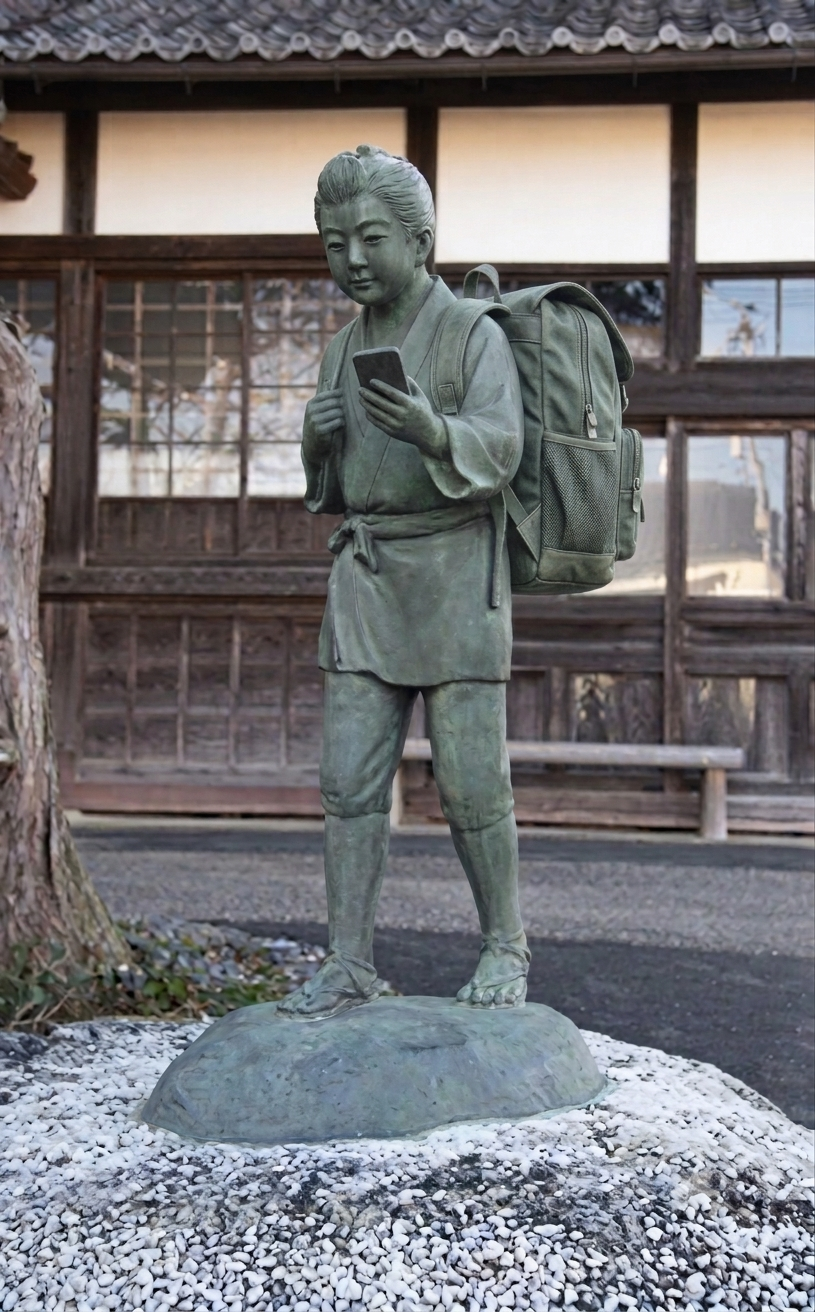
PS – In recent years a number of schools have actually removed the statues, partly over safety concerns about depicting a child reading while walking, some parents thought this was dangerous. Maybe the new image would show Sontoku concentrating not on a book but an iPhone……still as risky but potentially less rewarding.

