

The purpose of learning – Wisdom? Reflections on 30 years

I have always thought that wisdom was something slightly magical, even biblical, reserved for those who have travelled the world in search of the secrets and meaning of life.

But in reality, it’s far less mystical and is more likely the result of a lifetime or simply a longtime of “good learning”. 

This year marks my 30 years with Kaplan a professional education company here in the UK and I am leaving for pastures new. This has inevitably meant I have been doing a lot of thinking about the past, reflecting, and asking some fundamental questions such as, what do I know now that I didn’t know 30 years ago, what has been my most important lesson, and of course the classic, what do I know now that I would share with my younger self? So, I hope you will allow me this slightly self-indulgent post about wisdom.  

What is wisdom?
There seems to be no single definition of wisdom, although all agree that it is much more than simply possessing knowledge. There is also a commonly held view that intelligence plays a part largely because if you are intelligent you are able to solve problems and learn from experiences, but it would be wrong to conclude that intelligent people are wise.

A simple definition is probably all we need – “Wisdom is the ability to make sound judgments and decisions based on knowledge, experience, and understanding.” And when you read that back, wisdom becomes far more accessible and less mysterious. In fact, who wouldn’t want to make sound judgments every single day – We all need wisdom.

But the definition gives little away in terms of what is meant by knowledge, experience and understanding.  John Vervaeke, the philosopher, and cognitive scientist goes a little further by saying that to be wise you need the ability to identify what is relevant from the vast amount of information we are exposed to. “Relevance realisation” helps us navigate complexity and make sense of our world, but to do this you need to pay attention and challenge what you see, continually looking for feedback. This is an example of thinking about how you are thinking or metacognition, reflecting on what was momentarily in your mind and asking questions as to its accuracy, your bias and prejudice. And when you can do that, it becomes possible to develop insight, the aha” moment that comes from a deep understanding, revealing previously unseen connections.  

Okay, that might be a little too much detail but I think it shows that in order to develop wisdom you need the ability to challenge your own thinking, in search of a greater and deeper understanding.

Wisdom and age

The relationship between age and wisdom is nuanced and multifaceted. While age can contribute to wisdom, it is not an absolute guarantee. Wisdom, can be accumulated over time as a result of having different life experiences, but its not necessarily the experience that creates wisdom, it’s what you learn from it. Additionally, with age often comes a greater capacity for reflection, you may simply have more time to integrate your experiences into a broader understanding and as consequence develop that all important insight. Emotional regulation also tends to improve with age, contributing to more thoughtful and less emotional and reactive decision-making.

However, it is important to acknowledge counterpoints that some cognitive abilities for example problem-solving and processing speed, decline with age. In fact, studies from the Berlin Wisdom Project suggest there is a plateau of optimal wisdom performance in middle and old age, with some evidence of wisdom decline starting at the age of 75.  One interesting aside, wisdom tends to correlate with less loneliness. In a study from the University of California, San Diego, in 2020 researchers found that for middle-aged and older adults wisdom warded off the worst effects of loneliness.

In conclusion, it’s not necessarily age that helps you develop wisdom. Its just that you have had more life experience and time on which to reflect together with a greater inclination to do so.

How to acquire wisdom
To think that you can provide an instruction manual for wisdom is at best ambitious and more likely foolish, but there might a few lessons we could learn that will move us in the right direction. A good starting point might be to ask a couple of experts:

  • Confucius said “By three methods we may learn wisdom: First, by reflection, which is noblest; Second, by imitation, which is easiest; and third by experience, which is the bitterest.”
  • And Socrates “I am the wisest man alive, for I know one thing, and that is that I know nothing.

From these “wise words” we can perhaps extract some of the traits of wise people. Wisdom comes from:

  • Reflection – is the process of introspectively examining and evaluating your thoughts, experiences, and actions. It’s a continuous process requiring a creative and inquisitive mind, questioning assumptions and seeking new perspectives. Reflection is an essential component of both learning and wisdom.
  • Experience – you need to have had some interesting life experiences on which to reflect. It is however not necessary to have “seen it all,” only that you questioned, challenge and thought about the experiences you have had.
  • Humility – Socrates went around asking people questions about justice, truth, and wisdom and found that despite them thinking they knew lots, in reality they were ignorant. To be wise you need to reach a sufficiently high level of questioning that you find your own level of ignorance, whilst at the same time not slipping into becoming arrogant.
  • Although not derived directly from the quotes, we should include Virtue – this is about consistently choosing to do what is right and good. It requires perspective, the ability to see things from the point of view of others as well as honesty, courage, kindness, and fairness.

30 years later
What a long time 30 years is, but so far it has been a real privilege to work with good people in an industry that helps people learn, and get a chance to change lives for the good. If I’m honest It wasn’t what I set out to do but its not worked out to badly.

And now to the hardest part, how would I answer those three questions I posed at the start?

  • What do I know now that I didn’t know 30 years ago – in some ways this is the easiest one because I have learned so much. But if I had to pick one thing it would be the understanding I now have as to how learning works. This has served me well in both my teaching and wider career in education.
  • What has been my most important lesson – work hard, have focus and purspose but try to be kind, make friends, and don’t fall out with people, life’s too short.
  • What do I know now that I would share with my younger self – A couple of things I guess, firstly that Socrates was right, “I know that I know nothing.” This is not so much about humility but a recognition that even when you get to a level of competence or expertise, there is always another higher-level waiting for you. And secondly don’t compare yourself with others, only with yourself, if you’re moving forward that’s good enough.

I cant claim the above as wisdom, but give me another 30 years and maybe I will have something for you.

The independent learner – Metacognition

Metacognition is not a great word but it’s an important one when it comes to learning, especially if you are studying at higher academic levels or on your own. Cognition refers to the range of mental processes that help you acquire knowledge and understanding or more simply, learn. These processes include the storage, manipulation, and retrieval of information. Meta on the other hand means higher than or overarching, put the two together and we are talking about something that sits above learning, connecting it by way of thought. For this reason, it’s often described as thinking about thinking or in this context thinking about how you learn.

Smarter not harder

When you have a lot to learn in terms of subject matter it may feel like a distraction to spend any time learning something other than what you must know, let alone reflecting on it, but this fits under the heading of working smarter not harder, if you can find more effective ways of learning that must be helpful.
As mentioned earlier cognition is about mental processes, storage and retrieval relate to memory, manipulation, to the shifting of attention, changing perception etc. But the meta aspect creates distance, allowing us to become aware of what we are doing, standing back and observing how for example perception has changed, this reflection is a high-level skill that many believe is unique to humans. One final aspect is that we can take control of how we learn, planning tasks, changing strategies, monitoring those that work and evaluating the whole process.

Keeping it simple

Its very easy to overcomplicate metacognition, in some ways its little more than asking a few simple questions, thinking about how you are learning, what works and what doesn’t.  Here are some examples as to how you might do this.

  • Talk to yourself, ask questions at each stage, does this make sense, I have read it several times maybe I should try writing it down.
  • Ask, have I set myself sensible goals?
  • Maybe it’s time to try something different, for example mind mapping, but remember to reflect on how effective it was or perhaps was not.
  • Do I need help from anyone, this could be a fellow student or try YouTube which is a great way to find a different explanation in a different format?

Clearly these skills are helpful for all students but they are especially valuable when studying on your own perhaps on a distance learning programme or engaged in large periods of self-study.

Benefits

There are many reasons for investing some time in this area.

  • Growing self-confidence – by finding out more about how you learn you will discover both your strengths and weaknesses. Confidence isn’t about being good at everything but understanding your limitations.  
  • Improves performance – research has shown that students who actively engage in metacognition do better in exams.
  • Gives control – you are no longer reliant on the way something is taught; you have the ability to teach yourself. Being an autonomous learner is also hugely motivational.
  • The skills are transferable – this knowledge will not only help with your current subjects but all that follow, not to mention what you will need to learn in the workplace.  

It will take some time initially but, in a way, metacognition is part of learning, it’s an essential component and as such you will end up knowing more about yourself at some point, even if you don’t want to, so why not do it sooner rather than later.

And just for fun – Sheldon knows everything about himself – even when he is wrong

Case study – Omelettes and Cognitivism

1774_making_summer_sausage_omelette

If you have actually got as far as reading this first paragraph, there must have been something in the title that caught your attention. Perhaps you were simply curious as to how these three words are connected, or maybe one of the words relates to something you are interested in?

Whatever the reason, you have begun to process information and so engage in cognition, put more simply, you have started to think.

Making an omelette

But first a question, take a moment and think about how you make an omelette? ……….Then in your own words, explain how you would do this? ………. As you might imagine this is not about the omelette but the process you went through in order to answer the question.

The process – There was clearly an element of memory and recall as you thought back to the time when you last made an omelette, you would also have needed to direct your attention to the event itself and use strong visualisation skills, to see yourself actually whisking the egg, adding the salt and pepper etc. However so sophisticated is the human mind you can actually create images of making an omelette based on your knowledge of scrambling an egg! The point being, you have the ability to visualise activities of which you have no or little experience. The mental processes outlined above go some way to explaining Cognitivism. Cognitivism in learning is the study of how information is received, directed, organised, stored and perceived in order to facilitate better learning. Cognitivist believe that mental processes should be studied in order to develop better theories as to how people learn.

Case study is higher level

As you progress up the exam ladder the style of examination question changes. It starts with relatively simple activities that require you to recall something already taught e.g. what is the capital of France? It then moves to questions that test understanding, e.g. explain why Paris is the capital of France? At higher levels you will ultimately come across, Application, Analyse and Evaluation, and it is these higher level skills that a case studies often requires you to master.

I have written about case studies before, firstly, Putting the context into case study and secondly Passing case studies by thinking in words. Here I want to explore how by understanding how people think  (Cognitivism) you can develop strategies to help you answer what seem to be impossible questions.

Application of knowledge

Imagine you have been given a case study that has a large amount of information about the company, the people and the financial position. You have been asked to offer advise as to how the company should improve its internal controls within the HR department. Even though you may not think you know the answer, the process outlined above will give a framework to follow.

  • Firstly, focus your attention on the key words – internal controls and HR deportment
  • Secondly, recall any information you have about internal controls and HR departments
  • Thirdly, deploy strong visualisation skills, seeing yourself in that company, bringing in as much detail as possible to give context, and then use common sense
  • Finally write out your answer – Say what you see, talk through how you would do it, mention some of the problems you might experience and outline the possible solutions

These are cognitive strategies developed from learning more as to how people think, why not give them a go?

And here is how to make an omelette from my favourite instructor, Delia – yet another practical tip, remember last month it was how to make toast.

Reflections on Understanding ……Brexit

great briitain leaves european union metaphorI have to admit in the last few months I have spent a fair bit of time looking into the facts behind the EU and checking on some of the statements made by both the remain and leave sides, attempting to discover truths or otherwise so that I could make a more informed decision. It proved difficult; much was opinion dressed up as fact by using numbers open to interpretation. Another technique used on the face of it to offer clarity, but in reality did just the opposite, was to state the “facts” forcefully, with conviction and repeat them often, giving the impression that what was being said was not only true but believed to be true.
But this blog is not really about Brexit, well kind of, I couldn’t let the most important decision made in this country for over 40 years go without some mention.

Following the announcement of the results on Friday the 24th of June I found myself going through what Elizabeth Kubler-Ross described as the five stages of grief. Denial, no that can’t be true. Anger, WHO was it that voted like that, they must be MAD or words to that effect. Bargaining, let me break down the statistics and find out who voted and what group they came from, old/young, North/South, maybe they could be persuaded to change their minds, or better still perhaps we will have a second referendum. Depression, we are all doomed, and finally Acceptance, it is what it is, we now need to make the most of it.

Reflection

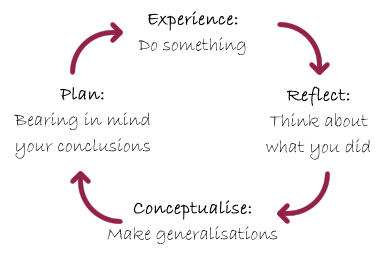
What I have described above is not simply the ramblings of a disgruntled and disenfranchised supporter of the in campaign but goes some way towards illustrating the process of reflection, one of the most important components of learning and a key technique in developing a deeper understanding.  It was David A Kolb who in 1984 put forward the argument that we learn from reflecting on our experiences.

KolbModelStep one in Kolb’s learning cycle is to have the experience. Step two, reflect, think back on what we have experienced. Step three, conceptualise, generate a hypothesis about the meaning of the experience, what is it we have learned, and step four, test that the hypothesis is supported by the experience, does it confirm that what we have learned is correct.

By three methods we may learn wisdom: First, by reflection, which is noblest; Second, by imitation, which is easiest; and third by experience, which is the bitterest. Confucius

Reflection – purposeful thought

Getting students to do this consciously is however difficult, in fairness I didn’t reflect consciously myself, it was part of a process in trying to understand why I was feeling the way I did. I felt angry but on one level didn’t know why, so I had to reflect on what had happened to find out.

The point being simply asking a student to complete say a reflection log, no matter how much you state the value of keeping one, will probably result in little more than blank pages. You need to have a reason to reflect, this might be to identify the cause of an emotion as was the case for me or to answer a question, which may be as simple as, “thinking back on the last essay you submitted, what have you learned?” it just needs to have a purpose. Of course the reflection log may still remain blank but that is more to do with motivation than the power of the exercise.

One simple technique to help with reflection is to think back on what has happened, identify the impact that it will have today on the present and what the implications will be for the future.

Lessons learned

So having passed through the stages of grief, rather too quickly I am sure some will say and reflected on the experience, what have I learned? Well, some has been confirmation of what I already knew. Firstly, that Politicians will make statements that they may or not believe at the time but will back away from after the event. This can be achieved whilst still retaining an internal level of integrity by pointing out that they never used those exact words, standing in front of a bus that has them blazoned across it, is not the same. Did anyone really believe that £350m would be spent on the health service or that Europe would not trade with us at all, after Brexit. Secondly that I like democracy as long as it comes up with the answer I want, but not when it doesn’t. Thirdly, the electorate does not make decisions using in-depth analysis and reflection but by deep held beliefs built up over time, often reinforced by the people closest to them. And lastly that the status quo is not sustainable and that happiness is a comparative process thus making change inevitable and with change comes risk.

Will it be for the better, only time will tell, we will have to wait for the historians to reflect on what the UK looked like in 2016 and whether it was better in 2026, as you can see reflection has many uses!

Let me leave you with my favourite quote of the campaign, not from one of the leading politicians involved, but Abraham Lincoln.

 “Elections belong to the people. It’s their decision. If they decide to turn their back on the fire and burn their behinds, then they will just have to sit on their blisters.”