Intelligence and IQ – does it matter?

Yesterday Boris Johnson delivered the annual Margaret Thatcher lecture at the Centre for Policy Studies in London, in it he said:

Whatever you may think of the value of IQ tests, it is surely relevant to a conversation about equality that as many as 16 per cent of our species have an IQ below 85, while about 2 per cent have an IQ above 130.”

Mr Johnson (Boris) uses the measure of IQ to make the point that if we don’t have equality in intelligence then economic equality is not possible. Effectively he is saying we should accept that some animals are more equal than others, apologies for the Animal Farm digression…..

What is Intelligence?

Yet a large part of Boris’s argument hinges on the term intelligence and that it has some meaning or value, but what is intelligence? The word itself is derived from the Latin verb intelligere, to comprehend or perceive. A good start, but that’s all it is a start, here are a few more definitions:

  • Judgment, otherwise called “good sense,” “practical sense,” “initiative,” the faculty of adapting one’s self to circumstances  (Alfred Binet the creator of the IQ)
  • The ability to learn or understand or to deal with new or trying situations (Merriam-Webster dictionary)
  • To my mind, a human intellectual competence must entail a set of skills of problem solving, enabling the individual to resolve genuine problems or difficulties that he or she encounters. (Howard Gardner, Multiple Intelligence Theory)

The last of these is my personal favourite as it gives purpose to having intelligence, to solve problems. The bottom line, there is no one single definition and experts disagree on how it should be tested/measured. Interestingly the IQ (intelligent quotient) developed by Alfred Binet was only ever intended to be used to identify intellectual disability not to form the basis of an elitist club or for Boris to hijack for his Margaret Thatcher lecture.

Does it matter?

People often have a personal view of their own intelligence, this can sometimes be empowering when you find out “You’re a god Dammed Genius” or limiting if “you discover your IQ is only 75.” Just for the record, 91-110 is average, 80-90 is dull normal, 66-79 borderline and 65 and below, defective.

The very fact that you believe you are intelligent can be motivational, resulting in you putting in more effort. The self belief that you can solve any problem will often result in you solving most of them, and of course proving you are not only intelligent but a genius!

I know that I am intelligent, because I know that I know nothing.

Socrates

Contrast that with the behaviour of someone who believes they are not intelligent or maybe not as intelligent as others. Faced with a problem they will give up, believing the solution is beyond them, and of course proving that they were also right and not a genius.

But Does Boris have a point?

Boris uses IQ (The measure of intelligence) to illustrate the point that we are all different, something that most people would readily accept. What I find uncomfortable is the deterministic nature of his proposition, it implies having a high IQ predicts success and by the exclusion of the many other factors that contribute to success, suggests is the only thing that matters. The Telegraph headline made this point very strongly.

Boris Johnson: some people are too stupid to get on in life

Natural differences between human beings will always mean that some will succeed and others will fail, the Mayor of London says in a speech

Yet on the basis that there is little agreement as to what Intelligence is, the testing and what should be tested is subjective, it would appear a poor basis on which to hang his argument.

Lessons for learning

What I do agree with is that we are all different and that some of this is the function of genetics. (Research indicates that 60% of intelligence is genetic) yet on the basis that you can do very little about this, does it matter?

It is always better to work on what you can change rather than what you can’t. I am sure many of us know people who seem to grasp principles, concepts’ etc and solve problems pretty quick. If you compare yourself to them it’s easy to conclude that they are better and you will always be second rate, so stop trying. The simple answer is don’t compare yourself with them, compare only with yourself, are you getting better and if you are then your improving, and that’s a result.

So forget about measuring intelligence and whether your better than someone else and get on with trying hard and being the best you can.

More on intelligence

Human intelligence, BBC Horizon. An interesting programme that evaluates the intelligence of different high performers.

And the smartest man in the world is…...click here

50 shades of Grade…..Measuring students worth

I don’t often write specifically about the market that I am most closely involved, that of accountancy training and education. But there does seem to be an anomaly in the way the accountancy world measure success that isn’t the case in many other professions and examinations.

To become a qualified accountant in the UK (ACCA, ICAEW,CIMA etc,  yes there are more) you have to pass a number of demanding examinations and submit evidence of practical experience. The exams are taken over 3 years and everything rests on a number of exams of 100 marks each, of which you need to get 50%. The pass rate for accountancy students varies from paper to paper but is around 60% In training and education terms these exams are often referred to as High stake exams. For some failure is not simply a setback in terms of time, it could result in a lost job.

50% good – 49% bad

The purpose of such exams (including the practical experience) is of course to ensure that those that pass are competent. But how competent….?  It seems that you are either competent or not, if you get 49% you are not competent, if you get 50% then you are. This makes the margin for error very high, many a career has taken a dramatic turn based on 1 mark. Now of course in any exam there has to be a point where someone succeeds and another fails but does competence not have many shades to it, is it not a continuous process rather than a discreet one.

Shades of Grade

You may be one of thousands of students (>300,000 actually) who have just had your A level results. But of course you don’t just pass or fail, in fact this has not been the case since 1963, even before then there was an indication of the mark. You are given a grade from A through to E and all are considered a pass, 98.1% passed their A levels this year.

And the grades refer to the marks e.g. E is 40%, a D is 50%, a C is 60%, a B is 70% and an A is 80%. A similar grading exists for Degrees, 2.1, 2.2 etc and for Law exams, Pass, Commendation, Distinction.

No pressure for excellence

So why is this not the case in accountancy? To be honest I am not sure. But by introducing grades above a pass you not only provide employers with a better indication of competency, you encourage colleges to teach to a higher and deeper level, motivated by the students who want to learn more. And that for me is the most important point; you create an incentive for students to try harder. At the moment if you are scoring 55% then why put in more work, a pass is a pass, but a distinction well that will make you stand out from the crowd.

Of course the market will adjust its perception of what a pass means, for example employers may only want students with a distinction rather than a simple pass, but they have always looked and will continue to look for differentiation, at least this is a meaningful one.

What it does not do is fix the 49% you fail problem, and careers will still hinge on 1 mark, but that unfortunately is the way with exams and the reason exam technique is so important.

So to all the accountancy examining bodies why not introduce grades – grey is good and isn’t it an accountants favourite colour?

Tipping the exam is bad….right?

No TippingFor me holidays are not a treat, they are an essential way of  recharging your batteries and provide an opportunity to re think ideas and put things into perspective. I am writing this particular blog whilst visiting Washington DC for a few days before moving onto the real America, Disneyland!


Exam tipping
Now whether its because I was having to get my head around the whole US tipping culture I don’t know, but I found my mind wondered to a conversation I had just before I came away as to the merits of predicting topics that will be on the next exam, so called tipping. This is a fascinating question, and one that is at the heart of the exam focused approach. The logic of the exam focused approach is simple (see  earlier blog for more detail) if the main objective is to pass the exam then the best preparation is to practice The questions that will be on that exam. But on the basis we don’t have The actual exam, then the next best preparation is to practice questions that “you think” will be in that exam, hence the tip.
In many other training environments this approach is common and well accepted. My daughter was taken on the routes most used by the driving test examiner. Although on the day she didn’t know exactly which route it was going to be. As a result of the training and familiarity she felt well prepared, more relaxed which in turn built her confidence, and I am sure this improved her performance on the day.
So what’s the problem?
The problem is that if taken to an extreme, teachers might only teach what they think will be on that particular exam, the so called “teaching to the test”. This results in students not receiving a sufficiently broad or in-depth coverage of the subject and exposing them and their chances of passing to risk, heads you pass, tails you fail.
Application – Focus – Prioritisation 
However exam questions are great tools for application, focus and prioritisation. If a student is taught something and then set a question on that topic, they very quickly appreciate its relevance and value. It certainly helps with concentration, focus and  putting topics in order of importance. The, you can’t learn everything so stop worrying and get on with this question approach…..
Its all about time
If students have sufficient time they should of course learn everything. Although if you think about it you can’t learn “everything”, so there is always some degree of prioritisation.  But in the professional education sector, they don’t. Many hold down demanding jobs by day and study is part time. They look to the educator to give them some degree of priority in what to learn. This comes into sharp focus in the last few days before the exam, and that’s why they will ask for what is most likely to be on the exam, the tip.
So should the teacher tip
It’s all about degrees, at one end of the spectrum, it is very risky and narrows a students learning, at the other it gives focus and application in the last few days before the exam. Personally I would like to see  research on this area some solid evidence to focus the debate. There may be something out there but I have not read anything on this specific question.
But in the absence of such research my view is not to be too dismissive of tipping, it is very easy to completely write it off, leaving the choice of what to focus on just before the exam to the student, when the teacher is probably in a better position to give advice.
and if your interested – How to predict exam questions


And finally my  Holiday books 
I have just started Sal Khans The one world school house – very easy to read summary of how Salman Khan got to become “Bill Gates favourite teacher” and the logic behind what the Khan Academy does.
Thinking fast and slow and The chimp paradox are still as yet to be read.


Now where’s that bill or is it cheque….20% tip!

The lecture -When does learning happen?

“Lectures were once useful; but now the internet and online content are freely available, lectures are unnecessary. If your attention fails, and you miss a part of a lecture, it is lost; you cannot go back as you can with online content. “

The above quote makes the point very forcefully that lectures may not be that effective, and certainly not as good as online. But let me ask a broader question, what is the purpose of a lecture in the first place, does it help you learn and if so when does the learning begin?

The lecture – step by step

In its most simple form the lecture involves little more than a lecturer standing at the front of the class reading from a set or prepared notes or reciting from memory, the student then listens and copies down what the lecturer is saying, presumably to read and absorb later.

So let us break down this process and consider how a lecture helps with learning. Firstly the student has made the effort to attend, this in itself means there is some motivation involved. Secondly they are in an environment designed for learning and with other like minded individuals. All of this helps to put the student in the right frame of mind.

The lecturer will however play a very important part. How well they explain the subject, their level of knowledge, passion and genuine interest can all make a dull topic seem fascinating. And if it is fascinating the student will find it easier to learn. But how much of this can you get from a book, and can this all be achieved online?

And when is the real learning taking place? True the lecturer may ignite a flame and create a sense of curiosity in the student, but the real learning takes place in private, by the student as they revisit the book, video or notes, rewrite, talk out loud and practice questions.  As I have heard student’s say many times, “I need to go over this latter and get it into MY head.”

I am reminded of an Ali quote.

The fight is won or lost far away from witnesses – behind the lines, in the gym, and out there on the road, long before I dance under those lights.

Conclusion

A lecture is a poor method of transferring information, a book or video can explain a topic as easily as a lecturer if well written/filmed. The book and video are both good at providing technically accurate information, but can they transfer the passion, maybe…… but I would argue not as well as the lecture.

You will get a far better view of a sporting event with expert commentary and the ability to watch again on TV, but you are more likely to get a life changing experience if your there watching it unfold live.

So if the only reason you are going to the lecture is to capture information then don’t bother. Stay in bed and get a good book, copy your friends notes or watch the lecture online. But if you want to be inspired/motivated, possibly get a unique view, then go to the lecture.

There is of course a message here for lecturers, your job is to be unique, to inspire and ignite the flame. If not you should also stay in bed, after recording all of you lecture of course.

And for the avoidance of doubt, I do not think this can all be achieved online, a live lecture is different, but the lecturer has to play their role, they have to entertain.

The debate is of course not new – the twist in the tale

Some of you may have recognised the above quote, it’s taken from (with a few amendments from me) James Boswell’s, life of Johnson, the quote is from Samuel Johnson, and the year…..1791!

Lectures were once useful; but now, when all can read, and books are so numerous, lectures are unnecessary. If your attention fails, and you miss a part of a lecture, it is lost; you cannot go back as you do upon a book. . . . People have nowadays got a strange opinion that everything should be taught by lectures. Now, I cannot see that lectures can do as much good as reading the books from which the lectures are take.

Examples of lectures

If only more lecturers could be like this – watch this

And not like this

And although not entirely my thing, everyone should watch the last lecture by Randy Pausche. Although you need to put aside over an hour you will not be disappointed and when you have you will join the 16 million others who have done the same.

Blogging to learn – Learn to Blog

12-bloggers-for-2012[1]Writing a blog can sometimes be a challenge, and sometimes a joy. Yet I have to admit I am not always sure as to my motives for writing one. Why would you want to share your thoughts on a particular subject with the world?

In years gone by it seemed everyone wrote letters or kept diaries. Now people keep in touch using social networks and only politicians keep diaries, needing them for the inevitable autobiography.
 

Never talk to strangers

Maybe blogging fills a void left by the letter writers and diarists of the past, being both a record of your thoughts and a means of communicating with others, even if you don’t know them.

Motives for blogging

There are said to be more than 180 million blog pages in existence, that sure is a lot of motivated people, but why do they bother?

Here are a few reasons and many of them are related to learning.

• Firstly It’s a great way to learn – one reason that making notes is so helpful when trying to learn is that you have to externalise your thoughts and physically write something down, blogging is no different.

• It helps clarify your thoughts – the process of writing also helps clarify exactly what you think, it gets you to question what you know, and as a result you begin to develop a deeper understanding of the subject or topic. Micro blogging (Twitter) is especially effective, not only do you need to be clear in what you want to say, you have to be incredibly concise, less than 200 characters in fact. And yes that includes spaces, full stops etc.

• It becomes a permanent record – others will of course be able to see what you have written but so can you. This means you can look back and reflect on what you thought at a point in time. A modern day diary! Published in weekly or monthly installments

• You become an expert – the more you think and write, the more you engage in something, the better you get. In order to support your views you will probably need to undertake a certain amount of research to check your facts. This again is something that will expand and deepen your knowledge. Remember you can add videos and pictures to the blog; it makes it far more interesting when you do.

• Do you have something to say – ever had a thought in your head and just needed to write it down? Ever had an opinion or a view and wanted to share it with others to get their reaction? A blog is a great medium to express your views and provides you with a much wider audience.

• You get feedback from others and intern learn from them – so having shared your view, the blog becomes a focal point for debate, allowing others to comment on what you have said. Perhaps challenging your views, teaching you new things and forcing you once more to think more deeply.

Learning blogs

You can blog about pretty much anything, but if your studying why not blog about the subjects or even the techniques you find work best when it comes to learning.

Every day you go to University, college or school you come across something new, let the events of your day inspire you. Happy Blogging!

Want to Learn morewikis and blogs

Exams in the headlines – but for the wrong reasons again!

Well it has certainly been an interesting time in the exam world! Here are just a few of the headlines.

Behind all of these headlines are personal stories, for example students who can’t get into sixth form colleges because they didn’t get the necessary grades. The argument being, that if the grade boundaries had not changed (by 10%) resulting in them getting a D and not a C then they would have got into their colleges of choice.

Stacey Cole chief executive of Ofqual said “the grades are right “

Although the impact on individuals is considerable, statistically the change was small. The proportion of test papers awarded at least an A fell by 0.8 percentage points to 22.4 per cent (this was 8.6 per cent in 1988!) the first annual drop since GCSE exams were first sat in 1988. A* grades also fell but only by 0.5 percentage points to 7.3 per cent.

However, when something goes up, it must come down so perhaps it was inevitable that the ever increasing improvement in student grades had to reverse or at least plateau.

What has changed/gone wrong? 

  • Teachers are encouraged to prepare students for the exam, because parents, employers and educational institutions measure success at least partly (exclusively?) by the results.
  •  Students are better at exam skills than ever before. After all, this blog is about how to pass exams and the skills needed to help.
  • Universities and employers seem equally unimpressed with the quality of students and candidates they get, complaining they don’t have basic levels of numeracy, literacy and common sense!

Answers to some of the questions

Have students been getting better each year?

I think the answer is yes, the results prove they have. But maybe they have been getting better at passingexams. And not improving on some of the more difficult to measure skills like, attitude, common sense, being thoughtful. Exams don’t give you time to be thoughtful! This might explain why employers are so unhappy.

But they may just be getting better…..
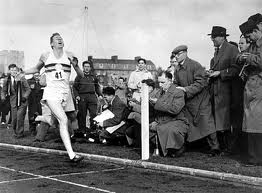
On the 6th of May 1954 Roger Banister ran the 4 minute mile, it is now the standard of all male middle distance runners. Does this mean the mile is now shorter…….or maybe runners have improved?

Why did someone not say something?

The pressure to succeed, measured by exam results has been so great on teachers, examining bodies and students that no one was willing nor was it in their best interest to say, “this just doesn’t make sense.”

Why do we have exams, to test knowledge/competence or to separate the best from the rest?

They should probably be to asses’ knowledge but are mostly used to try and pick the best people.

Have exams been made easier, the dumbing down argument?

This is tricky, and although you can compare exam papers it’s a bit like comparing Wayne Rooney with George Best. You can debate the pros and cons but I am not sure it is conclusive; things were just different in the past.

But it’s not fair

What does seem clear in this whole debacle is that raising the grade required
half way through the year is not an example of exam rigour, it’s an example of being unfair and that is the one thing exams should never be.

Also see my blog what do exams prove

Back to more exam tips next month….

Are you taught in the most efficient & effective way? – The flipped classroom

To pass any exam you need to learn in the most efficient and effective way but only part of that is down to you the student, much is about the way in which you are taught.

Little has changed in the way knowledge has been transferred over the years. Initially teaching was one person talking to a few people; let’s call this the Neanderthal approach, the first classroom? Then we had a major innovation the printing press, around 1450, which made it possible for knowledge to flow around the world, all be it slowly, no email in those days. But with the advent of the computer in 1837 (Charles Babbage) or 1942 (first digital computer) or the first PC, IBM 1953, the ability to store and transfer information to the masses was possible. Yet little changed in the way we were taught, until now.

Now we have both online and classroom learning. But what is best way to learn, what is the most efficient and effective way to transfer knowledge?

The lecture

If you think of a traditional lecture, the lecturer stands at the front and talks, the student makes notes and then goes away to read and perhaps actually learn something about the subject.

The online approach

A mass of content is available online, you can watch the very best lecturers from all around the world, stopping and starting the presentation to suite the speed in which you learn. Or perhaps you have a sophisticated e learning course where activities are carefully constructed to explain what you need to know. But this can be lonely and despite the claim that online is the same as being in a classroom, from my experience it is not, it is different.

The blend and the flip

But is the best method to have a blend of both online and Classroom / Lecture Theater. This is the idea behind the blended course. Attend the lecture and then watch some online instruction later in the day perhaps. However much thought needs to be given to how this works, directing students to random You Tube clips is far from ideal. Yet it feels like a move in the right direction.

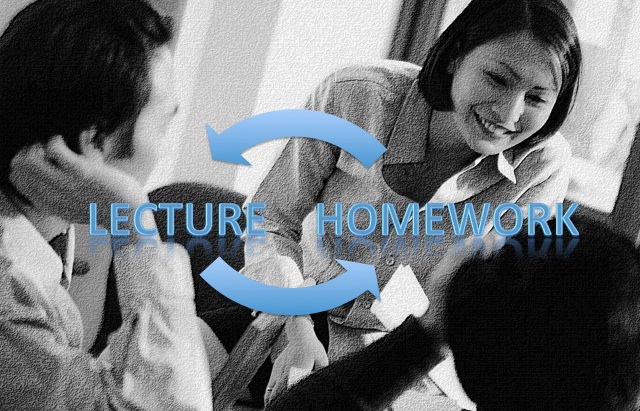
And now the Flip – The flipped classroom (2004 ish) takes its name from the idea that content has historically been taught in the day and students expected to apply that content in their own time for homework.  But is making notes in class the best use of that face to face time? Should students not watch the lecture on the evening, benefiting from studying at their own pace and then attend class the next day, where they can ask questions? Can we flip the process?

In class the lecturer or teacher can then bring the subject to life using real world examples, answer student questions and deal with individuals on a one to one basis.

It’s not perfect, but it is better

Okay it is far from perfect and it has yet to be proven over time. But it does seem to make a lot of sense and for the first time we may be seeing the power of the PC complementing rather than competing with the classroom.

Oh and it has some powerful supporters Sal Khan & Bill Gates

Watch this for a great explanation why flipping the class is a good idea

Deliberate reading – How to read technical content

In his book Five Minds for the Future Howard Gardner identifies one mind as the Synthesising Mind. He describes this as the mind that takes informationfrom disparate sources, understands and evaluates that information objectively, and puts it together in ways that make sense to the synthesiser and also to other persons.

We live in an age where knowledge is not hard to find, just Google something and you will find no shortage of information on any subject. The skill or mind that you need to develop is to be better able to filter information focusing only on what is important and ignoring what is not. 

But there is just too much!

As a student at some point you will find yourself having to read a book that contains masses of information that you need to learn but given the volume probably not able to absorb. You will need to filter the information, reduce it down into manageable chunks that can be understood and made sense.

As Gardner suggests, this understanding is initially for your benefit but eventually you will have to explain it to others, so the understanding needs to be deeper than simply knowing.

So we need a way in which you can both read and learn at a deep level. Children read instinctively using their finger, putting it under the words they are trying to say. Of course when they go to school using your finger to learn is not encouraged, so they stop. But there is good reason that children do this, you need to focus your attention and pointing or underlining is one way of doing it. Below is a step by step guide as to how to read technical stuff or in fact anything that you need to have a far better understanding than a few random facts.

How to read with your synthesising mind

1. Find the content page in your book and very loosely mind map or write out the chapter headings; see my previous blog on mind mapping. Do this IN THE BOOK, okay you will have to write on the book and that might feel uncomfortable, but you need the information all together and the book is the best place to store it. This will help you gain an overview of what is to come. Your brain will already begin to put some shape to what you are about to learn and begin to make linkages.

2. Read each chapter, but underline the key points, try to underline key words and not huge paragraphs. This in itself will help you start to focus on what is important. Yes it will slow you down but you are not just reading you are learning. Knowing what the key points are is not easy so you will have to concentrate, however don’t spend forever, often your gut instinct is the right one.

3. Write in the margin your understanding of the key points or even just copy out what is in the book. The purpose of this is to reinforce the knowledge and to make it stand out even more. It is better if you have to think about what is said in the context of what you are trying to learn and write it out in your own words. However you don’t always have time, so never be afraid to simply copy.

4. Mind map or summarise all the key points that you have written in the margin within the chapter at the front of that chapter. This is your chance to show how it all fits together. Double check your summary with the one that is in the back of the chapter, this will make sure you don’t miss anything. Now of course what you could do is just read the summaries at the end of each chapter and if you are really short of time this can be very effective, however you will not learn from this, but it can be a better way of getting a more detailed overview than you would from the contents page.

5. Look at each of the chapter summaries and add to your initial overview of the book or simply re write the whole thing. This final summary or mind map will help consolidate your thoughts on what the really important points were, the key messages and aid your understanding.

Also in a few years if you pick this book off your shelf, or when you come to revise, it will be this summary that will bring everything flooding back.

And just in case your curious – the other four minds are

The Disciplined Mind

The disciplined mind has mastered at least one way of thinking – a distinctive mode of cognition that characterizes a specific scholarly discipline, craft or profession.

The Creating Mind

The creating mind breaks new ground. It puts forth new ideas, poses unfamiliar questions, conjures up fresh ways of thinking, arrives at unexpected answers.

The Respectful Mind

The respectful mind notes and welcomes differences between human individuals and between human groups, tries to understand these “others,” and seeks to work effectively with them.

The Ethical Mind

The ethical mind ponders the nature of one’s work and the needs and desires of the society in which he lives. This mind conceptualizes how workers can serve purposes beyond self-interest and how citizens can work unselfishly to improve the lot of all.

It’s a Wonderful Life – lifelong learning

In 1946 Frank Kapra made what is arguably the best Christmas film of all time, it’s a Wonderful Life. It tells the story of George Bailey (Jimmy Stewart) who on Christmas Eve gets drunk after being told that there is a warrant out for his arrest for bank fraud.  In a moment of despair he threatens to throw himself into an icy cold river, believing that this will solve all his problems. He is interrupted by Clarence, his guardian angel (second class) who appears and jumps into the water before him. George is forced to rescue Clarence but does not believe that he is his guardian angel and wishes that he had never been born.

And so the scene is set for Clarence to show George that the world would be a very different place had he not been born. Had he not saved his brother from drowning, stopped Mr Gower (the local pharmacist) giving out a lethal prescription and put his dream of travelling the world on hold to run the local bank (Savings and loan).

George was a man with ambition and drive, he constantly put others before himself, in every way a good man. But as can often happen he found himself in situations that he had not expected, arguably did not deserve, that at the time seemed impossible to solve.

Lifelong learning

We often think that studying is something that you do when you are young and then when you have learned everything by the age of say 25/30, you sit back and relax!  Of course this is not true, learning is a lifelong pursuit. It may not always have an exam at the end, but there are lessons to learn and successes and failures to deal with in equal measure. A Wonderful Life follows the ups and downs of George Bailey and in one way is sad because he never does fulfil his ambition to travel. But he learns so many other things along the way, perhaps most importantly that some of the smaller things you do have a huge impact on others and that when faced with apparent failure or disappointment there is always a solution, and it’s not jumping off a bridge…

So perhaps you didn’t get the exam results you wanted or didn’t get a place at university but this is only a moment in time. It is not the end of the journey; it’s just a different beginning.

Steve Jobs tells a great story about “Joining the dots” how you can only join the dots backwards not forwards. Had he not dropped out of Reed College and wondered into a calligraphy class one day then in Steve’s words “the Mac would have never had multiple typefaces or proportionally spaced fonts. And since Windows just copied the Mac, it’s likely that no personal computer would have them.”

So wherever you are in your lifelong learning class, have a very Merry Christmas.

A lesson for today’s bankers

When faced with the bank collapsing George Bailey put in his own money to save it. A modern day lesson for some of today’s greedy bankers perhaps. Sir Fred Goodwin, please note….

A beautiful mind or just a different one – Personalised learning

My Daughter is sitting her mock exams at the moment, my wife is taking her to school just in case the train breaks down! And I have just finished teaching revision; only the dog seems unaffected by this November/December exams season.

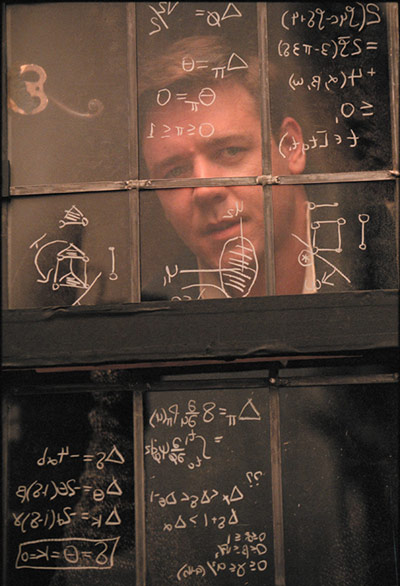
Watching my Daughter study was interesting, she has discovered that you don’t need a white board to make notes, and just like John Nash (A beautiful Mind) has been writing on our dining room windows with a marker pen.  She also created a game where the answer was under a flap of paper and found that she learned more effectively when teaching someone else, me. Go on ask me a question about respiration or stem cells…..

I have written on the merits of learning styles before,”learning styles don’t work or do they,” but in that blog I focused more on how you process information rather than using differing methods to learn. For example making notes using mind maps rather than in a linear format or writing on the window rather than on paper…..  Different people learn in different ways and at different speeds. This is why there is a big push in education to personalise learning, to make it sufficiently flexible for each individual to learn in their own way.

The argument is that in the last century education was delivered in a style needed to prepare people to work in factories. It required little in the way of individual thought just the ability to perform simple repetitive tasks, the same as everyone else. As a result pupils were all taught in the same way, sat in rows, repeating the same thing over and over again, and dressing alike. Okay a bit Orwellian and not entirely true, there have always been great teachers, but you get the point.

But now we live in a world that is constantly changing, problem solving is highly praised and keeping up to date with the latest information or developments is essential. So learning needs to change.

Different ways to learn

There are of course many ways to learn, but below are a few tips and hints.

  •  Making notes – writing something down is an incredibly powerful method of learning. Some people like mind maps, others prefer lists or bullet points and why not try Concept Mapping. The key point, just write it down.
  • Cards – reducing down what you have to learn and put it onto small cards. This is great for individuals who like to rearrange information, putting the most important first or eliminating what has been mastered.
  • Get a learning habit – make a routine out of what you do so that you perform a task without thinking. Learn one new fact before you go to bed, always have a book to hand or have notes on your mobile so that when you are on the train everyday you can study for 20/30 minutes.
  • Talk out loud – okay people may think you are a bit strange but listening to your own voice can really help.

Of course not all of the above will work for everyone that’s why you are you, an individual, the secret is not to give up if one method does not work.

Ps other great films about learning

Good will Hunting and the best of all Dead Poets Society

Let me know your favourites?

Learning styles – don’t work or do they?

Much has been written about learning styles and in the world of education the very idea that there might be one “good way” to learn remains controversial.

The term which refers to the many ways in which we learn is often used interchangeably with ‘thinking styles’, ‘cognitive styles’ and ‘learning modalities’.


However, a number of researchers have attempted to break down the concepts and processes that underlie the term into three inter-related elements:

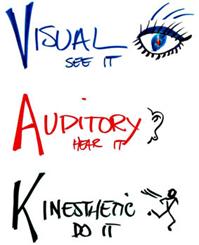
  • How you process Information – How you perceive, store and organise information, for example, VAK, visually, auditory, kinaesthetic.
  • The environment in which you learn – Your preference towards learning in a certain way, perhaps with others or on your own or in a certain setting or at a particular time of day.
  • Learning Strategies – Your use of differing methods to learn specific subject matter in a particular way. For example making notes using mind maps rather than in a linear format.

In this blog I want to concentrate on the first of these, how we process information, in particular VAK, however the observations are just as relevant to other learning styles.

 VAK – a preferred learning style

The argument is simple, everything you have learned at some point has come to you through your senses, but have you got a preference, is there one method that you as an individual are more receptive to than another? Do you for example prefer to look at pictures and diagrams  (visual) rather than listen to someone explain how it might work (auditory) or would you like to do something rather than talk about it (kinaesthetic).

Find out your learning style by taking this simple test

Learning style How we learn Learning tip
Visual seeing and reading Use mind maps and colours
Auditory listening and speaking Make an audio of your notes
Kinaesthetic touching and doing Practice questions.Build it….fix it….

But do learning styles work?

Watch this clip as Professor Daniel Willingham describes research showing that learning styles are a myth and that learning styles dont exist.

Baroness Susan Greenfield, Professor of Pharmacology at Lincoln College, Oxford University and ex Director of the Royal Institution has even been brought into the debate.

Writing in the Times Educational Supplement Magazine (29th July 2007), Susan Greenfield said that “from a neuroscientific point of view is nonsense” (the learning style approach to teaching) was nonsense. Humans evolved to build a picture of the world through our senses working in unison , exploiting the immense interconnectivity that exists in the brain, It is when the senses are activated together that brain cells fire more strongly than when the stimuli are received apart.” Abridged

Its learning about learning that matters

So, given this lack of consensus amongst researchers, why bother to consider learning styles at all?

The reason I would suggest that knowing about learning styles is helpful is not so that you can label yourself an “auditory learner” “theoretical learner” etc, this can narrow your ability to learn and even provide an excuse for poor performance, “I did not do very well at that because I am not that theoretical”. No it is to broaden your horizons and give you alternative ways of learning should you get stuck when trying to understand something.

Understanding more about how you (might) learn can really help. Imagine you are sat there at night reading and re reading a chapter in a book, clearly getting nowhere, becoming more frustrated at your own abilities. What if you stopped reading to yourself and begin reading out loud, thus changing a visual internal auditory style to a visual external auditory one. Susan Greenfield is right, we learn best when we stimulate the brain with all our senses and not just one of them. Understanding about learning styles is about creating more choice and flexibility, if one method isn’t working then change to another.

Sorry is not good enough – Exam paper mistakes

9 exam paper errorsExams seem to be in the news a lot these days, unfortunately often for the wrong reasons. This month we were told of at least six errors on exam papers sat by students studying A-level, AS-level and GCSEs taken in England, Wales and Northern Ireland. The errors were on questions with marks ranging from 1 to 11 and effect 90,000 students. In fact it is hard to keep up; only yesterday there was news of another possible three mistakes, bringing the new total to nine!

The examining bodies have said they were sorry and that they would take into account the errors when they come to mark the paper, ensuring that no students would be disadvantaged as a result. Firstly an apology is not good enough, it should not happen in the first place and secondly they can’t “take into account” the full impact of the mistakes. And it looks like David Cameron agrees……

Now of course everyone makes mistakes, but when the consequences are as important as this there should be a system in place to ensure they are spotted. That system should include having an examiner, an assessor and a sitter. This is in addition to the normal proofing and arithmetic checks. The examiner writes the paper, and presumably checks it, the assessor also checks the paper, ensuring the wording is clear and that what is being asked is within the syllabus and technically correct. The sitter should then attempt the paper under exam conditions, to make sure that it can be completed in the time available. If these processes are followed it would seem almost impossible for a mistake to be made, I wonder what went wrong?

Equally it is not possible for the examining body to ensure that no student is disadvantaged. What can they do, be generous with the marks for any attempts made?  What if the student looked at the question tried to do it, panicked and as a result wasted valuable time, making little or no attempt at the rest of that question, there is in effect nothing to mark. What can you do in these circumstances; just add on say 5 marks!

How can you take into account the student who raced through the second question because they spent so much time on the first and made mistakes due to the time pressure, add on another 5 marks!

And what about the student who looked at this question, lost their confidence and so failed to complete the paper, add another 5 marks!

Listen to this confident student describe the impact of a mistake in the exam.

And he got no reply…..

What to do if there is a mistake

There is however some good news, you can still give yourself the best chance of passing if you apply some simple exam techniques.

1. Stick to the mark allocation – if it is a 10 mark question then only spend 18 minutes on it, 1.8 marks per minute for a three hour exam. So even if you cannot answer the question because of a mistake on the paper you will not be wasting time that could be better used on the next question.

2. Don’t think you have to get everything exactly right. Your objective is to pass the exam with the highest mark, so you may have to accept that you will not get 100%. And of course getting 100% correct is impossible when the examining body has put down the wrong information! Do your best and move on.

3. Make assumptions – read the exam question slowly, underline the key points and if it doesn’t make sense clarify what you think it is saying by stating your assumptions. Then answer the question in accordance with your assumptions.

4. Don’t bother asking if you think there is a mistake. There is little point asking in the exam if there is a mistake on the paper. The invigilators on the day are unlikely to be subject experts and so will do nothing. Let others put their hand up and ask, you should keep your head down and get on with answering the question.

Remember exams are more than tests of knowledge and they are not always fair, but they are equal, everyone in the exam room is faced with the same examiners mistake. How you deal with those mistakes however can make all the difference….

Another TED lecture worth watching

And finally I have another TED lecture for you to watch. It is presented by Sir Ken Robinson who gives a very interesting talk on what he describes as a crisis in our education system – personalised learning not standardised/production driven learning.

No excuses FREE knowledge – The Khan Academy

I look to do one blog a month, not  that demanding I know but enough for me. However I am so excited about what I am going to show you next I wanted to post something now!

Check out this link to something called the Khan Academy. The Khan Academy is a not-for-profit organisation with the goal of changing education for the better by providing a free world-class education to anyone anywhere, okay their words not mine but an impressive mission none the less. All of the site’s resources are available to anyone. It doesn’t matter if you are a student, teacher, or parent. The Khan Academy’s materials and resources are available to you completely free of charge.

This is a great example of open or free content, knowledge that is available on the internet for free, so now you have no excuses you can learn anything for free………

Okay you can’t learn everything, there are ONLY 2,100 videos and there are issues, how good are the lessons, are they of the right standard and quality, are they up to date, how relevant are they in helping you pass your exam?

Equally the Khan Academy is not meant to be a substitute for structured learning. There is more to a course or a well written text book than simply knowledge.  Teachers motivate and focus attention, they identify what is important and what is not, they will link topics together in such a way that makes the whole subject easier to understand and follow. But this material can really help, it can complement a structured course so that teachers can free their time to support and show how the knowledge can be applied. And if there are specific topics that you have never understood, just check out one of the lectures from the library.

This is not of course the first website to provide free content and it is American, do they not know that Math’s has an S on the end! But it is pretty good and it’s not just me who thinks that, Bill Gates does too.

In a time when universities are increasing their fees to teach stuff, it might be that they need to reassess exactly what they are charging for, because if its knowledge, well why pay for that when you can get it for nothing! 

Watch this TED lecture given by Sal Khan the founder

And for my students not sure about earning per share EPS

Or the PE ratio

Or what market capiltalisation (wth an S) might mean

Exam techniques worth £100,000

I am not sure what to make of the latest news that a law student Maria Abramova is suing the Oxford Institute of Legal Practice (OXILP), part of Oxford Brookes University for £100,000 claiming they did not prepare her well enough to sit her legal examination, specifically they did not teach her exam techniques. 

She claims that failing the exams left her with a ‘blind spot’ when it came to taking future exams and eventually contributed to her failing the New York bar examination in 2008. She has since decided not re-sit the American examinations, as the process of taking legal tests causes her to become psychologically distressed.

Maria Abramova was clearly academically bright; she graduated in July 2004 with a 2:1 degree in law from Oriel College, Oxford. In all her studies with OXILP she had consistently been graded “very good”, the top grade.  Of the 357 other students that studied that year more than 99% went on to pass the paper at the heart of the litigation.

Who is to blame?

So what went wrong, does she have a case, is a college or university responsible for getting the student through the exam or is their job simply to deliver knowledge in an inspiring and understandable manner. And do exam techniques make that much difference anyway?

It is perhaps not surprising that a case of this nature has finally come to court. With exam results determining the opportunities for many and the price of education on the increase, why should educators not be accountable………….What is interesting is that this case has focussed not on the content of the course – “I was not taught X and X came up in the exam and that is the reason I failed,” but on exam techniques.

Now as someone who delivers courses on exam techniques and believes they are a vital part of passing examinations, it would be hard for me to argue they are unimportant or make no difference. But I come from a world (Professional accountancy and tax qualifications) where passing an exam is considered a vital part of the success of the course. I am not sure that this is the case with OXILP.

Its about responsibility

To answer some of these points you need to clarify how much responsibility should rest with the student and how much with the tuition provider. Education has to be a partnership; students are not empty vessels simply waiting to be filled with knowledge, they do have to try hard and study independent of the class, they should talk to other students and find out what they do and perhaps most importantly, they should challenge and if they are not happy seek a remedy.

I am of course no lawyer and await the outcome of this case with interest, but I can’t deny that I am pleased that someone has managed to put a £100,000 price tag on the value of exam techniques. And should Maria ever want to reconsider her decision to give up exams and need help with exam techniques I could certainly recommend a good book…..

Predictions for 2011 – but first 2010

Although the New Year has started without me I thought I might take the opportunity to look back at 2010 and make some predictions as to what might be happening in the world of education and learning in 2011.


First a retrospective

Degrees not free – 2010 will be remembered by most as the year in which a price tag was firmly hung around the neck of Higher Education in England, degrees were no longer free. True they weren’t free before but somehow £3,290 was acceptable or should I say accepted. With the government under pressure to reduce public expenditure and more and more people wanting to study full time, the costs could no longer be hidden and absorbed by all, they should be paid for by those who benefit most, the student.

Books published – On a personal level 2010 saw the publication of my two books. “The E word”, a book about how to pass exams and “A students guide to writing Business Report s” co-written with Zoe Robinson.  A giving birth experience for me I have to say….. 

The E word - published 2010


The E word – This book is a must read for anyone taking exams, especially financial exams. States the obvious but it’s the obvious that you haven’t thought of. Explains how we should revise and why we should revise in a certain way. Just reading this book puts you in the frame of mind to study and gives you a framework to start a study plan. Amazon.co.uk

 The E word – This is an excellent book for anyone taking any exams, from school to university. This is written by a teacher and parent which is most definitely reflected within the book. theschoolrun.com

Trends and Predictions for 2011

It’s always dangerous making predictions about the future, particularly in print, but here goes.

Innovative ways to study for degrees – Following the rise in tuition fees I believe we will see an increase in universities and the private sector (e.g. Kaplan et al) offering far more intensive and imaginative ways in which you can study. Two year degrees will become more common and eventually the norm, if not in 2011, within the next five years. Equally expect more from employers who may intervene in the market to finance the education of potential employees.

The deal between KPMG and Durham University is a great example of this. Under the scheme KPMG will pay £20,000, all fees and accommodation to budding 18 year olds so that they can study full time.

Live On-line learning – Students will be demanding more flexible and convenient ways to study, and live on-line lectures delivered via the internet will increasingly be used to satisfy this demand. Live on-line (synchronous) training, which should not be confused with pre- recorded (asynchronous). Live on-line is where you log onto your computer and see, hear and interact with your tutor as if you were in the classroom. I believe more content will be delivered using this approach in 2011 than ever before.

Hand held devices – With the explosion of the new generation of mobile phones and slates like the ipad you are never far from a screen or the internet and so able to learn wherever you are. I believe there will be a growth in applications that will help make the most of travel time and offer up material in a way that is suited to the individual as learner.

More Open content – This is a term used to describe material that is freely available on the internet. It is already possible to study many subjects using “free material,” I believe this trend will continue. It will mean that traditional gate keepers of knowledge (Publishers) may have to think carefully as to their role in the next few years. Should they in fact give away their content free, and look for other ways of using their intellectual capital to generate income?

How long before an exam do you start revising – the answer 6 weeks or more

A quick note on the results from the poll I set last October. I asked how long before an exam do you start revising, and with the highest percentage of the vote the answer was 6 weeks or more.  Of course the question was a little unfair because it depends on so many things, how many subjects you are taking, the complexity of the exam, if you are a full time or part time student etc. But to some people starting 6 weeks before an exam may seem mad, but believe me it is not. If you are sitting more than three exams and working during the day just work out how little time you have to revise everything you have learned!

 The next poll is all about how you study when on the move

To pass an exam – do an exam

To ride a bike - Ride a bike

Although the debate around the value of examinations (testing) is set to continue, new research from Kent State University in the US suggests that examinations aid learning by making the brain develop more efficient ways of storing information. Dr. Katherine Rawson, associate professor in Kent State’s Department of Psychology, and former Kent State graduate student Mary Pyc published their research findings in the Oct. 15, 2010, issue of the journal Science. 

“Taking practice tests – particularly ones that involve attempting to recall something from memory – can drastically increase the likelihood that you’ll be able to remember that information again later,” Rawson said. 

In the article titled “Why Testing Improves Memory: Mediator Effectiveness Hypothesis,” Rawson and Pyc reported an experiment indicating that at least one reason why testing is good for memory is that testing supports the use of more effective encoding strategies. In particular the brain comes up with mental keywords – called mediators – which trigger memories which they would not do when studying only.

 I have to say that this comes as no surprise to me nor would it to any student or anyone who has ever read a book on memory techniques.   It does however add some significant evidence to support the use of testing or mock examinations as a means of preparation for the real thing.

 To pass examinations you require much more than just memory techniques, and in many ways all this research* has done is show that you can recall certain words far more easily if you link them via another word, the mediator, and then test to find out if you can in fact remember them. But because you can’t pass an exam without remembering what you have learned it does mean that by spending a little more time in encoding the information and by testing yourself afterwards you must improve your chances of passing.

 To my mind the research still has some way to go in recognising the other benefits of doing practice exams or tests, and I should add looking at the answers. For example do they not give a very clear indication of the standard required, provide focus as to what is important and what is not, give a concise summary of key parts of the syllabus, show how the knowledge should be applied in the context of the question and improve your level of concentration knowing that you will be tested latter, I could go on.

 How does this help – some tips

 When trying to get something into your head, don’t just read it, although reading is a method of learning, it is not very effective when it comes to remembering. Reading is largely an auditory process; you say the words in your head. Ever heard the saying “I hear and I forget, I see and I remember, I do and I understand”. At the same time as reading, underline the key words and make notes with those key words. The very process of extracting them from the text will help. Next you need to remember those key words, well why not link them with a story (A mediator) or with single words as illustrated in the study. There are several memory techniques that use the principle of association to link words, check out the “stack and link and number rhyme” systems. See video below for an example of how to use the number rhyme system.

 And then of course you need to test yourself and your ability to recall those key words afterwards.

 So be in confident and inspired that what you new has now been proven and that  tests are not just about finding out if you will pass or fail the exam, they are an integral and vital part of the learning process, and that’s a fact.

 *In the research they asked students to remember Swahili-English word pairs, such as ‘wingu – cloud and use a mediator (wingu’ sounds like ‘wing’ – the mediator, birds have wings and fly in the ‘clouds) to link the two.

For more thoughts on what this means – click 

Be proud of trying hard

There has been much in the media about schools and education recently and Michael Gove the Education secretary has been making the headlines with comments like “Rich thick kids do better than poor clever children when they arrive at school (and) the situation as they go through gets worse.”   

The Institute of Education tested children aged 22 months and again at the age of six years. It found that on average toddlers with low ability from the richest homes overtook high achieving children from the poorest backgrounds within a few years. The gap widens throughout school, research has found. By the age of 16, children eligible for free school meals are half as likely to get five decent GCSEs as pupils from wealthier backgrounds. 

For the government there are clearly problems here, if you wish to have a society that provides equality and opportunity for all regardless of your background then something is going wrong. However what struck me was the implication that after being tested at 22 months you should be successful at school, because at 22 months you had ability. How exactly do you measure ability at 22 months anyway? 

This is not a story about rich verses poor, and how the rich are using their sharp elbows to force their way to the top. This is a story about how anyone, almost regardless of ability can go onto achieve if they try, work hard, have the right environment, are motivated and inspired. The implication is that this message and these qualities are being provided by the parents of the “Thick rich kids” or they are paying for it outside of the traditional classroom. 

Trying hard

I sometimes think that trying hard or putting in a lot of work is thought of as not as impressive as being naturally talented. Yes it is great to see someone who has a natural talent, performing to the best of their ability, but show me a top sportsperson who, regardless of talent does not have to work hard and put in hours and hours of practice. If you pass an exam you should be proud of how much effort you put in and how hard you worked. The student who has more ability and fails but is happy, knowing they could have put in more work has much to learn.

So please celebrate hard work and be proud of what you have achieved knowing that you got their by working as hard as you could.

Degree or no degree, that is the question

Looking different

I am writing this sat around the pool on holiday in the South of France. My book selection for the holiday, which included the “Third man” by Peter Mandelson and, “Through the language glass” by Guy Deutscher, had left me relatively uninspired.

The Sunday papers however had much to say, they were all fired up by the recently announced A level and GCSE results. An impressive 97.6 % passed their A levels this year (97.5% 2009) 27% achieved A or A star – 8% were awarded the new A star.

The Sunday Times contained several articles on the value of a university education. The one that caught my eye was written by AA Gill, who I have always felt had a style that was pompous, unnecessarily critical (yes I know he’s a critic) and over important. Yet he was writing from the humble perspective, of someone who did not go to university (He also failed his 11 plus and every other exam after that – see last month’s blog) and so does not have a degree. Nor apparently does Jeremy Clarkson. He (AA) argues that it is experience (practical not general) that matters, and that neither university nor a gap year provides this.

Yet more and more people are attending University, 6% in the 1950’s, and 43% this year, encouraged to do so by the higher salaries graduates command, parental aspiration and the previous Labour government. Oh and perhaps the poor job prospects……

This increase in graduate’s means it becomes inevitable that having a degree will no longer be the exclusive club it once was. It does not of course follow that the degree itself is any less worthy in terms of its academic rigour; although many will imply that this is the case. Differentiating yourself by way of a degree to potential employers does however become much harder.

And although it seems an enviable position for a country to be in, to have an ever increasing educated workforce, the current model is not only financially unsustainable, (Average debt for a student leaving university is now £25,000) worse it may be failing to deliver to both student and employer.

But what could be done?
One idea is to reduce degrees from three to two years. Although it could be argued that some degrees genuinely benefit from having three years, for most two is probably sufficient. Not of course my idea, the two year degree has recently been promoted by Vince Cable, and Buckingham University already offers them. This might be an area that the private sector Universities will look to invade.

It may also be time to accept that full time education is a luxury that neither the individual, the individual’s parents nor the state can afford. I am not suggesting that people should not study and obtain a degree; it’s just that studying for it full time may no longer be the best route. Ideally students should continue their education whilst in full time employment. I fully appreciate that this is easier said than done, particularly in the current environment where getting a job is at best difficult, but higher education should not be seen as a substitute for being unemployed!

Obtaining a degree in two rather than three years will make the whole process more affordable and by studying whilst in employment the individual will gain the practical on the job experience thought so important by Mr AA Gill.

Of course employers will still have a large choice of graduates to choose from, and the degree on its own may not differentiate one individual from another, but as is the case in the post degree job market, the employer will have to choose the best candidate based not only on their academic record but also on their level of practical experience and what they can actually do.

But what of the gap year? Of course you should still have a gap year, but perhaps not until you are 30 plus, when you might have a better idea what to do and perhaps more importantly would really appreciate and value it…..

Exam season is here to stay

Exam season is here to stay
Here goes my first blog ……It is that time of year again, the exam season when students (we are all students of something) sit in a room with a wobbly desk and hope that what they write in the next 2/3 hours bears some resemblance to what the examiner wants.
Believe it or not some people actually like exams; they enjoy the challenge and how they feel when doing them. That sensation of control and an “ask me another one” mentality that is only really enjoyable when you know the answer. They are in a way showing off, if not to others at least to themselves. Then there are other people who don’t like exams, but enjoy the study ,the learning but not the actual exam. They get a buzz from the discipline of knowing what they have to do and learning something new. For them it is a measurable form of achievement, they are not learning for a reason other than a “today I learned something that I did not know yesterday” feeling, they have a mindset that finds almost anything “interesting”. They are curious about everything.

And then there are the rest of us who don’t like examinations, don’t know everything and don’t wake up every morning wanting to learn something new, yet need to learn new things in order to stay a float in the modern world. Maybe exam success will bring a promotion or get you through the door for that all important interview. Or is it the status the qualification brings which will not only earn the respect of others but build self confidence. Whatever the reason exams are here to stay.

And so to the point, no one is born knowing everything and neither are they born with a sense of wonder and a desire to learn. They have just found that if they are curious then they are more likely to learn and if they feel good after getting a question right it, is more likely that they will want to get another one right so will work harder as a consequence. Don’t forget the person who knows the answer had to be sufficiently motivated to learn the answers in the first place, yes perhaps they find it easier to learn, perhaps they are able to pick things up quickly but they still had to learn it.
So if you have to take exams or have a need to continually learn perhaps it would be a good idea to be a little more curious and to take pleasure from knowing the answer because if you do it makes the whole process of learning and passing exams so much easier, which in turn might help with that next promotion, now that cant be a bad thing….

Things that made me think
I like Lucy Kellaway who writes a column in the FT. She often pokes fun at the business world which as I am sure she would freely admit is a very easy thing to do. However she recently wrote an article “underdog tale sheds light on pushy parenting” click

In it Lucy argues that although inspiring stories exist of the underdog winning, they are few and far between, or as Lucy put it “its claptrap”. She states that there is even more dominance by Oxbridge and private schools of the professions than ever. This she argues is the reason that pushy parents are perfectly rational to obsess over the qualifications of their children.

Now you will not find me arguing that exams don’t matter but the implications of what Lucy is saying is that unless your child is reading by the age of two, then there is little chance for them in this world. This is not only depressing and uninspiring but also suggests that the world in which we live is logical and that a path once started upon cannot be varied and it becomes inevitable what will happen.

Yes of course Lucy has a point, if you are born into a family who are supportive, push you hard and have both the money and time to do this, then on the whole you are more likely to do better than say someone with less advantages. But this apparent inevitability denies the role the individual plays in all this. It is what you do, given where you are and the skills/attitude you have that makes the difference not where you come from or what your parents did to help. And although Derek’s (Read the article) success may in fact be unusual, it is inspiring and does prove that you can achieve the unusual and so by definition making it, if not the norm, a possibility and one that might inspire others to follow.

So in a world of the first Black American president, where your money is no longer as safe as houses and Susan Boyle did not win Britain’s got talent, maybe there is a chance for us all.