
Effective learning = Affective learning

When we think of learning, we often focus on acquiring knowledge and developing skills. But there’s a third, often overlooked dimension, the affective domain. These are our attitudes, motivation, values, and emotions. It’s easy to view them as somehow less important and yet they are what transform knowledge and skill into true expertise.

Imagine two students sitting in a maths class, both are taught about addition (knowledge). They are then asked to add several numbers together, which they do successfully (skill). But one of them believes they are not very good at maths and that the subject is boring. The other likes the subject and is looking forward to the next class. It’s not hard to figure out who will learn more, not because they were in some way smarter but because of the difference in their attitude, levels of motivation and beliefs.

I’m trying something different this month – a two minute video explainer of the blog, enjoy

How to play the violin
One way to understand how knowledge, skills and the emotional side of learning fit together is to consider how you might learn to play the violin.

First you need to be able to read music, this is the knowledge phase. It’s not easy of course, and in some ways may feel a little abstract and lacking in purpose. Next there is the physical skill of being able to play the violin. Reading music is a prerequisite but its practice and repetition that will help you improve. And lastly, you pick up the violin and play a piece of music, this is when the affective domain becomes important. How confident are you there will be no mistakes, do you feel sad when playing, what emotion are you trying to pass onto your audience. To deliver a great performance will require the combination of knowledge, skills, and emotions, interwoven so closely they cannot be separated.

The research – There is a large body of evidence supporting the impact of emotions, attitudes, and beliefs on learning. In 2014 Reinhard Pekrun published Emotions and Learning, in it he demonstrated that positive emotions like enjoyment and pride enhance learning by increasing motivation, engagement, and cognitive flexibility. In contrast, negative emotions such as boredom and anxiety can suppress learning.  Carol Dweck’s work on growth mindset (2006) further reinforces this idea. She showed that learners who believe effort leads to improvement are more likely to persist through challenges. These beliefs rooted in the affective domain shape how students respond to setbacks and how resilient they become in the face of difficulty.

Another Bloom’s taxonomy!
Many will have heard about Blooms taxonomy but what you might not know is that there are three of them. The first is Cognitive, the Bloom most of us have seen before (The pyramid), the second Psychomotor domain, that looks at physical skills, and lastly the Affective domain that defines behaviours that correspond to attitudes and values.

This affective domain has five levels:

  • Receiving – The willingness to attend or listen, giving your attention  
  • Responding – Actively participating, effectively engaging
  • Valuing – Attaching worth to an idea, making it personal, forming the belief
  • Organisation – Integrating the values into your belief system, embedding the belief
  • Characterisation – The learning becomes part of your identity

Why it works – Bloom sets out the hierarchy of development but the reasons our brains respond and change are, firstly emotion directs attention and strengthen memory. Our brains evolved to prioritise emotionally charged information. Secondly, positive feelings boost motivation. When learners feel valued and capable, dopamine release reinforces effort and persistence. And lastly supportive environments reduce cognitive overload, freeing up working memory for reasoning and problem-solving

What does this all mean?
Understanding that there is a third aspect of learning is important, if not educators will spend disproportionate amounts of time on knowledge and skills, which of course is often the case! When in fact they should be thinking about how to use affective techniques to deepen learning. For students it gives an insight into the human side of learning, you are not ChatGPT able to simply scan content and recall it whenever needed, you are a human being who needs to feel, connect, and value the material for it to stick. That emotional and motivational component is the fuel you need for long-term mastery. Simply knowing that can make a big difference.

Want to learn more – Listen to Nick Shackleton-Jones talking with John Helmer about affective learning, and a lot more.

Human superpowers – Creative, Analytical and Critical thinking

Are you sure Gen AI doesn’t make mistakes Mr Spock? Because this just “feels” wrong to me.

Back in July 2022, I wrote about the importance of critical thinking, a skill long considered essential in education, leadership, and the workplace.

But that was before Gen AI arrived in the November, bringing with it the ability to answer almost any question within seconds. Its presence prompted reflection on the nature of learning, how education might change and what role humans should now play, if any.

If you don’t have time to read this month’s blog – listen to my AI alter ego summarise the key points.

But all is not lost we still have one last card to play, our ability to think and feel, okay maybe that’s two cards. Thinking is hopefully what you are doing whilst reading this blog, neurons will be firing as you reflect, analyse and question what is being said. It’s something we do in between day dreaming, sleeping and unconscious behaviours such as cleaning our teeth.

Thinking is however a little more nuanced, and there are many different types, for example you can think creatively, analytically, or critically. Whichever mode you engage in, there’s another essential human attribute that quietly shapes the process…. our emotions. These are the subjective experiences rooted in our limbic system that help us interpret information and as such see the world. Together these are our superpowers offering something AI can’t replicate, not yet at least!

An Artist, Pathologist and Judge walk into a bar
Critical thinking, creative thinking, and analytical thinking are often grouped under the umbrella of “higher-order cognitive skills,” but each one is different, playing a role in how we process, evaluate, and generate ideas.

  • Critical thinking is fundamentally about evaluation, it involves questioning assumptions, weighing evidence, and forming reasoned judgments. It’s the internal referee that asks, “Does this make sense? Is it credible? What are the implications?”
  • Meanwhile, analytical thinking breaks down complexity into more manageable components, identifying patterns, and applying logic so that we can better understand relationships.
  • And creative thinking is generative. It thrives on ambiguity, imagination, and novelty. Where critical thinking narrows and refines, creative thinking expands and explores. It’s the spark that asks, “What if? Why not? Could we do this differently?”

Humans are emotional – Far from being a distraction, emotions actively shape how we think, judge, and create. In creative thinking, emotion is the spark that fuels imagination and unlocks divergent ideas. In analytical thinking, emotion plays a subtler role influencing how we interpret data, what patterns we notice, and our levels of motivation.  Critical thinking, meanwhile, relies on emotion to provide an ethical compass and improve our self-awareness.

Learning to be a better thinker
Critical, creative, and analytical thinking aren’t fixed traits, they’re learnable skills. It’s tempting to believe they can only be acquired through the slow drip of wisdom from those who have had a lifetime of experience. The truth is, with good instruction, these skills can be learned well enough for any novice to get started. At first the beginner may simply replicate what they have been taught but with practice and reflection, they begin to refine, adapt, and eventually think for themselves.

By way of an example, this is how you might start to learn to think more critically.

  1. Start with knowledge – Critical thinking is the analysis of available facts, evidence, observations, and arguments to form a judgement.
  2. Use a framework
    • Formulate the question – what problem(s) are you trying to solve?
    • Gather information – what do you need to know more about?
    • Analyse and evaluate – ask challenging questions, consider implications, and prioritise.
    • Reach a conclusion – form an opinion, and reflect.
  3. Bring in Tools – These can provide ideas or change perspective, for example Edward de Bono’s six thinking hats.
  4. Apply by practicing with real world problems. This is largely experiential, and requires continual reflection and looping back to check you have asked the right question, gathered enough information, and correctly prioritised.

The real challenge and deeper learning take place in the application phase.  By working in groups, your arguments may well be questioned and potentially exposed by the use of Socratic type questions and differing views.  Your only defence is to start thinking about what others might say in advance. Over time like any other skill, it can begin to feel more like an instinct, requiring less conscious effort, simply popping into your mind when most needed.

To boldly go
Generative AI may offer logic, precision, and even flashes of creativity but it does not feel the weight of a decision, nor wrestle with the moral ambiguity that defines human experience. It is Spock without Kirk, brilliant, efficient, and deeply insightful, yet missing the emotional compass that gives judgment its humanity. True thinking is not just analysis, its empathy, intuition, and the courage to act without certainty. AI can advise, assist, and illuminate, but it cannot replace the uniquely human interplay of reason and emotion. Like Kirk and Spock, the future belongs not to one or the other, but to the partnership. Or at least I hope so…..

I will leave the last word to Dr McCoy.

Measuring success – “Authentic” Assessment

There is a saying often attributed to Peter Drucker – “what gets measured gets achieved.” I think the quote is “gets done” but that always feels a little clumsy. Although it’s easy to argue that the statement is crude and simplistic, it has a real-world truth.

Such is the inherent challenge with exams. Once a syllabus is written and a pass mark set, the students’ goal often shifts from trying to learn the subject to simply figuring out what needs to be done in order to pass. This, in turn, creates a ripple effect for teachers, especially if their performance is measured by pass rates. They will inevitably adapt their teaching methods to align with that target.

If you dont have time to read this months blog – listen to my AI alter ego summarise the key points.

Having spent over 30 years helping accountancy students pass high-stakes exams, I’m not personally going to criticise this (exam driven) approach, though I appreciate many will. I have seen how effective it can be in providing clarity and focus for students, helping them manage the huge amounts of information they are required to learn, and in many ways making what might seem impossible – possible.

But this isn’t an argument for ‘teaching to the test’, it’s an acknowledgment of a fundamental truth that targets shape behaviour, regardless of how well intentioned the original objectives. Keep this in mind as we discuss one of the solutions currently being proposed to improve assessment, it’s called – Authentic Assessment.

Authentic assessment
First a definition, authentic assessment (Grant Wiggins 1989) involves evaluating learners through realistic tasks that reflect the types of challenges they will face in the workplace. It prioritises realism, and encourages learners to “do” the subject, mirroring or simulating the real-world. These assessments measure a learner’s ability to apply knowledge and skills to complex, realistic tasks. There are two main components, one a real-life task that needs to be completed by the learner and two, a rubric by which their performance can be measured.

Beyond the exam room – Instead of asking learners to sit in a room for two maybe three hours regurgitating memorised content, an authentic assessment might need the learner to prepare a portfolio, complete a project, engage in a debate, and even enter a realistic business environment, as required for a case study or simulation. Many consider them more engaging and motivational largely because learners can appreciate their real-world application. They also foster the development of critical thinking, problem-solving and ease the transition into the workplace.

But they are not a panacea – and there area number of problems with authentic assessments, not least the lack of consistency in measuring performance. This is because they prioritises validity (measuring what it’s supposed to) over reliability (consistent results – marking scripts to the same standard). The issue with reliabilty is partly the result of not having a “perfect” model answer that can be used as a benchmark, nor a sufficiently robust rubric (marking guide). Traditional exams by way of contrast aim for high statistical reliability through objective scoring but allow little flexibility in rewarding learners who produce creative or original answers and arguably benefit those who are just good at exams.

In addition to the difficulty in objectively measuring success, as a method of assessment they are not well defined, for example what exactly is the “real world,” and what is meant by “authentic.” One company’s definition of the workplace will be very different from another.

One final observation, although authentic assessment has been proven to increase employability type skills, there is no evidence to show that having been assessed in this way increases you chances of getting a job!

What gets measured……
Changing the assessment directly alters the focus for both learners and teachers, shifting it towards real-world tasks means that learners are less a consumer of information but active participants in its use. For teachers, instead of concentrating on delivering content their role becomes more facilitative, guiding learners through complex tasks rather than just lecturing. And overall this change in approach is hugely positive.

But as highlighted above, it comes at a cost, there is some confusion over what authentic actually means, and measuring success becomes subjective making it difficult to mark consistently. This last point is important, because it means that one person may interpret your answer as a pass and another as a fail – it then becomes the luck of the draw!

The answer….well one of them – think of assessment not as a single exam but as a framework under which several different formats and approaches can be used. The assessment framework will expose the learner over several modules or even several years to a blend of formal (reliable) exams and authentic (valid) exams. The outcome, might just give us – the best of both worlds.

The virtual educator has arrived!

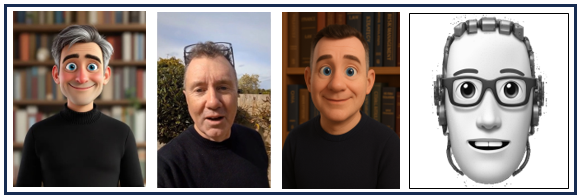
But which one is me?

Inspired by a recent LinkedIn post I made regarding what it might be like to have an avatar as a teacher, I thought I should check out the evidence in terms of the effectiveness of avatars to improve learning before I get too carried away with the technology itself.

What is an avatar?
An avatar is a digital or computer-generated representation of a person or character in a virtual environment. It can take various forms, for example a simple profile picture on social media or an audio avatar talking about a specific subject using a synthetic voice. However, with major advancements in generative AI, avatars are evolving beyond static images or basic voice interactions. We are increasingly seeing lifelike digital humans emerge, sophisticated AI-driven avatars capable of “understanding” what we say and generating intelligent responses, speaking with realistic voices and impressive synchronised lip movements. This transformation is redefining how humans engage with AI-powered virtual beings, blurring the lines between digital representation and authentic interaction.

As to what they look like, here are some examples:

  • Firstly, an audio avatar that I have now built into my blog to provide a different perspective on what has been written. Here the avatar “chats” about the blog rather than simply reading it out loud. See above.
  • Secondly a Pixar style avatar. The goal here is to challenge the assumption that an avatar must resemble a real person to be effective.
  • And lastly, this is a more realistic avatar. Effectively an attempt to replicate me, in a slightly imperfect way. This is not about fooling the audience, although this is now possible, but to explore the idea that humans respond better to a more human like character.

The talking head – good or bad?
However there’s an elephant in the room when it comes to avatars, why do we need a talking head in the first place? Wouldn’t a simple voice-over, paired with well-structured content, be just as effective?

If you look at YouTube, almost everyone uses talking-head videos in different ways, surely if they weren’t effective, no one would have them, a kind of “wisdom of crowds.” But does their popularity actually prove their value, or are we just following a trend without questioning its impact?

Let’s have a look at the evidence:
After reviewing multiple studies, the findings are somewhat mixed. However, there’s enough insight to help us find an approach that works.

First, we have research from Christina Sondermann and Martin Merkt – Like it or learn from it: Effects of talking heads in educational videos. They conclude that the learning outcomes were worse for videos with talking heads, their concern was that it resulted in higher levels of cognitive load. But participants rated their perceived learning higher for videos with a talking head and gave better satisfaction ratings, selecting them more frequently. Secondly, another piece of research published five months later by Christina Sondermann and Martin Merkt, yes, the same people, What is the effect of talking heads in educational videos with different types of narrated slides. Here they found that “the inclusion of a talking head offers neither clear advantages nor disadvantages.” In effect using a talking head had no detrimental impact, which is slightly at odds with their previous conclusion.

A little confussing I agree, but stick with it….

Maybe we should move away from trying to prove the educational impact and consider the student’s perception of avatars. In this first report, student Perceptions of AI-Generated Avatars, the students said “there was little difference between having an AI presenter or a human delivering a lecture recording.” They also thought that the AI-generated avatar was an efficient vehicle for content delivery. However, they still wanted human connection in their learning and thought some parts of learning needed to be facilitated by teachers and that the avatar presentations “were ‘not … like a real class.” The second report, Impact of Using Virtual Avatars in Educational Videos on User Experience raised two really interesting points. Students found that high-quality video enhanced their learning, emotional experience, and overall engagement. Furthermore, when avatars displayed greater expressiveness, they felt more connected to the content, leading to improved comprehension and deeper involvement.

For those designing avatars, this means prioritising both technical quality and expressive alignment. Avatars should be visually clear, well animated, and their facial expressions should reinforce the message being conveyed.

What does this all mean?
Bringing everything together, we can conclude that avatars or talking heads are not distractions that lead to cognitive overload. Instead, students appreciate them, relate to them emotionally, in fact they see little difference between a recorded tutor and an avatar. Their expressiveness enhances engagement and might prove highly effective in helping student remember key points.

To balance differing perspectives, a practical approach might be to omit the talking head when explaining highly complex topics, (reducing cognative load) allowing students to focus solely on the material. However, keeping the avatar visible in most other situations, particularly for emphasising key concepts or prompting action to ensure maximum impact. Alternatively, why not let the student decide by offering them a choice to have the talking head or not.

How might avatars be used?
One important distinction in the use of avatars is whether they are autonomous or scripted. Autonomous avatars are powered by large language models, such as ChatGPT, allowing them to generate responses dynamically based on user interactions. In contrast, scripted avatars are entirely controlled by their creator, who directs what they say.

A scripted avatar could be particularly useful in educational settings where consistency, accuracy, and intentional messaging are crucial. Because its responses are predetermined, educators can ensure that the avatar aligns with specific learning goals, maintains an appropriate tone, and avoids misinformation.

This makes it ideal for scenarios such as:
– Delivering structured lessons with carefully crafted explanations.
– Providing standardised guidance, ensuring every student receives the same high-quality information.
– Reinforcing key concepts without deviation, which can be especially beneficial when high stake assessments are used, as is the case with professional exams.

However, if we power these avatars with Generative AI, the possibilities increase significantly:

  • More personalised learning. One of the most exciting prospects is the ability of avatars to offer personalised and contextualised instruction.
  • Help with effective study. Avatars could be used to remind students about a specific learning strategy or a deadline for completion of a piece of work. A friendly face, at the right time might be more effective than an email from your tutor or worse still an automated one.
  • Motivational and engaging. These avatars could also have a positive effect on motivation and feelings about learning. They could be designed to match an individual’s personality and interests, making them far more effective both in terms of higher levels of motivation and engagement.
  • Contextualised Learning. AI-based avatars can support teaching in practical, real-world scenarios, including problem solving and case-based learning. Traditionally, creating these types of environments required significant resources such as trained actors or expensive designed virtual worlds.

A few concerns – autonomous avatars
Of course, as with any new technology there are some concerns and challenges:

Autonomous avatars pose several risks, including their ability to make mistakes, the problem with avatars in particular is, they will be very convincing. We are already acutely aware that large language models can sometimes ‘hallucinate’ or simply make things up. Data protection is another concern, with risks ranging from deepfake misuse to avatars persuading users into sharing personal or confidential information, which could be exploited. Finally, value bias is a challenge, as AI trained avatars may unintentionally reflect biased perspectives that a professional educator would recognise and navigate more responsibly.

Conclusions
Avatars, whether simple or lifelike, are gaining traction in education. Research indicates that while talking heads don’t necessarily improve learning outcomes, they don’t harm them, and students perceive them positively. A key distinction lies between scripted avatars, offering consistent and accurate pre-determined content, ideal for structured lessons, and autonomous avatars powered by AI that open up a world of possibility in several areas including personalisation.

Avatars are a powerful and exciting new tool that offer capabilities that in many ways go beyond previous learning technologies, but their effectiveness very much depends on how they are designed and used. But hasn’t that always the case….

Finally – This is an excellent video that talks about some of the research I have referred to. It is of course presented by an avatar.  What Does Research Say about AI Avatars for Learning?

PS – which one is me – none of them, including the second one from the left.

You can’t outsource learning – Cognitive offloading 

As we begin to better understand the capabilities of Generative AI (Gen AI) and tools such as ChatGPT, there is also a need to consider the wider implications of this new technology. Much has been made of the more immediate impact, students using Gen AI to produce answers that are not their own, but less is known as to what might be happening in the longer term, the effect on learning and how our brains might change over time.

There is little doubt that Gen AI tools offer substantial benefits, (see previous blogs, Let’s chat about ChatGPT and Chatting with a Chat Bot – Prompting) including access to vast amounts of knowledge, explained in an easy to understand manner, as well as its ability to generate original content  instantly. However, there might be a significant problem of using these tools that has not yet been realised that could have implications for learning and learning efficacy. What if we become too reliant on these technologies, asking them to solve problems before we even think about them ourselves. This fear has found expression in debates well before Gen AI, in particular an article written by Nicholas Carr in 2008 asking “is Google making us stupid’’ – spoiler alert, the debate continues. And an interesting term coined by the neuroscientist and psychiatrist Manfred Spitzer in 2012, “Digital dementia”, describing the changes in cognition as a result of overusing technology.

But the focus of this blog is on cognitive offloading (Circ 1995), which as you might guess is about allowing some of your thinking/processing/learning to be outsourced to a technology.  

Cognitive offloading
Cognitive offloading in itself is neither good nor bad, it refers to the delegation of cognitive processes to external tools or devices such as calculators, the internet and more recently of course Gen AI. In simple terms there is a danger that by instinctively and habitually going to Google or Chat GPT for answers, your brain misses out on an essential part of the learning process. That is reflecting on what you already know, pulling the information forward, and as a result reinforcing that knowledge, (retrieval practice), then combining it with the new information to better understand what is being said or required.

As highlighted by the examples in the paragraph above cognitive offloading is not a new concern, and not specifically related to Gen AI. However, the level of cognitive offloading, the sophistication in the answers and opportunities to use these technologies is increasing, and as a result the scale and impact is greater.

Habitual dependency – one of the main concerns is that even before the question is processed, the student instinctively plugs it into the likes of ChatGPT without any attention or thought. The prompt being regurgitated from memory, “please answer this question in 100 words”. This will lead to possibly the worst situation, where all thought is delegated and worryingly the answer unquestionable believed to be true.

Cognitive offloading in action – Blindly following the Sat Nav! Research has shown that offloading navigation to GPS devices impairs spatial memory.

Benefits of Cognitive offloading – it’s important to add that there are benefits of using cognitive offloading, for example it reduces cognitive load, which is a significant problem in learning. The technology helps reduce the demand on our short-term memory, freeing the brain to focus on what is more important.

Also, some disagree as to the long-term impact, arguing that short term evidence (see below) is not necessarily the best way to form long term conclusions. For example, there were concerns that calculators would affect our ability to do math’s in our heads, but research found little difference whether students used calculators or not. And the debate has moved on to consider how calculators could be used to complement and reinforce mental and written methods of math’s. These benefits have led some to believe that cognitive offloading increases immediate task performance but diminishes subsequent memory performance for the offloaded information.

Evidence
There is little research on the impact of Gen AI due to it being so new, but as mentioned above we have a large amount of evidence on what has happened since the introduction of the internet and search.

  • In the paper Information Without Knowledge. The Effects of Internet Search on Learning, Matthew Fisher, et al found that participants who were allowed to search for information online were overconfident about their ability to comprehend the information and those who used the internet were less likely to remember what they had read. 
  • Dr Benjamin Storm the lead author of Cognitive offloading: How the Internet is increasingly taking over human memory, commented, “Memory is changing. Our research shows that as we use the Internet to support and extend our memory we become more reliant on it. Whereas before we might have tried to recall something on our own, now we don’t bother.”

What should you do?
To mitigate the risks of cognitive offloading, the simple answer is to limit or reduce your dependency and use Gen AI to supplement your learning rather than as a primary source. For example, ask it to come with ideas and lists but not the final text, spend your time linking the information together and shaping the arguments.

Appy Christmas – Apps for learning

appsIt’s always interesting writing a Blog in the holidays, maybe it’s because you have more time than normal so think you should come up with something different, dare I say original. The reality is that when you have such a large canvas on which to think, you can’t think of anything!
The answer is to narrow it down, give yourself something specific to think about. So whilst staring at my ipad for inspiration, I stopped thinking about “everything”, focused on what was on my ipad and then it happened, an idea… ..Why not write about the apps I use most and how you might use them to improve your studying, so here goes.

It’s not about the technology stupid
First a disclaimer, although technology can be all absorbing, learning is a human quality, technology in many circumstances only makes learning more convenient, you still have to work at it. What it does do is provide you with the ability to study when you want and where you want. Time that would be wasted waiting for or actually on a train/bus etc can be much more effectively used learning. How good would it be if you had finished studying before you got home?

Google CalendarGoogle calendar – Helps plan your studies
I have written before about the importance of timetables and calendars. Sitting down and planning what you will study and when not only helps you become more organised it is essential for setting targets and challenges. And remember target setting is key to motivation.

Evernote Evernote – Organise and store notes
I am finding that I am using Evernote more and more. It is in effect a cloud based folder system. Consider setting up a folder for each subject you are studying. Then within each subject folder you can type notes, attach PDF’s, photos, maybe of places/objects/people relevant to that subject. You can even attach video. And if you want to collaborate with others just share the link. Maybe have a folder for revision with the questions you want to attempt linked via PDF, comment on what you found difficult and share with your friends. Evernote has so many uses.

PenultimatePenultimate – for making hand written notes and drawing mind maps
If you prefer to write rather than type, penultimate is for you, although I don’t think there is an android version at the moment. It is part of the Evernote family and links with Evernote so is easy to use. It is just like a paper based note book with a front cover showing the subject, page numbers and has a nice page turning feel. Unlike a paper based note book however, you can change the paper, plain/lined etc, save your work, add photos, and share with others. It also has a very clever way of making sure your hand when resting on the screen does not interfere with what you are writing.

Put simply it’s the best handwriting software I have come across, and comes close to replacing paper, close but not just yet….

DropboxDropbox – for file storage, back up and file sharing
Many of you will already be familiar with dropbox, it is free simple to use cloud based storage. Dropbox is great for saving/backing up all your files. This means that as long as you can get electronic versions of your text books and question banks you will be able to have them with you anywhere…

And you can share folders with friends.

Adobe ReaderAdobe reader – keep all PDF notes in one place and you can write on them!
This is just for Adobe PDF’s but as most documents can be turned into a PDF format that should not be a problem. Imagine having your notes in a PDF file, opening them up wherever you are and then updating them either by typing or writing on top of the PDF. You can also make margin notes that open up in a speech bubble, little reminders of what you were thinking, or additional work you need to look at.

Explain-EverythingExplain everything – become a teacher and teach yourself
Explain everything is a white board that you can add in pictures, shapes etc, and then the really clever part, record what you are doing in a high quality video. What makes this so good is how easy it is to use.

This would be ideal for working through a question, talking out loud explaining your thoughts (Explain everything will record your voice and your white board actions) and then when you get to the part that is difficult or simply don’t understand, ask your question out loud….? Then send the Mp4 file to your tutor/teacher or study colleagues for an answer. Unfortunately as with Penultimate I don t think there is an android version just yet.

twitterTwitter – limitless knowledge and support
Twitter can get a bad press when it comes to studying, it can be very distracting! But if used properly it can be great. The key is to follow people that have answers to your problems or are like you. If you are studying accountancy for example you will find lots of tweets from experts providing you with up to date news and information often linking to more in depth guidance, websites/PDF’s etc. Twitter is the most up to date text book you can get.

Okay a word of warning; just make sure you are not too far ahead of you teachers and the exam. Also that the people you are following are credible.
The other use is to follow fellow students who are studying the same subjects as you, it can be very reassuring that you are not the only ones who doesn’t understand something.

The big secret to twitter is is very selective who you follow, delete people that are not helping and keep the list down to about 200.

Mobile
Most of these are accessible on all mobile devises and for me that is the real benefit of the technology.

Happy 2013 and more apps
Hope you are all having a good Xmas and here’s to 2013, what will be new this time next year I wonder?

Related articles