Willpower – A muscle not a trait

Many people talk about willpower as if it’s all or nothing, something you either have or don’t. But that’s not how it works. Willpower isn’t genetic, its better thought of as a skill that you improve and develop over time. While we all have a basic foundation, the strength of your willpower depends heavily on learned habits. The implication being that anyone can improve their willpower through practice, just as they would strengthen a *muscle.

What is willpower?
While psychologists define willpower as the ability to resist short-term temptations for a longer-term gain, it might more easily be thought of as “doing what you know you should, even when you don’t want to do it.” There are also many terms used in a similar context as willpower that can be confusing. To add some clarity, here are a couple of sentences that puts them all together.

To achieve a long-term goal, Motivation provides the reason to start. Determination is the short-term commitment required to stay on track, Willpower is the moment to moment self-control needed to avoid temptation, and Grit is the perseverance necessary in the long term.

The science
Interestingly we know a reasonable amount about willpower and what is happening in the brain. Neuroscience research shows us that there is something called the Anterior Cingulate Cortex (ACC) which is heavily involved in conflict monitoring, spotting when short term impulses clash with long-term goals and in regulating attention and effort. The implication is that when you resist temptation or push through discomfort, the ACC becomes more active, helping the prefrontal cortex enforce discipline over the brain’s reward systems. In this way, the ACC functions as a kind of “emotional referee,” guiding persistence and aligning behaviour with intention.

Imagine you’re on a diet and someone offers you a slice of chocolate cake. In that moment, your brain experiences a clash between the short‑term impulse to enjoy the cake and the long‑term goal of losing weight. The ACC will spot the conflict and tell your prefrontal cortex, which steps in to enforce discipline over the brain’s reward systems. By saying “no thanks” and resisting the temptation, that’s willpower in action.

What this tells us about willpower is that it is not a fixed trait but a dynamic process rooted in brain activity. The ACC demonstrates that willpower is about managing competing signals balancing the pull of short-term gratification against the push of long-term purpose. Studies suggest that repeated acts of self-control strengthen ACC pathways, making persistence easier over time. In short, the science shows that willpower is a trainable skill, shaped by the brain’s ability to detect conflict and sustain effort, rather than an innate quality we are born with.

Willpower is closely linked to self-control, providing the mental energy it needs to be effective.  And as identified by University of Pennsylvania psychologists Angela Duckworth, and Martin Seligman this makes a real difference. Their research explored self-control in eighth-graders over the course of the school year. They found students who ranked high on self-discipline had better grades, better school attendance, and higher test scores, and were more likely to be admitted to a competitive high school program. Self-discipline, the researchers found, was more important than IQ in predicting academic success.

How to strengthen your Willpower
The good news is that willpower can be strengthened over time. By practicing small, deliberate strategies, it’s possible to build the mental resilience needed to make better choices, sustain effort, and push through discomfort. The following steps outline practical ways to improve your willpower and make it easier to stay on track when challenges arise.

  • Start small and build gradually – Begin with minor challenges, such as not checking your phone every 10 minutes. Each small success builds confidence and stamina for bigger goals.
  • Practice delayed gratification – Train yourself to pause before giving in to impulses. Even short waits strengthen your ability to resist temptation.
  • Manage stress and energy – Stress drains willpower, so restore your mental reserves with mindfulness, deep breathing, or just plain old regular sleep.
  • Set clear, achievable goals – Define specific actions like “I’ll study for 45 minutes this evening” instead of vague ones like “I will study a lot this week.” Concrete goals reduce decision fatigue.
  • Build routines and habits – Automating good choices such as scheduled study time reduces the need for constant self‑control and frees willpower for bigger challenges.
  • Reward progress. Celebrate achievements along the way to reinforce motivation and keep momentum strong.

For learning, this has important implications. Success is not simply about intelligence or talent, but about the discipline to persist, to resist distraction, and to sustain focus when challenges arise. Each act of willpower, choosing to study instead of scrolling, pausing before giving in to temptation, setting clear goals etc, reinforces the neural pathways that make staying with your task easier next time.

In this way, learning itself becomes an exercise in willpower – a process of training the mind to align effort with purpose.

Worth a listen – How to Build Extreme Willpower, David Goggins & Dr. Andrew Huberman

*Muscle – Its worth saying that the muscle reference is an analogy, it works to a certain extent but is not perfect. Some think a better example might be a battery, it has finite energy, reduces over time and with use, but can be recharged. Also it doesn’t get bigger the circuits become more efficient.


The Silent Teacher – learning environments

Have you ever walked into a bar or restaurant looking for atmosphere and when its not there, walked out? Isn’t that just a little bit odd! – and yet we have probably all done it. This gives some indication as to how sensitive we are to the environment in which we live, work, and play. The way you pull of this insightful magic trick is by detecting nonverbal cues such as body language, facial expression, tone of voice etc, soaking up the lighting, colour, sound and temperature, whilst sensing the emotions in the room using your primeval antennae.

We also learn in an environment – which is why it’s important we are mindful of the spaces we choose for study. The term learning environment is broad, encompassing all aspects that surround you, including the physical setting and learning materials, psychological factors, such as motivation and emotions, as wells as cultural influences. These elements all play a crucial role in your ability to absorb, process, and retain information, directly impacting learning outcomes.

Impact on learning
There is considerable evidence to support the importance of a “good” learning environment.

One study by Barrett et al. (2015) found that the physical characteristics of a classroom (light, noise, temperature, air quality, and seating arrangements) explained 16% of the variation in pupils’ academic progress. Ambady and Rosenthal (1993) discovered that people could accurately gauge a teachers’ mood and effectiveness from just six seconds of silent video clips. And as we know attitudes and moods are contagious, contributing to the overall feeling of a classroom. As discussed in a previous blog, in 2006 Carol Dweck’s brought to us the importance of a growth mindset that showed that learners who “feel psychologically” supported and encouraged are more likely to embrace challenges and persist in learning.

My blog Reading underwater – Context dependant memory, concludes that where you learn has a bearing on what you are able to remember at a later date. And Top Gun: Maverick or a Study With Me Video? Identifies the interesting trend of students choosing to play a video of other students studying in the background to create the “right mood” to help them study.

Having an effective study environment can improve….

Which is a very powerful list of learning ingredients.

The online learning environment
It’s essential to recognise the digital space as a learning environment and not merely a platform for content delivery. Whether through asynchronous (self-managed) or synchronous (real time streaming) methods, the design of online environments plays a crucial role in enhancing engagement, motivation, and knowledge retention.

To be effective the asynchronous environment must provide structured pathways, clear objectives, and opportunities for self-assessment. Incorporating interactive elements such as discussion boards, quizzes, and multimedia resources to promote active engagement. Whilst synchronous learning needs to develop a sense of community and provide immediate interaction. Designing sessions to encourage collaboration and participation is vital. Facilitators should use breakout rooms for small group discussions and incorporate polls or Q&A sessions to keep learners engaged and motivated.

Creating your own learning environment
But what does this all mean if you are studying on your own? Here is some guidance on creating your very own learning environment.

  • Physical environment – Have your own learning space – Choose a well-lit, quiet area with a comfortable chair and desk. A dedicated workspace signals to your brain that it’s time to focus, which can improve concentration and productivity. Organise your materials – Keep books within reach to minimise distractions. Use visual aids – Incorporate posters or mind maps, but make sure the space is uncluttered.
  • Maximising motivation – Set clear goals – Break study sessions into specific, achievable objectives. This provides direction and a sense of purpose, helping you maintain motivation throughout your studies. Self-assessment – Use quizzes and flashcards to evaluate your understanding. Celebrate small achievements – Keep a note of your progress and consider social media posts when achieving milestones.
  • Psychological environment Cultivate a positive mindset – Focus on progress and remind yourself of your goals. A positive mindset enhances resilience, making it easier to overcome challenges and stay committed to your learning journey. Manage distractions – Use techniques like the Pomodoro Technique for focused study sessions.
  • Emotional environment Create an enjoyable atmosphere – Listen to background music (preferably instrumental) or find a calming spot. A pleasant environment can reduce stress and make learning more enjoyable, which can improve retention. Practice mindfulness – Use deep-breathing exercises to reduce anxiety and maintain focus.
  • Social learning opportunities – Join online communities – Participate in forums or study groups for support and discussion. Engaging with others can provide motivation, diverse perspectives, and valuable insights into the material. Teach others – Explain concepts to a virtual peer or record yourself teaching. Teaching reinforces your understanding and helps clarify your own knowledge.

So, whether you step into a bar, restaurant, or classroom, remember that the right atmosphere can make all the difference. Just as a great venue enhances your night out, a well-designed learning environment can be the key to unlocking your best study experience.

Motivation by Reward and Consequence – Behaviourism

Motivation is one of the most important aspects of learning and as a result has featured in many previous blogs. In its simplest form motivation can be defined as something that you want; you want to get fit or you want to pass the exam, and as a result that want directs your behaviour. For example, if I want to pass the exam, a good behaviour would be to attempt 5 more questions.

But do we ever really know what is motivating someone? We could ask Tom Dean, the gold medal winner in the 200-meter freestyle at this year’s Tokyo Olympics. What motivated him to train even harder after he contracted Covid for a second time? I’m sure he would give us an answer, the problem is it could well be something he has constructed to explain it to himself rather than the real reason.

Maybe we should think less of the cognitive reasoning behind motivation and consider only the actions of a motivated person? It’s likely Tom had a few early mornings and went through some pretty painful training sessions in order to get fit for the games, but it could be that his ability to do this is more a consequence of conditioning rather than his desire for a gold medal. There is also the question as to why a gold medal is motivational, after all its not even gold, they are 92.5% silver. Interestingly the Tokyo medals include recycled metal from electrical devises. Maybe its because he associates it with success and or pride, something that he has been conditioned to over many years.

Behaviourism
Behaviourism, is a theory of learning which states that all behaviours are learned through interaction with the environment by a process called conditioning. The implication is that your behaviour is simply the response to a stimulus, a cause and effect.

The environment shapes people’s actions. B.F. Skinner

Its highly likely you will have experienced and even been involved in motivating someone in this way. For example, were you ever put on the naughty step as a child or told your dog to sit and when he does, reward him? These are examples of how changing the environment results in a different behaviour. The dog is motivated to sit not because it’s a lifelong ambition but because he wants the reward. Tom Dean may well have got up early to go training but that might have more to do with the conditioning resulting from his alarm going off, than a burning desire to get out of bed.

It is effectively motivation as a result of reward and consequence, if you do something you get something.

Classical conditioning – association
Ivan Pavlov, a Russian physiologist, discovered that dogs could “learn” to salivate at the sound of a bell that rang before they were fed. He called this classical conditioning, the dog associating the bell with food. These types of associations can be the reason people are afraid of spiders or chewing gum, yes, it’s real, Oprah Winfrey is a sufferer. It also explains why having a designated study area can help you feel more like studying, you associate it with getting work done. Here are a few more examples, your smart phone bleeps and you pick it up, celebrities are used to associate a product with glamour, Christmas music makes you feel Christmassy and an exam hall brings on exam anxiety.

Operant conditioning – reinforcement
In contrast to classical conditioning, operant conditioning encourages or discourages a specific behaviour using reinforcement. The argument being that a good behaviour should be reinforced by a repeated reward or a bad behaviour stopped by a repeated punishment. The person who developed this type of conditioning is B.F. Skinner, who famously used pigeons in what became known as “Skinner boxes”.

There are four types of reinforcement

  • Positive reinforcement – The behaviour is strengthened by adding something, a reward (praise/treats/prizes) which leads to repetition of the desired behaviour e.g. “Well done, Beth, that was a great question”. Here praise is added to encourage students to ask questions.
  • Negative reinforcement – The removal of something to increase the response e.g. “I can’t study because, everyone is shouting”. The shouting stops which encourages the behaviour of studying.
  • Punishment – The opposite of reinforcement, it adds something that will reduce or eliminate the response. e.g. “that’s probably the worse answer I have ever heard Beth, were you listening at all”. Here humiliation is added that will reduce the likelihood of students asking questions.
  • Negative punishment (Extinction) – This involves removing or taking something away e.g. “You can have your mobile phone back when you have done your homework”. In this situation removing access to the mobile phone results in the homework being completed.

A person who has been punished is not thereby simply less inclined to behave in a given way; at best, he learns how to avoid punishment. B.F. Skinner

Limitations
Skinner remained convinced anything could be taught with operant conditioning and went on to invent a teaching machine using the principles of reinforcement. It required students to fill in the blank, if the answer was correct, they were rewarded if incorrect they had to study the correct answer again to learn why they were wrong.

Give me a child and I’ll shape him into anything. B.F. Skinner

However, there are many limitations, the motivation is not always permanent, it’s too basic to teach complex concepts, punishment can lead to a reinforcement of the undesirable behaviour and its possible the person is just pretending.

Operant conditioning is still a hugely influential in the modern world, for example have you ever watched someone play a fruit machine, the required behaviour rewarded to extract more money. What about online gaming where points and leader boards provide rewards in terms of status and prizes.
Then then there are the ideas surrounding behavioural economics popularised by Nudge theory which suggest that you can influence the likelihood that one option is chosen over another by changing the environment.

And finally, have ever seen how the military train, check out this video.

So next time you think you are making a decision of your own free will, maybe you’re just responding to an external stimulus!

Motivated ignorance – is ignorance better than knowing?

If it’s true that the cat wasn’t killed by curiosity and that ignorance was to blame (see last month’s blog) then it follows that we should better educate the cat if it is to avoid an untimely death. But what if the cat chooses to remain ignorant?

Ignorant – lacking knowledge or awareness in general; uneducated or unsophisticated.

In a paper published last February, Daniel Williams puts forward a very challenging and slightly worrying proposition, that when the costs of acquiring knowledge outweigh the benefits of possessing it, ignorance is rational. In simple terms this suggests that people are not “stupid”, or ignorant, when they are unaware of something, they are in fact being logical and rational, effectively choosing not to learn.

“Facts do not cease to exist because they are ignored.” – Aldous Huxley

Beware the man of a single book St. Thomas Aquinas
In terms of education this is clearly very important, but it has far wider implications for some of the challenges we are facing in society today. There is an increasing divergence in opinion across the world with people holding diametrically opposite views, both believing the other is wrong. We can probably attach personas to these groups, on the one side there are the knowledgeable and well educated, on the other those who may not be in possession of all the facts but trust their emotions and believe in community and identity. The two groups are clear to see, those that believe in climate change and those that don’t, Trump supporters and anyone but Trump supporters, take the vaccine or anti-vaccine.

The stakes could not be higher.

“Ignorance is a lot like alcohol. The more you have of it, the less you are able to see its effect on you.” – Jay Bylsma

Motivated ignorance
The idea that choosing to be ignorant could be both logical and rational is not new. In his book An Economic Theory of Democracy first published in 1957 Anthony Downs used the term “rational ignorance” for the first time to explain why voters chose to remain ignorant about the facts because their vote wouldn’t count under the current political system. The logic being that it was rational to remain ignorant if the costs of becoming informed, in this case the effort to read and listen to all the political debate outweigh the benefits, of which the voters saw none.

“If you think education is expensive, try ignorance.” – Robert Orben

Daniel Williams is making a slightly different point; he argues that motivated ignorance is a form of information avoidance. The individual is not remaining ignorant because the costs of obtaining the information are too high, they are actively avoiding knowledge for other reasons. He also goes on to say that if you are avoiding something it follows that you were aware of its existence in the first place, what the US Secretary of Defense Donald Rumsfeld so eloquently referred to as a known unknown.

We need one final piece of the jigsaw before we can better understand motivated ignorance, and that is motivated reasoning. Motivated reasoners reach pre-determined conclusions regardless of the evidence available to them. This is subtly different to confirmation bias, which is the tendency to only notice information that coincides with pre-existing beliefs and ignores information that doesn’t.

If motivated reasoning is the desire to seek out knowledge to support the conclusions you want, motivated ignorance is the opposite, it is the desire to avoid knowledge in case it gives you the “wrong” answer. For example, although you might feel ill, you avoid going to the doctors to find out what’s wrong because you don’t want to know what the doctor might say.

The question that we should ask is, why don’t you want to know the answer? The implication here is that something is stopping you, in this instance perhaps the emotional cost of the doctor’s prognosis is greater than the gain. Similar examples can be found in other domains, the husband who doesn’t ask as to his wife’s whereabouts because he is afraid, she is having an affair, and doesn’t want it confirmed, although in reality she might have just been late night shopping!

“If ignorance is bliss, there should be more happy people.” – Victor Cousin

The idea that we should always seek out knowledge to be better informed clearly has its limitations and that far from being illogical motivated ignorance has some degree of rationality.

What have we learned?
Human beings do not strive to answer every question nor have within their grasp all the knowledge that exists. We are selective based on how much time we have available, how we might like to feel and, in some instances, the social groups we would like to belong. There is always a sacrifice or trade-off for knowledge and sometimes the price might be considered too high.

The answer to ignorance is not to throw more information at the problem in an attempt to make the ignorant more enlightened. If you don’t believe in climate change, not even a well-crafted documentary by David Attenborough is likely to help If the motivation for choosing ignorance is not addressed. This over supply of information was evident in the Brexit debate here in the UK. For those who had “made up their mind”, providing very powerful arguments by equally powerful captains of industry as to why leaving Europe was a bad idea failed to educate because most chose not to listen.

The role of education and learning has to be inspiration and curiosity, we need to get closer to those underlying motivational barriers and break them down. We have to help people appreciate the feeling you get as a result of challenging your views and coming out the other side with a better and possibly different answer. There is a need to move away from the competitive nature of right and wrong and the idea that changing your mind is a sign of weakness.

“When the facts change, I change my mind. What do you do, sir?”- attributed to J Maynard Keynes

And maybe we have to accept that although there is a price to pay whatever it is, it will be worth it.

“no people can be both ignorant and free.” – Thomas Jefferson

Storytelling – The cave

telling stories

There is a lot written today about the power of storytelling and how it can help persuade, influence and of course educate. Stories come in many shapes and sizes, sometimes they are true, but might be embellished, sometimes they are not true but include powerful messages hidden in the form of metaphor or allegory.

The simplest definition of a story is that “one thing happens in consequence of another,” and it can engage, motivate and inspire. But cognitively the brain is working very hard forming connections, asking questions, creating images and helping offer up opinion.

“If you want your children to be smart, tell them stories. If you want them to be brilliant, tell them more stories.” Albert Einstein.

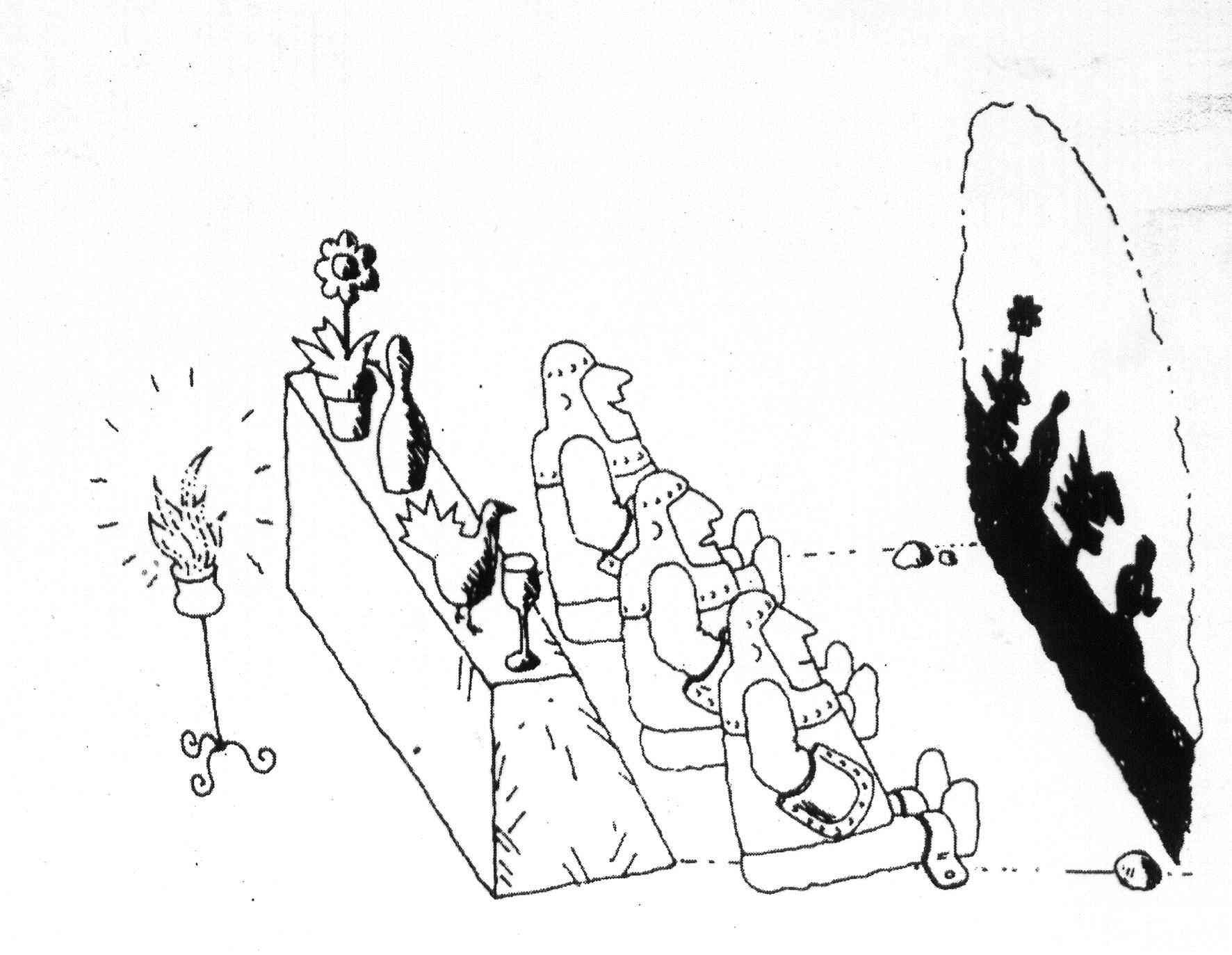
Below is an allegory, arguably one of the most important in the whole of western philosophy, but its message for educators and students is sometimes lost. It’s called Plato’s cave, read it carefully, thinking about what it might mean.

Plato’s cave
Plato caveAlthough Plato is the author, it is Socrates who is the narrator talking to Plato’s elder brother Glaucon.

The story told is of a group of people who from birth have been chained up in a cave with their heads fixed in one direction so they can only look forward. They face a cave wall on which they can see moving images, shadows that they believe to be reality. Socrates’s explains that when the prisoners, because that is what they are, talk to each other they discuss the shadows as if they were real. But they are an illusion, created by shadows of objects and figures played out in front of a fire, manipulated by the puppeteers.

Socrates goes on to say that one of the prisoners breaks free of his chains and is forced to turn around and look at the fire, the light hurts the prisoner’s eyes but as they adjust, he can see the fire and the puppets he had believed to be real. He doesn’t want to go any further fearing what it might bring but once more is forced to go towards the mouth of the cave and into the blazing sunlight.

At first, he can only look at the reflections because as with the firelight the sun is too bright but as his eyes adjust once more, he finally looks at the sun, only then “is he able to reason about it” and think what it could mean. His thoughts are interrupted by the sorrow he feels for his fellow prisoners who have not seen what he has, have not learned the truth. So, he goes back into the cave to tell them everything. But when the prisoners look at him, they see a man stumbling, strained, no longer able to see in the dark cave. But worse when he begins to explain they think him dangerous because what he tells them is so different to what they know.

The prisoners do not want to be free, the effort is too great, the pain and apparent disability sufficient to stop them trying. They are content in their own world of ignorance and will fight anyone who wants to change that.

But what does that mean?
The answer of which should be, well what do you think it means? But sometimes you just don’t have time for that answer so here is one interpretation, it’s worth pointing out there are many.

  • The puppeteers are those in power or authority. They prefer it if people don’t ask questions, remain content and are not causing trouble.
  • The fire is knowledge and wisdom.
  • The prisoners are society.
  • The escaped prisoner is the student. The student who through education escapes and finds answers.
  • The person that frees the student and drags him towards the light is the teacher.

If we put this all together, it gives us an insight into learning that has remained unchanged since Plato wrote the Republic in which this story sits in 514a–520a.

Learning is not easy, it can be difficult and hard work. Some people are happy to remain as they are, ignorant, after all it’s not pleasant having your beliefs challenged and finding out that what you thought was true in fact isn’t. Teachers can help take you towards knowledge and learning but you need to want it for yourself, and once you have knowledge you can’t go back to what you were before, education will have changed you forever.

To find out more about the power of stories watch this video – The rules to telling a story by the Filmmaker Andrew Stanton (“Toy Story,” “WALL-E”)

Plato’s cave at the movies

The Matrix and Plato’s Cave – Neo meets Morpheus and explains he is a slave

The Truman Show – Truman shows bravery by going towards the light


Engaged

There are a number of terms that crop up continually in learning, motivation, attention, inspiration, concentration, curiosity etc. But one that is becoming increasingly important especially for those students studying online, is engagement.

Many of the above terms are closely related and often used in the same sentence, but by taking some of them we can make an attempt at defining engagement – the degree of attention, curiosity, interest and passion demonstrated when learning.

Types of engagement

However when you look into any subject in detail it’s never as easy as you first thought. Fredricks, Blumenfeld and Paris identified three types or as they called them dimensions of engagement:

1. Behavioural engagement e.g. attendance, involvement and absence of disruptive or negative behaviour.

2. Emotional engagement e.g. interest, enjoyment, or a sense of belonging.

3. Cognitive engagement e.g. invested in learning, seek to go beyond the requirements and relish a challenge. A cognitively engaged student can become unaware of time and will be capable of taking the subject matter outside its context, form new connections and begin asking questions in order to ensure they have fully understood.

In simple terms an engaged student is physically, emotionally and mentally present.

Why is it important?

There is a large body of evidence that shows correlation between high levels of engagement and a number of desirable learning based outcomes, for example improved critical thinking, cognitive development, skills transfer, self-esteem, deeper understanding and better *exam results. It’s also worth adding that an engaged student is more likely to complete the course.

If you are not engaged, then what are you doing?

Engagement clearly helps students learn more effectively but it is also closely linked to motivation. In fact the expression motivated and engaged are sometimes used as if they were the same, but there is a subtle difference. I have written about motivation many times and unlike engagement tends to be more long term, possibly internal and certainly goal orientated. You can of course be engaged but not motivated, for example engaged in an activity, perhaps concentrating and interested but it’s not a topic or subject that you feel is important and have no long term need or desire to find out more. Engagement is the response to an external and immediate satisfaction, entertainment, curiosity, or recognition.

How to engage – for the teacher

As with motivation, it’s better to be engaged than not, so before we answer the question, what can teachers do to engage their students, it’s worth noting the role of the student, if you sit with your arms folded thinking of something else, you won’t engage.

  • Make it relevant – outline before you start why this topic is important for your audience. How is this online session going to help the students achieve their objectives, try to be specific.
  • Use real world examples – related to the above, a real world example can help the student appreciate the importance of what they are learning, i.e. if it’s used in the real world it must work. This may result in the student asking questions internally as to how it might work in their organisation or concluding that it will not.
  • Positive reinforcement – praise may sometimes feel artificial and of course should not be given all of the time, but recognising the difficulty of a task and congratulating everyone for doing well is both motivational and engaging.
  • Build rapport – use student names to help personalise the process. Break down barriers by saying what you personally find difficult, and perhaps why. If you can empathise with the student it helps build rapport, which makes it more likely they will listen and follow your advise.
  • Inspire – not everyone will think of themselves as inspirational but in some ways it takes very little, a simple story that means something to you can do the trick. Simon Sinek suggests that inspirational leaders know their WHY, they know why the are doing something. Ask what’s your why, and it’s not just because it’s your job, it’s because it’s your passion and fits with your personal beliefs.
  • Inclusive activities – plan for a number of activities that will encourage the group to engage with each other, the subject matter and you. These can be as simple as asking questions, setting quizzes, polls, or more involved, such as break out groups. Importantly the activities should not be easy, they need to be challenging, bored students are not engaged.
  • Manage and facilitate, don’t tell, ask – try to get the students thinking, ask them why, do you all agree, is there an alternative answer? It’s also a good idea to encourage students to think and believe in themselves, to become independent and autonomous learners.

And one last tip, make it short and don’t go on too long or labour a point, there is a danger your students will disengage!

Which is probably my queue to bring this to an end and wish you all a Merry Xmas.

*improved grades (Astin 1977, 1993; Indiana University Center for Postsecondary Research 2002; Pike, Schroeder & Berry 1997; Tross, Hpersistencearper Osher & Kneidinger 2000)

Boring is interesting

One of the reasons a subject might be difficult to learn is because its just very boring…….but is any subject really boring?

boredom11

Why do we get bored?

Firstly, we should define what boredom is, surprisingly for something that many people have experienced and therefore feel they know, definitions are a little vague, for example, from the dictionary we have, “the feeling of being bored by something tedious”, which is not particularly helpful. If we dig a little deeper we find “the aversive experience of wanting but being unable to engage in satisfying activity” or put another way, what you are currently doing is not sufficiently stimulating such that your mind will wander looking for a more satisfying alternative task.

The brain is in effect searching for dopamine, the neurotransmitter that helps control your reward and pleasure centres. The implication being that the task you are currently involved with is not delivering enough dopamine for you to continue with it. There is some evidence to show that people with low levels of dopamine production may get bored easily, continually looking for new and more stimulating activities. This so called “trait boredom” has been linked to dropping out of school, higher levels of anxiety, gambling and alcohol/drug abuse.

Boredom is an emotion often brought on by routine, monotonous and repetitive work that has little perceived value.

The opposite of boredom is engagement

On the basis that being bored is not a particularly good emotion when it comes to learning we should look to change it by becoming more engaged. One small but important point before we move on, being bored is not completely without its uses, watch this TED lecture – How boredom can lead to your most brilliant ideas, presented by Manoush Zomorodi. In this Manoush argues that because the brain is searching for stimulation when bored, it can lead to increased creativity and great ideas.

An interesting way of thinking of engagement is that it’s what you see when someone is motivated.  This is important if you want to pass an exam because there is evidence (Wang & Eccles, 2012a) to show that students who are engaged are more likely to do well in examinations and aspire to higher education.

But what to do?

  • Recognise that you are feeling bored. This is the first step because if you don’t know your bored its easy to build up a deep dislike for the subject, and when you do that the answer becomes easy. It’s not my fault, it’s the subject that’s boring.
  • Your subject needs to be meaningful. Students often say, “I will never use what I have to learn.” This is of course an opinion; the truth is you simply don’t know. I can still remember thinking I would never need to understand the Capital Asset Pricing Model (a formula used in Financial Management to calculate shareholder returns) little did I know one day I would actually teach it.
  • Be curious, keep thinking, “that’s interesting”. Nothing is really boring it’s only the way you are looking at it. Curiosity is a state of mind that fortunately has is no cure.

The cure for boredom is curiosity. There is no cure for curiosity.    Ellen Parr

  • Make it fun or turn the activity into a game.  There is no doubt that during your studies there will be a need to rote learn information and because this is a repetitive task it can be boring. But if you break up what you have to learn into bite size chunks and turn it into a game with rewards e.g. if I learn these 4 definitions by 6.00 I can finish for the day, you will be amazed how much easier it can become.
  • Find people who are engaged and ask them to explain what they see, why do they find it interesting. This might be necessary if your teacher or lecturer fails to bring the subject to life, fails to engage you in the subject. Interest and engagement are contagious, unfortunately so is boredom.
  • Its too easy – its too hard. Your boredom might come from the fact that what your learning is basic, if so ask for more advanced work, I know that sounds counter intuitive but you will benefit in the long run. And if its too hard, speak to your teacher, they will be able to help. This is an example of taking control, often boredom strikes when you feel there is nothing you can do, sitting waiting for a train that has been delayed. By taking some form of control e.g. checking alternative routes home, the boredom will pass.

And if you want to find out more

Why Do We Get Bored? 

On the Function of Boredom

The Unengaged Mind: Defining Boredom in Terms of Attention

What to do if you fail the exam? – growth mindset

failure-sucess

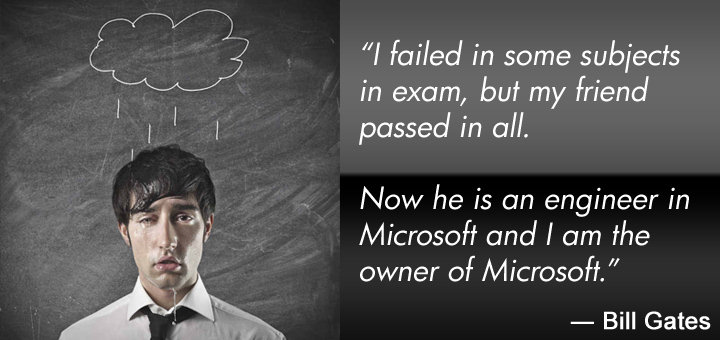
Back in 2011 I wrote about what to do if you fail an exam, it’s one of my most read blogs. Last week I delivered an online presentation for the ACCA, (Association of Chartered Certified Accountants) on how having a growth mindset can help improve your chances of passing an exam, the very opposite of failing. But that is partly the point, very few successful people have never failed, in fact coping with failure is one of the reasons they ultimately succeed.   Having the “right mindset” can not only help you pass, it can give direction and motivation if you fail.

Mindset

The term “growth mindset” was coined by Carol Dweck, Professor of Psychology at Stanford University. She became fascinated as to why some children shrink in the face of problems and give up, while others avidly seek challenges, almost as a form of inspiration. What she discovered was that the type of mindset students held was at the heart of these two differing views. This search for resilience in the face of challenge and adversity has become her life’s work and something that has guided her research for over 40 years.

Fixed – When students have a fixed mindset, they tend to believe abilities are carved in stone, that you have a certain amount of let’s say talent or intelligence and that’s that. They perceive challenges as risky, that they could fail, and their basic abilities called into question. And the fact that they hit obstacles, setbacks, or criticism is just proof their views were correct in the first place.

Growth – In contrast, when students have more of a growth mindset, they believe that talents and abilities can be developed and that challenges were one way of doing this. Learning something new and difficult was in fact the way you get smarter. Setbacks and feedback are not seen as confirmation of frailty but as information that could be used to improve.

This does not mean that people with a growth mindset think talent doesn’t exist or that everyone is the same. To them it’s more a belief that everyone can get better at whatever they do, and improve through hard work and learning from mistakes.

How can you develop a growth mindset?

The good news is that you can develop a growth mindset, but just to be clear, the world is not divided into those with a growth mindset and those with a fixed one, a mindset is not a character trait. Everyone is a mixture of fixed and growth mindsets. You could have a predominant growth mindset in one area but there can still be a thought or event that acts as a trigger and moves you into a fixed one. The secret is to work on understanding your triggers so that you’re able to stay in a growth mindset more often.

Beliefs – ask, what you believe about yourself and the subject you are studying. Do you believe you are below average, not very clever or that the subject or topic you are studying too hard? If this is the case you have wandered into a fixed mindset. What you believe is neither true nor false. What we can say is that it’s certainly not “helpful” to believe you are not clever, and is not what someone with a growth mindset would do.

Talent and effort – thinking that people are either naturally talented or not, is a classic example of being in a fixed mindset. You may never be top of your class but you can improve, and this is achieved by making more effort and working harder.

Positive self-talk – we all have voice inside our head, it’s called your inner speech. It has a significant impact on what you believe and how you behave. If you find your inner speech is telling you to give up or that you will never understand a particular topic or subject, change your voice, tell it off, and then say something more positive. Dweck says that just by adding NOT YET to the end of your statement can help. For example, I don’t understand portfolio theory – at least NOT YET.

The importance of mindset and failure

If you have failed an exam or just sat one and believe you have failed, I have two pieces of advice.

Firstly, on the whole students are not the best judge of their own performance. They tend to reflect on what they didn’t understand or thought they got wrong rather than what they might have got right. As a result, you may have done better than you think and are worrying about nothing.

Secondly, if you do fail, you have a choice as to what this might mean. On the one hand, it might simply be confirmation of what you already know, that you are not very good at this subject or clever enough to pass. Alternatively, you could move to a growth mindset, recognising that you have slipped into a fixed one.  Find out what areas you need to work harder on, and start again.

Everyone has to deal with failure, it’s what you do when you fail that matters most.

And the badge goes to …….

la-la-land

And the winner is ……La La land……..you have to feel a little sorry for Warren Beatty and Faye Dunaway at this year’s Oscars, after all they only read out what was on the card, which is kind of what actors do. And I have to share some of the responsibility, it does seem as if my own profession played no small part in the mistake.

But what is it that makes 3,500 of the most well paid, successful people in their industry give up an evening to watch, on the whole other people receive an award. And why does anyone want an Oscar or the Academy Award of Merit to give its correct name, after all it’s only a 13.5-inch badge, and it’s not even gold.

Why do people want badges?

Perhaps we can answer this question by taking a closer look at gamification, the use of game based incentives in education of which I have written before. PBL (Points, badges and leader boards) is the term most often used to describe some of the elements within games that make them so compelling and worthy of further investigation.

Points and leader boards are perhaps self-explanatory but what is it about the badge, why do people like/want them? They are of course not new, teachers have awarded good students with a star for an excellent piece of work for years, the Scouts offer a whole range of badges when certain skills have been demonstrated, and those with qualifications will proudly display letters after their name as if in some way it mattered. The point is of course, it does.

Social psychologist and research scientist Judd Antin together with Elizabeth Churchill, collaborated on a paper called “Badges in Social Media: A Social Psychological Perspective” antin-churchill. There work helps shed some light on the value of badges.

The 5 Primary Functions of badges

Antin and Churchill suggested that badges could serve several individual and social functions depending on the nature of the activities that the badge rewarded and the application of the badge in a particular context.

  1. Goal setting – desire is the first part, you have to want or need something. But then the best way of satisfying that desire is to make it into a goal, planning the smaller steps that will help you get there.  Wanting the badge is motivational.
  2. Instruction – badges are instructive, showing the individual what is available and most valued. This may help direct learning and move students out of their silos as they see what else they might work towards. E.g. giving a badge for the student who attempts more questions might encourage others to do the same.
  3. Reputation – badges are a physical means of storing experience, expertise and interest. In fact, some argue that badges will replace CV’s in the future as they are a more dynamic and current record of what an individual has achieved and a means of measuring their reputation.
  4. Status/affirmation – badges advertise past achievements, and communicate accomplishments without you having to say anything. They are also a form of personal affirmation, confirming to yourself that you are successful. When studying becomes more challenging its possible self-doubt might creep in, maybe when you get to this point you might want to look at your past achievements, and a badge is a great way of storing past success.
  5. Group identification – badges are clear indications that you belong to a certain group or club, you are the same as someone else and so will be accepted by them. Are you a qualified accountant, if so you must be the same as me. A classic example of social ranking.

Antin and Churchill go on to suggest that badges don’t work for everyone and more research should be undertaken in different contexts to explore the circumstances in which badges are the most effective. But on the whole badges offer an incredibly simple and motivational way of changing behaviors, and getting people to take action rather than not.

A unique badge

La La land will of course never get the ultimate badge, the Oscar, but in years to come it may achieve something far more important, a unique badge that is unlikely to be given to anyone else. The badge that everyone will remember who didn’t win the Oscar for best picture in 2017.

True Grit – Passion and persistence

True Grit“They say he has grit. I wanted a man with grit.” So says Mattie Ross in the 1969 film True Grit staring John Wayne. But what exactly does the young Mattie Ross actually mean, what is grit?

Well maybe Angela Duckworth can answer this, she is the author of a book called, Grit, the power of passion and perseverance.

IQ, EQ and Grit

Many will be familiar with IQ (The Intelligent Quotient). It was developed by Alfred Binet around 1911. Not to measure intelligence so that individuals can demonstrate superiority over others, but to identify under performers so that remedial action could take place. Then in 1995 Daniel Goleman wrote about the Emotional Quotient (EQ) or Emotional Intelligence. The idea that individuals can recognise their own, and other people’s emotions, discriminate between different feelings and use this emotional information to guide thinking and behaviour. This idea has enjoyed some success and helped people shift their focus towards valuing something other than simply being clever.

Grit in a way makes a similar point. If we took at a group of highly successful individuals, what qualities would they have, what would it be that made them so successful? Would it be intelligence, maybe a high EQ or is it something else. Angela Duckworth found that it was grit, which she defines as having a passion and persistence for long term goals.

Grit is sticking with your future, day in, day out, not just for the week, not just for the month, but for years, and working really hard to make that future a reality. Grit is living life like it’s a marathon, not a sprint.’

Gritty people work hard, but they are doing this with a long term goal in mind.  They also find their work meaningful, important and interesting.

I’ve never interviewed someone who was truly world class in what they do, who didn’t say in the first five minutes “I love what I do”.

You can become grittier

To learn how to become “more gritty” we need to bring in Carol Dweck. A professor of psychology from Stanford University. Dweck coined the phrase a growth mind set and identified two groups of people. One those who believe their success is based on innate ability, a fixed mindset and two, those who believe their success is based on hard work, learning, training and doggedness a growth mindset.

The logic being that you are more likely to develop grit if you have a growth mindset. This is because if you fail, rather than giving up, you see it as a learning experience and continue to work hard towards your long term goal. Dweck even uses the term doggedness, often described as someone who has an obstinate determination or persistence.

Grit and exam success

I would argue that examination success has far less to do with intelligence and more to do with grit. This is not to say that passing an exam does not require intelligence just that along the way most will face some form of failure and having a growth mindset together with a large dollop of grit is more likely to result in success.

Think about the following:

  • You don’t have to be the cleverest person to pass the exam
  • It is possible to learn most things – if you work hard
  • It’s a marathon not a sprint – failing an exam can be a setback but that’s all, pick yourself up and carry on
  • Be clear what your long term goal is – three years to pass an exam is a long time but your goal is probably much longer. Passing the exam is only part of the journey
  • You may not at first find the work meaningful, but almost everything you learn can be interesting

Find out your grit score

If you would like to find out what your grit score is then click here, it will take less than a minute and you get immediate feedback.

John Wayne also said

Tomorrow is the most important thing in life. Comes into us at midnight very clean. It’s perfect when it arrives and it puts itself in our hands. It hopes we’ve learned something from yesterday.

A growth mindset perhaps.

27 Million People per day can’t be wrong – Gamification

League of LegendsThe statistics are astonishing, as of January 2014, over 67 million people play League of Legends per month, 27 million per day, and over 7.5 million concurrently during peak hours. And if your good at it the prize money for winning the world championship might get you to question your chosen profession, it was $2.3m in 2014 and 2015. Playing an on-line game is part of daily life for many people.


This blog is “of course” not about League of Legends. In fact I have to admit I had never heard of it, just shows how far out of touch you can become with popular culture. It’s not even about the gaming industry which is said to be worth £3.9 bn to the UK economy, it’s about a growing and fascinating area of learning called gamification.

Gamification is the use of game mechanics (rules, design and tools) in a non game context to better engage and motivate learners to achieve a desired objective. There are two types, structured, where you are looking to propel a learner through content and reward them for the desired behaviours and content driven where the game is the content i.e. the learner is a character in the game and is required to undertake tasks that are in turn rewarded.

Gamification techniques – Game mechanics

Games are not of course all the same but they do have similar characteristics, these “techniques” can then be used in a non game context i.e. a learning context. The idea being that if they engage and motivate the gamer, they will do the same for the student.  Games need some form of measurement to assess performance and a reward to act as an incentive.  Below is a note of some of the measurements and rewards used in gaming but could be adapted for learning.

  • Points – Used to keep score
  • Badges – visual stamps that are awarded to users on certain achievements and are normally displayed in their header and profile page
  • Levels – shows ranking and progress
  • Leader boards – a high score that is displayed for all to see
  • Rewards – not a badge but something tangible e.g. money….

Personal gamification

You don’t need to spend millions developing a game to get the benefits from gamification, and its not all about beating others, here are a few tips.

  • Set up a points system – identify the activities that will help you achieve your goal e.g. spend 2 hours each evening studying, 10 points. Answer 2 questions each evening, 20 points. Attempt the mock exam, 40 points. Score 50%, 80 points etc. Keep a running total of your points in a place that you can see when you study
  • Levels – Only move onto the next chapter or session when you have the desired points
  • Leader board – Keep a note of your highest score from the other subjects
  • Rewards – The best part. Set up a series of rewards e.g. a night off, go for a run, have a glass of wine, bar of chocolate etc. Increase the rewards as gaining the points becomes more difficult. If you beat your leader board score, then your rewards can be even greater, maybe a day out shopping/at the football etc. Why not ask others to contribute to the reward, if I get to the top of my leader board how about you buy me dinner. You will be surprised how many people, friends and family will effectively sponsor you.Other brands are available....

And finally tell your friends what you have done, “just eating a massive bar of chocolate which was my reward for scoring 80 points on my study game.”

Of course you might get fat doing this, but don’t worry there is another game that can help – it’s called weight watchers…..

Technology can help

As ever technology can help, check out this app HabitRPG – Click 

Staying the course – commitment

Mo-Farah-EthiopiaYesterday Brendan Foster described Mo Farah as the greatest sportsman Britain has ever had. You may of course disagree, it’s probably one of those conversations best left to have in the pub, I am sure there are many worthy contenders. Farah responded modestly by saying that because we have so many great sportsman simply being put in the “great” category was amazing. He nominated his greats, David Beckham, Sir Alex Fergusson and Sir Steve Redgrave.

Watch Mo win the 5,000 meter gold at the world athletics championship 2015.

I have to confess to knowing little about sport or in fact having much interest, but what has always impressed and inspired me is the level of commitment successful sportsmen and women have. I have written in the past about Sir Steve Redgrave who won gold medals in five consecutive Olympics. How do you do that, how do you get up every morning and work towards a goal that is four years away, every day for 25 years?

Mandy Monday – procrastination

Start MondayMandy is a weight watcher character who promises to start her diet on Monday, in the interest of gender equality I am sure there is a male equivalent let’s call him Marty. Of course Monday never comes and so although Mandy sort of commits to Monday she constantly puts it off, choosing to do “other things” in preference. Initially this seems like you are delaying the pain in favour of the pleasure but I am not sure delaying something that is in your best interest is pleasurable? Pleasure implies satisfaction and I don’t think you feel satisfaction, probably more like relief.

Exams – you need to commit

It can be like this with studying and exams. Very few students want to sit an exam, its hard work, stressful and you might fail. So if you were given a choice when to sit the exam when would it be, Monday?

In fact delaying an exam can feel perfectly logical and rational. This is how the internal conversation might sound. “I have to sit this exam and it’s not going to be easy, to pass you need to know everything. There is no point sitting the exam if I am not 100% ready, an athlete wouldn’t enter a race if they weren’t 100% fit, it’s like that for me. The best thing to do is sit the exam in another month, another month is all I need, then I will be ready.

The million dollar question is do you ever feel ready?

On demand exams – Set the date and stick to it

If the exam was once every four years my guess would be that most students would not put the exam off, can you imagine waiting another four years? But when an exam is on demand and its left to the individual when you have to take the exam, you never have to commit. At the back of your mind you know that you can always delay. This means you never made the commitment in the first place.

But how to commit – Take a calendar and pick the date you want to finish all of your exams, when you want to qualify, write it down. Then list out all the exams you have to pass to get there, set dates for these and write them down as well. Put them on a wall chart, electronic calendar, even post them on Facebook, they cannot change. These dates are no longer in your control; you have passed that to someone else and in so doing have made the commitment to yourself. Go on do it now!

And finally an antidote to exams

Not anti school, but pro education – If you have not seen any of these spoken word videos – watch this one. Why I hate school but love education, you will not be disappointed.

Ps if you like the no add video check out quite tube.

“You never fail until you stop trying.” – Toms story

The young Tom

The young Tom – inspiring us even then

I am not sure when I first met Tom but it was certainly early on in his studies. Tom was not your typical accountancy student, he was slightly older and perhaps more reflective, the two points may be related. Students studying for professional accountancy exams are probably around 25 and focused very much on looking forward, not back.

Tom started his exam journey in November 2009, his first 2 papers went well and he passed them first time. You need to pass 10 exams broken down over three levels if you want to become a member of the Chartered Institute of management accountants (CIMA).  Boosted by this Tom decided to sit the next 4 papers all at once, something he now thinks was a mistake, he passed just the one. By the end of 2011 however he had passed the other 3. That was 6 papers and two levels complete, Tom was back on track.

“Even though the ship may go down, the journey goes on.” – Margaret Mead

2012 was not a great year for Tom on a personal level which almost certainly had an impact on his performance in the exam room. As a result the whole of that year went by with only one exam success. Between 2012 and 2013 Tom sat one of the remaining papers three times and the other one six times, to quote Tom, that’s six, count them 1…..2….3…..4…..5…..6….. He finally passed that paper in November 2013.

It’s probably worth pausing at this point, how would you feel if you sat an exam twice and failed, let alone 6 times. At this stage your biggest enemy is your own mental attitude. You begin to question your ability, your intelligence and even your choice of career. On top of this is the boredom and stress of having to study the same exam over and over again, trying to do something different, fearing if you don’t you will get the same result. And of course as many of you will know when you are studying your life is on hold, making decisions about work, family/friends is difficult as you need to put your studies first.

In fact Tom did consider giving up, but there were two reasons he didn’t. One the support of his teacher, Maryla who remained positive throughout whilst working with Tom on what he needed to do to improve, and two Toms stubborn attitude, his determination and desire to get something good from all the hard work he had put in so far. To quote Tom, “all I kept thinking was I have lost so much because of this bloody course I have to get something positive from it.” When Tom finally passed that paper he felt excited, and as if he had slain a personal demon.

“Adversity causes some men to break; others to break records.” – William Ward

With only one paper to go Tom was still to face a number of challenges, and it was far from plain sailing.  Knowing a large amount of detail was essential for the earlier papers, now it was all about the big picture, prioritisation and time management.

He was told that gaining the qualification would open doors … So he imagined an open door, on the other side were green fields, money, cars, holidays, being the boss. This focus really helped motivate him to see it through. He passed his last exam on the 29th of May 2015.

It had taken Tom 6 years, in which he had sat in the exam room approximately 22 times. This is not the story of someone who always knew he would pass, destined for success nor of a naturally gifted student who simply needed the right motivation to bring out his talent. This is about what you can achieve if you are willing to make sacrifices, give everything you have and learn from failure.

Congratulations Tom you deserve your success.


Big fish – little pond

Best be a Big fish in a Small pond

It’s taken me a little time to get round to reading the latest Malcolm Gladwell (MG) book, David and Goliath, underdogs, misfits and the art of battling giants. Although consisting of three separate sections they all examine the idea of what it means to have an advantage and how we account for the success of the underdog.

Of all the ideas MG lays before the reader, the one I felt was of most interest is something called the big fish little pond effect (BFLPE) and the theory of relative deprivation.

Relative deprivation theory (RDT)

Relative deprivation refers to the discontent people feel when they compare their positions to others and realise they have less. e.g. I judge BMW ownermyself to be successful on the basis I have a brand new car that cost £15,000.  That is until my neighbour pulls on the drive with a brand new BMW costing £30,000, now how successful do I feel?

MG applies this theory to the world of academia. If you take Harvard’s Economics PhD programme and consider the number of times each PhD graduate was published in the last 6 years, Harvard’s top students will do this 4.31 times. Those that are about 5th or 6th in the class publish .71 times and those that are about average .07 times. If however you compare these results to a “mediocre” school, say the University of Toronto, where MG went,  the top students will publish 3.13 times, those that are 5th or 6th .29 times and those that are average .05 times. The point being that students who attend a much lesser university but where they are top of their group perform considerably better than the 5/6th best at Harvard. The question is why?

The smarter your peer group the dumber you feel…..

This is where RDT comes in, we tend to judge our ability by comparing with others, and if you are in a class with very smart people who always do better than you, your perception of your own ability will be effected. The second problem is that this self perception will have a significant impact on your behaviour and ultimately what you achieve, hence the results above. The implication, you will achieve more if you are in a class with others of equal or less ability than yourself.

Bottom line, your performance will improve if you are a big fish in a small pond. It’s even called, the big fish little pond effect (BFLPE)

But what to do?

Admittedly you can’t always pick and choose your peer group, but you can be aware that comparing yourself with the very best may be having a detrimental impact on your own performance, so stop doing it! Instead be inspired by the best but compare your performance with those that are the same as you. Better still compare your current performance with what YOU have achieved in the past and if you are doing better you must be improving…..

David-and-Goliath-Malcolm-Gladwell


Listen to MG talking about relative deprivation theory or if you prefer the Big Fish little pond theory….


Listen to MG being interviewed about the book

Carrots and sticks – Motivation and the thinking Donkey

Donkey carrot and stickMotivation is one of those topics that is so important to learning and passing exams that we will constantly keep coming back to it.

If you are motivated when studying then you will study for longer, more frequently and be more focused.

As a result I have written about motivation in the past Motivation – How to want to study, Rocky boxing No – it’s about motivation to name but two.

I have always liked the simple idea that if you want to motivate someone to do something then you give them a reward (carrot) or a punishment (stick). You will probably have used carrot and stick techniques on yourself. If I answer these exam questions by the weekend I will have Sunday off or if I don’t answer these exam questions by the weekend then I won’t have Sunday off.

But are we more complicated?

In his book Drive – the surprising truth about what motivates us, Daniel H Pink (a former Al Gore speech writer) argues that there are in fact three motivational systems. One survival , motivated to eat, drink and reproduce. Two, seek reward and avoid punishment, the so called carrot and stick and three, intrinsic  motivation, the idea that motivation comes from within not from external stimuli.

These are not mutually exclusive, you are still motivated to eat, drink and reproduce, equally carrots and sticks do work, but what are these intrinsic motivators.

Type X and Type I

Type X behaviour is fuelled more by extrinsic desire, how much money will I get, I don’t want to have to work Sunday, this fits with carrot and stick. Type I behaviour requires intrinsic motivation and is concerned with the satisfaction gained from an activity. Pink argues that extrinsic motivation works better for algorithmic/routine tasks that require little cognitive processing. But if you have to think, understand, create then intrinsic motivation is more effective. Got it……

And the point is……

Studying and learning require a huge amount of cognitive processing (It is a type I behaviour) and so rather than using carrot and stick motivators you would be better using intrinsic ones. Pink explains that intrinsic motivators can be broken into Autonomy, Mastery and Purpose.

  • Autonomy – This can be achieved by making your own decisions as to how you study when you study, rather than listening to others or being rewarded for doing it. It’s about taking ownership.
  • Mastery -This is a mind set and involves you believing that what you are learning is not something in isolation but contributing to a greater and longer term skill set.
  • Purpose – This links nicely back to goals, which has been the topic of previous blogs. You must feel that what you are learning has some value and purpose possibly beyond simply passing the exam. Will it help you do your job better etc

Motivation can be difficult to understand, personally I feel that it does come from within (intrinsic), it’s my desire to do something not someone else’s and so the argument that you should not use carrot and stick (extrinsic ) type rewards makes a whole lot of sense.

Let me know what you think….?

Listen to Daniel H Pink at TED And an RSA animated lecture 

Reflection/Goals/Planning……Inspiration and bravery

2013_time100_yousafzaiIt’s nearly the start of a New Year 2014, traditionally a time for both reflection, taking stock of what went well/not so well and looking forward to what the future might hold. On the whole this is a healthy process, looking back gives you chance to put things into perspective and hopefully learn a few lessons, whilst looking forward gets you thinking about what you might like to happen and set goals to make those events more likely.

Looking back on 2013, one event that stood out for me was the nomination of Malala Yousufzai for the Nobel peace prize in November 2013*. It is not the nomination that is important but the fact it provided a reason to revisit the incredible story of one little girls determination to have an education, something that many of us are fortunate enough to be given for free or at least freeish!

Reflection – The story in brief

By 1997, the year in which Malala was born her father Ziauddin Yousufzai had been running a private girls school for several years in the Swat

A classroom in Swat valley

A classroom in Swat valley

district of Pakistan. This was before the Taliban took over. At the end of 2008 the local Taliban leader, Mullah Fazlullah, issued a warning, all female education had to cease within a month, or schools would suffer consequences. Malala was 11 and supported by her father started an anonymous blog for the BBC Diary of a Pakistan school girl.”  The blog stopped after only 10 weeks as Malala had to leave Swat. Although clearly influenced and inspired by her father Malala had a voice of her own and one that was now being heard outside Pakistan, she was passionate about education, especially for women. A documentary by the New York Times bought the story to a wider audience.

 All I want is an education, and I am afraid of no one. 

But on the 9th of October 2012 when Malala was just 15 two men boarded her school bus and asked “Which one of you is Malala? Speak up, otherwise I will shoot you all” The other girls looked at Malala, innocently identifying her; she was shot in the head and neck and left for dead. She was initially flown to a military hospital in Peshawar and then onto the Birmingham Queen Elizabeth hospital in the UK where she had further operations and continued her recovery.

They cannot stop me. I will get my education, if it is in (the) home, school or any place. 

On 12 July, nine months after the shooting, came a major milestone. Malala stood up at the UN headquarters in New York and addressed a specially convened youth assembly. It was her 16th birthday and her speech was broadcast around the world.

Goals and Planning

Malala wanted to be a Doctor, but wanting to be a Doctor is not an effective goal, it’s a wish or desire, it was outside her control. What was within her control was to work hard, motivate herself and fight for the education she deserved.

Malala wanted to be a Doctor but events changed all that, a bullet intended to kill her sent her down a different path. Now she wants to be a politician, not a goal but a wish, driven perhaps by a deep routed desire to help people less fortunate than herself. Yet those same goals of hard work, motivation and learning will equally help turn this wish into a reality.

Let us make our future now, and let us make our dreams tomorrow’s reality.

And so to 2014

When thinking back on 2013, learn from your mistakes, maybe the exams (life in general) didn’t go as well as you might have hoped. But don’t Happy New Yearask why, ask what have I learned and so need to do differently in 2014. Remember when setting those goals make sure they are within your control and take inspiration from the story of a brave little girl who worked hard, motivated herself and most of all believed in the importance of education.

  Let us remember: One book, one pen, one child, and one teacher can change the world. 

Ps

Malala is now working hard for her GCSE’s incidentally at the same school as my daughter.

Well worth watching – BBC – Shot for going to school.

And the *Nobel Peace Prize 2013 was awarded to Organisation for the Prohibition of Chemical Weapons “for its extensive efforts to eliminate chemical weapons.

50 shades of Grade…..Measuring students worth

I don’t often write specifically about the market that I am most closely involved, that of accountancy training and education. But there does seem to be an anomaly in the way the accountancy world measure success that isn’t the case in many other professions and examinations.

To become a qualified accountant in the UK (ACCA, ICAEW,CIMA etc,  yes there are more) you have to pass a number of demanding examinations and submit evidence of practical experience. The exams are taken over 3 years and everything rests on a number of exams of 100 marks each, of which you need to get 50%. The pass rate for accountancy students varies from paper to paper but is around 60% In training and education terms these exams are often referred to as High stake exams. For some failure is not simply a setback in terms of time, it could result in a lost job.

50% good – 49% bad

The purpose of such exams (including the practical experience) is of course to ensure that those that pass are competent. But how competent….?  It seems that you are either competent or not, if you get 49% you are not competent, if you get 50% then you are. This makes the margin for error very high, many a career has taken a dramatic turn based on 1 mark. Now of course in any exam there has to be a point where someone succeeds and another fails but does competence not have many shades to it, is it not a continuous process rather than a discreet one.

Shades of Grade

You may be one of thousands of students (>300,000 actually) who have just had your A level results. But of course you don’t just pass or fail, in fact this has not been the case since 1963, even before then there was an indication of the mark. You are given a grade from A through to E and all are considered a pass, 98.1% passed their A levels this year.

And the grades refer to the marks e.g. E is 40%, a D is 50%, a C is 60%, a B is 70% and an A is 80%. A similar grading exists for Degrees, 2.1, 2.2 etc and for Law exams, Pass, Commendation, Distinction.

No pressure for excellence

So why is this not the case in accountancy? To be honest I am not sure. But by introducing grades above a pass you not only provide employers with a better indication of competency, you encourage colleges to teach to a higher and deeper level, motivated by the students who want to learn more. And that for me is the most important point; you create an incentive for students to try harder. At the moment if you are scoring 55% then why put in more work, a pass is a pass, but a distinction well that will make you stand out from the crowd.

Of course the market will adjust its perception of what a pass means, for example employers may only want students with a distinction rather than a simple pass, but they have always looked and will continue to look for differentiation, at least this is a meaningful one.

What it does not do is fix the 49% you fail problem, and careers will still hinge on 1 mark, but that unfortunately is the way with exams and the reason exam technique is so important.

So to all the accountancy examining bodies why not introduce grades – grey is good and isn’t it an accountants favourite colour?

Rocky boxing No – it’s about motivation

In 1976 a relatively unknown actor, Sylvester Stallone, wrote and starred in Rocky, a film that grossed $225m and won three Oscars. What a success story, “unknown actor becomes a star overnight”. But there is another story, the story as to how Sylvester Stallone came to write the script and got to star in the film.

This is even more interesting and it’s not about boxing or Hollywood it’s about motivation.

I wrote about motivation back in January 2012, but it is so important because it impacts on your ability to study and as a result exam success I think we should explore it in more detail.

If you’re motivated you will work harder, study longer and if you study longer guess what, you significantly improve your chances of passing.

In my earlier blog I described motivation as the wants, needs and beliefs that drive an individual towards a particular goal or perceived outcome. I went on to talk specifically about goals and how to set them, but there is much more to being motivated than simply setting goals.

A structure to help with motivation

I recently came across a framework* that provides a great way to think about motivation.

Engage – with yourself

Firstly ask yourself a few simply questions. How come you have got this far, what has been your motivation, what is it you want and why do you think that passing this exam will help you? Okay the idea of talking to yourself might seem odd, but trust me its normal.

If you can identify what it is that has motivated so far and there will be something, you can use it to motivate yourself even more.

Stallone recognised in himself a hunger to be an actor; he fed that hunger because he knew that it would help him succeed.

Structure

This is where the goal setting fits in. Set yourself a goal, exactly how to do this is described in detail in my January blog. Click here motivation – how to want to study.

Most thoughts and ideas have structure, motivation is no different.

Stallone clearly had a goal, it was vivid, very much within his control and positive, something he wanted as appose to something he didn’t want.

Relevance

Ask why is this goal important to me? What will it give me that I don’t have now? Repeat the questions several times, what pictures do you see?

The goals that you set have to be relevant to you, they have to have meaning for you, they are personal.

There was something that made wanting to be an actor highly relevant for Stallone. From this story we are not exactly sure what it is, just that it was powerful.

Beliefs

What do you believe about yourself, do you believe you’re clever or not? Do you believe you should pass? What do you believe will make the difference to your exam success?

Beliefs are probably the most important element of motivation. As Henry Ford once said “Whether you believe you can do a thing or not, you are right.” Challenge what you believe and ask yourself one very simple question – Does this belief help me achieve my goal or not – if not change it!

Stallone had a huge amount of self belief; he first turned down $250k, said no to $325k and finally accepted $35! Ask yourself would you have done that, honestly I don’t think I would.

Listen to Tony Robbins tell the Stallone story

Click this link to hear Tony Robbins, I would recommend you listen, it’s well worth it.


*A framework for motivation – Motivational Drivers, Alan McLean

Motivation – How to want to study

2012, another year and an opportunity to set some New Year resolutions, but how many will you keep, and why won’t you keep them? It’s not because you don’t want to, it’s not because they are not important. But somehow you just don’t want them enough; you lack the motivation to make them happen.

Just imagine if you woke up every morning jumped out of bed and said, “I can’t wait to start studying today.” How much would you learn if that was the way you felt? Well, that’s what it would be like if you were motivated. The interesting thing is that motivation can be learned, just like anything else. With the right techniques you can improve your desire to want to study.

People often say that motivation doesn’t last. Well, neither does bathing – that’s why we recommend it daily.”

Zig Ziglar

What is motivation?

Motivation can be thought of as the wants, needs and beliefs that drive an individual towards a particular goal or perceived outcome. It will generally result in affecting a person’s behavior: they will do something as a result.

Setting goals is the first step in turning the invisible into the visible.

Tony Robbins

Motivation is about setting goals

If motivation is about being driven towards a particular goal, then, to be motivated, you must set a goal or outcome in such a way that it invades your thoughts and affects your actions. In principle, then motivation is about goal-setting. You cannot be motivated if you don’t want something.

In absence of clearly defined goals, we become strangely loyal to performing daily acts of trivia.

How to set goals

The process that you go through in order to set goals is important, below is an easy to follow guide as to what questions you need to ask to set motivational goals.

1. What do you want? State the goal in positive terms, what you want, not what you don’t want.

This needs to be something you want, so, saying “I don’t want to fail my exams” needs to be changed to “I want to pass my exams.”

2. What will you accept as evidence that you have achieved your outcome? – Make it real

  •  Ask – How will you know that you have this outcome? What will you see, what will you hear, how will you feel? or

So if your objective is to pass your exams, perhaps you would see yourself opening the letter and it showing a clear pass, you hear yourself shout “yes” and you feel so proud or maybe just relieved.

3. Is achieving this outcome within your control? –  Must not depend on others

  •  Ask – Is this something which you can achieve? Or does it require OTHER people to behave in a certain way?

If the answer to what do you want was, “To pass my exams,” then, when you get to this point it will become clear that this outcome is not achievable by you. To pass the exam, you need the examiner to consider your script worthy of a pass. So the outcome needs to be refined to smaller outcomes that can be achieved by you. E.g. “I want to practice more questions.” This is within your control.

4. Are the costs and consequences of obtaining this outcome acceptable?  – What do you gain and lose as a result of achieving your outcome?

  •  Ask – What are the advantages of making this change?
  • Ask – What are the disadvantages of making this change?

This will help identify if what you want (your outcome) is really best for you and the balance of your life? If you achieve your outcome, how will your life be affected?

5. And then….. Write them all down

 A creative man is motivated by the desire to achieve, not by the desire to beat others.

Ayn Rand

And finally – The E word

Many of my blogs, including this one contains extracts from my book “The E word,” the book about how to pass exams.

You can buy this book now at Amazon.

PS Want to know what the guys from Apple think text books should look like – check out this video

It’s a Wonderful Life – lifelong learning

In 1946 Frank Kapra made what is arguably the best Christmas film of all time, it’s a Wonderful Life. It tells the story of George Bailey (Jimmy Stewart) who on Christmas Eve gets drunk after being told that there is a warrant out for his arrest for bank fraud.  In a moment of despair he threatens to throw himself into an icy cold river, believing that this will solve all his problems. He is interrupted by Clarence, his guardian angel (second class) who appears and jumps into the water before him. George is forced to rescue Clarence but does not believe that he is his guardian angel and wishes that he had never been born.

And so the scene is set for Clarence to show George that the world would be a very different place had he not been born. Had he not saved his brother from drowning, stopped Mr Gower (the local pharmacist) giving out a lethal prescription and put his dream of travelling the world on hold to run the local bank (Savings and loan).

George was a man with ambition and drive, he constantly put others before himself, in every way a good man. But as can often happen he found himself in situations that he had not expected, arguably did not deserve, that at the time seemed impossible to solve.

Lifelong learning

We often think that studying is something that you do when you are young and then when you have learned everything by the age of say 25/30, you sit back and relax!  Of course this is not true, learning is a lifelong pursuit. It may not always have an exam at the end, but there are lessons to learn and successes and failures to deal with in equal measure. A Wonderful Life follows the ups and downs of George Bailey and in one way is sad because he never does fulfil his ambition to travel. But he learns so many other things along the way, perhaps most importantly that some of the smaller things you do have a huge impact on others and that when faced with apparent failure or disappointment there is always a solution, and it’s not jumping off a bridge…

So perhaps you didn’t get the exam results you wanted or didn’t get a place at university but this is only a moment in time. It is not the end of the journey; it’s just a different beginning.

Steve Jobs tells a great story about “Joining the dots” how you can only join the dots backwards not forwards. Had he not dropped out of Reed College and wondered into a calligraphy class one day then in Steve’s words “the Mac would have never had multiple typefaces or proportionally spaced fonts. And since Windows just copied the Mac, it’s likely that no personal computer would have them.”

So wherever you are in your lifelong learning class, have a very Merry Christmas.

A lesson for today’s bankers

When faced with the bank collapsing George Bailey put in his own money to save it. A modern day lesson for some of today’s greedy bankers perhaps. Sir Fred Goodwin, please note….