Okay kids – Just remember always sit a mock exam

Always sit a mock exam

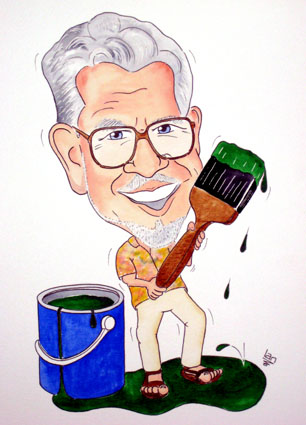
Rolf Harris has had a very varied career, musician, singer-songwriter, composer, painter, television personality and passionate advocate of sitting a mock exam. Okay I made that last one up but Rolf did make a very good point in an interview that I think illustrates one of the main benefits of sitting a mock exam.

In his early days Rolf used to paint on a huge canvass using wallpaper brushes and rollers, and it was in front of a live TV audience with only a 5 minute slot. Many years later in an interview he was asked why he practised painting the same thing over and over again, “after all Rolf you are a very good artist” said the interviewer, Rolf replied, “yes I can paint, but I am not practising to improve my painting, I am practising to make sure I finish on time, this is live television I have to finish at exactly the right time, that’s what I am trying to learn.”

And the same applies to mock exams, you’re not sitting a mock to find out what mark you’re going to get, that’s just the by product, you’re doing it to make sure you will finish on time. Knowing all the answers is no good if you run out of time….

Reasons to sit a mock exam:

1. Practice at leaving questions and moving on. Leaving a question you can do but have spent too much time on is easier said than done, remember there are often easier marks in the first 5 minutes of the next question than in the previous one. If you sit a mock exam you can practice leaving questions, sticking exactly to the time indicated by the marks in the question.

2. It’s an opportunity – I like to think of exams as opportunities to improve, they help identify what you need to improve to be better next time. This means the more mocks you sit the better you get!

3. Helps manage ignorance – There will certainly be questions in the exam that you won’t be able to do, where you don’t know the answer. Managing ignorance is a higher level skill, it is the ability to have a go, give it your best shot, even if you don’t know, just use your common sense. You may be very surprised at your mark. Only when you sit a mock will you really force yourself to have a go.

4. Gives you an indication of the topics that you are good at and the ones you aren’t. Sometimes you think you know something but when it comes to it, like in a mock you don’t.  Don’t worry there will still be time after the mock to brush up on those “think you know areas” areas.

5. Can help you deal better with stress. If you sit a mock exam it can feel like the real thing, but it isn’t. So if you panic and lose time as a result it doesn’t matter. It gives you a chance to think how you would deal with that situation should it arise again.

The best reason

But the best part of sitting a mock exam is if the mock you sit turns out to be very similar to the real thing. What would your chances of passing be then! Mocks should always be written with an eye on what might come up.

What it is not

On the whole a mock exam is not meant to predict success or failure although many people think of it like this, only the real exam matters. So why not give it a go and sit a mock exam this time, what have you got to lose.

And finally no mention would be complete of Rolf without a chance to watch Rolf sing Two little boys. Nothing to do with exams but a classic….

Exam techniques worth £100,000

I am not sure what to make of the latest news that a law student Maria Abramova is suing the Oxford Institute of Legal Practice (OXILP), part of Oxford Brookes University for £100,000 claiming they did not prepare her well enough to sit her legal examination, specifically they did not teach her exam techniques. 

She claims that failing the exams left her with a ‘blind spot’ when it came to taking future exams and eventually contributed to her failing the New York bar examination in 2008. She has since decided not re-sit the American examinations, as the process of taking legal tests causes her to become psychologically distressed.

Maria Abramova was clearly academically bright; she graduated in July 2004 with a 2:1 degree in law from Oriel College, Oxford. In all her studies with OXILP she had consistently been graded “very good”, the top grade.  Of the 357 other students that studied that year more than 99% went on to pass the paper at the heart of the litigation.

Who is to blame?

So what went wrong, does she have a case, is a college or university responsible for getting the student through the exam or is their job simply to deliver knowledge in an inspiring and understandable manner. And do exam techniques make that much difference anyway?

It is perhaps not surprising that a case of this nature has finally come to court. With exam results determining the opportunities for many and the price of education on the increase, why should educators not be accountable………….What is interesting is that this case has focussed not on the content of the course – “I was not taught X and X came up in the exam and that is the reason I failed,” but on exam techniques.

Now as someone who delivers courses on exam techniques and believes they are a vital part of passing examinations, it would be hard for me to argue they are unimportant or make no difference. But I come from a world (Professional accountancy and tax qualifications) where passing an exam is considered a vital part of the success of the course. I am not sure that this is the case with OXILP.

Its about responsibility

To answer some of these points you need to clarify how much responsibility should rest with the student and how much with the tuition provider. Education has to be a partnership; students are not empty vessels simply waiting to be filled with knowledge, they do have to try hard and study independent of the class, they should talk to other students and find out what they do and perhaps most importantly, they should challenge and if they are not happy seek a remedy.

I am of course no lawyer and await the outcome of this case with interest, but I can’t deny that I am pleased that someone has managed to put a £100,000 price tag on the value of exam techniques. And should Maria ever want to reconsider her decision to give up exams and need help with exam techniques I could certainly recommend a good book…..

Be proud of trying hard

There has been much in the media about schools and education recently and Michael Gove the Education secretary has been making the headlines with comments like “Rich thick kids do better than poor clever children when they arrive at school (and) the situation as they go through gets worse.”   

The Institute of Education tested children aged 22 months and again at the age of six years. It found that on average toddlers with low ability from the richest homes overtook high achieving children from the poorest backgrounds within a few years. The gap widens throughout school, research has found. By the age of 16, children eligible for free school meals are half as likely to get five decent GCSEs as pupils from wealthier backgrounds. 

For the government there are clearly problems here, if you wish to have a society that provides equality and opportunity for all regardless of your background then something is going wrong. However what struck me was the implication that after being tested at 22 months you should be successful at school, because at 22 months you had ability. How exactly do you measure ability at 22 months anyway? 

This is not a story about rich verses poor, and how the rich are using their sharp elbows to force their way to the top. This is a story about how anyone, almost regardless of ability can go onto achieve if they try, work hard, have the right environment, are motivated and inspired. The implication is that this message and these qualities are being provided by the parents of the “Thick rich kids” or they are paying for it outside of the traditional classroom. 

Trying hard

I sometimes think that trying hard or putting in a lot of work is thought of as not as impressive as being naturally talented. Yes it is great to see someone who has a natural talent, performing to the best of their ability, but show me a top sportsperson who, regardless of talent does not have to work hard and put in hours and hours of practice. If you pass an exam you should be proud of how much effort you put in and how hard you worked. The student who has more ability and fails but is happy, knowing they could have put in more work has much to learn.

So please celebrate hard work and be proud of what you have achieved knowing that you got their by working as hard as you could.

Degree or no degree, that is the question

Looking different

I am writing this sat around the pool on holiday in the South of France. My book selection for the holiday, which included the “Third man” by Peter Mandelson and, “Through the language glass” by Guy Deutscher, had left me relatively uninspired.

The Sunday papers however had much to say, they were all fired up by the recently announced A level and GCSE results. An impressive 97.6 % passed their A levels this year (97.5% 2009) 27% achieved A or A star – 8% were awarded the new A star.

The Sunday Times contained several articles on the value of a university education. The one that caught my eye was written by AA Gill, who I have always felt had a style that was pompous, unnecessarily critical (yes I know he’s a critic) and over important. Yet he was writing from the humble perspective, of someone who did not go to university (He also failed his 11 plus and every other exam after that – see last month’s blog) and so does not have a degree. Nor apparently does Jeremy Clarkson. He (AA) argues that it is experience (practical not general) that matters, and that neither university nor a gap year provides this.

Yet more and more people are attending University, 6% in the 1950’s, and 43% this year, encouraged to do so by the higher salaries graduates command, parental aspiration and the previous Labour government. Oh and perhaps the poor job prospects……

This increase in graduate’s means it becomes inevitable that having a degree will no longer be the exclusive club it once was. It does not of course follow that the degree itself is any less worthy in terms of its academic rigour; although many will imply that this is the case. Differentiating yourself by way of a degree to potential employers does however become much harder.

And although it seems an enviable position for a country to be in, to have an ever increasing educated workforce, the current model is not only financially unsustainable, (Average debt for a student leaving university is now £25,000) worse it may be failing to deliver to both student and employer.

But what could be done?
One idea is to reduce degrees from three to two years. Although it could be argued that some degrees genuinely benefit from having three years, for most two is probably sufficient. Not of course my idea, the two year degree has recently been promoted by Vince Cable, and Buckingham University already offers them. This might be an area that the private sector Universities will look to invade.

It may also be time to accept that full time education is a luxury that neither the individual, the individual’s parents nor the state can afford. I am not suggesting that people should not study and obtain a degree; it’s just that studying for it full time may no longer be the best route. Ideally students should continue their education whilst in full time employment. I fully appreciate that this is easier said than done, particularly in the current environment where getting a job is at best difficult, but higher education should not be seen as a substitute for being unemployed!

Obtaining a degree in two rather than three years will make the whole process more affordable and by studying whilst in employment the individual will gain the practical on the job experience thought so important by Mr AA Gill.

Of course employers will still have a large choice of graduates to choose from, and the degree on its own may not differentiate one individual from another, but as is the case in the post degree job market, the employer will have to choose the best candidate based not only on their academic record but also on their level of practical experience and what they can actually do.

But what of the gap year? Of course you should still have a gap year, but perhaps not until you are 30 plus, when you might have a better idea what to do and perhaps more importantly would really appreciate and value it…..