Learning starts with what you already know – Making connections  

Have you ever stopped to think about what you already know?

It’s not something we tend to do every day, but it’s a surprisingly powerful technique especially when you’ve made a mistake and feel like you’ve learned nothing. In moments like these, recognising what you already know can be both grounding and motivating. Rather than starting from scratch, you’re building on a foundation that already exists.
And it is on this principle of foundational knowledge that the educational psychologist David Ausubel developed one of the most important theories in learning. He said that making connections between new ideas and prior knowledge helps us learn more deeply and retain information for longer. He referred to this as meaningful learning.

Ausubel’s meaningful learning
Ausubel’s meaningful learning offers a stark contrast to rote learning, primarily because it aligns more effectively with how our brains naturally process and retain information. Instead of treating the mind as a passive storage unit, merely accepting and holding isolated facts, meaningful learning actively engages the learner’s existing cognitive structure. While rote learning might achieve short-term recall, it fosters a superficial understanding devoid of context or connection to existing knowledge. This isolation makes the newly “learned” information fragile and easily forgotten.

But if making connections is the objective, how is this best achieved?

Anchoring New Information – When you come across new information it needs to be anchored to a relevant and stable concept that already exists. The stronger and more clearly defined this anchor is, the more effectively the new information can be integrated and retained. For example, imagine you understand what a mammal is, and are introduced to new information about a “dolphin,” if you can appreciate that despite living in the water, the dolphin shares many core characteristics with mammals the connection can be built.

Developing context (Advance organisers) – When you’re learning something completely new, its possible you dont have a solid enough understanding of the subject on which to anchor the new information. To solve this, its a good idea to have a general outline or some background information as a way of introducing the subject. This can help provide the new information with something it can be anchored to. For example, before talking about the concept of supply and demand, ask the students to think about something they might like to buy, perhaps training shoes, and why the price might be so high? Follow that up by adding “today we are going to see that it’s a function of how many units of the product the company is willing to make at a given price, compared to how much the consumer is willing to pay.” This simple introduction provides the student with sufficient “prior knowledge” to connect the new information. Note that the training shoes example is practical, tangible and relatable.

Impact of AI
It is not of course possible for me to write a blog without referencing AI, and there are some interesting ways in which Ausbells theory could become more effective, for example:

  • Analysing prior knowledge (personalisation) – It could be used to asses student’s prior knowledge and generate highly tailored “advance organisers”. Instead of a generic introduction, AI could create summaries, analogies, or concept maps specifically designed to connect with what the student already knows.
  • Intelligent tutoring – AI tutors can engage students in conversation that encourage them to explicitly connect new information to their existing knowledge. By asking probing questions and providing feedback, AI can guide students through the process of meaningful integration.  
  • Identifying knowledge gaps – AI can analyse student responses and identify specific gaps in their prior knowledge that might hinder their ability to link the new information.
  • Dynamic concept and mind mapping – AI tools can help students create and visualise maps that explicitly show the relationships between new and existing knowledge.

Implications for students
This is all very interesting but what does it mean if you are studying.

  • Reflect, think back Before diving into something new, take a moment to think about what you already know that might be related. Even a little connection can make a big difference.
  • Ask “how does this fit?” As you learn new things, constantly ask yourself how this new information connects to what you already understand.
  • Look for similarities and differences – How is this new idea like something you’ve learned before?
  • Pay attention to introductions – When your teacher/lecturer gives you an overview or a summary before starting a new topic, pay close attention! These “advance organisers” are like maps that show you where you’re going and how the new content fits into the bigger picture.  
  • Use mind maps or concept maps Often, it’s helpful to understand the main ideas first and how each one relates to the other.

The teacher – facilitator of connection
The educator’s role will shift from “sage on the stage” to “guide on the side.” They should become facilitators of connection, helping learners build bridges between new and existing knowledge. In this new role, educators do not just guide students toward knowledge, they inspire them to see the interconnectedness of ideas and the possibility of shaping their own paths of understanding.

Research (update) – Ausubel’s meaningful learning re-visited – the core idea that what a learner already knows remains a key principle, but recent research in cognition and neuroscience shows that memory is dynamic and not just like retrieving fixed recordings.


The simple Mr Feynman

Feynman

Richard Phillips Feynman was co-awarded the Nobel prize for Physics in 1965 for successfully resolving problems related to the theory of quantum electrodynamics.  No, I’m not sure what that means either. If that was not enough he also helped build the atom bomb, being part of the Manhattan project, and following the Challenger explosion on January 28, 1986 he was the person largely credited with figuring out why it happened.

In fact, Richard Feynman is widely considered to be one of the greatest and most influential theoretical physicists in history. His physics lectures have become world famous. Here is one on the Law of Gravitation.

“I’m smart enough to know that I’m dumb.”

Richard Feynman

He was intensely curious and believed that unless you could explain a concept or idea in simple terms you really didn’t understand it. In this clip Feynman was asked by his father to explain where a photon comes from – listen for his metaphor.

The Feynman technique

Richard Feynman was worried that a lot of people thought they knew something when in fact they only had a superficial grasp of the subject matter.

“You can know the name of that bird in all the languages of the world, but when you’re finished, you’ll know absolutely nothing whatever about the bird. You’ll only know about humans in different places, and what they call the bird… I learned very early the difference between knowing the name of something and knowing something.”

Richard P. Feynman

Such was his concern that he created a process to help take an individual’s knowledge to a far deeper and more fundamental level, it’s called the Feynman Technique.

Step 1: Take a sheet of paper and write the name of the concept, topic or subject you would like to learn.

Step 2: Explain the concept in your own words as if you were teaching someone else – see also Protege effect.  Imagine your pupil is a small child, this will help focus your mind on plain, simple language. Don’t limit your explanation to definitions or overviews, challenge yourself, and include lots of examples, which as mentioned in earlier blogs is a great way of making sure you have understood it.

Step 3: Review your explanation and identify the gaps. These might be areas where you simply didn’t have the necessary knowledge or your explanation was weak. Once you have done this go back to your notes or textbook, re-learn the subject matter and add what you have learned to your sheet of paper, then repeat step 2.

“The first person you should be careful not to fool is yourself. Because you are the easiest person to fool”.”

 Richard Feynman

Step 4: Review again and remove technical or overly complex terms, think, “how can I say this more simply?” Also put your notes into an order that flows easily, this might involve rewriting large sections and even starting again with a clean piece of paper, but thats all part of the process. One final tip, as with step 2, it often helps to read out loud.

And that’s it!

I am not saying that if you follow this technique you will win a Nobel prize or be able to play the bongos, another skill that Feynman was famous for, but it will certainly deepen your understanding of the subject, and that’s not a bad start is it!

Richard Feynman: “The Great Explainer” click for an interesting  10-minute summary of his career in science.

The Protege effect – Learning by Teaching

Protege

The Protege effect states that the best way to learn is to teach someone else. Students develop a better understanding and retain knowledge longer than those who study in more traditional ways. The Roman philosopher Seneca put it even more simply ‘While we teach, we learn’.

The method, also called learning by teaching was originally developed by Jean-Pol Martin in the 1980s. Click to watch a short video.


There are many theories written about learning and education but the ones that are always most powerful for me are those that you can evidence in some way from your own experiences or from the experiences of others whose opinion you value. And I would be very surprised if any of my teaching colleagues would disagree with the basic concept that no matter how much you think you know about a subject or topic, the very process of teaching always offers up new thoughts and insights, deepening your understanding.

The teacher might be the student

The argument hinges on the relationship between a teacher and learner. Traditionally the teacher is the expert who provides knowledge, the learner the one who receives it, but the teacher need not be the person who stands at the front of class, the teacher can be the student and the student the teacher.

This role reversal is not as odd as it at first might seem, a good teacher will always listen to the answer a student gives in order to evaluate their own performance. And if you think of it like that, who is teaching who?

But how does it work? Imagine you were asked to teach a subject to others in your peer group. Knowing you were going to have to explain a topic will increase your level of engagement with the learning materials. In addition, reflection will be far deeper as you continually ask, does this makes sense to me? This process of preparing, “prepping” is one of the reasons teaching improves learning but there are others. For example, the construction of the learning itself will require imagination and creativity, how exactly will I teach this subject?  It may be a simple verbal explanation, conversational even, or perhaps something more formal, requiring slides or additional illustrations. Once again you will be forced to reflect, possibly writing down some of your ideas and again asking questions, how long will it take, am I making myself clear, what questions could I be asked? Its at this stage that you may even find your understanding lacking, requiring you to go back over what you previously thought you knew.

There is research (Bargh and Schul 1980) to prove that preparing to teach in the belief that you will have to do so improves learning, however there is one final stage, the teaching itself.  In 1993 Coleman, Brown and Rivkin investigated the impact of actually teaching, eliminating the effects resulting from the interaction with students, their conclusions, that there was a significant improvement in performance of those that taught compared to the those who prepared but didn’t in the end teach.

In summary, although thinking you have to teach and going through the process to do so improves learning, following through with the actual teaching is even better.

Protege in practice

Bettys Brain (Vanderbilt University) – Bettys brain is a computer based, Teachable Agent that students can teach and in so doing learn. The students develop a visual map (A concept map) of their own knowledge, forcing them to organise their thoughts. There are resources available within the programme to help them develop a deeper undertesting of the subject. They then teach what they learned to Betty, who like any other student will face a test at the end. If she does not do well in the test it is a reflection of the quality of the teacher or perhaps more precisely their understanding of the subject.

Click here for more details

Lessons for students – This is not a plea for students to pair up and teach each other, as good an idea as this might be. It is a hope that by explaining why teaching helps you learn, it gives an insight into how we all learn. For example, it highlights that reflection, i.e. thinking back on what you know is so important, it shows that high levels of concentration are required, the result of knowing you will have to explain concepts and ideas to others, and it offers up some evidence as to why talking out loud as you do when presenting, consolidates learning.

A few other takeaways, why not imagine you have to teach the subject you are learning and study with a “teaching mindset”. Preparing notes as if you are going to teach, crafting ideas as to how you might explain it to others. Get involved in group discussions, try to answer other student questions as they might answer yours.

Oh, and don’t always assume that the person in front of you fully grasps what they are saying, they are still learning as well.


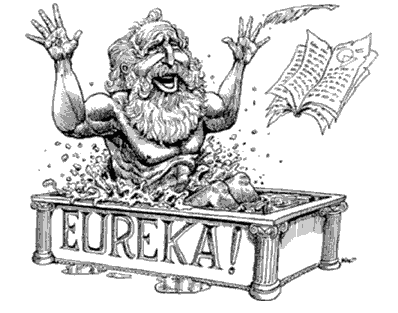
Eureka – I Understand Understanding!

I Understand!If you understand the subject you are studying your chances of passing the exam must be good.

A simple and perhaps obvious statement but what does understand mean and what do you have to do to truly understand something? Of course understanding is a key part of passing but it is not enough on its own, you can understand something yet fail because you run out of time, misinterpret the question, thought you understood but didn’t! etc.

To understand

The dictionary defines to understand as, to know what someone or something means, to grasp the meaning, to be familiar with, make sense of etc. Understanding is clearly different to knowing, for example, you may know that gravity is a force that pulls objects to earth but that does not mean you understand what gravity is or how it works. Of course you need both knowledge and understanding, the one is no good without the other. Examiners try to test for understanding by asking questions that require you to compare, contrast, explain, interpret etc.

Understanding is not a Eureka moment, it has different levels. It might seem that there is a point where you didn’t understand and then suddenly you did, a Eureka moment. In reality what you have done is move closer to gaining a better and fuller understanding. Ask any lecturer or teacher, often they will tell you they never fully understood something until they had to teach it, they just thought they did.

Proving you understand – The 6 facets of understanding

Understanding by design, Wiggins and McTighe (1998) is one part of an instructional design process that provides a very helpful framework we can use to explore the depth of understanding and perhaps more importantly what you can do to develop a deeper understanding. Think of it as a hierarchy with the easiest one first, the greater you’re understanding the higher the number.

1. Explain, the classic exam question – Explain to someone what the concept/idea means and say why. Explaining out loud to yourself or making a recording can be just as effective.

2. Interpretation – Relate the concept/idea to your own experiences, tell a meaningful story. Try to add something personal into your explanation. To do this you will need to reflect on past events, whilst attempting to find parallels with the concept/idea.

3. Application – Use the concept/idea in a different context. The ability to apply knowledge in different contexts (transfer) is a key milestone in learning as well as understanding. It should result in you never being caught out by a difficult exam question. Understand to this level and it doesn’t matter what the examiner asks.

4. Perspective – Read around the concept/idea, get other people’s views, and see the big picture. If your struggling with understanding, read another text book or my favourite is to go onto you tube and watch a video. The internet is great for discovering alternative views.

5. Empathy – Try to get inside another person’s feelings about the concept/idea. This is difficult as it requires you to put aside your feelings about the concept/idea and accept that it is not the only way of thinking about it.

6. Self Knowledge – Ask questions about your understanding, ask what are the limits of your understanding, what are your prejudices, become aware of what you don’t understand. Often called metacognition, the ability to think about thinking.

The Eureka moment

Understanding, like Eureka moments are not of course the result of sitting in a bath and suddenly finding you understand something you had previously found confusing. It is the gift of hard work and long hours of study, hopefully by trying some of the techniques above your depth of understanding will only improve.

Ps apparently the jeweller was trying to cheat the king….

Understanding by Design

Want to know more about understanding by design, watch this.