

I first wrote about metacognition back in 2019 – the skill of thinking about your own thinking. Since then, much has changed, I have learned a bit more but crucially AI has come along and is having a significant impact on much of what we do.
It’s now woven into how we write, make decisions and even remember, and with that comes the danger of AI quietly eroding our ability to develop metacognitive skills. Taking the path of least resistance and delegating the hard work to AI leaves us exposed, and ultimately dependant.
As important as metacognition is for managing our own thinking, it’s indispensable when working with AI. It’s what allows us to evaluate the output rather than simply accept it.
TL;DR – the short audio version
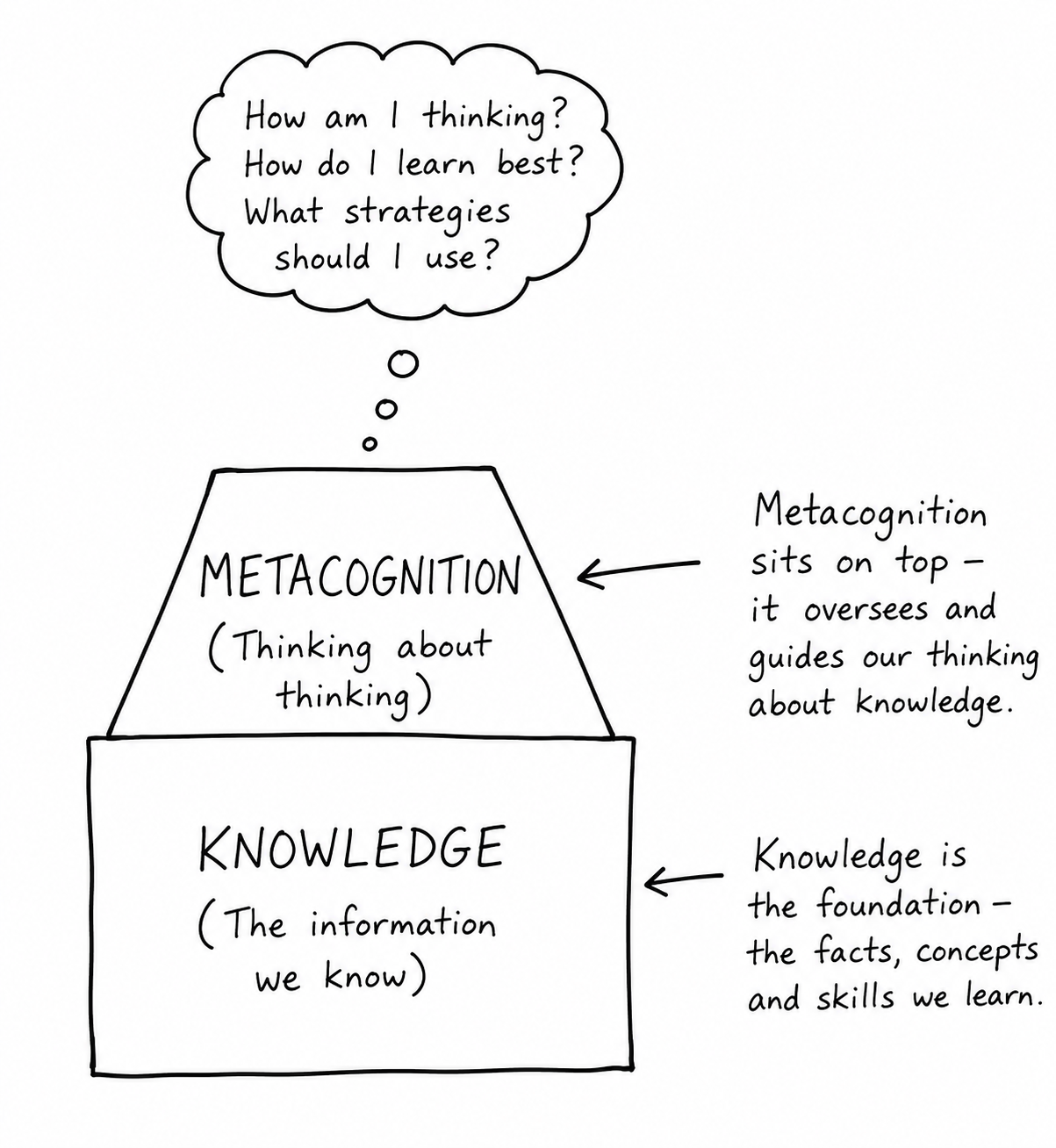
Metacognition
Meta comes from Greek, meaning “beyond” or “about.” Metadata for example is data about data, so “metacognition” is thinking about thinking, you’re not solving the problem, you’re watching yourself solve it. Think of it like this – when a chef makes a sauce, he is cooking. He tastes as he goes, deciding if it needs a little more salt, that pause to check if it’s all going to plan, is the meta part. Metacognition works the same way – you’re not just thinking, you’re pausing to ask questions about what you’re doing e.g. does that make sense, what’s the evidence for this, what should I try next?
“Those who know how to think need no teachers.” – Mahatma Gandhi
Flavell and the fluency illusion – Metacognition was coined by the developmental psychologist John Flavell in the 1970s, he made an important distinction.
- Cognition – the actual knowledge and skills you’re acquiring (formulas, theories etc)
- Metacognition – your knowledge about that knowledge, your ability to judge accurately what you understand, what you don’t, and what to do about the gap
“Metacognition refers to one’s knowledge concerning one’s own cognitive processes” – John Flavell
Flavell broke it down even further:
- Metacognitive knowledge – understanding how you learn best.
- Metacognitive regulation – planning, monitoring, and adjusting your approach as you go.
- Metacognitive experience – the gut feeling of “I’ve got this” or “I’m lost”, which, crucially, is often wrong.
That last point, the gut feeling being wrong, is where most students come unstuck. Psychologists call it the fluency illusion. Re-reading a chapter, highlighting a paragraph – these feel like learning because the material is familiar and easy to process. But familiarity is not the same as retrieval. You recognise the answer when it’s in front of you but that’s a completely different mental operation to producing it from memory in the exam under pressure. The result is a systematic and predictable overconfidence, students walk out of revision sessions feeling as if they are ready, and walk out of the exam hall feeling like they weren’t.
Why does it matter – Research suggests metacognitive skill is often a better predictor of exam success than IQ, because it’s not about how much a student knows but how well they manage their own learning process. That said, it only helps if it leads to action, noticing confusion is only useful if the student actually changes course rather than just being aware of the problem.
“Metacognition is the ability to, at any moment, step off the stage and sit down in the director’s chair.” – Ujjwal Ganesh, author The Observation Effect
The Antidote to AI
In a previous blog I highlighted the problems with Khanmigo, Khan Academy’s AI tutor. It struggled because it was built like a virtual Socrates, and needed students to ask good questions to prove its worth. The trouble was that many students simply replied “IDK” (I Don’t Know). Not because they were being difficult, but because if you don’t have the metacognitive skills to think through what you know and what you don’t, you can’t ask useful questions. This is the quiet danger of a world with answers on tap. AI can hand you correct information in seconds, but it cannot give you a sense of what you personally still need to learn. That judgement remains yours.
“Thinking: the talking of the soul with itself.” – Plato
It’s also the skill we need most in order to work with AI properly, to check whether its answers are actually correct, to judge whether they’re useful for what we’re trying to do, and to push our understanding to a higher level. In other words, we need to apply metacognition to AI’s output the same way we apply it to our own thinking, not just to ask “do I understand this?” but “is this actually right, and is it what I needed?” Metacognition does two jobs here. It protects (The antidote) stopping AI from doing our thinking for us. It also helps us get better at using AI by teaching us to question, test, and push back. Same skill, two uses.
Conclusion
Metacognition has always been very important in terms of learning, helping us regulate our own thinking, finding the gap between what we assume we know and what we actually know, which helps us deepen our understanding. That job hasn’t gone away. If anything, it matters even more. But AI makes it doubly important, it’s not just about regulating our own thinking, but our thinking about AI’s thinking.
Nobody will wake up having forgotten how to think. It’s a slow transfer of judgement, question by question, until the habit of checking simply isn’t there anymore. AI hasn’t changed what metacognition is, It’s just made it a skill we can no longer afford to leave undeveloped, for our own thinking, and now, for everything we borrow from someone, or something, else.
Want to learn more – Metacognition: An Important Skill for Modern Times | Brendan Conway-Smith

