

Are attention spans getting shorter – Spoiler, No?

Now what was I saying
A goldfish can remember certain tasks and environments for weeks and even months – a Gnat however doesn’t have an attention span at all. *

There has been a significant amount of space in the press devoted to telling us that attention spans are getting shorter, largely the result of an increased use of digital technologies.

One headline read – “You Now Have a Shorter Attention Span Than a Goldfish

This story can be traced back to a 2015 Microsoft report which included the claim that the average human attention span had decreased from 12 seconds in 2000 to 8 seconds in 2013, shorter than the alleged 9 second attention span of a goldfish.

It has however since been debunked and is simply not true. It was based on vague, unsupported opinion and lacked the necessary evidence. Microsoft has since taken the report down from its website.

And yet the myth remains popular possibly because most days you will see people using their smart phones endlessly scrolling, looking for something to grab their attention in order to satisfy their “dopamine bump” addiction. They pause only momentarily to read or look at the image on the screen before continuing the search. Ask them what they are doing, and without looking up to acknowledge the question, they will answer “nothing”!

Many social media platforms are designed around the idea of short attention spans, furthering the belief that we have a new generation of learners who are different in some way to those that went before.

Attention spans
An attention span is typically defined as “the amount of time a person can maintain attention on a specific task or activity, without becoming distracted.” The key point here is that attention has a lot to do with the brains ability to resist interruption.

For this reason, its useful to think about it in two ways:

  • Sustained Attention (maintaining focus over time) is the ability to concentrate on a single task over a long period, such as when you are reading or studying. The average person can focus their attention for around 20 to 30 minutes, which is a lot more that 8 seconds! The Pomodoro technique that was developed by Francesco Cirillo in the late 1980’s works on this principle. With the aid of a timer, you are required to take a short break every 25 minutes.  As a result, you can then maintain focus for hours.
  • Selective Attention (choosing what to focus on) is the ability to focus on one thing while filtering out distractions, such as focusing on a single conversation in a noisy room.

These are of course interrelated with sustained attention relying on selective attention to be effective. It’s also important to note that attention is not fixed and is dependent on age, level of interest, fatigue, stress etc.

This study by Rosen, Lim, Carrier, and Cheever (2011) found that students averaged less than 6 minutes on a task before switching to another, most often because of a need to reply to a text or check social media. It concluded that allowing students short “technology breaks” could help reduce these distractions, and that teaching students’ metacognitive strategies would also be beneficial. They stated that the students were prone to distraction due to device notifications, not because they had reduced attention spans.

Attention Deficit Hyperactivity Disorder (ADHD)
ADHD is a neurodevelopmental condition that affects attention, impulse control, and activity levels. Symptoms include difficulty in maintaining focus, being impulsive and having high levels of energy. It is a recognised medical condition that results in a lower attention span. It is thought to be highly heritable, with levels in the region of 70 – 80%, but it’s not as common as you might think given its prominence in the press. In the UK, there are only believed to be around 3 – 4% of children and 2% of adults who suffer from it. One caveat, it is possible that there are a lot of people who remain undiagnosed.

The impact on learning
The main point here is that in terms of our cognitive ability attention spans have not really changed. What has, are the levels of distraction and cultural and environmentally accepted norms. Think about the rise of digital devices, instant messaging, and social media, people now have a vast number of ways in which they can distract themselves. In addition, the sheer amount of information available can be overwhelming, making it harder to focus on one task for long. Many of us also lead busy lives, forcing us to juggle multiple tasks and often failing to any of well.

For the learners – Don’t fall into the trap of thinking “it’s not your fault” your genetics have given you a short attention span. Your attention span is fine it’s the environment you find yourself in that is the problem – see last month’s blog on learning environments.

A few tips

  • Take regular breaks – as highlighted above taking short 5 to 15 minute breaks every 20 to 30 minuets, maybe even 45 minutes can improve your ability to focus.
  • Reduce distractions – eliminate or minimise distractions, this means not having your mobile phone in the room or at least turning off your notifications. You need to create a dedicated, distraction free workspace.

And for the educators – While adapting content for individuals to accommodate short attention spans can be useful, especially when trying to engage them. It’s important not to think about it as a new way of learning, it’s more of an environmental challenge. As a consequence it would be wrong to design all lessons with it at the forefront of your mind. Evidence from cognitive science suggests that learning should be challenging (desirably difficult), requiring sustained focus, active engagement, and mental effort. But perhaps worse of all, if we continue to produce content that caters only to short attention spans, there is a danger of inadvertently reinforcing the behaviour.

Fake NBC Goldfish news
Here is a video typical of what you can find on the internet that continues to support the 8 second myth – Is Your Attention Span Shorter Than a Goldfish’s?

And finally, In defence of Gnats
Gnats, like many insects, are primarily focused on tasks like finding food, mating, and avoiding predators. While their attention may shift quickly between these tasks, it’s not really fair to say they have a short attention span in the same way humans or goldfishes do.

Chatter – why talking to yourself matters

If you are reading this, think for a moment as to what you are doing……… are you sounding out the words in your head or did you pause, reflect and ask yourself “what exactly am I doing?”, either way you have been using your inner voice, your internal dialogue or have been experiencing what Ethan Kross calls Chatter.

Ethan is the Professor of Psychology and Management at the University of Michigan and author of a book called Chatter, the voice in our head and how to harness it.

On the one hand this might all seem a little strange, how many people would you ask what they have been talking to themselves about today, perhaps you wouldn’t because it’s too personal a question or maybe you don’t want to admit you do it all of the time. The good news is its perfectly normal and the vast majority of people talk to themselves. It’s worth adding however that not everyone has an internal voice, with some suggesting that this might be more likely for people with dyslexia.

Where does it come from?
Evolution would suggest that if we have this ability, it must serve a purpose. Mark Scott from the University of British Columbia has found evidence that a brain signal called “corollary discharge” plays an important role in our experiences of internal speech. Corollary discharge arises when the brain generates an internal copy of the sound of our voice in parallel to the external sound we hear. Its purpose is to prevent confusion between a self-caused sound or sensation for example, a dog growling noise inside our head and an externally-caused sound, for example a real dog growling who is about to bite. If both are the same, we run pretty fast, if not the brain will cancel the internal sound. This is the reason we can’t tickle ourselves; the brain sends a signal that we are going to tickle ourselves before we actually do, effectively cancelling the sensation.

Interestingly children don’t develop this skill until around 6 or 7 although its gradual and starts much earlier. This is the reason a young child will just say what they think, regardless of the consequences!

“Don’t let the noise of others’ opinions drown out your own inner voice.” Steve Jobs

Why it matters and what you can do?
One of the most powerful tools to help manage stress, wellbeing and self-esteem is your inner voice, and examinations provide a rich environment where without support all of these can bring you down. Heightened dialogue is not of course just experienced when studying or in the exam room, how was it possible that Marcus Rashford, Jadon Sancho and Bukayo Saka missed penalties in the Euros. Maybe it was the result of too much chatter, telling themselves that they must score, they have to score, the country is relying on them?

“Non-judgment quiets the internal dialogue, and this opens once again the doorway to creativity.” Deepak Chopra

And this is where Ethan Kross offers a whole raft of advice. He talks about having the ability to step back from the Chatter by adopting a broader, calmer and more objective perspective. You also need to listen to what your saying, low self esteem for example can easily develop if you are continually criticising yourself, perhaps as a thoughtless parent might do, always finding fault no matter what.

Here are a few of the practical tools in the book.

  1. Use distanced self-talk – rather than saying “why can’t I do this”, use your name in the second person “why is it that Stuart can’t do this”. This results in reduced activation in brain networks associated with negative thoughts.
  2. Imagine advising a friend – this has a similar impact in that it helps you view the experience from a distance. “I know this is a tricky question but you’ve been in a similar situation before and you figured it out”. This is also an example of what Kross calls time travel, (temporal distancing) either going forward in time to look in the rear-view mirror at the problem, effectively leaving it behind or travelling back to a time when you were successful.
  3. Broaden your perspective – in this situation, compare what you’re worrying about with other adverse events or ask what other people would do in the same situation. A variation on the “what would Jesus do?” question.
  4. Reinterpreted your bodies chatter response – when you experience stress its likely your heart rate will increase and you will begin to sweat. Becoming aware of this can lead you to conclude that you are stressed which in fact makes the situation worse. Kross suggest you tell yourself that this is not bad news but the body doing what it has to in order to help you.

And finally, if you want to find out more, check out this video, Do you have an inner voice?

Exam stress – Mindfulness and the “7/11”

I have been aware of the term mindfulness for a few years now, but had struggled to think how it could help with exams.  That was before reading an article in the Guardian, Could beditation be the answer to exam nerves? ‘Mindfulness’ is the latest big thing in schools. What is it and why is it so popular?

In the article they describe two ways in which mindfulness may be used to help with exams. One is called the “7/11” the other bedetation.

  • The “7/11” is a relaxation breathing exercise. Matching the counting to the breath, you breathe in through your nose for a count of seven, and out through your nose for a count of 11. As with many mindfulness techniques this helps focus your attention, in this instance you use the breath as an object of concentration. By focusing on the breath you become aware of the mind’s tendency to jump from one thing to another. The simple discipline of concentration brings us back to the present moment and all the richness of experience that it contains. Watch this video, it shows exactly how to do “7/11” breathing.
  • Beditation is simply the process of meditation whilst lying down. Meditation might sound slightly new world, but it is of course thousands of years old. On one level meditation is a simple yet powerful technique that effortlessly allows your mind to become calm and peaceful. Which is not a bad state to be in when you’re studying or in the exam room.

What exactly is Mindfulness?

Although mindfulness has its roots in eastern philosophy, many acknowledge the work of Jon Kabat-Zinn from the Medical Centre at the University of Massachusetts as being the founder of the modern mindfulness movement. Jon Kabat-Zinn defines mindfulness as “paying attention, on purpose in the present moment non judgementally.”

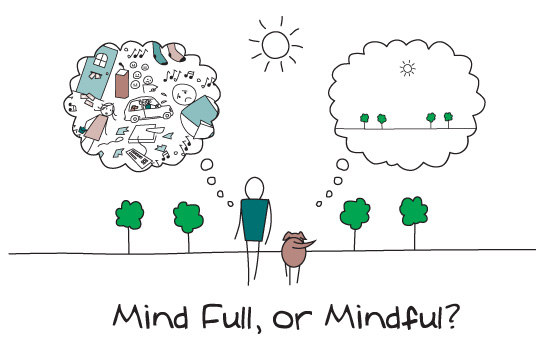
If you imagine that there are two modes of attention, thinking and sensing. Attention often gets drawn to what’s wrong, what’s threatening, our attention scans for problems and this is for good reason, it is a primeval survival technique. This triggers the thinking part as you attempt to solve the problem. Now there is nothing wrong with this but the mind needs a balance and there is a time to think and a time to relax and sense.

By moving your attention to the present moment and into the sensing mode you will instantly become more relaxed. The “7/11” breathing and meditation techniques are just ways of helping you do this. Research is showing that there are huge benefits of spending some time in the sensing mode and not in the thinking mode.

Listen to this TED lecture given by Richard Burnett who is the co-founder of the Mindfulness in Schools Project (also known as .b, pronounced “dot b”), whose aim is to introduce mindfulness as a discipline in the school curriculum.

How it helps with exam stress

Stress is often created by thinking what might happen if I fail, what happens if I am not good enough, or can’t answer this question? These are all examples of the thinking state of attention. Now as I have mentioned before in a previous blog, exam stress or is it your stress to feel stressed is a perfectly natural reaction; it is the result of being faced with a challenge that initially at least, looks impossible to overcome. But in an exam it is far from helpful, often cutting off your ability to think straight and sometimes paralysing your actions.

By using the “7/11” breathing techniques before the exam, to help you feel more relaxed, during the exam to stop a panic attack taking over, and even after the exam when you begin to wonder what you should have done but didn’t, can be incredibly helpful.

And meditation can help both in the short and long run, our mental health and intellectual skills are shaped by what we do with our attention, where we place our awareness. And of course intellectual skills are vital not just in the exam but whilst studying as well.

Is it just in the mind?

Brain-imaging studies show that mindfulness meditation can reliably and profoundly alter the structure and function of the brain and produce, for example, greater blood-flow to and a thickening of the cerebral cortex in areas associated with attention and emotions. As well its impact on specific problems, mindfulness has been shown to have a very positive effect on intellectual skills, improving sustained attention, visual special memory, working memory and concentration

The National Institute for health and care excellence (Nice) are recommending mindfulness.

Watch this short video on more ways that mindfulness may help in exams.

Can ‘Mindful’ meditation increase profits?

And for the more commercial minded of you, it might even help your business increase profits. Watch this to find out more.