
Woody Allen on speed reading
I was asked recently by a student if there was anything they could do to speed up the way that they read. As a student there are many situations where it would be great if you could read more quickly.


Woody Allen on speed reading
I was asked recently by a student if there was anything they could do to speed up the way that they read. As a student there are many situations where it would be great if you could read more quickly.
 Three stories caught my eye this month that I thought might be of interest.
They are all ways in which new research is providing evidence as to how it is possible to learn more effectively, a kind of smart brain learning.
Sleep is good for study
A new study from the University of Notre Dame suggest that sleeping soon after learning new material is best for recall. This clearly has implications for students in those latter stages of revision and arguably the night before the exam. The answer it would seem is that you can study right up to the last minute (probably memorising facts) as long as you are getting a good night’s sleep after wards.
Although it is not known with certainty why sleep is so good, it is believed that it brings some form of consolidation of the facts, a kind of updating and reorganising of the brain while you rest.
The idea is not that new, this research was out in 2004
Pictures are better than words
This might come as no surprise to people who have read this blog before but it is reassuring that there is some science to support the view that the brain is more effective with pictures than words.
A story from the BBC about a group of people who had their brainwaves scanned while completing a series of tasks, individually and in groups, to see if data visualisation, presenting information visually, in this case a series of mind maps can help. The results showed that when tasks were presented visually rather than using traditional text, individuals used arround 20% less cognitive resources. In other words, their brains were working a lot less hard.
The research was carried out by Mindlab International, an independent research company that specialises in neurometrics – the science of measuring patterns of brain activity through EEG, eye tracking and skin conductivity, which tracks emotions.
This is not just another plug for mind maps, they are just one way in which information is presented visually. When reading a book or study manual, put information in boxes, use graphs, draw people and objects, make it look visual, it will all help.
The first sign of madness – talking to yourself out loud
Gary Lupyan, a cognitive psychologist at the University of Wisconsin-Madison often found himself talking out loud so he thought it might try to find out if it helped, and guess what it did.
In one experiment, volunteers were shown 20 pictures of various objects and asked to look for a specific one, such as a banana. In half of the trials, participants were asked to repeatedly say what they were looking for out loud to themselves, the others were asked to remain silent. The researchers found self-directed speech helped people find objects more quickly by about 50 to 100 milliseconds.
Most people talk to themselves when studying, but they don’t say the words out loud they keep it inside their heads. What this research suggests is that what you should do is say the words out loud, use different voices even. I know it sounds strange but it does work. Okay maybe you should do it behind closed doors; you don’t want to upset the neighbors…..
 As the month of March slips effortlessly away it is time for some of you to be thinking about revision, my daughter is, or should I say should be. For others the very word revision will help focus your attention and remind you that it is not too far away for you either. If only we had more time….or perhaps could better manage the time we have.
David Allen is a productivity consultant (great job title) and bestselling author of Getting Things Done: The Art of Stress-Free Productivity. He suggests that “‘Time management’ is a foolish idea,” “You don’t manage time. Have you ever mismanaged five minutes and come up with six? Or four-and-a-half? Time just is. Our actions are what we manage, during time.”
And if you think about it he‘s right, the amount of time you have is a matter of fact. So we just need to prioritise the tasks in that time dependant on what we want to achieve. To better organise your time it is a very good idea to have a study/revision timetable.
When to start
It is difficult to be prescriptive about when to start revision as it depends on many things: the length of the course, the level of complexity of the subject, the time you have before the exam and how many exams you are doing at any one time. But we do need a rough idea, so I am going to assume that revision has to start somewhere between two and six weeks before the exam. For some people, starting 2 weeks before the exam may sound early, but if you are studying more than one subject and or are working full time, when you actually break down the amount of hours you are revising, anything less than 2 weeks will be insufficient for an effective revision program.
Revision timetable
There are many different ways in which you can draw up your timetable and I have included several examples below for you to print off and or download. One thing I would say is that the very process of creating your own time table will help you begin thinking about what it is you have to do, how long it will take etc. In fact you could say that your revision starts with your timetable.
Don’t forget Google calendar which I use a lot and it will sync to your mobile.
But what should you do in the time available?
In order to give you some idea what you should be doing in the time available I have produced a mock-up of a revision timetable showing various activities. It is based on the assumption that you have 6 weeks before the exam.
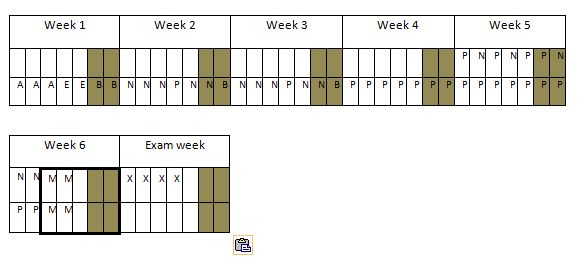
Key to activities
The shaded areas are weekends and X denotes the actual exams. Week 5 and 6 assumes that you are not at work if of course you do work and so have a full day to devote to your revision. As you can see of the last 5 days 2 are taken up with mock exams and the last 3 are left blank. This is because there are two parts to revision.
The first is very much to do with making notes, practicing questions based on the key examinable topics and continuing to learn but in a much more focused way than on tuition. Equally, what you are learning is far more about application, how the topic will be examined rather than what the topic is about.
The second is more about recognising that there will be some topics that you won’t be able to master in the time you have left and others that you have mastered but can’t remember some of the key prompts, definitions or formats. In this second period, we need to start committing things to memory.
Not related to time but…
I came across these videos by Dr Stephen Chew a professor of physiology at Samford University, Birmingham Alabama. They are a series of 5 videos about how to get the most out of studying. Not only are they interesting but they include some very helpful tips and hints as to how you can become more time efficient with your studying.
Video 1 Beliefs that make you fail …or succeed
Video 2 what students should know about how people learn?
Video 3 cognitive principles for optimizing learning
Video 4 putting principle for learning into practice
Video 5 I blew the exam now what
Enjoy and let me leave you with this thought “For every minute spent in organizing, an hour is earned.” anon
 Last week I presented a live on-line lecture to about 250 students who had registered to attend the course, the subject How to learn faster.
So I thought it might be interesting to devote this blog to a summary of the key points from that presentation.
Accelerated or fast learning
Accelerated leaaning is a collective term for a series of practical approaches to learning. In many ways it is simply an explanation of the way in which you learn, the logic being that if you understand how information gets into your head you will be able to speed up individual parts of that process and so learn faster. Let’s have a look at what is involved in the accelerated learning process.
How we learn – or at least one version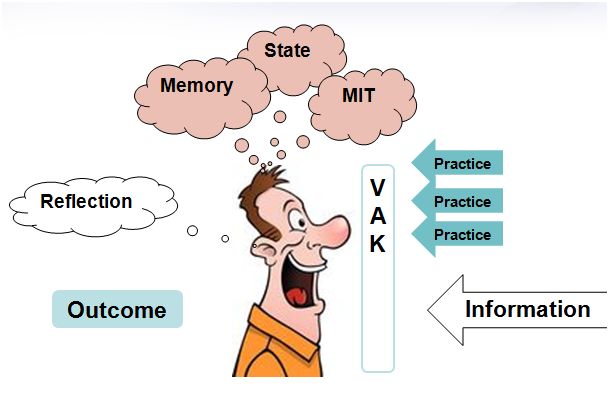
Take a look at the picture on the right, focus on the information arrow. This represents what you are trying to learn, you receive that information either Visually, Auditory or Kinaesthetically (smell touch taste) see July blog.
Learning tip 1 – Use all of your senses. When learning think about the best way of processing information, if it doesn’t make sense having read it a few times, then why not draw a picture?
One of the big problems with learning is motivation and the secret to motivation is to set goals and have Outcomes. Before you start learning think what your objectives are both short and long term then write them down.
Learning tip 2 – Write down your learning goals but make them positive and within your power. It is no good writing down I want to pass an exam when you cannot control that. Better to write that you will practice 4 questions tonight, now you can do that.
Next focus on the Practice arrows – Practice is vital. You can’t get away from the fact that the more you practice the better you get, see August blog on deliberate practice.
Learning tip 3 – Practice practice, practice….and practice again
Now look at the first of the 3 pink bubbles, MIT. MIT stands for Multiple Intelligence Theory – Don’t ask how intelligent you are, ask which intelligence you have. Howard Gardner suggested that there were 8 different intelligences, ranging from musical to logical to interpersonal.
Learning tip 4 – Don’t get hung up about intelligence, it doesn’t help, chances are your average. There are lots of types of intelligences and you may not like maths/logical subjects and are better at the written/linguistic papers. If you’re not good at maths just work harder at it, but have confidence that you are good at many other things. Intelligence is not one thing that you either have or don’t, it is more complicated.
Second of the pink bubbles is – State. State is another word for frame of mind. If you are not in the right frame of mind then you won’t learn quickly.
Learning tip 5 – If you don’t feel in the right mood for learning, then change your mood. Get up walk around, make a coffee or remind yourself you have the exam in only two weeks time. That normally works!
Memory is the third of the bubbles – Memory is not the same as intelligence, you can improve the speed at which you learn by using memory techniques.
Learning tip 6 – Learn and begin to use some simple memory techniques, mind mapping, acronyms and acrostics are a good start.
And finally in the white bubble – Reflection. No learning process is complete without thinking back over what you have learned. What might you do differently next time, can you explain what you have learned to others?
Learning tip 7 – Keep a learning log or at least take some time out of your day to think back on what you have learned.
It’s not magic but it will work
Accelerated or fast learning is not a magic built or a pill that you can take that will require no effort from you, but it is an explanation
of learning, that stops you thinking of learning as something that happens sometimes. It is just a process and the more you understand about that process the
faster you can learn.
As they say learning is not a spectator sport…..

I have just discovered twitter. You can follow me by clicking on the panel to the right. My initial thoughts were that it was a waste of time but I have found it very demanding to make your point in 140 characters and have picked up lots of new information from others, see everyone is learning.
 Exams seem to be in the news a lot these days, unfortunately often for the wrong reasons. This month we were told of at least six errors on exam papers sat by students studying A-level, AS-level and GCSEs taken in England, Wales and Northern Ireland. The errors were on questions with marks ranging from 1 to 11 and effect 90,000 students. In fact it is hard to keep up; only yesterday there was news of another possible three mistakes, bringing the new total to nine!
The examining bodies have said they were sorry and that they would take into account the errors when they come to mark the paper, ensuring that no students would be disadvantaged as a result. Firstly an apology is not good enough, it should not happen in the first place and secondly they can’t “take into account” the full impact of the mistakes. And it looks like David Cameron agrees……
Now of course everyone makes mistakes, but when the consequences are as important as this there should be a system in place to ensure they are spotted. That system should include having an examiner, an assessor and a sitter. This is in addition to the normal proofing and arithmetic checks. The examiner writes the paper, and presumably checks it, the assessor also checks the paper, ensuring the wording is clear and that what is being asked is within the syllabus and technically correct. The sitter should then attempt the paper under exam conditions, to make sure that it can be completed in the time available. If these processes are followed it would seem almost impossible for a mistake to be made, I wonder what went wrong?
Equally it is not possible for the examining body to ensure that no student is disadvantaged. What can they do, be generous with the marks for any attempts made? What if the student looked at the question tried to do it, panicked and as a result wasted valuable time, making little or no attempt at the rest of that question, there is in effect nothing to mark. What can you do in these circumstances; just add on say 5 marks!
How can you take into account the student who raced through the second question because they spent so much time on the first and made mistakes due to the time pressure, add on another 5 marks!
And what about the student who looked at this question, lost their confidence and so failed to complete the paper, add another 5 marks!
Listen to this confident student describe the impact of a mistake in the exam.
And he got no reply…..
What to do if there is a mistake
There is however some good news, you can still give yourself the best chance of passing if you apply some simple exam techniques.
1. Stick to the mark allocation – if it is a 10 mark question then only spend 18 minutes on it, 1.8 marks per minute for a three hour exam. So even if you cannot answer the question because of a mistake on the paper you will not be wasting time that could be better used on the next question.
2. Don’t think you have to get everything exactly right. Your objective is to pass the exam with the highest mark, so you may have to accept that you will not get 100%. And of course getting 100% correct is impossible when the examining body has put down the wrong information! Do your best and move on.
3. Make assumptions – read the exam question slowly, underline the key points and if it doesn’t make sense clarify what you think it is saying by stating your assumptions. Then answer the question in accordance with your assumptions.
4. Don’t bother asking if you think there is a mistake. There is little point asking in the exam if there is a mistake on the paper. The invigilators on the day are unlikely to be subject experts and so will do nothing. Let others put their hand up and ask, you should keep your head down and get on with answering the question.
Remember exams are more than tests of knowledge and they are not always fair, but they are equal, everyone in the exam room is faced with the same examiners mistake. How you deal with those mistakes however can make all the difference….
Another TED lecture worth watching
And finally I have another TED lecture for you to watch. It is presented by Sir Ken Robinson who gives a very interesting talk on what he describes as a crisis in our education system – personalised learning not standardised/production driven learning.

Always sit a mock exam
Rolf Harris has had a very varied career, musician, singer-songwriter, composer, painter, television personality and passionate advocate of sitting a mock exam. Okay I made that last one up but Rolf did make a very good point in an interview that I think illustrates one of the main benefits of sitting a mock exam.
In his early days Rolf used to paint on a huge canvass using wallpaper brushes and rollers, and it was in front of a live TV audience with only a 5 minute slot. Many years later in an interview he was asked why he practised painting the same thing over and over again, “after all Rolf you are a very good artist” said the interviewer, Rolf replied, “yes I can paint, but I am not practising to improve my painting, I am practising to make sure I finish on time, this is live television I have to finish at exactly the right time, that’s what I am trying to learn.”
And the same applies to mock exams, you’re not sitting a mock to find out what mark you’re going to get, that’s just the by product, you’re doing it to make sure you will finish on time. Knowing all the answers is no good if you run out of time….
Reasons to sit a mock exam:
1. Practice at leaving questions and moving on. Leaving a question you can do but have spent too much time on is easier said than done, remember there are often easier marks in the first 5 minutes of the next question than in the previous one. If you sit a mock exam you can practice leaving questions, sticking exactly to the time indicated by the marks in the question.
2. It’s an opportunity – I like to think of exams as opportunities to improve, they help identify what you need to improve to be better next time. This means the more mocks you sit the better you get!
3. Helps manage ignorance – There will certainly be questions in the exam that you won’t be able to do, where you don’t know the answer. Managing ignorance is a higher level skill, it is the ability to have a go, give it your best shot, even if you don’t know, just use your common sense. You may be very surprised at your mark. Only when you sit a mock will you really force yourself to have a go.
4. Gives you an indication of the topics that you are good at and the ones you aren’t. Sometimes you think you know something but when it comes to it, like in a mock you don’t. Don’t worry there will still be time after the mock to brush up on those “think you know areas” areas.
5. Can help you deal better with stress. If you sit a mock exam it can feel like the real thing, but it isn’t. So if you panic and lose time as a result it doesn’t matter. It gives you a chance to think how you would deal with that situation should it arise again.
The best reason
But the best part of sitting a mock exam is if the mock you sit turns out to be very similar to the real thing. What would your chances of passing be then! Mocks should always be written with an eye on what might come up.
What it is not
On the whole a mock exam is not meant to predict success or failure although many people think of it like this, only the real exam matters. So why not give it a go and sit a mock exam this time, what have you got to lose.
And finally no mention would be complete of Rolf without a chance to watch Rolf sing Two little boys. Nothing to do with exams but a classic….
 I am not sure what to make of the latest news that a law student Maria Abramova is suing the Oxford Institute of Legal Practice (OXILP), part of Oxford Brookes University for £100,000 claiming they did not prepare her well enough to sit her legal examination, specifically they did not teach her exam techniques.
She claims that failing the exams left her with a ‘blind spot’ when it came to taking future exams and eventually contributed to her failing the New York bar examination in 2008. She has since decided not re-sit the American examinations, as the process of taking legal tests causes her to become psychologically distressed.
Maria Abramova was clearly academically bright; she graduated in July 2004 with a 2:1 degree in law from Oriel College, Oxford. In all her studies with OXILP she had consistently been graded “very good”, the top grade. Of the 357 other students that studied that year more than 99% went on to pass the paper at the heart of the litigation.
Who is to blame?
So what went wrong, does she have a case, is a college or university responsible for getting the student through the exam or is their job simply to deliver knowledge in an inspiring and understandable manner. And do exam techniques make that much difference anyway?
It is perhaps not surprising that a case of this nature has finally come to court. With exam results determining the opportunities for many and the price of education on the increase, why should educators not be accountable………….What is interesting is that this case has focussed not on the content of the course – “I was not taught X and X came up in the exam and that is the reason I failed,” but on exam techniques.
Now as someone who delivers courses on exam techniques and believes they are a vital part of passing examinations, it would be hard for me to argue they are unimportant or make no difference. But I come from a world (Professional accountancy and tax qualifications) where passing an exam is considered a vital part of the success of the course. I am not sure that this is the case with OXILP.
Its about responsibility
To answer some of these points you need to clarify how much responsibility should rest with the student and how much with the tuition provider. Education has to be a partnership; students are not empty vessels simply waiting to be filled with knowledge, they do have to try hard and study independent of the class, they should talk to other students and find out what they do and perhaps most importantly, they should challenge and if they are not happy seek a remedy.
I am of course no lawyer and await the outcome of this case with interest, but I can’t deny that I am pleased that someone has managed to put a £100,000 price tag on the value of exam techniques. And should Maria ever want to reconsider her decision to give up exams and need help with exam techniques I could certainly recommend a good book…..
 Pedleysmiths Blog