
Sticky – The Science of Storytelling

Long before writing, and even “classrooms,” people shared knowledge through the telling of stories. These stories conveyed essential lessons in survival and reflected the social norms of their time, handed down through generations.

To fulfil their purpose, they had to be memorable. What remains unclear is, did the story evolve to fit the brain’s natural ability to remember or did stories in some way shape our brains to make them easier to recall – a classic chicken-and-egg dilemma.

Regardless, it could be argued that stories were our first educational technology, influencing culture, guiding decisions, and ensuring knowledge was not lost.

If you don’t have time to read this month’s blog – listen to my AI alter ego summarise the key points.

Today, when we think of stories, we often associate them with novels, films, animations and more recently podcasts. At its core, they are simply a structured way of sharing events and information, with most following a familiar pattern. They begin by setting the scene, move into a middle phase where the story unfolds and end with some form of resolution that provides clarity or closure. This structure helps us make sense of experiences, maintain attention, communicate ideas, evoke emotions, and connect with others in meaningful ways. All of which help with recall.

They are also incredibly persuasive, and can become a vehicle for knowledge transfer, simply saying, “let’s take a moment, relax, I want to tell you a story” changes the mood in the room and opens the mind for a new experience.

If you’re still unsure about their power, Yuval Noah Harari provides a compelling example. He explains that money holds no inherent value, a banknote is simply paper, and digital currency just data. What makes money meaningful is the collective belief in its worth. This shared understanding allows it to function as a medium of exchange for goods, services, and influence.

He goes on to say….

Why are stories sticky?
But what is happening in the brain when you hear a story or read one for yourself? Why do stories stay with us long after we’ve heard them, what makes them stick?

Cognitive rapport – When someone tells a story, something remarkable happens in the brain. Instead of just processing words, the listener’s brain begins to light up in multiple areas all at once. Stories create what researchers call neural coupling, the listener’s brain patterns start to mirror the storyteller’s, helping ideas flow more smoothly and making them easier to understand (Stephens et al., 2010).

Emotional – Importantly, stories also stir emotion and when emotions are triggered, the amygdala and hippocampus work together to strengthen memory (Article McGaugh, 2013). In one test, a neutral learning event was given an emotional focus. Subjects were asked to memorise a list of words, a non-emotional task. They were then exposed to a brief, intense emotional experience e.g. Putting their arms into icy water (Cold Pressor Stress Test), which released stress hormones, epinephrine, and cortisol, telling the brain it is an important event. When tested weeks later, the individuals had forgotten the cold-water experience, but remembered the list of words!

Structured – Stories give knowledge a shape and structure. A beginning, a challenge, and a resolution acting like mental scaffolding, allowing learners to slot new information into place. Structure also reduces cognitive load, (John Sweller 1988), and help create schemas, which are interconnected mental chunks of knowledge that are stored more easily in long term memory.

Engaging – And lastly, stories build a human connection, helping creat greater levels of engagement. Neuroscientist Paul J. Zak (2015) discovered that compelling narratives those with a strong dramatic storyline trigger the release of oxytocin, the neurochemical responsible for trust and empathy. In a learning context, this surge of empathy makes you more receptive to the message and strongly motivates, helping internalise the information and transforming simple facts into knowledge.

A word of caution – seductive details
However not all stories help us learn. The danger is that they include fascinating but irrelevant information known as “seductive details” (Harp & Mayer, 1998). This results in cognitive overload, causing the brain to waste resources processing the more interesting information at the expense of core principles. It can also break down that strong mental scaffolding, misdirecting the brain, to build a new organisational framework around the wrong idea. To avoid this, the detail in your narrative must directly support the learning objective, ensure the story integrates the facts, rather than just decorating them.

The final chapter
For educators, storytelling is not just a “nice extra” it’s a valuable tool and a natural way to help people learn. A well-told story draws attention, lowers resistance, and creates the sense that what follows is worth holding on to. Learners don’t just hear the information, they experience it, making knowledge far more memorable.
For learners, resist the urge to dismiss the story as a diversion from the important stuff, and instead listen with curiosity. They work on the mind in subtle ways connecting ideas, evoking emotions, and helping you see meaning, long after the classrrom door has closed. In this state, your brain does much of the hard work for you.

Want to know more?

Old Marley was as dead as a door nail – the power of analogy

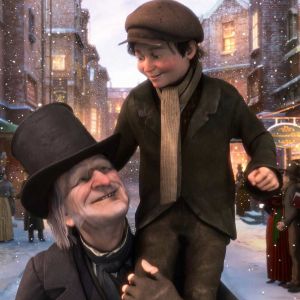
“Marley was dead, to begin with. There is no doubt whatever about that. The register of his burial was signed by the clergyman, the clerk, the undertaker, and the chief mourner. Scrooge signed it. And Scrooge’s name was good upon ‘Change for anything he chose to put his hand to. Old Marley was as dead as a doornail.”

A Christmas Carol was written by Charles Dickens in October 1843 and published on December 19th the same year. By Christmas’s Eve it had sold 6,000 copies at 5 shillings each, unfortunately Dickens only made £230 due to the elaborate illustrations and a not so lucrative deal with Chapman and Hall, the publishers. Today you could by an original copy for around £40,000.

Although Dickens might not have struck a particularly good business deal, he used an excellent analogy to describe exactly how dead Marley, his business partner was. Incidentally the reason a doornail is considered so dead is to do with the way it is bent over and hammered flat, making it unusable. Click for a more detailed explanation.

Analogy
Put simply, analogies highlight shared characteristics between two things. It’s an umbrella term for a cognitive process where we transfer meaning or information from one subject to another and as a result improve understanding. For example, “life is like a box of chocolates – you never know what you’re gonna get” is an analogy from Forrest Gump that makes the connection between the choices and surprises you face when deciding on what chocolate to have…. and life. It helps illustrate the uncertainty of life, the fact that faced with choice you don’t always make the best one and sometimes when you “bite” into life you might be pleasantly surprised. Many analogies are used in everyday speech, for example “doing that will be as about as effective as rearranging deck chairs on the Titanic”, meaning it will make no difference. Similes and metaphors can be used in the same way, in many instances providing the infrastructure to support the analogy. Life is like a box of chocolates, is a simile.

But the distinction between, analogy, metaphor and similia doesn’t really matter, the important point is that all of these can be used to improve understanding, navigate complexity and help with problem solving by using what is called analogical reasoning.

Making abstract concrete
There are many reasons as to why analogies work so well. They often require the use of images, connect existing information with new and encourage reflection, retrieval and the manipulation of ideas. All of which help move information from short to long term memory. There is also a strong connection with the 6 evidenced based learning strategies covered in previous blogs, in particular using concrete examples to make concepts more real. This is one of the most powerful ways to use an analogy.

How do you explain the dual concept in accounting? Here is the answer – the dual concept tells us that every transaction affects the business in at least two ways which are equal and opposite in nature.

Even though you have an explanation, because it’s a concept, an abstract idea, it has no form which makes it difficult for the brain to grasp. But if you can relate it by way of an analogy, perhaps thinking of the dual concept as a set of scales where whatever you put on one side you have to put on another, it becomes more tangible and an understanding develops.

Designing an analogy
Sometimes an analogy will just emerge, from my own experience this is often the case when I have thought about a particular topic or taught it for many years. The catalyst might be someone saying, I don’t understand. As a result, you rack your brains to come up with an alternative way of explaining, and the analogy just appears. However, when studying, you don’t have time for this but coming up with your own analogy might really help. Here is one way of doing it.

Pick two objects, ideas or domains
e.g. a carrot and learning
Write down the main characteristics
– Carrots – are orange, grow from a seed, need water, good for you etc
– Learning – requires effort, takes time, builds on prior knowledge, helps you in life etc
Evaluate by looking for commonalities
Learning is not dissimilar to a carrot, it starts very small, takes time to grow, needs nurturing and is good for you. A slightly silly example but hopefully it shows how the process could work.

A word of warning, as powerful as analogies can be they aren’t the answer to everything. Research shows they can cause learners to create incorrect mental models and as such draw the wrong conclusions, so always keep a check on the logic behind the analogy and at what point it stops working.

A few more analogies
– “A good speech should be like a woman’s skirt; long enough to cover the subject and short enough to create interest.” Winston S. Churchill
– “You see, wire telegraph is a kind of a very, very long cat. You pull his tail in New York and his head is meowing in Los Angeles. Do you understand this? And radio operates exactly the same way: you send signals here, they receive them there. The only difference is that there is no cat.” Albert Einstein
– “Truth, like gold, is to be obtained not by its growth, but by washing away from it all that is not gold.” Leo Tolstoy
They can also make you laugh – “When I die, I want to go peacefully like my Grandfather did, in his sleep – not screaming, like the passengers in his car.”

And as Tiny Tim said, “A Merry Christmas to us all; God bless us, every one!”
Happy Holidays and here’s to a much better 2022.

Storytelling – The cave

telling stories

There is a lot written today about the power of storytelling and how it can help persuade, influence and of course educate. Stories come in many shapes and sizes, sometimes they are true, but might be embellished, sometimes they are not true but include powerful messages hidden in the form of metaphor or allegory.

The simplest definition of a story is that “one thing happens in consequence of another,” and it can engage, motivate and inspire. But cognitively the brain is working very hard forming connections, asking questions, creating images and helping offer up opinion.

“If you want your children to be smart, tell them stories. If you want them to be brilliant, tell them more stories.” Albert Einstein.

Below is an allegory, arguably one of the most important in the whole of western philosophy, but its message for educators and students is sometimes lost. It’s called Plato’s cave, read it carefully, thinking about what it might mean.

Plato’s cave
Plato caveAlthough Plato is the author, it is Socrates who is the narrator talking to Plato’s elder brother Glaucon.
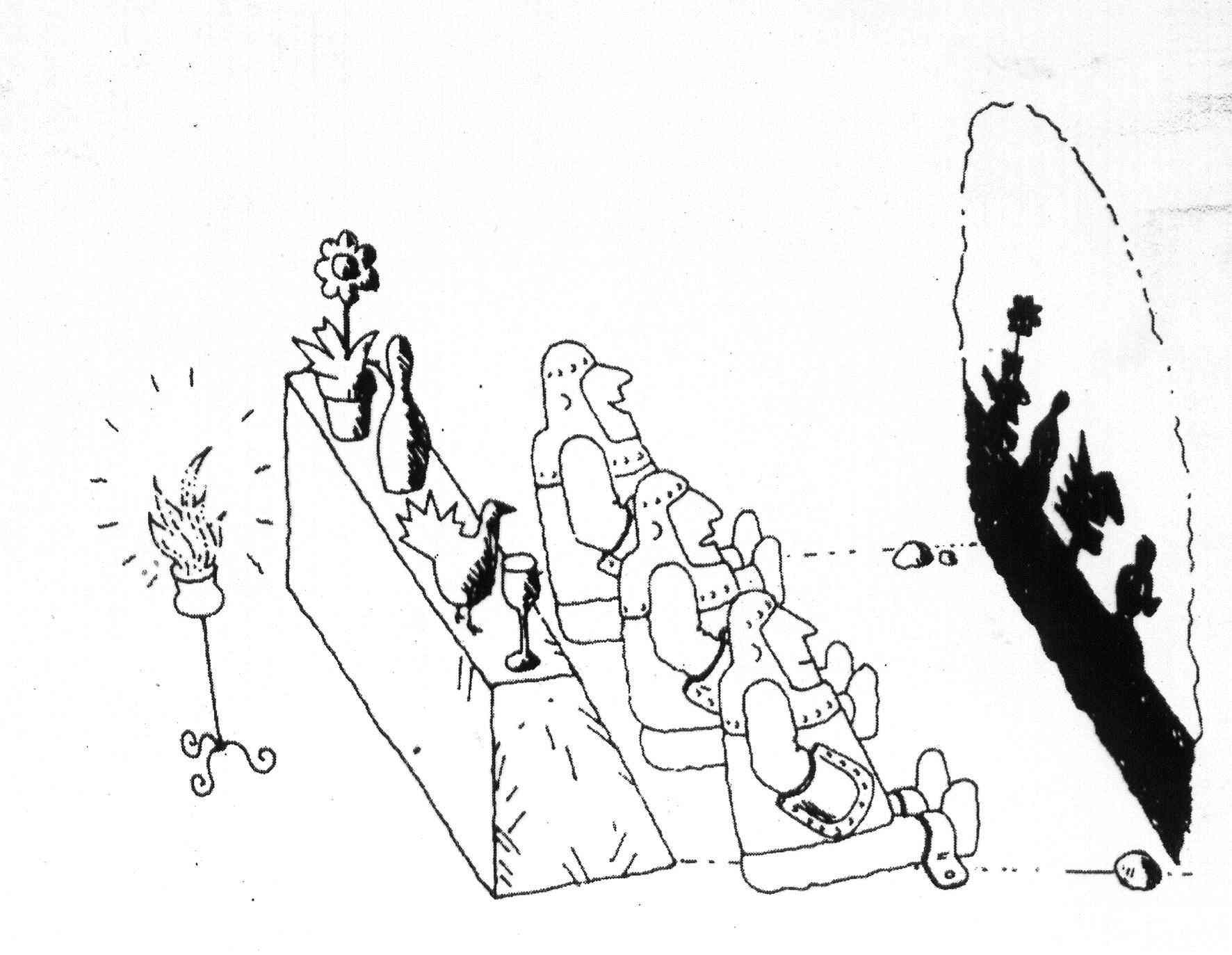
The story told is of a group of people who from birth have been chained up in a cave with their heads fixed in one direction so they can only look forward. They face a cave wall on which they can see moving images, shadows that they believe to be reality. Socrates’s explains that when the prisoners, because that is what they are, talk to each other they discuss the shadows as if they were real. But they are an illusion, created by shadows of objects and figures played out in front of a fire, manipulated by the puppeteers.

Socrates goes on to say that one of the prisoners breaks free of his chains and is forced to turn around and look at the fire, the light hurts the prisoner’s eyes but as they adjust, he can see the fire and the puppets he had believed to be real. He doesn’t want to go any further fearing what it might bring but once more is forced to go towards the mouth of the cave and into the blazing sunlight.

At first, he can only look at the reflections because as with the firelight the sun is too bright but as his eyes adjust once more, he finally looks at the sun, only then “is he able to reason about it” and think what it could mean. His thoughts are interrupted by the sorrow he feels for his fellow prisoners who have not seen what he has, have not learned the truth. So, he goes back into the cave to tell them everything. But when the prisoners look at him, they see a man stumbling, strained, no longer able to see in the dark cave. But worse when he begins to explain they think him dangerous because what he tells them is so different to what they know.

The prisoners do not want to be free, the effort is too great, the pain and apparent disability sufficient to stop them trying. They are content in their own world of ignorance and will fight anyone who wants to change that.

But what does that mean?
The answer of which should be, well what do you think it means? But sometimes you just don’t have time for that answer so here is one interpretation, it’s worth pointing out there are many.

  • The puppeteers are those in power or authority. They prefer it if people don’t ask questions, remain content and are not causing trouble.
  • The fire is knowledge and wisdom.
  • The prisoners are society.
  • The escaped prisoner is the student. The student who through education escapes and finds answers.
  • The person that frees the student and drags him towards the light is the teacher.

If we put this all together, it gives us an insight into learning that has remained unchanged since Plato wrote the Republic in which this story sits in 514a–520a.

Learning is not easy, it can be difficult and hard work. Some people are happy to remain as they are, ignorant, after all it’s not pleasant having your beliefs challenged and finding out that what you thought was true in fact isn’t. Teachers can help take you towards knowledge and learning but you need to want it for yourself, and once you have knowledge you can’t go back to what you were before, education will have changed you forever.

To find out more about the power of stories watch this video – The rules to telling a story by the Filmmaker Andrew Stanton (“Toy Story,” “WALL-E”)

Plato’s cave at the movies

The Matrix and Plato’s Cave – Neo meets Morpheus and explains he is a slave

The Truman Show – Truman shows bravery by going towards the light