
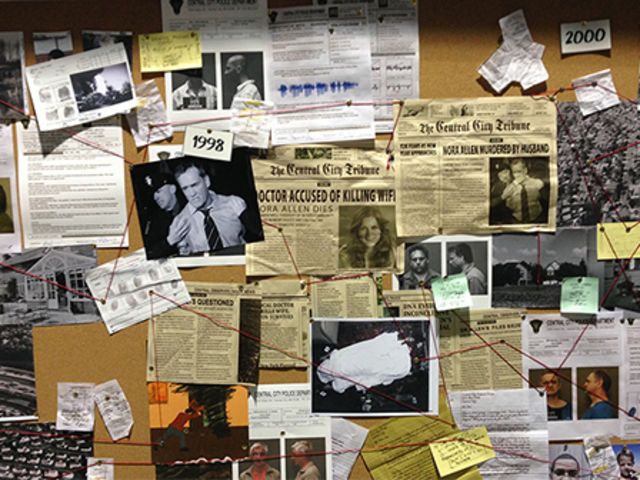
Have you ever wondered why in pretty much every crime drama the “hero” stares at a wall, with names, locations and pictures pinned to it. He’s trying to solve a crime but there’s no logic, nothing makes sense, he has more questions than answers. The phone rings, it’s his daughter asking when he will be home, the dog is barking in the background, then suddenly he puts down the phone and says “that’s it, why didn’t I see that connection before” “why did the dog not bark that night?” The connection is made and the crime solved.
What was on the wall was effectively a concept map, a visual tool used to organise and represent knowledge or ideas in a hierarchical manner, showing the relationships between them to help develop a better understanding, clarify relationship and in some instances solve problems.

Concept mapping
Although a concept map and a mind map are both visualisation tools, they are not the same. A concept map differs in that as the name suggests its focus is on the relationship between concepts rather than on a single theme placed at the centre of a blank page as is the case with a mind map. Another way of thinking about them is that concept maps are more suited to planning and organising, they have a structured hierarchy and highlight relationships. On the other hand, mind maps are “free spirits”, used more spontaneously, encouraging creativity.
A concept map typically consists of nodes, representing concepts or ideas, connected by labelled lines or arrows to indicate the relationships between them.
Why concept maps work
Concept maps are effective because they mirror the way our brains naturally categorise and store information. When we create one it activates various regions of the brain involved in memory, comprehension, and critical thinking. This process helps to reinforce learning and deepen understanding by facilitating the formation of neural connections. Additionally, the visual nature of concept maps appeals to the brain’s preference for processing information in a spatial and interconnected manner, making it easier to grasp complex relationships and retain information over time.
Concept mapping as a technique was developed by Dr. Joseph D. Novak at Cornell University in the 1960s and is based on the theories of Dr. David Ausubel, who emphasised the importance of prior knowledge in learning new information. It stems from the ‘constructivism‘ approach to learning which suggests that individuals construct their own understanding and knowledge of the world, based on their own unique experiences.
“The most important single factor influencing learning is what the learner already knows. Ascertain this and teach accordingly.” David Ausubel. (1968).
Research also supports their use with studies showing that they improve learning outcomes, promote critical thinking, and increase retention of information. For example, a meta study published in 2024 concluded that “concept maps are highly effective in enhancing the academic achievement of students and must be used in the education process”.

How to design a concept map
Designing a concept map involves visually organising information to illustrate the relationships between concepts. Here’s a brief introduction to the process:
- Identify Key Concepts: Start by identifying the main concepts relevant to your topic. Think of them as the building blocks of your map.
- Determine Sub-Concepts: Branch out to list related sub-concepts, organising them from general to specific. Then start thinking about the relationship between the concepts, is there for example a cause-and-effect.
- Connect the Dots: Draw lines to connect related concepts, and label the lines to explain the relationships and organise in a hierarchy if not already done so.
- Refine and Expand: As you study, add more concepts and links, perhaps using colour to clarify different groupings, continually refining the map as your understanding develops.
Although you can use pen and paper there are lots of digital tools available, you can find some here – 10 Top Free Concept Map Makers & Software in 2024.
And finally – the best way to learn how to produce a concept map is to watch someone building one – here is a short 8-minute video that explains all. How to Make a Concept Map.
 Pedleysmiths Blog