
The virtual educator has arrived!

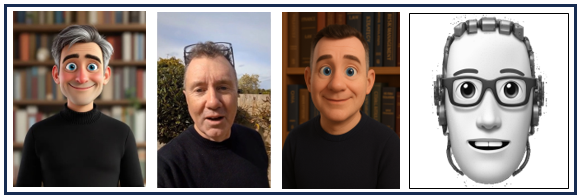
But which one is me?

Inspired by a recent LinkedIn post I made regarding what it might be like to have an avatar as a teacher, I thought I should check out the evidence in terms of the effectiveness of avatars to improve learning before I get too carried away with the technology itself.

What is an avatar?
An avatar is a digital or computer-generated representation of a person or character in a virtual environment. It can take various forms, for example a simple profile picture on social media or an audio avatar talking about a specific subject using a synthetic voice. However, with major advancements in generative AI, avatars are evolving beyond static images or basic voice interactions. We are increasingly seeing lifelike digital humans emerge, sophisticated AI-driven avatars capable of “understanding” what we say and generating intelligent responses, speaking with realistic voices and impressive synchronised lip movements. This transformation is redefining how humans engage with AI-powered virtual beings, blurring the lines between digital representation and authentic interaction.

As to what they look like, here are some examples:

  • Firstly, an audio avatar that I have now built into my blog to provide a different perspective on what has been written. Here the avatar “chats” about the blog rather than simply reading it out loud. See above.
  • Secondly a Pixar style avatar. The goal here is to challenge the assumption that an avatar must resemble a real person to be effective.
  • And lastly, this is a more realistic avatar. Effectively an attempt to replicate me, in a slightly imperfect way. This is not about fooling the audience, although this is now possible, but to explore the idea that humans respond better to a more human like character.

The talking head – good or bad?
However there’s an elephant in the room when it comes to avatars, why do we need a talking head in the first place? Wouldn’t a simple voice-over, paired with well-structured content, be just as effective?

If you look at YouTube, almost everyone uses talking-head videos in different ways, surely if they weren’t effective, no one would have them, a kind of “wisdom of crowds.” But does their popularity actually prove their value, or are we just following a trend without questioning its impact?

Let’s have a look at the evidence:
After reviewing multiple studies, the findings are somewhat mixed. However, there’s enough insight to help us find an approach that works.

First, we have research from Christina Sondermann and Martin Merkt – Like it or learn from it: Effects of talking heads in educational videos. They conclude that the learning outcomes were worse for videos with talking heads, their concern was that it resulted in higher levels of cognitive load. But participants rated their perceived learning higher for videos with a talking head and gave better satisfaction ratings, selecting them more frequently. Secondly, another piece of research published five months later by Christina Sondermann and Martin Merkt, yes, the same people, What is the effect of talking heads in educational videos with different types of narrated slides. Here they found that “the inclusion of a talking head offers neither clear advantages nor disadvantages.” In effect using a talking head had no detrimental impact, which is slightly at odds with their previous conclusion.

A little confussing I agree, but stick with it….

Maybe we should move away from trying to prove the educational impact and consider the student’s perception of avatars. In this first report, student Perceptions of AI-Generated Avatars, the students said “there was little difference between having an AI presenter or a human delivering a lecture recording.” They also thought that the AI-generated avatar was an efficient vehicle for content delivery. However, they still wanted human connection in their learning and thought some parts of learning needed to be facilitated by teachers and that the avatar presentations “were ‘not … like a real class.” The second report, Impact of Using Virtual Avatars in Educational Videos on User Experience raised two really interesting points. Students found that high-quality video enhanced their learning, emotional experience, and overall engagement. Furthermore, when avatars displayed greater expressiveness, they felt more connected to the content, leading to improved comprehension and deeper involvement.

For those designing avatars, this means prioritising both technical quality and expressive alignment. Avatars should be visually clear, well animated, and their facial expressions should reinforce the message being conveyed.

What does this all mean?
Bringing everything together, we can conclude that avatars or talking heads are not distractions that lead to cognitive overload. Instead, students appreciate them, relate to them emotionally, in fact they see little difference between a recorded tutor and an avatar. Their expressiveness enhances engagement and might prove highly effective in helping student remember key points.

To balance differing perspectives, a practical approach might be to omit the talking head when explaining highly complex topics, (reducing cognative load) allowing students to focus solely on the material. However, keeping the avatar visible in most other situations, particularly for emphasising key concepts or prompting action to ensure maximum impact. Alternatively, why not let the student decide by offering them a choice to have the talking head or not.

How might avatars be used?
One important distinction in the use of avatars is whether they are autonomous or scripted. Autonomous avatars are powered by large language models, such as ChatGPT, allowing them to generate responses dynamically based on user interactions. In contrast, scripted avatars are entirely controlled by their creator, who directs what they say.

A scripted avatar could be particularly useful in educational settings where consistency, accuracy, and intentional messaging are crucial. Because its responses are predetermined, educators can ensure that the avatar aligns with specific learning goals, maintains an appropriate tone, and avoids misinformation.

This makes it ideal for scenarios such as:
– Delivering structured lessons with carefully crafted explanations.
– Providing standardised guidance, ensuring every student receives the same high-quality information.
– Reinforcing key concepts without deviation, which can be especially beneficial when high stake assessments are used, as is the case with professional exams.

However, if we power these avatars with Generative AI, the possibilities increase significantly:

  • More personalised learning. One of the most exciting prospects is the ability of avatars to offer personalised and contextualised instruction.
  • Help with effective study. Avatars could be used to remind students about a specific learning strategy or a deadline for completion of a piece of work. A friendly face, at the right time might be more effective than an email from your tutor or worse still an automated one.
  • Motivational and engaging. These avatars could also have a positive effect on motivation and feelings about learning. They could be designed to match an individual’s personality and interests, making them far more effective both in terms of higher levels of motivation and engagement.
  • Contextualised Learning. AI-based avatars can support teaching in practical, real-world scenarios, including problem solving and case-based learning. Traditionally, creating these types of environments required significant resources such as trained actors or expensive designed virtual worlds.

A few concerns – autonomous avatars
Of course, as with any new technology there are some concerns and challenges:

Autonomous avatars pose several risks, including their ability to make mistakes, the problem with avatars in particular is, they will be very convincing. We are already acutely aware that large language models can sometimes ‘hallucinate’ or simply make things up. Data protection is another concern, with risks ranging from deepfake misuse to avatars persuading users into sharing personal or confidential information, which could be exploited. Finally, value bias is a challenge, as AI trained avatars may unintentionally reflect biased perspectives that a professional educator would recognise and navigate more responsibly.

Conclusions
Avatars, whether simple or lifelike, are gaining traction in education. Research indicates that while talking heads don’t necessarily improve learning outcomes, they don’t harm them, and students perceive them positively. A key distinction lies between scripted avatars, offering consistent and accurate pre-determined content, ideal for structured lessons, and autonomous avatars powered by AI that open up a world of possibility in several areas including personalisation.

Avatars are a powerful and exciting new tool that offer capabilities that in many ways go beyond previous learning technologies, but their effectiveness very much depends on how they are designed and used. But hasn’t that always the case….

Finally – This is an excellent video that talks about some of the research I have referred to. It is of course presented by an avatar.  What Does Research Say about AI Avatars for Learning?

PS – which one is me – none of them, including the second one from the left.

GenAI for Gen Z: Rethinking studying with GenAI

If you dont have time to read this months blog – listen to my AI alter ego summarise the key points.

Anyone falling into the Gen Z category would have been born between 1997 and 2012, meaning they range in age from 13 to 28. They are the first true digital natives, having grown up with the internet, smartphones, and social media as integral parts of their lives. This constant connectivity has shaped their worldviews, making them, in theory tech-savvy, innovative, and quick to adapt to new digital tools and platforms.

Gen Z is at the forefront of Generative AI adoption (GenAI), with high usage rates across various platforms. Whilst it’s hard to get exact numbers especially those of school age, a poll undertaken by the Higher Education Policy Institute, said that 88% of undergraduates had used GenAI over the past year,  and 25% said they had used AI-generated text to help them draft assessments. Most however “said” they were using ChatGPT and similar tools to explain concepts, summarise relevant articles or suggest ideas.

67% agreed that it was essential to understand how to use AI and yet only 36% said that they had received support from their university

Like it or not GenAI is becoming an integral part of learning, studying and assessment. And that’s why there needs to be more guidance on its use, welcome to this month’s blog – Rethinking studying with GenAI.

Tasks not Tech
The common mistake people make with technology, in this instance GenAI is they get caught up with what it can do and start to look for ways they can use it. This is perfectly logical, but not the best approach – it’s a great example of:

Far better is to identify a specific task and decide how you might save time without reducing the effectiveness of learning. For example, using GenAI to generate ideas for an essay is time consuming, and whilst it could be argued that you can learn from almost any activity, generating ideas does not significantly improve learning. Contrast this with actually writing the essay. This also takes time but the learner will have to structure their thoughts, challenge ideas, and produce an answer that not only makes sense to them but to others. It is this type of mental gymnastics that helps people learn and should never be substituted by GenAI.  

Using GenAI to study more effectively
Here are some of the best ways of transforming your study approach by leveraging GenAI. Importantly, these methods are designed to enhance learning without compromising the depth and quality of understanding. Note Generative AI (GenAI) is a type of artificial intelligence that creates new content. A GPT is a specific kind of GenAI e.g. ChatGPT and Claude.

1. Planning

  • Personalised Study Planning – Use ChatGPT, Claude etc to create a tailored study timetable based on exam dates and your personal strengths and weaknesses. This can be as detailed as you like, but because it’s personalised the GPT could for example allocate more time to the areas you find more difficult. Another level of sophistication might be to prioritise your time on the more examinable topics.
  • Identifying examinable areas – Analysing past papers and reading examiners guidance and reports has long been a top study tip. This is an ideal task for a GPT, get the prompt right and it will even put it into a table for you.

2. Reducing cognitive load (information overload)

One of the challenges in learning is coping with the large amounts of information you need to learn. GenAI can help by:

  • Chunking content – This is a hugely effective technique, just ask the GPT to break down complex ideas into smaller, digestible parts.
  • Filtering information – A lot of time can be spent reading documents not really learning because you are only skimming looking for key words or phrases. GPT’s are excellent at extracting key information from documents, videos, and even discussions.
  • Visual aids – A picture paints a thousand words, ask the GPT to provide information in different formats for examples a diagram, chart, table, or mind map.

3. Summarising

This is similar to chunking but more specific, all you need to do is add more guidance when designing the prompt. This is not about reducing content, but capturing the essence of what is being said.

  • Summarising large amounts of text or articles – Asking a GPT to summarise an article may be a little vague. Be more specific, by stating how many words you want it to use or asking it to focus on five key areas. You can also ask it to summarise the information in a style easier for the individual to consume, perhaps for someone with dyslexia.
  • Note taking from video – In addition to YouTube, many organisations now offer video recordings of lectures, webinars, and presentations that can be watched later. A GPT can scan the transcript and summarise the key points, even offering alternative explanations if it was not clear.
  • Forum conversations – Whilst a forum is an excellent way of engaging with others, it’s possible you don’t have the time. A GPT can easily summarise a thread picking out the main points.  

4. Improving understanding

  • Breaking down complex topics – Although this also reduces cognitive load, breaking down complex topics is an excellent way of helping to gain a better understanding of a subject or topic. One of the bests ways to do this is by asking the GPT to break the problem down into a series of steps. You could also ask it to explain the topic to someone who has only recently started the course, or maybe even a 10 year old.
  • Ask questions – This is possibly the most popular use of a GPT, simply asking it a question. For example, what is the capital asset pricing model and can you give me an example? The best part is you can ask follow up questions if you don’t understand the first time.
  • Teach me – Why not ask the GPT to teach you the topic.  It might be easier to use one of the custom GPT’s that’s been specifically designed to do this, for example check out Universal Primer. Some of these can act as a coach and not simply give you the answer but ask you further questions to test your understanding and then provide feedback.

5. Creating study materials

One of the most powerful ways to use GPTs for studying is to generate structured, personalised materials tailored to your learning needs.

  • Flip cards – This can be time consuming but not for a GPT. They can generate question and answer pairs from textbooks, lecture notes, or past exam papers. For example, “Create 10 flashcards on Modigliani and Miller’s capital structure theory.”
  • Study notes and revision notes – Many learners struggle with condensing large volumes of information into digestible summaries. GPTs can simplify this process by extracting key points, breaking down complex ideas, and even adapting explanations to suit your level of understanding.
  • Mind maps – Mind maps help learner see relationships between concepts, improving comprehension and recall. GPTs can create structured outlines that you can easily convert into visual diagrams. For example, “Create a structured mind map for managing foreign exchange risk, including hedging strategies.”
  • Writing questions and designing quizzes – One of the best ways to test knowledge is through self-assessment. GPTs can generate quizzes tailored to your own study material, which can range from basic recall to complex scenario-based questions. For example, “Generate five exam style exam questions on interest rate risk, including one scenario-based question.”

6. Assessments and Feedback

This section highlights situations were using a GPT is not advisable, particularly when answering questions designed to test your understanding and promote learning. While a GPT can generate correct answers, it does not facilitate the deeper cognitive processes in the leaner for them to fully grasp concepts.

Another concern is that GPTs can occasionally produce answers that, although plausible, may be incorrect or oversimplified. This is especially problematic in technical subjects, where even small errors can lead to significant misunderstandings and hinder a student’s ability to apply knowledge accurately.

But they can be used to help

  • Plan the answer for your assessment – GPTs can be an invaluable tool for structuring and planning your response to an assessment. They can help you break down complex questions, identify key themes, and organise your thoughts logically, which can significantly improve the quality of your answer. However, it’s essential to use GPTs responsibly by focusing on the planning and brainstorming phase rather than relying on them to generate the entire response.
  • Providing feedback – A GPT can be a powerful tool for providing feedback, offering valuable insights to help improve the quality of your work. Whether you’re refining an essay, reviewing a problem set, or crafting a project, GenAI feedback can highlight areas that need attention, suggesting ways to enhance clarity, depth, and structure. However, it’s important to approach this feedback with a critical and reflective mindset to ensure it leads to genuine learning and improvement, rather than simply accepting it at face value.

Conclusions
This is not an exhaustive list, but I hope it has inspired you to explore these tools and use them responsibly. GenAI can be a powerful aid in helping you learn more effectively, from breaking down complex topics to enhancing revision and providing feedback. However, its true value goes beyond simply learning, by using GenAI thoughtfully while studying, you are also developing essential digital skills that will be increasingly important in the future of work.