
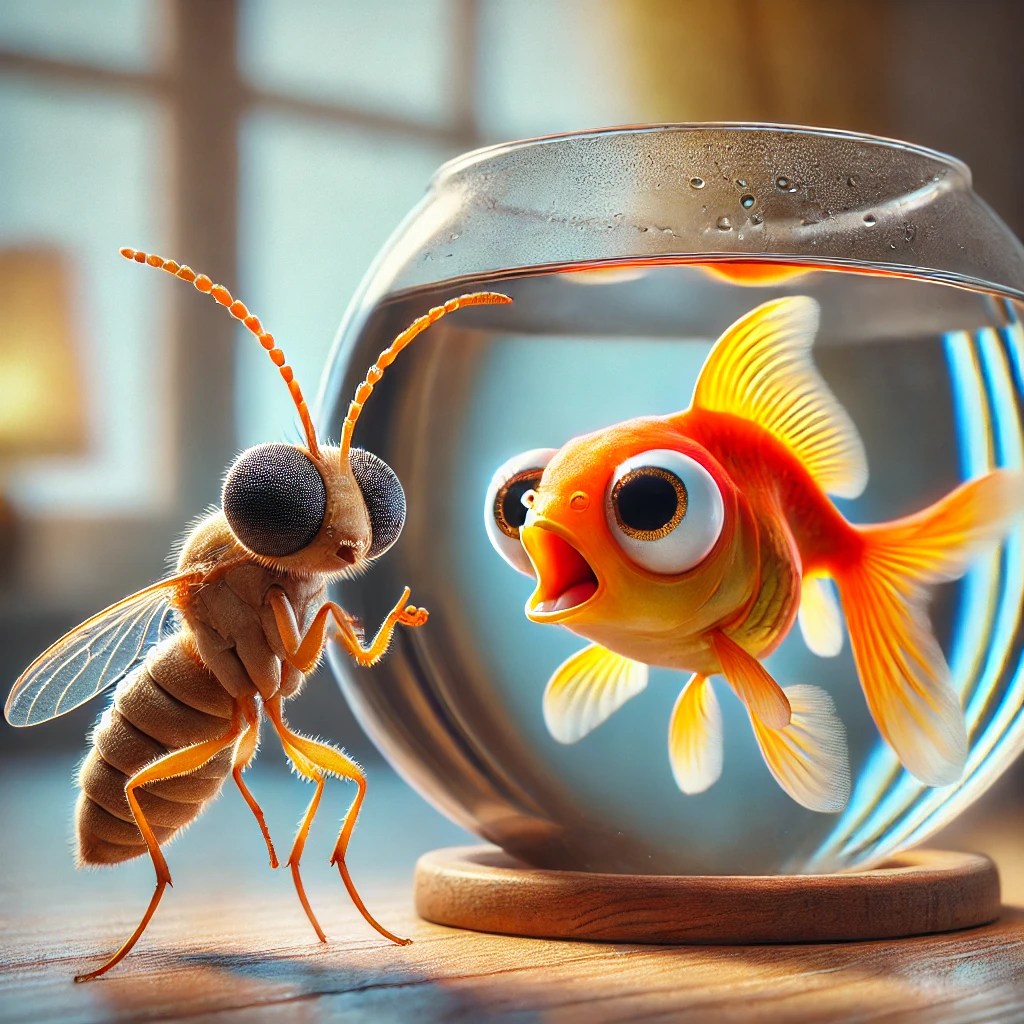
A goldfish can remember certain tasks and environments for weeks and even months – a Gnat however doesn’t have an attention span at all. *
There has been a significant amount of space in the press devoted to telling us that attention spans are getting shorter, largely the result of an increased use of digital technologies.
One headline read – “You Now Have a Shorter Attention Span Than a Goldfish“
This story can be traced back to a 2015 Microsoft report which included the claim that the average human attention span had decreased from 12 seconds in 2000 to 8 seconds in 2013, shorter than the alleged 9 second attention span of a goldfish.
It has however since been debunked and is simply not true. It was based on vague, unsupported opinion and lacked the necessary evidence. Microsoft has since taken the report down from its website.
And yet the myth remains popular possibly because most days you will see people using their smart phones endlessly scrolling, looking for something to grab their attention in order to satisfy their “dopamine bump” addiction. They pause only momentarily to read or look at the image on the screen before continuing the search. Ask them what they are doing, and without looking up to acknowledge the question, they will answer “nothing”!
Many social media platforms are designed around the idea of short attention spans, furthering the belief that we have a new generation of learners who are different in some way to those that went before.
Attention spans
An attention span is typically defined as “the amount of time a person can maintain attention on a specific task or activity, without becoming distracted.” The key point here is that attention has a lot to do with the brains ability to resist interruption.
For this reason, its useful to think about it in two ways:
- Sustained Attention (maintaining focus over time) is the ability to concentrate on a single task over a long period, such as when you are reading or studying. The average person can focus their attention for around 20 to 30 minutes, which is a lot more that 8 seconds! The Pomodoro technique that was developed by Francesco Cirillo in the late 1980’s works on this principle. With the aid of a timer, you are required to take a short break every 25 minutes. As a result, you can then maintain focus for hours.
- Selective Attention (choosing what to focus on) is the ability to focus on one thing while filtering out distractions, such as focusing on a single conversation in a noisy room.
These are of course interrelated with sustained attention relying on selective attention to be effective. It’s also important to note that attention is not fixed and is dependent on age, level of interest, fatigue, stress etc.
This study by Rosen, Lim, Carrier, and Cheever (2011) found that students averaged less than 6 minutes on a task before switching to another, most often because of a need to reply to a text or check social media. It concluded that allowing students short “technology breaks” could help reduce these distractions, and that teaching students’ metacognitive strategies would also be beneficial. They stated that the students were prone to distraction due to device notifications, not because they had reduced attention spans.
Attention Deficit Hyperactivity Disorder (ADHD)
ADHD is a neurodevelopmental condition that affects attention, impulse control, and activity levels. Symptoms include difficulty in maintaining focus, being impulsive and having high levels of energy. It is a recognised medical condition that results in a lower attention span. It is thought to be highly heritable, with levels in the region of 70 – 80%, but it’s not as common as you might think given its prominence in the press. In the UK, there are only believed to be around 3 – 4% of children and 2% of adults who suffer from it. One caveat, it is possible that there are a lot of people who remain undiagnosed.
The impact on learning
The main point here is that in terms of our cognitive ability attention spans have not really changed. What has, are the levels of distraction and cultural and environmentally accepted norms. Think about the rise of digital devices, instant messaging, and social media, people now have a vast number of ways in which they can distract themselves. In addition, the sheer amount of information available can be overwhelming, making it harder to focus on one task for long. Many of us also lead busy lives, forcing us to juggle multiple tasks and often failing to any of well.
For the learners – Don’t fall into the trap of thinking “it’s not your fault” your genetics have given you a short attention span. Your attention span is fine it’s the environment you find yourself in that is the problem – see last month’s blog on learning environments.
A few tips
- Take regular breaks – as highlighted above taking short 5 to 15 minute breaks every 20 to 30 minuets, maybe even 45 minutes can improve your ability to focus.
- Reduce distractions – eliminate or minimise distractions, this means not having your mobile phone in the room or at least turning off your notifications. You need to create a dedicated, distraction free workspace.
And for the educators – While adapting content for individuals to accommodate short attention spans can be useful, especially when trying to engage them. It’s important not to think about it as a new way of learning, it’s more of an environmental challenge. As a consequence it would be wrong to design all lessons with it at the forefront of your mind. Evidence from cognitive science suggests that learning should be challenging (desirably difficult), requiring sustained focus, active engagement, and mental effort. But perhaps worse of all, if we continue to produce content that caters only to short attention spans, there is a danger of inadvertently reinforcing the behaviour.
Fake NBC Goldfish news
Here is a video typical of what you can find on the internet that continues to support the 8 second myth – Is Your Attention Span Shorter Than a Goldfish’s?
And finally, In defence of Gnats
Gnats, like many insects, are primarily focused on tasks like finding food, mating, and avoiding predators. While their attention may shift quickly between these tasks, it’s not really fair to say they have a short attention span in the same way humans or goldfishes do.
 There are a number of terms that crop up continually in learning, motivation, attention, inspiration,
  Pedleysmiths Blog