
Making predictions is of course a mugs game. Most people start with what they currently know and project forwards using logic to justify their conclusions. This however leads to our first problem – “you don’t know what you don’t know.”
Secondly, a prediction is more likely to be true if the environment is stable, and that leads to problem number two – we are living in hugely unpredictable times. Technology, in particular AI is moving so fast it’s hard to keep up, politically there is both change and instability, making it difficult to say with any certainly what policies or regulatory requirements will come into effect, and the climate is shouting at us, although we don’t seem to be listening.
And yet it’s still worth making predictions, not so much to see if you can get it right, but to play around with what the future might bring, take advantage where you can and make changes or at least warn others if you don’t like what you see.
The best way to predict the future is to create it. Peter Drucker
So here goes – what might happen this year in the world of learning?
1.Learning will not change: But learners will adapt to different ways of studying
While the world around us continues to change, the fundamental way we learn as humans remains largely unchanged. Despite advancements in AI, neuroscience, and educational tools, the core processes of how our brains absorb and retain information are rooted in biology and consequently, relatively stable. But learners will begin to adapt to this new world, and some will take full advantage of what these new technologies have to offer.
A new world problem Cognitive “offload” – Who is doing the heavy lifting – the machine or the human?
“There are no gains without pains” Benjamin Franklin
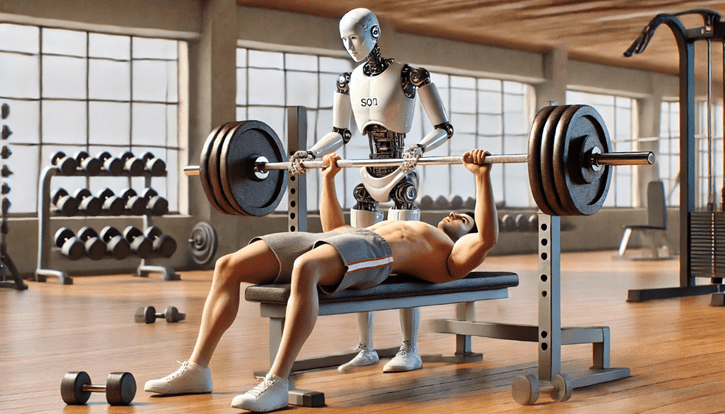
However, there will be those who fall into the trap of taking the easy way out and using the technology to “offload” learning, and as a consequence, learn very little. My prediction is that we will see far more people offloading learning in 2025, which is clearly a concern!
2.AI (GenAI) will continue to dominate: Bye Bye Text Books
Possibly the easiest prediction is that AI will dominate. Almost every day we are met with a new model that is easier to use, providing more effective ways of answering questions, summarising complex information and responding with high quality opinion. By the end of 2025 AI (GenAI) will have firmly established itself as a tool for learning, offering instant access to vast amounts of information. Traditional textbooks will become increasingly less valuable as students and professionals turn to large language models to provide real-time answers and explanations.
But AI’s capabilities extend far beyond simply generating content. We will also see the expansion of the use of chat bots (study buddies) to not only answer questions but, provide coaching, motivation, and personalised feedback. The natural progression for these “study buddies” is that they will develop into “intelligent agents/tutors.” Agents are more autonomous and can perceive the environment, process information, and take actions to achieve specific goals. This means they will be able to analyse individual progress, suggest next steps, adapt materials in real time, and offer tailored support.
3.Sector disruption: Content, assessment, and the thirst for data
The focus here is on the educational publishers, institutions that produce textbooks, workbooks, teacher guides and even digital learning platforms. With AI being capable of generating high-quality content quickly and at scale, traditional content providers will need to rethink their business models. Although there is unlikely to be a significant impact in 2025, we will begin to see changes in how some of these businesses operate. The focus will shift from storing knowledge inside “books” to recognising the value is in curation and providing meaningful learning experiences, organising knowledge into effective sequences and simplifying complex topics to support deeper understanding.
Assessments are in need of significant transformation and we will increasingly see calls for alternative methods of assessment to be used. This is mostly driven by concerns around plagiarism, but AI brings some interesting and arguably more robust ways of testing knowledge and skills. For example, AI-driven adaptive testing, offering real-time performance analysis and personalised assessments that move beyond standardised testing. Skills will remain high on the agenda this year with even more pressure being applied on educators to encourage them to close the gap between what is taught in the classroom compared to what is required in the workplace. A change in assessment, perhaps using real world simulation to assess these skills, could be part of the solution.
It is easy to get carried away with predictions and forget about some of the reasons they may not come to fruition. One such barrier is that organisations will struggle to get their data in one place to provide meaningful information for these models. 2025 will see organisations spending significant amounts of both time and money cleaning and tagging data so that it is useful
“The Internet will collapse in 1996″ Robert Metcalfe”. 1995
4.Regulation, the green agenda, and commercial pressures
Speaking of barriers, by the end of 2025, regulatory frameworks for AI in education will be far more developed but the landscape for adoption is likely to be patchy. Governments and educational bodies both in the UK and around the world will seek to strike a balance between innovation and ethical concerns, ensuring that AI-driven learning tools are used responsibly. The environmental impact of AI will become an increasingly critical consideration, with growing awareness of the substantial energy consumption required to train and run large AI models. These high energy costs add complexity to discussions about AI’s role in education.
Commercial interests and financial investments will heavily influence the direction of policy. Big technology firms will continue to play a major role in shaping the future of education, with their AI tools becoming more deeply embedded in learning institutions. As AI becomes an integral part of the education ecosystem, the debate will centre around who controls the technology and how it can best serve learners rather than corporate interests, all while addressing the significant environmental footprint of the AI infrastructure.
“Subscription models for music are bankrupt”. Steve Jobs, 2003
Summary
I have summarised the key points below, briefer of course but as a consequence less nuanced. Will they come true, maybe but as Yogi Berra once said – “It’s tough to make predictions, especially about the future.”
- Prediction 1 – learning will not change but learners will. They will begin to adapt, changing how they study, the problem is this could lead to them not learning at all.
- Prediction 2 – AI (GenAI) will continue to dominate. This will lead to the demise of the text book, the development of GenAI study buddies and in time, intelligent agents/tutors.
- Prediction 3 – Watch out for sector disruption, especially for educational publishers. In addition, assessments are due for a revamp but data will remain king.
- Prediction 4 – Regulation will be in conflict with innovation. There will be a growing tension between regulation and the responsible use of AI with commercial organisations having the space to innovate.
 Pedleysmiths Blog