
GenAI for Gen Z: Rethinking studying with GenAI

If you dont have time to read this months blog – listen to my AI alter ego summarise the key points.

Anyone falling into the Gen Z category would have been born between 1997 and 2012, meaning they range in age from 13 to 28. They are the first true digital natives, having grown up with the internet, smartphones, and social media as integral parts of their lives. This constant connectivity has shaped their worldviews, making them, in theory tech-savvy, innovative, and quick to adapt to new digital tools and platforms.

Gen Z is at the forefront of Generative AI adoption (GenAI), with high usage rates across various platforms. Whilst it’s hard to get exact numbers especially those of school age, a poll undertaken by the Higher Education Policy Institute, said that 88% of undergraduates had used GenAI over the past year,  and 25% said they had used AI-generated text to help them draft assessments. Most however “said” they were using ChatGPT and similar tools to explain concepts, summarise relevant articles or suggest ideas.

67% agreed that it was essential to understand how to use AI and yet only 36% said that they had received support from their university

Like it or not GenAI is becoming an integral part of learning, studying and assessment. And that’s why there needs to be more guidance on its use, welcome to this month’s blog – Rethinking studying with GenAI.

Tasks not Tech
The common mistake people make with technology, in this instance GenAI is they get caught up with what it can do and start to look for ways they can use it. This is perfectly logical, but not the best approach – it’s a great example of:

Far better is to identify a specific task and decide how you might save time without reducing the effectiveness of learning. For example, using GenAI to generate ideas for an essay is time consuming, and whilst it could be argued that you can learn from almost any activity, generating ideas does not significantly improve learning. Contrast this with actually writing the essay. This also takes time but the learner will have to structure their thoughts, challenge ideas, and produce an answer that not only makes sense to them but to others. It is this type of mental gymnastics that helps people learn and should never be substituted by GenAI.  

Using GenAI to study more effectively
Here are some of the best ways of transforming your study approach by leveraging GenAI. Importantly, these methods are designed to enhance learning without compromising the depth and quality of understanding. Note Generative AI (GenAI) is a type of artificial intelligence that creates new content. A GPT is a specific kind of GenAI e.g. ChatGPT and Claude.

1. Planning

  • Personalised Study Planning – Use ChatGPT, Claude etc to create a tailored study timetable based on exam dates and your personal strengths and weaknesses. This can be as detailed as you like, but because it’s personalised the GPT could for example allocate more time to the areas you find more difficult. Another level of sophistication might be to prioritise your time on the more examinable topics.
  • Identifying examinable areas – Analysing past papers and reading examiners guidance and reports has long been a top study tip. This is an ideal task for a GPT, get the prompt right and it will even put it into a table for you.

2. Reducing cognitive load (information overload)

One of the challenges in learning is coping with the large amounts of information you need to learn. GenAI can help by:

  • Chunking content – This is a hugely effective technique, just ask the GPT to break down complex ideas into smaller, digestible parts.
  • Filtering information – A lot of time can be spent reading documents not really learning because you are only skimming looking for key words or phrases. GPT’s are excellent at extracting key information from documents, videos, and even discussions.
  • Visual aids – A picture paints a thousand words, ask the GPT to provide information in different formats for examples a diagram, chart, table, or mind map.

3. Summarising

This is similar to chunking but more specific, all you need to do is add more guidance when designing the prompt. This is not about reducing content, but capturing the essence of what is being said.

  • Summarising large amounts of text or articles – Asking a GPT to summarise an article may be a little vague. Be more specific, by stating how many words you want it to use or asking it to focus on five key areas. You can also ask it to summarise the information in a style easier for the individual to consume, perhaps for someone with dyslexia.
  • Note taking from video – In addition to YouTube, many organisations now offer video recordings of lectures, webinars, and presentations that can be watched later. A GPT can scan the transcript and summarise the key points, even offering alternative explanations if it was not clear.
  • Forum conversations – Whilst a forum is an excellent way of engaging with others, it’s possible you don’t have the time. A GPT can easily summarise a thread picking out the main points.  

4. Improving understanding

  • Breaking down complex topics – Although this also reduces cognitive load, breaking down complex topics is an excellent way of helping to gain a better understanding of a subject or topic. One of the bests ways to do this is by asking the GPT to break the problem down into a series of steps. You could also ask it to explain the topic to someone who has only recently started the course, or maybe even a 10 year old.
  • Ask questions – This is possibly the most popular use of a GPT, simply asking it a question. For example, what is the capital asset pricing model and can you give me an example? The best part is you can ask follow up questions if you don’t understand the first time.
  • Teach me – Why not ask the GPT to teach you the topic.  It might be easier to use one of the custom GPT’s that’s been specifically designed to do this, for example check out Universal Primer. Some of these can act as a coach and not simply give you the answer but ask you further questions to test your understanding and then provide feedback.

5. Creating study materials

One of the most powerful ways to use GPTs for studying is to generate structured, personalised materials tailored to your learning needs.

  • Flip cards – This can be time consuming but not for a GPT. They can generate question and answer pairs from textbooks, lecture notes, or past exam papers. For example, “Create 10 flashcards on Modigliani and Miller’s capital structure theory.”
  • Study notes and revision notes – Many learners struggle with condensing large volumes of information into digestible summaries. GPTs can simplify this process by extracting key points, breaking down complex ideas, and even adapting explanations to suit your level of understanding.
  • Mind maps – Mind maps help learner see relationships between concepts, improving comprehension and recall. GPTs can create structured outlines that you can easily convert into visual diagrams. For example, “Create a structured mind map for managing foreign exchange risk, including hedging strategies.”
  • Writing questions and designing quizzes – One of the best ways to test knowledge is through self-assessment. GPTs can generate quizzes tailored to your own study material, which can range from basic recall to complex scenario-based questions. For example, “Generate five exam style exam questions on interest rate risk, including one scenario-based question.”

6. Assessments and Feedback

This section highlights situations were using a GPT is not advisable, particularly when answering questions designed to test your understanding and promote learning. While a GPT can generate correct answers, it does not facilitate the deeper cognitive processes in the leaner for them to fully grasp concepts.

Another concern is that GPTs can occasionally produce answers that, although plausible, may be incorrect or oversimplified. This is especially problematic in technical subjects, where even small errors can lead to significant misunderstandings and hinder a student’s ability to apply knowledge accurately.

But they can be used to help

  • Plan the answer for your assessment – GPTs can be an invaluable tool for structuring and planning your response to an assessment. They can help you break down complex questions, identify key themes, and organise your thoughts logically, which can significantly improve the quality of your answer. However, it’s essential to use GPTs responsibly by focusing on the planning and brainstorming phase rather than relying on them to generate the entire response.
  • Providing feedback – A GPT can be a powerful tool for providing feedback, offering valuable insights to help improve the quality of your work. Whether you’re refining an essay, reviewing a problem set, or crafting a project, GenAI feedback can highlight areas that need attention, suggesting ways to enhance clarity, depth, and structure. However, it’s important to approach this feedback with a critical and reflective mindset to ensure it leads to genuine learning and improvement, rather than simply accepting it at face value.

Conclusions
This is not an exhaustive list, but I hope it has inspired you to explore these tools and use them responsibly. GenAI can be a powerful aid in helping you learn more effectively, from breaking down complex topics to enhancing revision and providing feedback. However, its true value goes beyond simply learning, by using GenAI thoughtfully while studying, you are also developing essential digital skills that will be increasingly important in the future of work.

Transforming Learning – GenAI is two years old

ChatGPT – Happy second birthday
Generative AI (GenAI), specifically ChatGPT exploded onto the scene in November 2022, which means it is only two years old. Initially people were slow to react, trying to figure out what this new technology was, many were confused, thinking it was a “bit like Google.” But when they saw what it could do – “generating” detailed, human-like responses to human generated “prompts,” ideas as to what it could be used for started to emerge. The uptake was extraordinary with over 1 million people using it within the first five days, a year later this had grown to 153 million monthly users and as at November 2024 its around 200 million. The use of GPTs across all platforms is difficult to estimate but it could be something in the region of 400 – 500 million. That said, and to put this in perspective, google search has over 8.5 billion searches every day, that’s the equivalent to the world’s population!

From Wow to adoption
Initially there was the WOW moment, true AI had been around for a long time but GenAI made it accessible to ordinary people. In the period from November 2022 to early 2023 we saw the early adopters, driven mostly by curiosity and a desire to experiment. By mid 2023 it became a little more mainstream as other GPTs emerged e.g. Googles Bard (Now Gemini), and Microsoft’s Copilot to name just two. But it was not all plain sailing, ethical concerns began to grow and by the end of 2023 there were people talking about misinformation, problems with academic integrity, and job displacement. This led to calls for greater regulation especially in Europe, where AI governance frameworks were developed to address some of the risks.

In terms of education, initially there were calls to ban learners from using these tools in response to answers being produced that were clearly not the work of the individual. And although many still worry, by early 2024, there was a creeping acceptance that the genie was out of the bottle and it was time for schools, colleges, and universities to redefine their policies, accept GPTs, and integrate rather than ban. 2024 saw even greater adoption, according to a recent survey, 48% of teachers are now using GenAI tools in some way.

GenAI – Educational disrupter
There have been significant changes in education over the last 50 years e.g. the introduction of personal computers and the Internet (1980s -1990s), making content far more accessible, and changing some learning practices. Then in the 2000 – 2010s we saw the development of E-learning Platforms and MOOCs such as Moodle, Blackboard and Coursera. This fuelled the growth of online education providing learners with access to quality courses across the globe.

But I am going to argue that as important as these developments were, not least because they are essential underpinning technologies for GenAI, we are always “standing on the shoulders of giants” – GenAI is by far the biggest educational disrupter than anything that has come before. Here are a few of the reasons:

  • Personalised Learning at scale: GenAI tools make it possible for everyone to enjoy a highly personalised learning experience. For instance, AI can adapt to an individual’s learning style, pace, and level of understanding, offering custom explanations and feedback. This brings us far closer to solving the elusive two sigma problem.
  • Easier access to knowledge and resources: Although it could be argued the internet already offers the worlds information on a page, the nature of the interaction has improved making it far easier to use, and have almost human conversations. This means learners can now explore topics in depth, engage in Socratic questioning, produce summaries reducing cognitive load and be inspired by some of the questions the AI might ask.
  • Changing the Teachers role: Teachers and educators can use GenAI to automate administrative tasks such as marking and answering frequently asked questions. And perhaps more importantly the traditional teacher centered instructor role is shifting to that of a facilitator, guiding students rather than “telling” them.
  • Changes the skill set: Learners must rapidly enhance their skills in prompting, AI literacy, critical thinking, and foster a greater level of curiosity if they are to remain desirable to employers.
  • Disrupting Assessment: The use of GenAI for generating essays, reports, and answers has raised concerns about academic integrity. How can you tell if it’s the learners own work? As a result, educational institutions are now having to rethinking assessments, moving towards more interactive, collaborative, and project-based formats.

Transforming learning
GenAI is not only disrupting the way learning is delivered its also having an impact on the way we learn.

A recent study by Matthias Stadler, Maria Bannert and Michael Sailer compared the use of large language models (LLMs), such as ChatGPT, and traditional search engines (Google) in helping with problem-based exploration. They focused on how each influences cognitive load and the quality of learning outcomes. What they found was a trade-off between cognitive ease and depth of learning. LLMs are effective at reducing the barriers to information, making them useful for tasks where efficiency is a priority. But they may not be as beneficial for tasks requiring critical evaluation and complex reasoning. Traditional search engines, need the learner to put in far more effort in terms of thinking, which results in a deeper and better understanding of the subject matter.

The research reveals a fascinating paradox in how learners interact with digital learning tools. When using LLMs, learners experienced a dramatically reduced cognitive burden. In other words, they had far less information to think, making it easier to “see the wood from the trees.” This is what any good teacher does, they simplify. But because there was little effort required (desirable difficulty) they were less engaged and as a result there was little intellectual development.

This leads to one of the biggest concerns about Generative AI, the idea that it is seen as a way of offloading learning – the problem is you cant.

Conclusions
As we celebrate ChatGPT’s second birthday, it’s clear that GenAI is more than a fleeting novelty, it has already begun to disrupt the world of education and learning. Its ability to personalise learning, reduce cognitive barriers, and provide a human friendly access to resources holds immense potential to transform how we teach and learn. However, the opportunities come hand in hand with significant challenges.

The risk of over-reliance on GenAI, where learners disengage from critical thinking and problem solving, cannot be ignored. True learning requires effort, reflection, and the development of independent thought, skills that no technology can substitute.

The role of educators is crucial in ensuring that GenAI is used to complement, not replace, these processes.

The best GPTs for learning & exam success

If you have been on a desert island for the last 18 months without internet access or contact with the outside world it’s possible you have never heard of GenAI, GPTs or ChatGPT.

But even if you haven’t, it might still be worth a quick recap to bring you up to speed with some of the more recent developments and key terms before we go any further.

A GPT (Generative Pre-trained Transformer) is a type of AI designed to understand and produce human-like text. When you ask a GPT something, using a “prompt” it predicts what comes next in a sentence based on what it has learned. It doesn’t actually “think” like a human but uses patterns from its training to predict responses that often seem intelligent and relevant. A prompt is simply the text used to communicate with the GPT, it’s like a recipe, setting out the ingredient’s and how to combine them to get the desired result.

You input your question into what are called GPT models. These to a certain extent are defined by the companies that build them, for example ChatGPT is owned by OpenAI, Copilot, Microsoft, Gemini, Google, and Claude, Anthropic.

A whole industry has grown up around OpenAI’s ChatGPT. Custom GPTs are a feature of ChatGPT that lets users customise or fine-tune the GPT for specific tasks or domains. For example, “Legal Assistant GPT,” is trained on legal documents, case law, and regulations and helps lawyers with research and drafting, also “Math Tutor GPT” which specialises in explaining mathematical concepts and helping solve maths problems step-by-step. At the time of writing there were over 100,000 custom GPTs and growing. In many ways it’s like the app market where independent companies develop what they believe will be desirable GPTs, hoping to cash in at a later date when or if their GPT grows in popularity.

But which is the best?
This is a little like asking which is the best car or computer, it really depends on what you want to use it for. And even if we narrow it down and ask – what is the best GPT for learning, it’s still not that easy. For example, if you think of each GPT model as a different type of teacher, some are good at breaking down complex topics and making them easy to understand, others have a way with numbers or telling motivational stories, you get the idea.

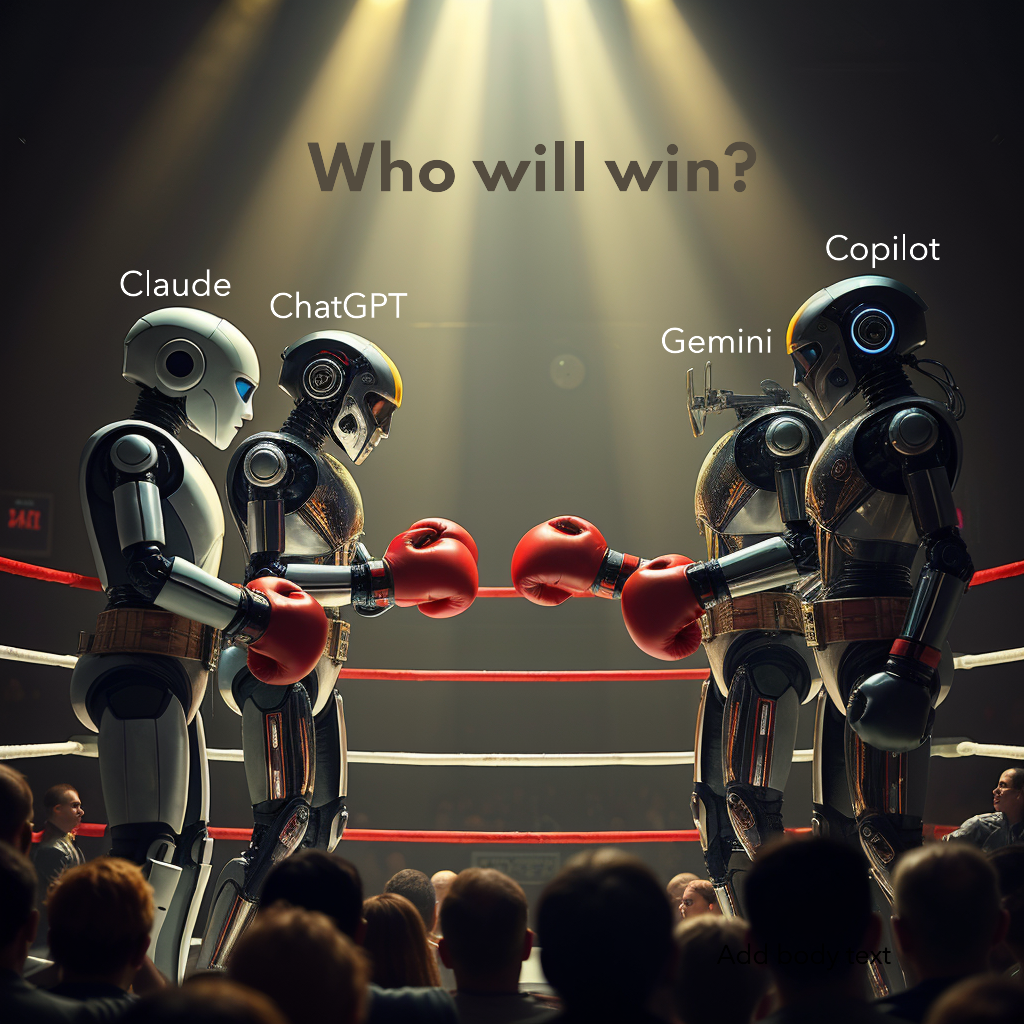
But we must start somewhere so I have chosen 4 popular models, ChatGPT, Copilot, Gemini, and Claude. The plan is to put them each to the test using a series of standardised prompts, designed to mimic real-world learning and exam scenarios. By comparing their responses across various tasks, we should gain some insights into their strengths, weaknesses, and potential application in learning.

The testing focussed on professional accounting examinations using the free versions of the GPT models available at the time (August 2024). Each GPT was required to complete 7 different learning-based tasks, these were 1. Write practice questions, 2. Explain a particular concept, 3. Solve a numerical problem, 4. Summarise technical content, 5. Answer questions, 6. Provide feedback on an answer and 7. Create flashcards. The criteria used was Clarity, Accuracy, Relevance, and Teaching skills. This last category related to how well the GPT answers incorporated teaching skills such as step by step instruction, examples, motivation, coaching etc.

Results
The winner was ChatGPT with 86%, followed by Claude, scoring 77% and joint third with 65% were Copilot and Gemini. They all scored well on explaining concepts, summarising content, and giving feedback. But Copilot and Gemini were not always accurate, especially when dealing with numbers which brought their scores down. Although a link was provided to the respective syllabi, none of the GPTs were particularly good at producing exam standard questions. They were all too simplistic and lacked the required level of difficulty. A more detailed prompt with additional guidance providing examples of past question would however help improve this.

Conclusions
Based on these results, ChatGPT is the clear winner which is consistent with the findings of others, confirming that it is probably the best overall model at the moment. However, it’s possible that with more sophisticated prompts some of the problems that Copilot and Gemini had with calculations could be resolved.

More generally having now used these models for a few real-world learning tasks, they are hugely impressive but should be used with caution. They make mistakes but even worse the answers to the non-expert will appear convincing. That said as long as you know this, they can be of real value if used properly. Here are a few tips to help.

Use at least two GPTs – Save two GPTs into your task bar, and when in doubt as to the accuracy or relevance of an answer simply input the same question into both and let each validate the other. Based on these findings the best models to use would be ChatGPT and Claude. If they give different answers use a third.

• Use GPT’s to summarise content, provide feedback and explain complex topics

– Summarising a large block of text, reducing a complex topic down to easier to digest chunks of information not only saves time but reduces cognitive load.
– Feedback is as they say the “breakfast of champions,” which makes it an invaluable learning tool, all the GPTs were good at this. Put your answer into the GPT and ask how it might be improved or how to score more marks. If you provide a marking guide the answer will be more accurate.
– Explanations and examples are essential for learning. Simply ask the GPT to explain a concept in say “100 words” or to “a novice” who has never come across the topic before. Asking the GPT to include an example or go through it “step by step” can really help develop a much better understanding. And for difficult concepts, ask it to use an analogy or explain by way of a story.

• Use GPTs to help produce study timetables – but less so for flashcards and mind maps, which tend to be little more than words listed together. In fairness the problem with flashcards has more to do with teh quality of the questions and in some instances the answers.

• Be careful with asking technical questions – Stick to the texts that are produced by the experts and their answers.

The bottom line – Think of your GPT as a young teacher who sometimes gets over confident and makes mistakes but is very, very smart and wants to help you do well.

And if used properly it will!

You can’t outsource learning – Cognitive offloading 

As we begin to better understand the capabilities of Generative AI (Gen AI) and tools such as ChatGPT, there is also a need to consider the wider implications of this new technology. Much has been made of the more immediate impact, students using Gen AI to produce answers that are not their own, but less is known as to what might be happening in the longer term, the effect on learning and how our brains might change over time.

There is little doubt that Gen AI tools offer substantial benefits, (see previous blogs, Let’s chat about ChatGPT and Chatting with a Chat Bot – Prompting) including access to vast amounts of knowledge, explained in an easy to understand manner, as well as its ability to generate original content  instantly. However, there might be a significant problem of using these tools that has not yet been realised that could have implications for learning and learning efficacy. What if we become too reliant on these technologies, asking them to solve problems before we even think about them ourselves. This fear has found expression in debates well before Gen AI, in particular an article written by Nicholas Carr in 2008 asking “is Google making us stupid’’ – spoiler alert, the debate continues. And an interesting term coined by the neuroscientist and psychiatrist Manfred Spitzer in 2012, “Digital dementia”, describing the changes in cognition as a result of overusing technology.

But the focus of this blog is on cognitive offloading (Circ 1995), which as you might guess is about allowing some of your thinking/processing/learning to be outsourced to a technology.  

Cognitive offloading
Cognitive offloading in itself is neither good nor bad, it refers to the delegation of cognitive processes to external tools or devices such as calculators, the internet and more recently of course Gen AI. In simple terms there is a danger that by instinctively and habitually going to Google or Chat GPT for answers, your brain misses out on an essential part of the learning process. That is reflecting on what you already know, pulling the information forward, and as a result reinforcing that knowledge, (retrieval practice), then combining it with the new information to better understand what is being said or required.

As highlighted by the examples in the paragraph above cognitive offloading is not a new concern, and not specifically related to Gen AI. However, the level of cognitive offloading, the sophistication in the answers and opportunities to use these technologies is increasing, and as a result the scale and impact is greater.

Habitual dependency – one of the main concerns is that even before the question is processed, the student instinctively plugs it into the likes of ChatGPT without any attention or thought. The prompt being regurgitated from memory, “please answer this question in 100 words”. This will lead to possibly the worst situation, where all thought is delegated and worryingly the answer unquestionable believed to be true.

Cognitive offloading in action – Blindly following the Sat Nav! Research has shown that offloading navigation to GPS devices impairs spatial memory.

Benefits of Cognitive offloading – it’s important to add that there are benefits of using cognitive offloading, for example it reduces cognitive load, which is a significant problem in learning. The technology helps reduce the demand on our short-term memory, freeing the brain to focus on what is more important.

Also, some disagree as to the long-term impact, arguing that short term evidence (see below) is not necessarily the best way to form long term conclusions. For example, there were concerns that calculators would affect our ability to do math’s in our heads, but research found little difference whether students used calculators or not. And the debate has moved on to consider how calculators could be used to complement and reinforce mental and written methods of math’s. These benefits have led some to believe that cognitive offloading increases immediate task performance but diminishes subsequent memory performance for the offloaded information.

Evidence
There is little research on the impact of Gen AI due to it being so new, but as mentioned above we have a large amount of evidence on what has happened since the introduction of the internet and search.

  • In the paper Information Without Knowledge. The Effects of Internet Search on Learning, Matthew Fisher, et al found that participants who were allowed to search for information online were overconfident about their ability to comprehend the information and those who used the internet were less likely to remember what they had read. 
  • Dr Benjamin Storm the lead author of Cognitive offloading: How the Internet is increasingly taking over human memory, commented, “Memory is changing. Our research shows that as we use the Internet to support and extend our memory we become more reliant on it. Whereas before we might have tried to recall something on our own, now we don’t bother.”

What should you do?
To mitigate the risks of cognitive offloading, the simple answer is to limit or reduce your dependency and use Gen AI to supplement your learning rather than as a primary source. For example, ask it to come with ideas and lists but not the final text, spend your time linking the information together and shaping the arguments.

Chatting with a Chat Bot – Prompting

In December last year I wrote about what was then a relatively new technology, Generative AI (GAI). Seven months later it has become one of the most exciting and scary developments we have seen in recent years, it has the potential to create transformative change that will affect our very way of life, how we work and the area I am most interested in, how we learn. Initially it was all about a particular type of GAI called ChatGPT 3.5, a large language model funded by Microsoft. But the market reacted quickly and there are now many more models, including Bard from Google, Llama 2 from Meta and a pay for version of ChatGPT imaginatively entitled ChatGPT 4. And just to make this a little more complicated, in early February, Microsoft unveiled a new version of Bing (Microsoft’s search engine that competes with Google) that includes an AI chatbot powered by the same technology as ChatGPT.

One of the reasons for its rapid adoption is it’s so easy to use, you can literally chat with it as you might a human. However as with people, to have a meaningful conversation you need to plan what you want to say, be clear in how you say it whilst providing sufficient context to avoid misunderstanding.

“A computer would deserve to be called intelligent if it could deceive a human into believing that it was human.” The Turing Test – Alan Turing

Prompting – rubbish in rubbish out

Prompting is how we talk with these GAI models. The quality and specificity of the prompt can significantly influence the response you get. A well-crafted prompt can lead to a coherent and relevant answer, whilst a poorly formulated one offers up ambiguity and irrelevant information. If only people thought as deeply about how they communicate with each other, we might avoid a lot of problems!

How to prompt
• Be clear, use specific and unambiguous language.
• Provide context as to why you are asking the question or who are, and write in complete sentences. For example, “would William Shakespeare be considered a great writer if he were to be published today?”
• Ask open ended questions, you will get more detailed and creative responses.
• Set rules such as the tone required or length of an answer, limiting it to so many words, sentence or paragraphs. For example, “in a sentence could you provide a motivational response as to why learning is important?”
• Ask a follow up question if you don’t get the answer you want. GAI is conversational and will remember what you asked last. For example, if you don’t think the answer goes into sufficient detail, say “could you provide more detail as to why this particular event was considered so important?”.
• Provide examples of what you want will result in far more accurate answers. For example, why not copy in the report you wrote last time and ask GAI to update it with new information but keeping the same style and within 10% of the word count.

……And although there is no need to be polite, I have to admit to saying please and thank you.

Types of questions

ChatGPT is very flexible when it comes to answering question, the secret is in getting the prompt right. Here are just a few examples with responses from ChatGPT.

• General knowledge, Q When was Winston Churchill born? A Winston Churchill was born on November 30, 1874.
• Explainer questions, Q Can you explain in 5 words why Churchill was considered a great prime minister? A Inspiring leadership during wartime victory.
• Comparison questions, Q In a sentence can you compare Winston Churchill with Boris Johnson? A. Winston Churchill was a historical wartime leader known for his inspirational leadership during World War II, while Boris Johnson is a contemporary British politician who served as Prime Minister from 2019 to 2022.
• Others, ask…. How to do something e.g. bake a lemon drizzle cake, Can you define apprentice, Tell me a joke, Write me a poem in Japanese. You are limited only by your imagination.

Using it to learn

There are many ways in which this new technology can help with learning but it comes with a couple of health warnings, firstly – GenAI can be a great teacher but it cannot learn for you. It is an excellent resource, able to provide answers 24/7, clarify, summarise etc but ultimately you are the one that has to do the learning. Secondly – All GenAI bots suffer from something called hallucination, they make stuff up. The problem with this is as a learner you might not be able to tell because the answer will sound so authentic. In terms of how common this is, ChatGPT estimates around 20% of answers given might have something wrong with them, but they are working on reducing this to less than 10%.

Here are a few ways you can use GAI
• Summarise large amounts of text – copy a whole section of text into the model and ask it to summarise the most important points. Remember the more detail you give, the more relevant the response, e.g. Produce me a timeline of key events or identify the theories used in the answer.
• Question practice and marking – copy a question in and ask for the answer in 100 words. Paste your answer in and ask it to give you some feedback against the answer it has just produced. This can be further refined if you put in the examiners answer and if you have it, the marking guide.
• Ask for improvement – put into the model your answer with the examiners answer and ask how you might improve the writing style, making it more concise or highlighting the most important points.
• Produce flip cards – ask the model to write you 5 questions with answers in the style of a flip card.
• Produce an answer for a specific qualification – ask if it could produce an answer that is possible to complete in one hour, that would pass the AQA, GCSE exam in biology.
• Explain something – ask can you explain, for example Photosynthesis in simple terms or as an analogy or metaphor.
• Coach me – Ask it to review your answer against the examiners answer but rather than correct it ask it to coach you through the process so that you develop a better understanding.

There is little doubt as to the potential of GenAI in learning, its biggest impact may be in developing countries where there is limited access to teachers and few resources. Although most would agree that an educated world is a better one, there will need to be some safeguards. It cant be left to the open market, education is simply too important.

“Education is the most powerful weapon which you can use to change the world”
Nelson Mandela

And If you want to see some of these tools in action as well as hear Sal Khan talk about Khanmigo, his version of a teacher chatbot, see below.
Sal Khan talks about Khanmigo
ChatGPT in action for studying and exams
Revise SMARTER, not harder: How to use ChatGPT to ace your exams

Let’s chat about ChatGPT – WOW!

If you have not heard of ChatGPT, where have you been since November 30th when it was launched by OpenAI the company that developed what is fast becoming a groundbreaking technology. Since then, it’s been making waves, everyone is talking about and using it. In the first week alone over 1,000,000 people had subscribed to what is for the time being at least, free. OpenAI was founded in 2016 by Elon Musk, Greg Brockman, Ilya Sutskever, Wojciech Zaremba, and Sam Altman, although Musk stepped down from the board in February 2018 to avoid any conflict with Tesla.

Originally a “not for profit”, in 2019 it became a “capped for-profit”, meaning in this instance that investors can’t earn more than 100 times their investment. And just to give some idea of scale, OpenAI expects to generate $200 million in revenue next year and $1 billion by 2024.

Its mission is simple, yet as you might imagine ambitious – to ensure that artificial general intelligence benefits all of humanity.

In contrast here is Googles mission – to organise the world’s information and make it universally accessible and useful.

But what is ChatGPT? – To find an answer to this question, we can actually ask ChatGPT, however before we do there are some points worth noting. ChatGPT is not a search engine unlike Google, it’s not even connected to the internet, in fact the data sets used to train it haven’t been updated since the end of 2021. You will find this out if you ask anything relatively topical, for example, who won the World Cup this year, it will say….

“I’m sorry, but I am not able to provide information about events that have occurred after my knowledge cut-off in 2021”.

The answers appear in real time in a suitably bot like fashion, but what makes it really interesting is that it uses Generative AI, which enables it to start with existing content but from that produce something new and original, let me clarify, its not simply taking content from somewhere else, its creating new and original stuff.

ChatGPT is a variant of the GPT (Generative Pre-trained Transformer) language model developed by OpenAI for use in chatbots and conversational systems. It is able to generate human-like text in real-time and understand the context of a conversation, allowing it to generate appropriate responses based on the topic being discussed. ChatGPT is also efficient and fast, making it ideal for use in chatbot applications where fast response times are important. It is able to handle a wide variety of tasks, including answering questions, providing information, and engaging in casual conversation.

The above was the answer provided by ChatGPT when asked for a definition within 90 words. In fact everything in purple and italics in this blog has been taken directly from ChatGPT.

How does it learn?
Once again let’s ask ChatGPT, after all why should I do all the hard work.

ChatGPT uses a type of machine learning called supervised learning. In supervised learning, the model is trained on a labeled dataset, where the correct output is provided for each input. The model is then able to make predictions for new, unseen data based on the patterns it learned during training. too train ChatGPT, a large dataset of text is fed into the model, and the model is then trained to predict the next word in a sequence based on the words that come before it. Through this process, the model learns to recognize patterns in language and generate coherent text. The more data the model is trained on, the better it becomes at generating natural-sounding text and understanding the relationships between words and concepts

In summary, the model is initially trained by humans (The labeller), this is the supervised stage. It is then able to provide multiple answers to a question of which the trainer ranks in terms of quality, this is the reinforcement stage which provides more data for the model. And lastly, reward models are created that automatically reward the model for getting it right, the unsupervised stage.

It might be easier to think of it in the same way as you would if learning to ride a bike, for example firstly someone shows you how to ride a bike, (supervised) secondly you have a go and are given feedback in order to improve (reinforcement) and finally, if you ride for 5 minutes, you will be rewarded with £5.00, fall off and you get nothing. (Reward model – unsupervised).

Clever… but what are the implications?
We are at one of those “genie out of the bottle” moments, when something that you thought might happen in the future becomes a reality today. As a consequence, we start to ask questions such as, is this technology good or bad, what will it mean for jobs and the future of work? If it can produce high quality answers to questions, how can we tell if it’s the student’s work or simply the result of an exercise in cut and paste? And because it can write poems, stories and news articles, how can you know if anything is truly original, think deep fake but using words. By way of an example, here is a limerick I didn’t write about accountants.

There once was an accountant named Sue
Who loved numbers, they were her clue
She worked with great care
To balance the ledger with great flair
And made sure all the finances were true

Okay it might need a bit of work but hopefully you can see it has potential.

We have however seen this all before when other innovative technologies first appeared, for example, the motor car, the development of computers and more recently mobile phones and the internet. The truth is they did change how we worked and resulted in people losing their jobs, the same is almost certainly going to be the case with ChatGPT. One thing is for sure, you can’t put the genie back in the bottle.

Technology is neither good nor bad; nor is it neutral. Melvin Kranzberg’s first law of technology

And for learning
There have already been some suggesting that examinations should no longer be allowed to be sat remotely and that Universities should stop using essays and dissertations to asses performance.

However, ChatGPT is not Deep thought from The Hitchhikers Guide to the Galaxy nor Hal from 2001 a Space Odyssey, it has many limitations. The answers are not always correct, the quality of the answer is dependent on the quality of the question and as we have already seen, 2022 doesn’t exist at the moment.

There are also some really interesting ways in which it could be used to help students.

  • Use it as a “critical friend”, paste your answer into ChatGPT and ask for ways it might be improved, for example in terms of grammar and or structure.
  • Similar to the internet, if you have writers block just post a question and see what comes back.
  • Ask it to generate a number of test questions on a specific subject.
  • Have a conversation with it, ask it to explain something you don’t understand.

Clearly it should not be used by a student to pass off an answer as their own, that’s called cheating but it’s a tool and one that has a lot of potential if used properly by both students and teachers.

Once upon a time, sound was new technology. Peter Jackson filmmaker

PS – if you are more interested in pictures than words check out DALL·E 2, which allows anyone to create images by writing a text description. This has also been built by OpenAI.