Back in July 2022, I wrote about the importance of critical thinking, a skill long considered essential in education, leadership, and the workplace.
But that was before Gen AI arrived in the November, bringing with it the ability to answer almost any question within seconds. Its presence prompted reflection on the nature of learning, how education might change and what role humans should now play, if any.
But all is not lost we still have one last card to play, our ability to think and feel, okay maybe that’s two cards. Thinking is hopefully what you are doing whilst reading this blog, neurons will be firing as you reflect, analyse and question what is being said. It’s something we do in between day dreaming, sleeping and unconscious behaviours such as cleaning our teeth.
Thinking is however a little more nuanced, and there are many different types, for example you can think creatively, analytically, or critically. Whichever mode you engage in, there’s another essential human attribute that quietly shapes the process…. our emotions. These are the subjective experiences rooted in our limbic system that help us interpret information and as such see the world. Together these are our superpowers offering something AI can’t replicate, not yet at least!
Sometimes a feeling is all we humans have to go on. Captain James T Kirk
An Artist, Pathologist and Judge walk into a bar
Critical thinking, creative thinking, and analytical thinking are often grouped under the umbrella of “higher-order cognitive skills,” but each one is different, playing a role in how we process, evaluate, and generate ideas.
- Critical thinking is fundamentally about evaluation, it involves questioning assumptions, weighing evidence, and forming reasoned judgments. It’s the internal referee that asks, “Does this make sense? Is it credible? What are the implications?”
- Meanwhile, analytical thinking breaks down complexity into more manageable components, identifying patterns, and applying logic so that we can better understand relationships.
- And creative thinking is generative. It thrives on ambiguity, imagination, and novelty. Where critical thinking narrows and refines, creative thinking expands and explores. It’s the spark that asks, “What if? Why not? Could we do this differently?”
Without freedom of choice there is no creativity. Captain James T Kirk
Humans are emotional – Far from being a distraction, emotions actively shape how we think, judge, and create. In creative thinking, emotion is the spark that fuels imagination and unlocks divergent ideas. In analytical thinking, emotion plays a subtler role influencing how we interpret data, what patterns we notice, and our levels of motivation. Critical thinking, meanwhile, relies on emotion to provide an ethical compass and improve our self-awareness.
There Is no such thing as the unknown, only things temporarily hidden. Captain James T Kirk
Learning to be a better thinker
Critical, creative, and analytical thinking aren’t fixed traits, they’re learnable skills. It’s tempting to believe they can only be acquired through the slow drip of wisdom from those who have had a lifetime of experience. The truth is, with good instruction, these skills can be learned well enough for any novice to get started. At first the beginner may simply replicate what they have been taught but with practice and reflection, they begin to refine, adapt, and eventually think for themselves.
Computers make excellent and efficient servants, but I have no wish to serve under them. Science officer and first officer Spock
By way of an example, this is how you might start to learn to think more critically.
- Start with knowledge – Critical thinking is the analysis of available facts, evidence, observations, and arguments to form a judgement.
- Use a framework
• Formulate the question – what problem(s) are you trying to solve?
• Gather information – what do you need to know more about?
• Analyse and evaluate – ask challenging questions, consider implications, and prioritise.
• Reach a conclusion – form an opinion, and reflect. - Bring in Tools – These can provide ideas or change perspective, for example Edward de Bono’s six thinking hats.
- Apply by practicing with real world problems. This is largely experiential, and requires continual reflection and looping back to check you have asked the right question, gathered enough information, and correctly prioritised.
The real challenge and deeper learning take place in the application phase. By working in groups, your arguments may well be questioned and potentially exposed by the use of Socratic type questions and differing views. Your only defence is to start thinking about what others might say in advance. Over time like any other skill, it can begin to feel more like an instinct, requiring less conscious effort, simply popping into your mind when most needed.
To boldly go
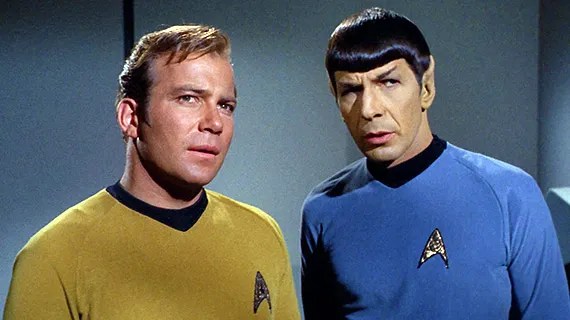
Generative AI may offer logic, precision, and even flashes of creativity but it does not feel the weight of a decision, nor wrestle with the moral ambiguity that defines human experience. It is Spock without Kirk, brilliant, efficient, and deeply insightful, yet missing the emotional compass that gives judgment its humanity. True thinking is not just analysis, its empathy, intuition, and the courage to act without certainty. AI can advise, assist, and illuminate, but it cannot replace the uniquely human interplay of reason and emotion. Like Kirk and Spock, the future belongs not to one or the other, but to the partnership. Or at least I hope so…..
I will leave the last word to Dr McCoy.
Compassion. That’s The One Thing No Machine Ever Had. Maybe It’s The One Thing That Keeps Men Ahead Of Them.”
 Pedleysmiths Blog
Pingback: Human superpowers: Creative, analytical and critical thinking - Accounting Cafe